 Activity Book Studio
KDP Publishing Limit: Only 2 Books Per Week and How It Changes the Strategy for Activity Books
Team at Activity Book StudioWritten with AI assistance12 min readIn summary
- As of Monday, September 21, 2026, Amazon KDP only allows creating 2 new titles per format and week; on October 5, 2026, the same limit of 2 was added to publication submission. The counter resets every Sunday at 00:00 UTC.
- Formats are counted separately: 2 ebooks + 2 paperbacks + 2 hardcovers in the same week.
- The previous limit was 10 titles per format and week: a cut of 80%, announced with little prior notice.
- Updates to titles already submitted do not consume quota, so polishing what has been published is free in terms of quota.
- In parallel, KDP tightens against duplicate interiors, massive uploads, and misleading metadata. The conclusion for low content is the same: fewer titles, better made.
The business of hobby notebooks on Amazon had been running for years with a simple arithmetic: the more titles you upload, the more lottery tickets you buy. That arithmetic broke in September 2026. If you publish word searches, crosswords, or sudokus, the change does not force you to work faster: it forces you to work better, because you now only have two shots per format and week. In this article, I review what the new rule exactly says, what else has tightened in KDP this year, and how to reshape a publishing plan with two titles per week; at the end, I explain how to create hobby books for Amazon KDP with Activity Book Studio, the AIsToHire app designed specifically to produce a few well-finished books.

How many books can I publish on KDP per week in 2026: two per format
Two new titles per format and week. KDP documentation sets a limit of 2 titles per book format each week, with the counter resetting every Sunday at 00:00 UTC and no accumulation of unused quotas. Since formats have independent counters, the real ceiling for an account is 2 ebooks, 2 paperbacks, and 2 hardcovers in the same seven days.
The sequence of the measure had two steps:
| Date | What changed | Limit |
|---|---|---|
| September 21, 2026 | Limit on creation of new titles | 2 per format and week |
| October 5, 2026 | Limit on publication submission | 2 per format and week |
| Before (guideline valid until September 2026) | Creation of new titles | 10 per format and week |
Sources: KDP announcement on title creation limits, the compilation of KDP changes in 2026 by KDP Metric and the analysis of weekly title limits published by eBookPbook on October 9, 2026.
Translated to a full year: 104 titles per format, compared to the 520 allowed by the previous limit. For a fiction author, this is irrelevant. For those who built hobby catalogs based on volume, it is the end of a business model.
Why the cut hurt so much: 80% less and almost no notice
The jump from 10 to 2 titles per format represents a cut of 80% of weekly capacity, and it came practically without a margin for adaptation. According to the analysis by PublishFlow on the title creation limit, the measure came into effect the same day it was communicated, and the only justification offered by Amazon was to maintain "a positive publishing experience for all authors," without data or explicit mention of AI or spam. That same source notes that, along with the new limit, the formula inviting users to contact KDP for an exception to the limit disappeared from the help page.
There are also gray areas that Amazon has not clarified. The review by Vappingo on KDP's publication limit lists the open questions: at what exact moment does a draft consume a quota, if deleting a draft returns the used quota, how translations and special editions are counted, and whether there will be expanded limits for established publishers. Until these are resolved, the practical reading is conservative: do not open a title in KDP until the book is finished.
The volume strategy is dead: the niche now plays for quality per title
The weekly limit is not an isolated fact: it fits with the tightening of content review that KDP has been applying to low content during 2026. With two slots per week, each title you spend has to be able to survive that review and sell on its own, because there are no longer fifty siblings to compensate for the one that fails.

The review of PubNook on KDP's low content policy in 2026 summarizes the most common reasons for removal: duplicate interiors, minimal differentiation between titles, mass-generated uploads, and misleading or keyword-stuffed metadata. The KDP review compares the similarity of interiors both within your account and against the general catalog, so the old trick of having the same interior with fifty different covers no longer passes the filter.
It is important to clarify a widespread confusion in the industry, as it affects how you fill out the book's details: in the official KDP help on low content books, a low content book is one that has "minimal or no content on the interior pages," is "generally repetitive," and is "designed for the user to fill in." Notebooks, planners, journals, and logbooks fall into this category; hobby books and coloring books are explicitly listed among those that are NOT generally low content, precisely because their pages are not repetitive. A well-made sudoku notebook is not a blank book: it is a book with 80 pages of distinct content.
And there lies the good news of the change. If your interior is genuinely unique page by page, the new framework favors you over those who filled the category with clones.
What "quality" means in a hobby book
In a hobby book, quality is not prose: it is that the puzzles work, that the difficulty matches the reader, and that the file passes review on the first try. There are five specific things, and all can be checked before spending a weekly slot.
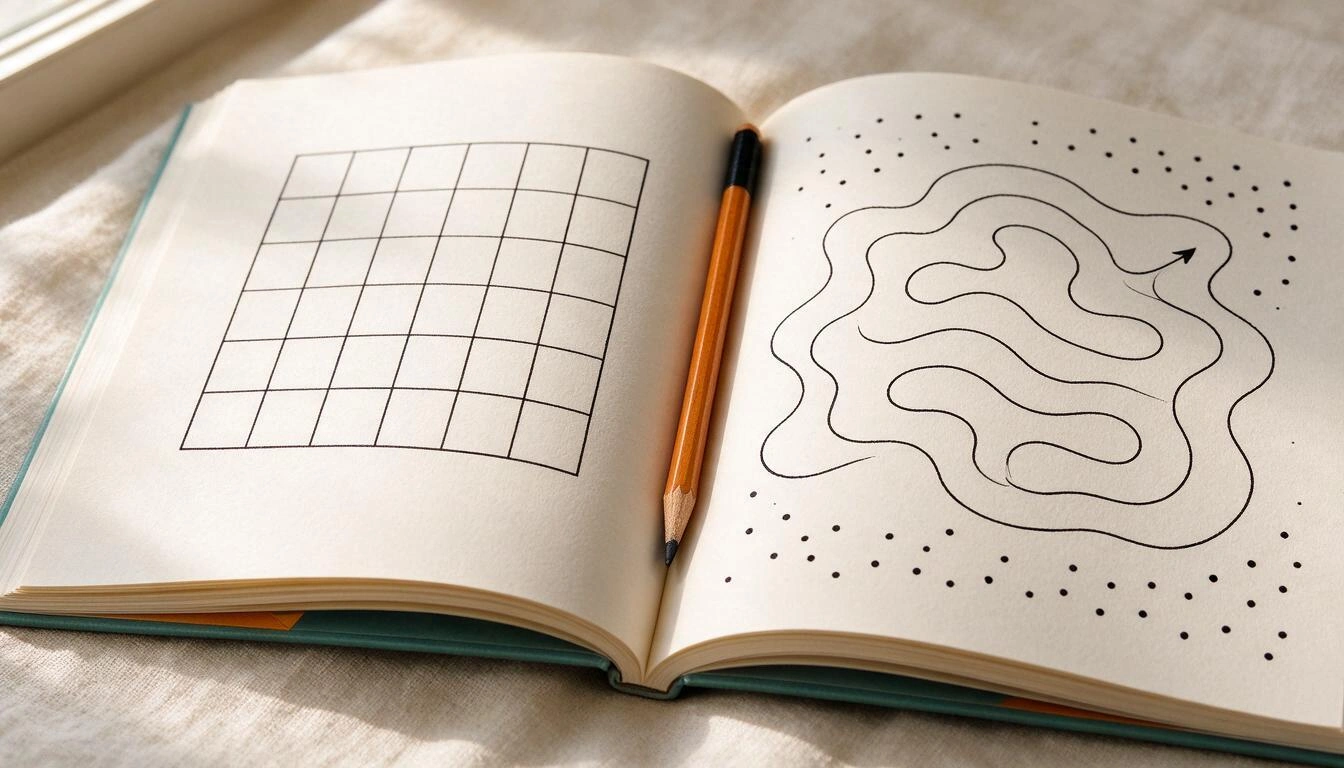
- Verified solution. A sudoku without a unique solution or a maze without an exit path is the quickest way to a one-star review. The solution is not promised: it is calculated and printed in the answer key.
- Mix and difficulty adjusted to the audience. A word search for children ages 6 to 8 is not the same as a crossword for adults: the grid size, vocabulary length, and type of clue change.
- An interior that does not resemble another 300. Specific theme, niche-specific vocabulary, and variety of types of hobbies in the same notebook. It is exactly the opposite of what the KDP review marks as "minimal differentiation."
- Honest metadata. Title, subtitle, and description that say what is inside: number of hobbies, type, audience, and whether it includes solutions. Keyword stuffing is on the list of reasons for removal.
- Cover with well-calculated spine. It is the technical error that causes the most review returns in paperback, and it is pure arithmetic.
The spine: the arithmetic that makes more covers bounce
The thickness of the spine depends on the number of pages and the paper. For paperback in KDP, the usual calculation is pages × 0.002252" in white paper and pages × 0.0025" in cream paper, and the complete cover is assembled as 0,125" + trim width + spine + trim width + 0,125" of bleed, according to the spine width formulas compiled by KDP Easy.

With an interior of 8.5" × 11" and 100 pages, for example, the spine comes out to 0.2252" in white and 0.25" in cream: changing the paper and not recalculating the cover is enough for the file not to match. And before someone asks it in the forums: that white space on the back cover is still mandatory, but it will no longer carry a transparency code. The KDP help on barcodes confirms that transparency codes are being removed from KDP print barcodes and are not available for books created after November 2025; books published before can still be printed with it. A minor detail, but it resolves the doubt of anyone comparing their back cover with old tutorials.
A realistic weekly plan with only 2 titles
With two slots per format and week, the bottleneck shifts: it is no longer production, it is the niche decision. The plan that works divides the week between deciding, producing, and polishing, and leaves the slot for last.
| Day | Task | Why it goes there |
|---|---|---|
| Monday | Choose the 2 niches for the week and validate titles | It is the most expensive decision to undo: a poorly spent slot takes a week to recover |
| Tuesday–Thursday | Produce the 2 interiors and the 2 covers | Includes verifying solutions and recalculating the spine according to the chosen paper |
| Friday | Final review of files and metadata | Last filter before touching KDP |
| Saturday | Create and send the 2 titles | Rush before the restart on Sunday at 00:00 UTC |
| All the rest of the week | Update already published titles | Does not consume a slot: it is "free" time |
Three rules that change with the new limit:
- Prioritize the queue by evidence, not whim. From your list of ideas, those with demonstrable demand and weak competition rise first, not those that are quicker to generate. With 104 titles per year per format, each gap is worth what the niche it occupies is worth.
- Do not open the title in KDP until you have the final PDF. Until it is clarified whether deleting a draft returns the slot, opening a title "to reserve space" is wasting a bullet.
- Take advantage of the fact that updates are free. Both the official statement and the analyses from KDP Metric and eBookPbook agree that updates of already submitted titles do not consume weekly slots: keywords, categories, description, price, and the allowed updates of manuscript and cover. That is, the published catalog becomes your zone of unlimited improvement while the two slots go to the new.
A planning note about formats: since the three counters are independent, releasing the same notebook in paperback and hardcover does not take away the ebook slot. It is the cheapest way to stretch the limit without inventing filler titles.
Demand is still there: the problem was the noise, not the market
It is advisable not to read the cut as a signal that the category is sinking. Sales data for hobby books point exactly the opposite: the market is growing and what was surplus was clone catalog, not readers.
According to NielsenIQ BookData data cited by the distributor Bookspeed in its analysis of hobby and quiz books, sales of hobby books in 2026 are 91% above those of 2019, and those of the distributor itself grew 29% in the 2025/26 fiscal year, with an additional 10% so far this year. The recurring drivers in industry analyses are screen fatigue, interest in analog leisure, and the cognitive benefits associated with hobbies.
In addition, another change in 2026 improves the economics per title: the compilation from KDP Metric places July 7, 2026 as the date when the 70% royalty band expanded its price ceiling from $9.99 to $12.99 on Amazon.com, the first movement of that band since 2007. With fewer titles allowed, being able to set a higher price for a notebook that truly deserves it is no longer a detail.
Frequently Asked Questions
How many books can I publish on KDP per week?
Two new titles per format and week: 2 ebooks, 2 paperbacks, and 2 hardcovers. The counter resets on Sundays at 00:00 UTC and unused slots do not accumulate.
Since when has the limit of 2 KDP titles been in effect?
The creation limit came into effect on September 21, 2026, and the submission limit was added on October 5, 2026, according to the official KDP announcement and the analyses from KDP Metric and eBookPbook.
Do updates to an already published book count against the weekly quota?
No. Modifying keywords, categories, description, price, or applying allowed manuscript and cover updates to already submitted titles does not consume creation or submission quota.
Do hobby books count as low content on KDP?
Generally, no. The official KDP help includes hobby and coloring books among those that are not typically low content, because their pages are not repetitive, although it warns that there may be exceptions.
Why is my hobby notebook being rejected in KDP review?
The most common reasons noted by the PubNook low content policy analysis are duplicated interiors or minimal differentiation from other titles, mass-generated uploads, and misleading metadata or excessive keywords. For paperbacks, technical cover errors are added, especially a spine miscalculated for the number of pages and paper type.
Can I ask Amazon to increase my weekly limit?
The analysis from PublishFlow indicates that when the new cap was introduced, the invitation to request an exception disappeared from the KDP help page. As of today, there is no documented way to increase the quota.
What happened to the transparency codes for barcodes?
KDP is phasing them out: according to their barcode help, they are not available for books created after November 2025. Those published before can still be printed with the code.
Two well-made books per week: what to produce them with
If the limit leaves you with two weekly slots, what you need is not a faster generator, but a way to reach the final PDF without technical errors and without the interior resembling that of the neighbor. For that, there is Activity Book Studio, the hobby book studio for Amazon KDP from AIsToHire: five types of hobbies —word searches, crosswords, sudokus, mazes, and connect-the-dots— generated with their answer key, batches in which the AI proposes the mix before building it, cover and back cover that are refined through versions until arriving at the good one, and exports in PDF of 8.5" × 11" of the interior with answer key and of the complete cover with the spine calculated according to the paper, white or cream.
And before spending one of the two slots of the week, Theresa —the niche advisor of the studio— is the one who helps you decide which theme and which title deserve that slot. With 104 titles a year per format, that five-minute conversation is the most profitable part of the process.
Produce your two books for the week with Activity Book Studio: create puzzles with solutions, refine the cover, and download the PDFs ready for Amazon KDP. Start for free.
Produce your two books for the week with Activity Book Studio: create puzzles with solutions, refine the cover, and download the PDFs ready for Amazon KDP. Start for free.Keep reading
View all articles →
How to Create a Hobby Book for Amazon KDP: Dimensions, Spine, and Pages (2026 Guide)

Why Your Car Insurance Increased in 2026: Average Premium of €1,412 and Historic Record

Discussing via WhatsApp or talking in person: what science says about couple conflicts through messages