 aiMindMap
Mind map, concept map, and outline: differences and when to use each one
Team at aiMindMapWritten with AI assistance19 min readIn summary
- Mind map (Tony Buzan): a single central idea and radial branches that subdivide. It serves to generate, memorize, and review. Tree structure: nothing connects with anything other than its parent.
- Concept map (Joseph D. Novak, Cornell, 1972): concepts in boxes connected by lines with linking words that form propositions ("photosynthesis requires light"). It serves to explain and assess understanding. It allows cross-links between branches.
- Outline: indented list. It is the fastest format to write, the easiest to read on paper, and the one that best withstands long texts, but it does not show lateral relationships.
- Research is clear on one thing: building the organizer works better than looking at one made, and compared to writing a summary or an outline, the advantage of the map is small (Nesbit and Adesope, Review of Educational Research, 2006).
- Practical rule: if you need to decide a hierarchy, mind map; if you need to explain why one thing leads to another, concept map; if you need to write or study a long syllabus, outline.
If you've come here looking for "mind map or concept map" it's because someone —a teacher, an academy, a boss— has asked you for one of the two and it's not clear which. It's not a silly question: they are two techniques with different authors, different theories, and different uses, and the third format, the outline of a lifetime, still wins in many cases. This article covers the origin of each, what each one exactly represents, what the evidence says, and a table to decide in thirty seconds. At the end, you will also see how aiMindMap fits in here, the AI mind mapping app from AIsToHire, which is specifically designed for the case of the hierarchical mind map and also returns the same content in outline mode if you prefer to write.
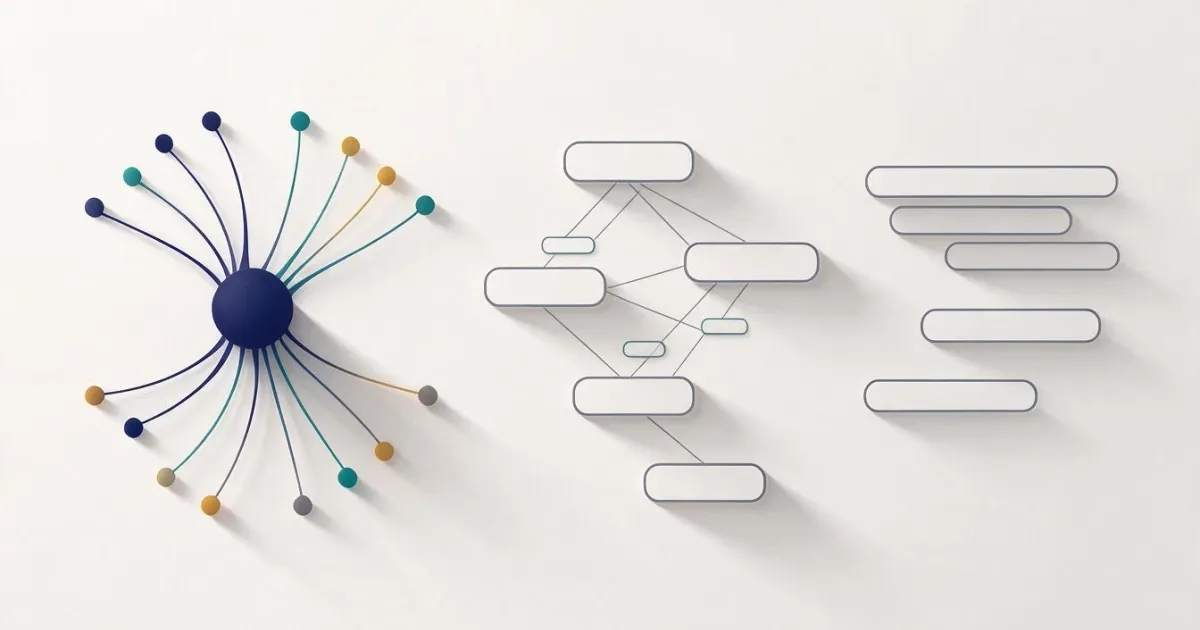
What is the difference between a mind map, a concept map, and an outline?
The difference is not aesthetic, it is structural: the mind map is a tree with a single root, the concept map is a network of propositions with words on the lines, and the outline is an indented list. A mind map answers "What parts does this consist of?"; a concept map answers "How are these things related to each other?"; an outline answers "In what order do I present it?".
| Mind map | Concept map | Outline | |
|---|---|---|---|
| Author / origin | Tony Buzan, popularized since the seventies with the BBC series Use Your Head | Joseph D. Novak, Cornell University, 1972 | Classic typographic format, no single author |
| Theoretical basis | Radiant thinking and visual memory | David Ausubel's assimilation theory | Editorial and study convention |
| Form | Radial, a single root, branches that bifurcate | Hierarchical top-down, with cross-links | Vertical, levels by indentation |
| What goes on the lines? | Nothing: the line only indicates belonging | Linking words that turn two concepts into a phrase | Nothing: the indentation indicates the level |
| Entries per node | One (each branch has a single parent) | Several (a concept can receive multiple links) | One |
| Words per node | Few, ideally one or two | Brief concepts + phrases in the connectors | As needed, even paragraphs |
| Best for | Generating ideas, memorizing, reviewing, planning | Explaining, assessing understanding, detecting conceptual errors | Writing, studying long syllabi, minutes, scripts |
| Worst for | Lateral relationships, explicit causality | Quick brainstorming, very large maps | Seeing the overall structure at a glance |
The mind map was born as a memory technique, and that explains its form
The mind map is radial because it is designed for visual memory to retrieve it at once: a central image, branches that emerge from it and thin out as they branch, colors for each branch, and few words per node. It was popularized by British psychologist Tony Buzan —he coined the idea of "radiant thinking"— first with the BBC series Use Your Head in the seventies and then with The Mind Map Book (1993); his books for the BBC sold over three million copies by 2003, according to the biographical profile of Tony Buzan. Buzan died in 2019.
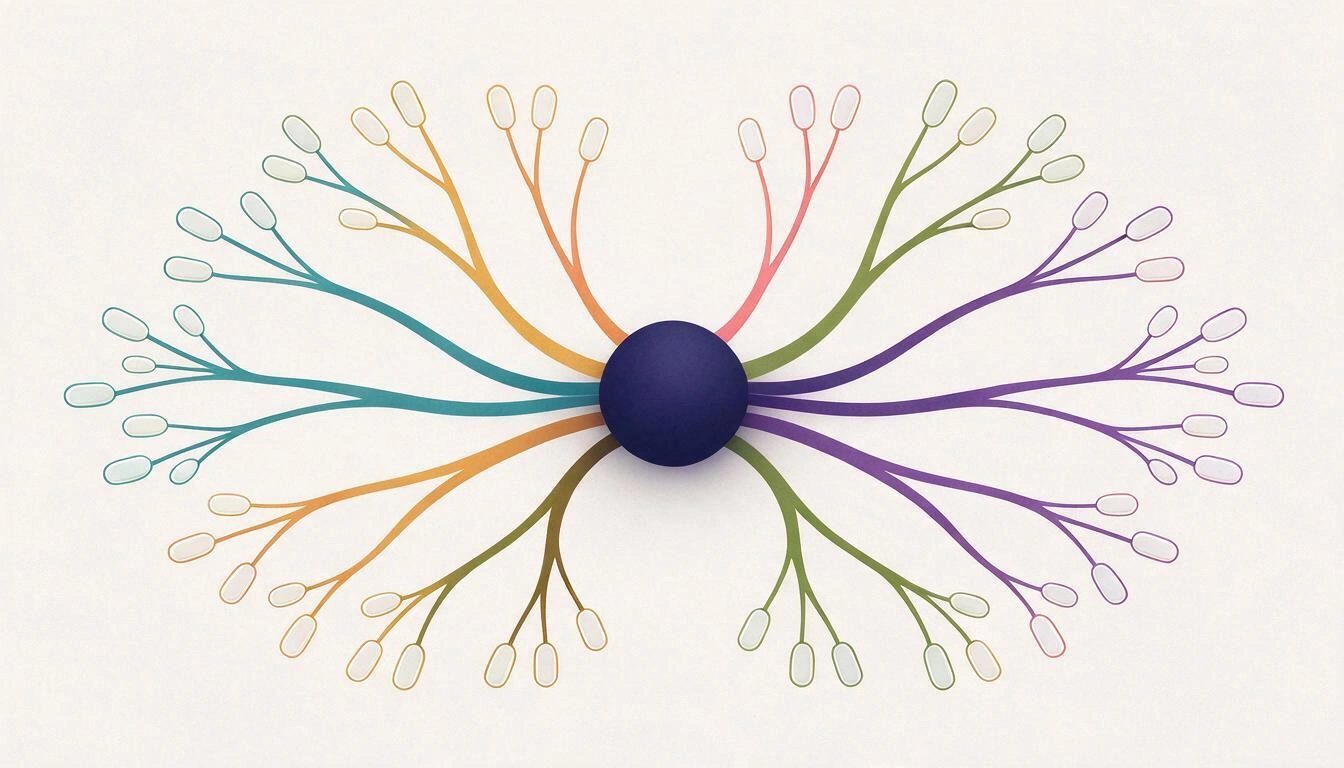
The important thing to choose: in a mind map each node has a single parent. This is a deliberate limitation, not a neglect. It forces you to decide where each idea hangs, and that decision is precisely the cognitive work that makes the map stick in your mind. If you are struggling with where to place something, you don't lack a tool: you lack a clear hierarchy.
Practical consequences of the radial format:
- Scales poorly wide and well deep. Twenty first-level branches make for an unreadable map; five branches with four levels each do not.
- It is the fastest format to produce. There is no need to write connectors.
- It is the best for reviewing. A single image, clockwise traversal, color as a memory anchor.
- It is ambiguous. "Inflation → unemployment" in a mind map does not say whether inflation causes unemployment, reduces it, or they are simply studied together. That’s what the other format is for.
The conceptual map was born as a research instrument, and that’s why it requires writing on the lines
A conceptual map is not a mind map with boxes: it is a set of propositions. It was created by the team of Joseph D. Novak at Cornell University in 1972, researching how children's understanding of science changed, and it is based on David Ausubel's cognitive psychology, which states that "learning occurs through the assimilation of new concepts and propositions into the conceptual and propositional frameworks that the learner already possesses" (underlying theory of concept maps, IHMC).
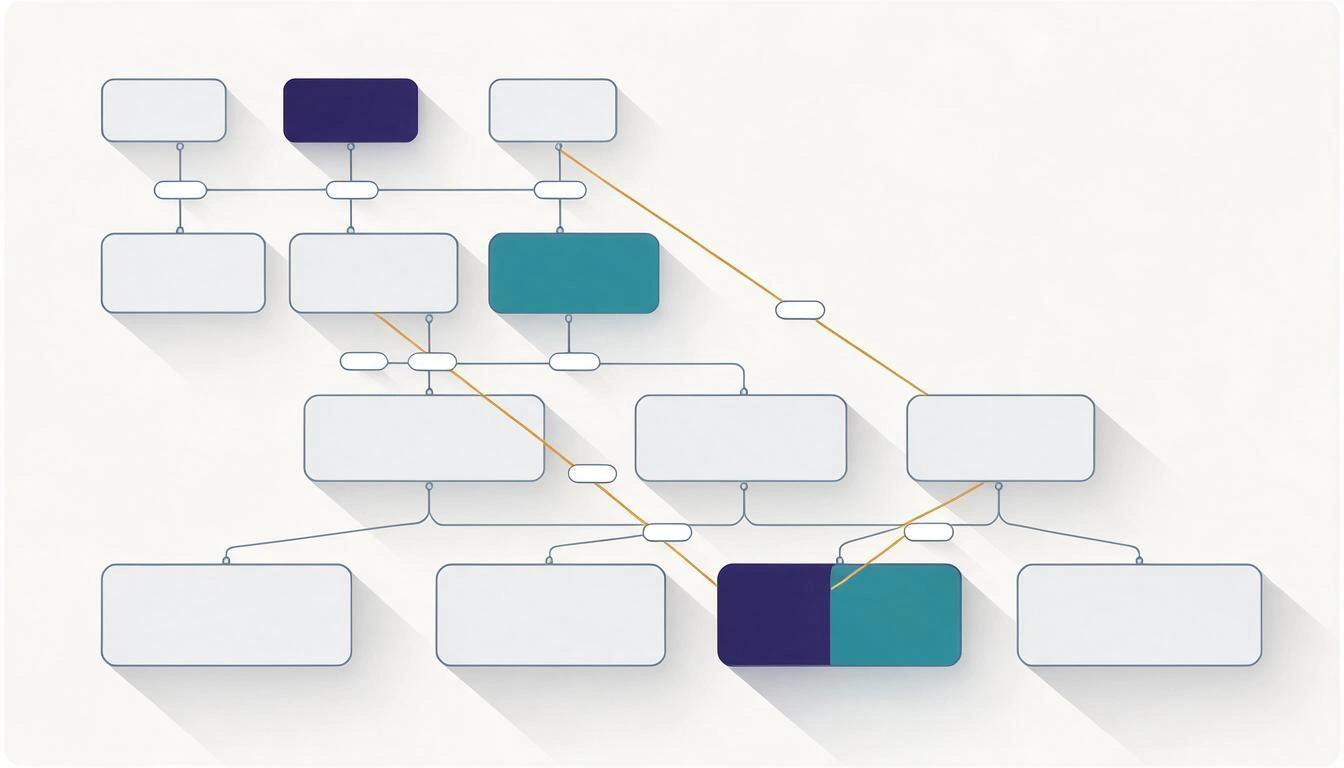
From that definition arise the four rules that distinguish a true conceptual map from any diagram:
- Concept: a "perceived regularity in events or objects […] designated by a label". It goes in a box, and it is a noun, not a phrase.
- Linking words over each line: they "specify the relationship between the two concepts". Without them, there is no proposition, just an arrow.
- Focus question: the map is constructed to answer a specific question, and that question determines what goes in and what does not.
- Cross-links: connections between concepts from different branches. They are the mark of integrated learning and what a tree cannot represent.
This comes at a cost: a conceptual map is written slowly. Each line requires committing to a verb. That’s why it works so well as an assessment tool —the teacher sees exactly where the conceptual error is— and so poorly as a brainstorming tool.
The outline is not the poor brother: it is the format that is written best
The outline —the indented list— remains the most efficient format for two things that maps do worse: drafting and studying long texts. It is linear, fits in a column, can be read without zooming, can be printed without cropping, and allows entire paragraphs in a node. That’s why opposition syllabuses, scripts, and minutes remain outlines and not maps.

And there is a fact worth considering before dismissing it: in the reference meta-analysis of the field, when the comparison group also did something constructive —writing a summary or an outline— the advantage of the map became small. The authors themselves write that "there is evidence that conceptual mapping is slightly more effective than other constructive activities like writing summaries and outlines, but the small size of this effect raises doubts about its authenticity and pedagogical significance" (Nesbit and Adesope, 2006).
Translated: a well-made outline is worth almost the same as a well-made map. What is not worth it is to underline and reread.
What research says: what matters is building it, not looking at it
The most repeated finding in forty years of literature is that the benefit lies in doing the organizer, not in consuming it. The meta-analysis by Nesbit and Adesope (Review of Educational Research, vol. 76, no. 3, 2006) extracted 67 effect sizes from 55 studies with 5,818 participants, from 4th grade to university, and concluded that "compared to activities like reading texts, attending lectures, and participating in debates, conceptual mapping activities are more effective for retention and transfer of knowledge," and that much of that benefit "may be due to the greater involvement of the learner" rather than the properties of the map as a medium.
| Study | Year | What was measured | Result |
|---|---|---|---|
| Nesbit and Adesope, Review of Educational Research | 2006 | 55 studies, 5,818 participants | Mapping outperforms reading, listening to class, and debating; compared to summarizing or outlining, the advantage is small |
| Izci and Acıkgoz Akkoc, Heliyon | Dec. 2023 | 78 studies on academic performance | Strong positive effect (d = 1.08); greater in high school (d = 1.61) than in university (d = 0.62) |
| Mesk et al., SAGE Open Medicine | 2026 | Mental maps in nursing degree (quasi-experimental) | Moderate effect with practical significance (d = 0.52) |
| Van der Weel and Van der Meer, Frontiers in Psychology | Jan. 26, 2024 | High-density EEG: handwriting vs. typing | Handwriting, not typing, produces broad brain connectivity in theta/alpha in parietal and central regions |
Two useful readings of that table. First: the effect is greater at pre-university stages, probably because a university student already has their own organizational strategies. Second: if the format you choose leads you to write by hand as part of the process, that adds on its own —the 2024 EEG study does not talk about maps, it talks about handwriting, but points out that manual writing activates networks that the keyboard does not.
Spoke, chain and net: there are not three formats, there are three structures of knowledge
The shape of the diagram reveals the level of understanding of the person who created it. In a classic work of Educational Research, Kinchin, Hay and Adams (2000) described three morphologies in student maps: spoke, chain, and net, and interpreted them as progressive levels of understanding (Kinchin, Hay and Adams, 2000).
- Spoke: everything hangs directly from the central concept and nothing relates to each other. It is the natural form of the first-pass mind map; it provides little more than a bullet point list.
- Chain: a linear sequence. It is associated with rote learning and is resistant to change: it is learned in one go or not at all.
- Net: a network with cross-links and explanatory connectors. It is the one associated with meaningful learning.
This taxonomy remains relevant twenty-five years later and is now used to automate grading: a paper presented in 2025 trained classifiers on hundreds of real maps to automatically assign their structural type, aiming for conceptual map assessment systems (Concept Map Assessment Through Structure Classification, arXiv, 2025).
The practical consequence is the most important point of the article: start in spoke and end in net. First, create the tree —quickly, without connectors, without thinking about lateral relationships— and only afterwards, if the goal is to explain or you are going to be assessed on understanding, rewrite it as a net with linking words. Trying to do both at once is what blocks most people in front of a blank canvas.
When each chooses a student, a teacher, and a professional
There is no better format: there is a format for each task. A high school student and a candidate with 60 topics do not need the same thing, and a teacher correcting 120 maps does not either.
The student and the candidate
To memorize and review: mind map. To understand causality and for the drafting phase: outline. The typical candidate works with syllabi of dozens of topics and a written test at the end; the outline is their production format (it is what they will write in the exam) and the mind map their review format (it is what they will remember the night before). It is a large audience: only in Andalusia, the teaching call of 2026 sums up to 5,167 positions —4,406 for Secondary in 36 specialties— according to the February-March 2026 ANPE magazine.
Routine that works: complete topic mind map on one page (structure), outline by heading (draftable content), and review of the mind map, not the outline.
The teacher
To assess understanding: conceptual map, always. It is the only one of the three that makes the error visible: if a student writes "energy is consumed" instead of "is transformed", the connector reveals it. The mind map does not provide that information because its lines say nothing. To explain in class, however, the mind map is better: it can be projected, navigated branch by branch, and does not require reading.
An important nuance: meta-analyses indicate that the effect is greater in secondary and high school than in university (Izci and Acıkgoz Akkoc, Heliyon, December 2023), so it is in those stages where it is most worthwhile to invest class time in teaching the format.
The professional
To kick off a project, a meeting, or a script: mind map. To document a system or a process with dependencies: conceptual map or flowchart. For delivery: outline. In a work environment, the map is almost never the final product; it is the intermediate step between someone’s mind and a document. What matters then is not the beauty of the diagram, but that it can be turned into a list, a record, or slides without rewriting everything.
What has changed in 2025 and 2026: AI generates the tree, but the hierarchy remains yours
What’s new in the sector is not the format, it’s the starting point: today it is assumed that the first draft of the map is written by a model from a text or a PDF. Google normalized this by incorporating interactive mind maps into NotebookLM, with rollout starting in March 2025 and included in the Google Workspace news package for May 2025, and since then generating a tree from a document has been a basic function, not a differentiator.
What’s interesting is what the evidence says about the quality of those automatic maps. A study published in Medical Teacher in 2025 compared concept maps generated with ChatGPT and maps written by experts for clinical reasoning: in terms of clinical content quality, there were no statistically significant differences, but the AI maps lacked abstraction, prioritization, and alignment with context, and sometimes exceeded the reasonable cognitive load for a student (ChatGPT versus human authors, Medical Teacher, 2025). In another line, a paper from Quality & Quantity in 2025 that used conceptual mapping to compare ChatGPT with human participants observed that the model’s iterations systematically left out some statements despite explicit instructions to include them all (comparison of human conceptual mapping versus ChatGPT).
Operational conclusion, and it’s the same as that given by classical research: AI is great for the first pass and bad for the decision. Having it generate the complete tree in ten seconds saves you the mechanical part; what cannot be delegated is deciding what’s extraneous, what’s a priority, and where each thing hangs, which is exactly the part that produces learning. An unedited generated map is a map you haven’t learned.
In parallel, the market is growing slowly but it is growing: the consultancy Business Research Insights places the mind mapping software market at 770 million dollars in 2026, with a forecast of 1.46 billion in 2035 (CAGR of 7.34%), in a report dated April 10, 2026. It’s a small niche compared to that of general productivity, which explains why large suites are absorbing it as a function rather than buying it as a product.
Decision table: what format to use depending on what you need
If you take away only one thing from the article, let it be this table. The left column is the actual task; the right one, the format that will bother you the least.
| What you need to do | Format | Why |
|---|---|---|
| Get all ideas out of your head in 10 minutes | Mind map | Doesn’t require writing connectors or deciding relationships |
| Memorize a topic for an exam | Mind map | A single image, fixed path, color as an anchor |
| Demonstrate that you have understood a topic | Concept map | The linking words are proof of understanding |
| Correct and detect conceptual errors | Concept map | The error lives in the connector, not in the node |
| Study a 60-topic opposition syllabus | Outline + review mind map | The outline is what you will write; the map, what you will remember |
| Write an article, a final project, or a report | Outline | It’s linear like the final text |
| Plan a project with phases and responsibilities | Mind map with task states | Clear hierarchy + branch tracking |
| Document a process with cross dependencies | Concept map or flowchart | A tree cannot represent two parents |
| Prepare a meeting or a class to project | Mind map | It’s navigated branch by branch without forcing reading |
| Turn a 40-page PDF into something manageable | AI-generated mind map, and then manually edited | The AI does the first pass; you decide the hierarchy |
And a quick discard criterion, in case the table doesn’t resolve it for you: Do you need a node to have two parents? If the answer is yes, you need a concept map. If no, a mind map will be faster and an outline will be more comfortable to read.
Frequently Asked Questions
Is a mind map the same as a conceptual map?
No. A mind map is a radial tree with a single central idea, without text on the lines, created by Tony Buzan as a memory and creativity technique. A conceptual map is a hierarchical network of concepts connected by linking words that form propositions, developed by Joseph D. Novak at Cornell in 1972 based on Ausubel's assimilation theory. They are similar in that both are diagrams; they differ in that one represents belonging and the other represents assertions.
What is better for studying, a mind map or an outline?
It depends on the phase. To see the structure of a topic and review it, the mind map; to study extensive content and to draft it in an exam, the outline. The evidence does not give a clear advantage to the mind map when compared to writing a summary or an outline: in the meta-analysis by Nesbit and Adesope (2006) that difference was small and the authors themselves doubted its pedagogical relevance. What is clear is that building either of the two works much better than highlighting and rereading.
Does a conceptual map have to have words on the arrows?
Yes, and it is its defining feature. According to the formulation of the method itself, the connectors "specify the relationship between the two concepts" and, without them, two connected concepts do not form a proposition. If your diagram has boxes and arrows but the arrows are empty, what you have is a mind map with rectangular boxes, not a conceptual map.
How many branches should a mind map have?
There is no normative figure, but the usual practice is between three and seven main branches and to delve vertically rather than widen. A map with twenty first-level branches is, in the taxonomy of Kinchin, Hay, and Adams (2000), a spoke structure: it does not provide more information than a bullet list. If you have excess branches, it almost always means that two or three of them are actually sub-branches of a fourth.
Can artificial intelligence make a good mind map?
It can make a very good and very fast first draft from a topic or a document, and that saving is real. What it still does worse than a person is abstract and prioritize: the study from Medical Teacher in 2025 found that conceptual maps generated with ChatGPT matched the quality of clinical content from experts, but lacked abstraction, prioritization, and alignment with context. Use it for the first pass and edit afterwards; the map you do not touch is the map you do not learn.
What format do they ask for in an opposition or a class assignment?
If they ask you to demonstrate understanding or they are going to evaluate the diagram, it is almost always a conceptual map with labeled connectors; if they ask you to organize or present, a mind map; if they ask you to submit written content, an outline. When in doubt, ask if the lines have to have text: that single question distinguishes the two types of maps.
Is it worth doing them by hand?
For the review phase, yes, there is a neurophysiological argument: the high-density EEG study by Van der Weel and Van der Meer (Frontiers in Psychology, January 26, 2024) found that writing by hand —and not typing— generated broad brain connectivity patterns in the theta and alpha bands, associated with memory and attention. For the construction and reorganization phase, however, digital wins for a silly but decisive reason: on paper, you cannot move a branch around.
Choose the structure before the tool
The most common mistake is not choosing the format poorly: it is starting to draw without having decided whether what you have at hand is a hierarchy, a network, or a sequence. If it is a hierarchy —and in study and planning it is most often— what you want is a tree with a single root, automatic placement, and the ability to drag a branch around without remaking anything.
That is exactly the case covered by aiMindMap, the mind mapping app from AIsToHire: you write the topic or upload the document (PDF, DOCX, TXT, or a photo of your notes) and the AI returns the map already branched, with radial auto-layout, so you only have to decide what is unnecessary and what hangs from where. And if you prefer writing, its outline mode gives you the same map as an indented and bidirectional list: what you edit in the outline appears in the map and vice versa, with export to PNG, PDF, and Markdown. You can start wherever feels natural in aiMindMap, to create mind maps with AI.
Start with the format you have already decided: write your topic or upload your PDF and let aiMindMap return the branched mind map, complete with auto-layout and outline mode. Creating your first map is free.
Start with the format you have already decided: write your topic or upload your PDF and let aiMindMap return the branched mind map, complete with auto-layout and outline mode. Creating your first map is free.Keep reading
View all articles →
How to Create a Mind Map for Studying: Method, Evidence, and Mistakes That Ruin It

Why Your Car Insurance Increased in 2026: Average Premium of €1,412 and Historic Record

Discussing via WhatsApp or talking in person: what science says about couple conflicts through messages