 aiMindMap
How to Create a Mind Map for Studying: Method, Evidence, and Mistakes That Ruin It
Team at aiMindMapWritten with AI assistance15 min readIn summary
- Mind maps work, but only if you build them yourself: the meta-analysis by Schroeder, Nesbit, Anguiano, and Adesope (Educational Psychology Review, June 2018; 142 effect sizes, 11,814 participants) found a medium effect of g = 0.58, and within it g = 0.72 when the student creates the map versus g = 0.43 when simply studying a pre-made one (ERIC EJ1179084).
- They do not replace self-testing: Karpicke and Blunt (Science, 331, February 2011) measured 50% more retention after a week in the group practicing free recall compared to the one making concept maps (Science 10.1126/science.1199327). The map is the structure; active review is the memory.
- Practical rule: central idea in the center, 3 to 7 main branches, one idea per node, long details in notes and not in the node.
- AI changed the starting point, not the work: 89% of Spanish university students already use generative AI (Fundación CYD, May 2025), and the MIT Media Lab study on "cognitive debt" (Kosmyna et al., 2025) shows that delegating the entire writing reduces neuronal connectivity and recall of one's own. Use AI for the draft; you decide the hierarchy.
- Regulation: the deadline for high-risk obligations in Annex III of the European AI Regulation —which includes systems that evaluate learning outcomes— was postponed from August 2, 2026, to December 2, 2027 (approval by the European Parliament, June 16, 2026). A mind mapping app does not evaluate or grade anyone.
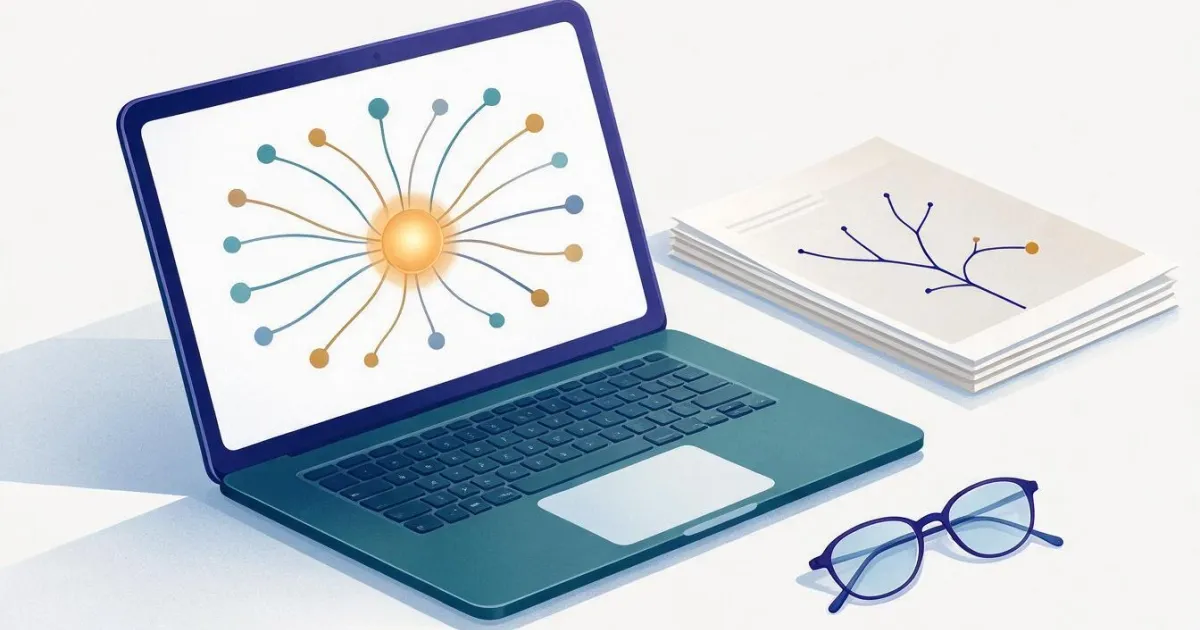
If you have arrived here looking for "how to make a mind map for studying" you probably have in front of you a syllabus of 300 pages, a PDF of class notes, or a project with twenty open fronts, and the feeling that no matter how much you highlight, you can't quite see the structure. This article is the method: what research says about mind maps, how to build them well, where they fail, and how the automatic generation of 2026 fits in without leaving you without learning anything. In the end, you will see where aiMindMap, the AI mind mapping app from AIsToHire, fits into that flow, but the method works with paper and pencil.
Do mind maps really work or are they a fad from the 70s?
They work, with a moderate to large effect, and the evidence has been consistent for two decades. The most comprehensive meta-analysis (Schroeder et al., Educational Psychology Review, 2018) places the overall effect at g = 0.58 on learning, and the meta-analysis by Izci and Akkoç in Heliyon (2023), with 78 studies and 6,464 participants, reaches d = 1.08 in academic performance. What matters is not that they "help," but when they help: the benefit is concentrated in the act of building the map.
| Study | What it measured | Result |
|---|---|---|
| Farrand, Hussain, and Hennessy — Medical Education, 36(5), May 2002 | 50 medical students, mind map vs. own technique | +10% factual recall after a week (CI 95%: −1% to 22%) |
| Nesbit and Adesope — Review of Educational Research, 76(3), 2006 | 55 studies, 5,818 participants, 67 effect sizes | Significant advantage in knowledge retention |
| Schroeder, Nesbit, Anguiano, and Adesope — Educational Psychology Review, June 2018 | 142 effect sizes, 11,814 participants | g = 0.58 overall · 0.72 building · 0.43 studying a given one |
| Izci and Akkoç — Heliyon, 2023 | 78 studies, 6,464 participants | d = 1.08; secondary d = 1.61, university d = 0.62 |
| Karpicke and Blunt — Science, 331(6018), February 2011 | 200 students, concept map vs. free recall | Free recall surpassed the map by 50% in retention after a week |
Two honest nuances that almost no article in the field mentions:
- Farrand's confidence interval (2002) includes zero. That "+10% retention" so often cited was a trend, not a certainty; and in the same study, the motivation of the mind map group decreased compared to their usual method. The large effect appears in later meta-analyses, not in the foundational study.
- The effect size decreases with age: d = 1.61 in secondary versus d = 0.62 in university (Izci and Akkoç, 2023). The more expert the reader, the less the external structure contributes, because they already have it in their head.
Mind map, concept map, and outline: they are not the same
A mind map has a single root and branches that open hierarchically from it; a concept map is a network with nodes that connect to each other and labels on the relationships ("causes", "depends on"); an outline is the same hierarchy in the form of an indented list. Choosing the wrong format is the number one cause of unreadable maps.
| Mind map | Concept map | Outline | |
|---|---|---|---|
| Structure | A center, radial branches | Network with cross-links | Indented list |
| Labeled relationships | No | Yes | No |
| Best for | Memorizing, structuring a topic, generating ideas | Explaining causes and systems | Writing, reviewing in text |
| Worst for | Processes with loops and multiple dependencies | Seeing it at a glance | Seeing the whole |
| Where used | Syllabuses, minutes, scripts, brainstorming | Sciences, medicine | Papers, documentation |
If your content is "a topic with parts", the mind map wins. If it is "A causes B which in turn feeds back into A", you need a concept map and the mind map will feel forced.
How to create a mind map step by step (the method that holds an entire syllabus)
Seven rules, in this order: a short central idea, between 3 and 7 main branches, one idea per node, details in notes, maximum depth of four levels, color by branch, and final review for duplicates. The limit of 3 to 7 is not aesthetic: working memory handles about four elements at a time (Cowan, Behavioral and Brain Sciences, 2001), so a branch with twelve children can no longer be "seen"; it is read.
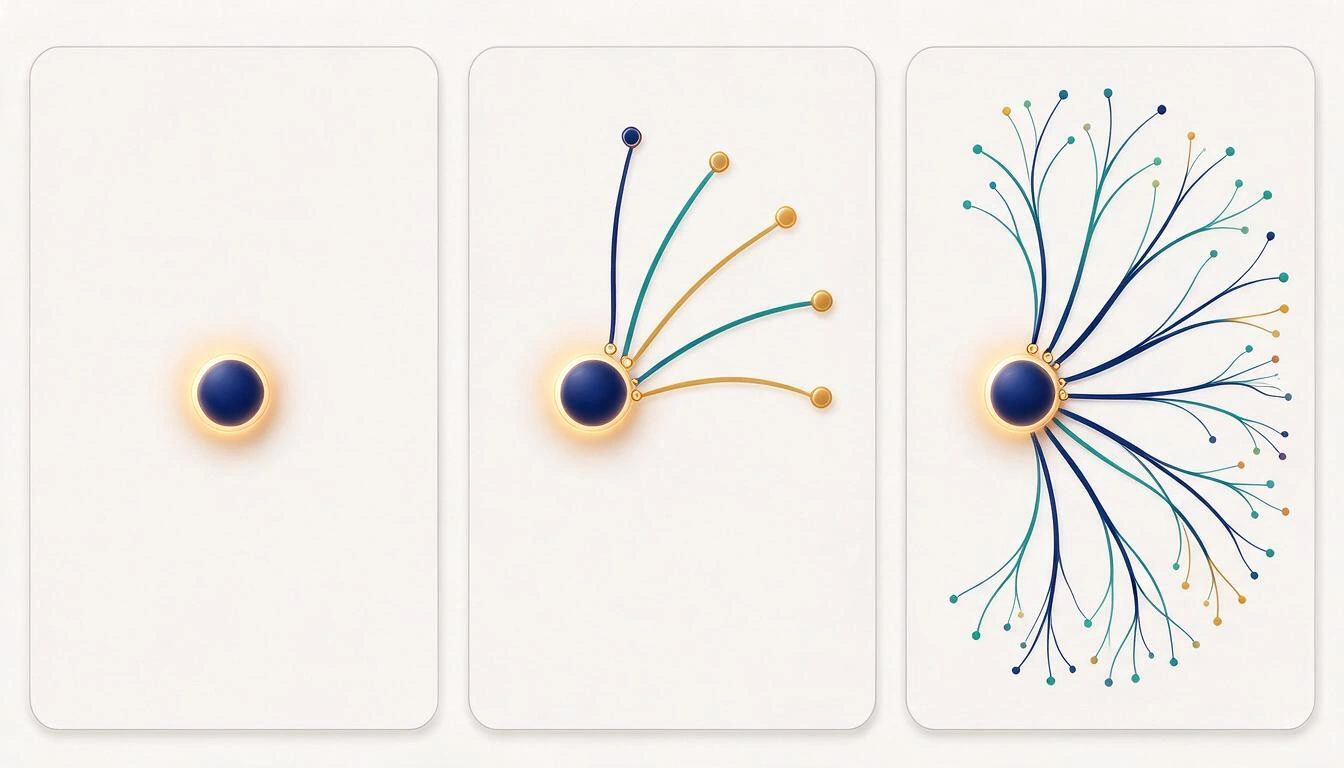
- Write the central idea in three words or less. If it doesn't fit in three words, the map is not on one topic: there are two maps.
- First, draw the first-level branches, without going into detail. In a syllabus, these are the blocks; in a project, the phases; in minutes, the agenda items.
- One idea per node, in a short noun or verb. "Prescription: 4 years" is a node. "The tax prescription is interrupted when..." is a note.
- Details, definitions, and quotes go in the node's note, not in the node itself. The map is read at a glance; the note is opened when needed.
- Do not exceed four levels. If you need a fifth, that branch deserves its own map.
- Color by branch, not whimsically. The color inherited by the entire branch is what allows you to recognize a block without reading it.
- Final cleaning pass: look for nodes that say the same thing in different words and merge them. A map with duplicates teaches the same thing twice and hides what is missing.
And the rule that is not about drawing but about learning: when the map is done, fold it and try to reconstruct it from memory. This is where it connects with the finding of Karpicke and Blunt (2011): the folded map turned into a question ("What was hanging from this block?") is active retrieval, and that is what solidifies the information.
Why do linear notes hide the structure?
Because running text forces you to keep in mind the hierarchy that is not drawn: when reading paragraph 14, you no longer remember which heading it depended on. The radial format externalizes that hierarchy, and that is what research on dual coding has been describing for decades: information that arrives through both the verbal and visual channels at the same time is better retrieved than information that arrives through only one.
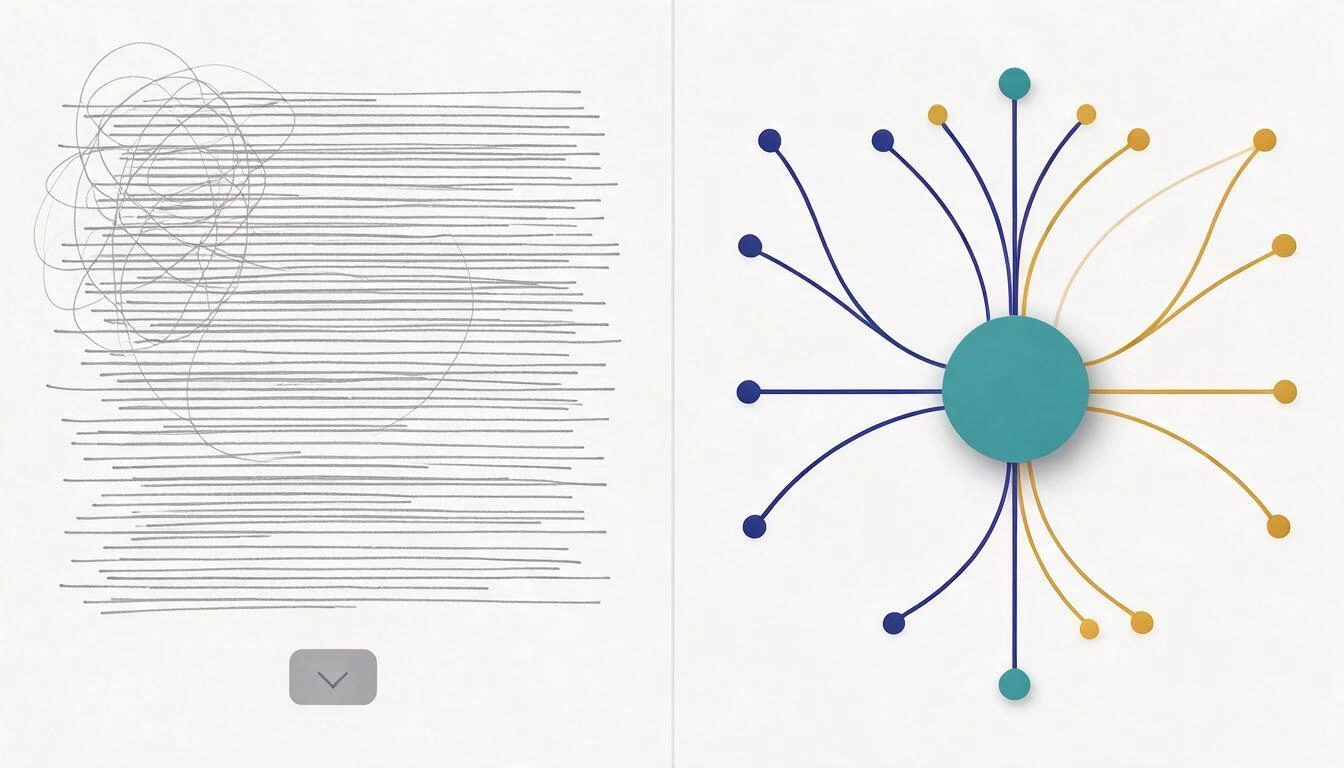
There is a counterpoint that is worth knowing before moving everything to digital: Van der Weel and Van der Meer (Frontiers in Psychology, January 2024) recorded with high-density EEG in 36 students that writing by hand generates broader brain connectivity patterns than typing. It does not say that digital is not useful —it says that the stroke contributes something. A reasonable combination: the digital map as a structure that is reorganized without being redone, and handwriting for reviews and exam outlines.
From a 60-page PDF to a mind map: how this is done in 2026
The flow that has been imposed is: generate an automatic draft from the document or topic, and then edit it node by node until the hierarchy is yours. Order matters: if you stay in the draft, you save exactly the work that produced the learning.
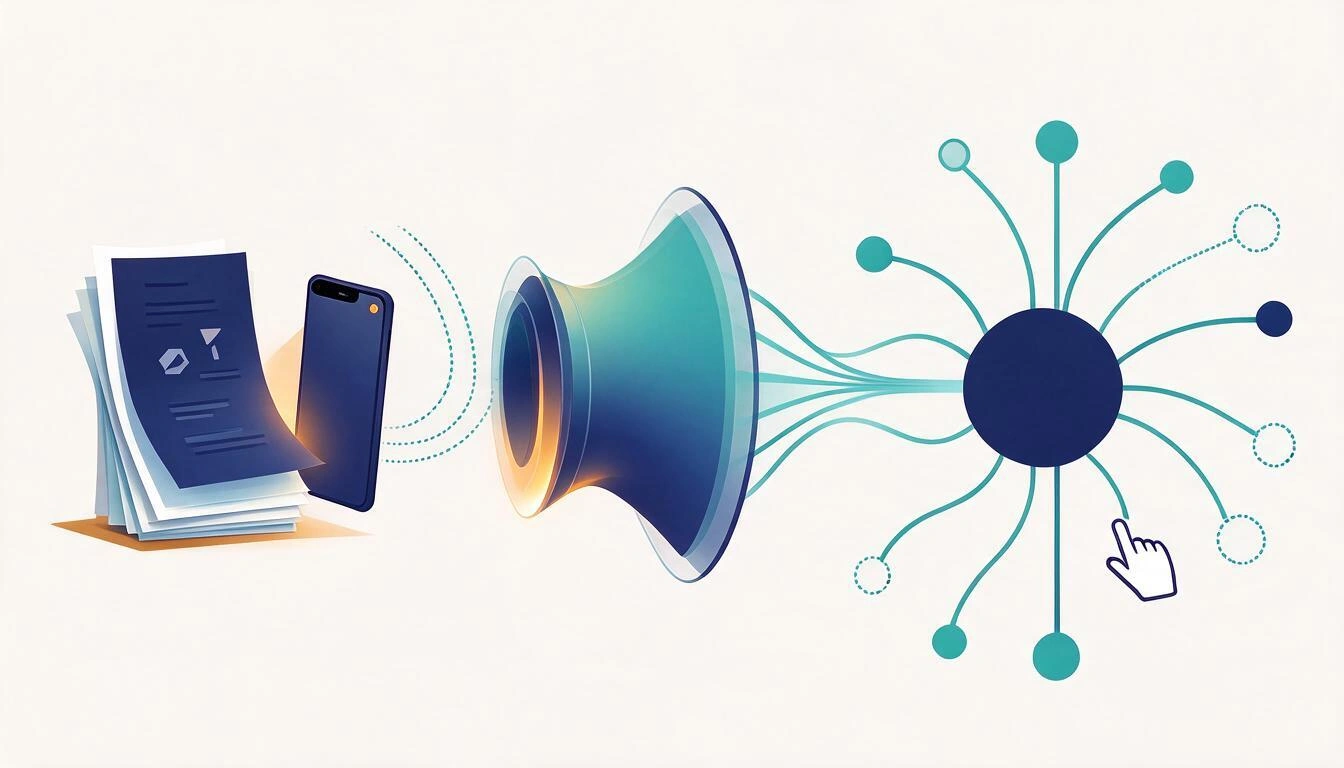
The usage data is striking: 89% of Spanish university students report using generative AI tools and 35% do so daily, but only 34% have received training from their university to use them (Fundación CYD, Use and perception of AI in the university environment, May 2025, with 800 undergraduate students and 20 universities). That gap between use and criteria is where mistakes are made.
And the warning comes from the lab: in the MIT Media Lab study Your Brain on ChatGPT (Kosmyna et al., 2025), 54 participants wrote essays with EEG from 32 electrodes; the group that used the assistant showed the weakest neural connectivity in memory and attention networks, the least sense of authorship, and poorer recall of their own text, with effects that persisted when writing later without help. The authors call it "cognitive debt."
Translated to mind maps, three usage rules:
| Use of AI | Effect on learning | Verdict |
|---|---|---|
| Request the entire map and study it as is | It is "studying a given map": g = 0.43 (Schroeder et al., 2018) | Wastes half the effect |
| Request the draft and reorganize it, rename nodes and delete branches | You rebuild: g = 0.72 | This is what works |
| Request to expand a branch that you found lacking | It forces you to judge what you accept and what you do not | Useful, if you review one by one |
This is where aiMindMap, from AIsToHire, is designed in that direction and not the other way: you can create a mind map with AI from a topic or from a PDF in aiMindMap —also DOCX, TXT or a photo of your notes, with three distinct approaches to reading the document—, but what the AI proposes appears as nodes in dashed lines that you have to accept or discard one by one: nothing is written in your map without your approval. From there, editing is done via keyboard: Tab creates a child, Enter a sibling, and the map rearranges itself with a radial auto-layout, without dragging nodes manually.
What are mind maps used for if you are not studying?
For any content with hierarchy and no loops: project planning, meeting minutes, scripts, SWOT analysis, structure of a paper or article. The map is the draft of the structure before writing the first sentence.
| Use case | Central idea | First level branches | What the map reveals that the list does not |
|---|---|---|---|
| Opposition syllabus | The subject | Program blocks | Which block is empty of content |
| Project | The deliverable | Phases | Dependencies and phases without tasks |
| Meeting minutes | The meeting | Agenda items | Orphaned agreements without a responsible party |
| Script or article | The thesis | Sections | Repeated arguments and logical jumps |
| Brainstorming | The question | Response categories | The categories that no one has touched |
In task work, marking nodes as completed and seeing the aggregated progress by branch is more practical than a parallel spreadsheet: in aiMindMap each node supports task status, priority P1–P4, long note, link, emoji, and color, and the progress cumulates upwards in the parent branch. And the same map can be viewed as an indented outline, switched to presentation mode branch by branch, or exported in PNG, PDF, or Markdown to paste into another document.
What does European regulation say about using AI for studying?
The European AI Regulation classifies as high risk (Annex III) the AI systems used in education to decide admissions, evaluate learning outcomes or monitor exams; a tool that organizes your own notes in a tree does not fall into that category. The deadline for those high-risk obligations was postponed: the European Parliament approved on June 16, 2026, the simplification package that moves its application from August 2, 2026, to December 2, 2027 (Morgan Lewis, June 2026; Gibson Dunn).
What has not been postponed and remains in effect:
- The prohibitions on unacceptable risk practices and the requirements for AI literacy, starting from August 2, 2026.
- The obligations of transparency under Article 50 (knowing that you are interacting with an AI and marking generated content), with the date of December 2, 2026 for marking systems already on the market.
Two limits that are worth clarifying, and that are not legal but common sense: the AI that summarizes a document can make mistakes or leave out important information, so the content of the map must be cross-checked with the source; and if your institution or your call restricts the use of AI tools in submitted work, that supersedes any European deadline. This article is informative and does not constitute legal advice.
Checklist: a decent mind map in 10 minutes
- Minute 0–1: write the central idea in three words.
- Minute 1–3: launch the first level branches. Between 3 and 7. Without going into detail.
- Minute 3–6: go down one level in each branch. One idea per node, no sentences.
- Minute 6–8: move to the notes anything that is a definition, quote, or long data.
- Minute 8–9: color by branch and merge duplicates.
- Minute 9–10: fold all branches and try to recite each block from memory. What you can’t recall is what you need to review.
Do pass 6 again the next day and again in three days. The map is not the review: it is the script for the review.
Frequently Asked Questions
How many branches should a mind map have?
Between 3 and 7 main branches. Below 3, there is no structure to show, and above 7, the map becomes hard to view at a glance, because working memory holds about four elements at a time (Cowan, 2001). If you have extra branches, group two or three under an intermediate node.
Is it better to make the mind map by hand or on the computer?
By hand has a measured advantage in the stroke: Van der Weel and Van der Meer (Frontiers in Psychology, 2024) found greater brain connectivity when writing by hand than typing. On the computer, the advantage is reorganization: you can move a branch around without redrawing anything, and that’s exactly what happens when you better understand the topic halfway through the syllabus. Practically, it’s digital for building and maintaining, hand for reviews.
Is a mind map created by AI useful?
It serves as a starting point, not as study material. Studying a map given to you has an effect size of g = 0.43 compared to g = 0.72 if you build it yourself (Schroeder et al., 2018). The reasonable approach is to ask for the draft, erase half, rename nodes in your own words, and reorganize what doesn’t fit: when you finish, the map is yours, and so is the effect.
Can a mind map be made from a PDF or a photo of my notes?
Yes. In aiMindMap, you can upload a PDF, a DOCX, a TXT, or an image —including a photo of some notes— and choose the approach you want for reading the document; the result comes as a proposal that you can accept or discard in parts. Always cross-check the data on the map with the original document before studying it.
How many times should a mind map be reviewed?
What matters is not the number of readings but that each review is of recall, not rereading. Folding the branches and trying to reconstruct them from memory the same day, the next day, and three days later yields better results than reading the map six times: this is the central finding of Karpicke and Blunt (Science, 2011), where free recall exceeded retention by 50% compared to the group that created maps.
Is a mind map useful for a work project or just for studying?
It is useful for any hierarchical content: phases of a project, points of a minutes, sections of a script. For work, the useful part is that the nodes can hold task status and priority and that progress can be aggregated by branch, so you can see which phase is stalled without opening a separate spreadsheet.
What is the difference between a mind map and a conceptual map?
The mind map has a single root and hierarchical branches without cross-links; the conceptual map is a network where any node can connect with any other, and the relationships are labeled. For memorizing and structuring a topic, use a mind map. For explaining causes, loops, and systems, use a conceptual map.
Can I export the map from the app to deliver or print it?
In aiMindMap, the map can be exported as high-resolution PNG, PDF, or Markdown/indented list, and it can also be viewed as an outline or presented branch by branch. What the app does not provide is real-time collaborative work: it is a tool for building and maintaining your maps, not a shared canvas.
Start with the structure, not with the summary
The conclusion of twenty years of research is uncomfortably simple: the value of the mind map lies in the time you spend deciding what hangs from what. What AI can take off your plate is the blank page —the first draft based on your topic or your PDF— not the decision about hierarchy, which is exactly the part that makes you learn. And when the map is done, fold it and recite it: that’s half the effect.
If you want to try that flow with your own syllabus or your next project, aiMindMap from AIsToHire is made for this: mind maps with AI from a topic or document, with auto-layout, notes, tasks, and export to PNG, PDF, and Markdown.
Turn your syllabus or PDF into a mind map with aiMindMap: type the topic or upload the document, accept branch by branch what the AI suggests, and export it in PNG, PDF, or Markdown. Try it for free.
Turn your syllabus or PDF into a mind map with aiMindMap: type the topic or upload the document, accept branch by branch what the AI suggests, and export it in PNG, PDF, or Markdown. Try it for free.Keep reading
View all articles →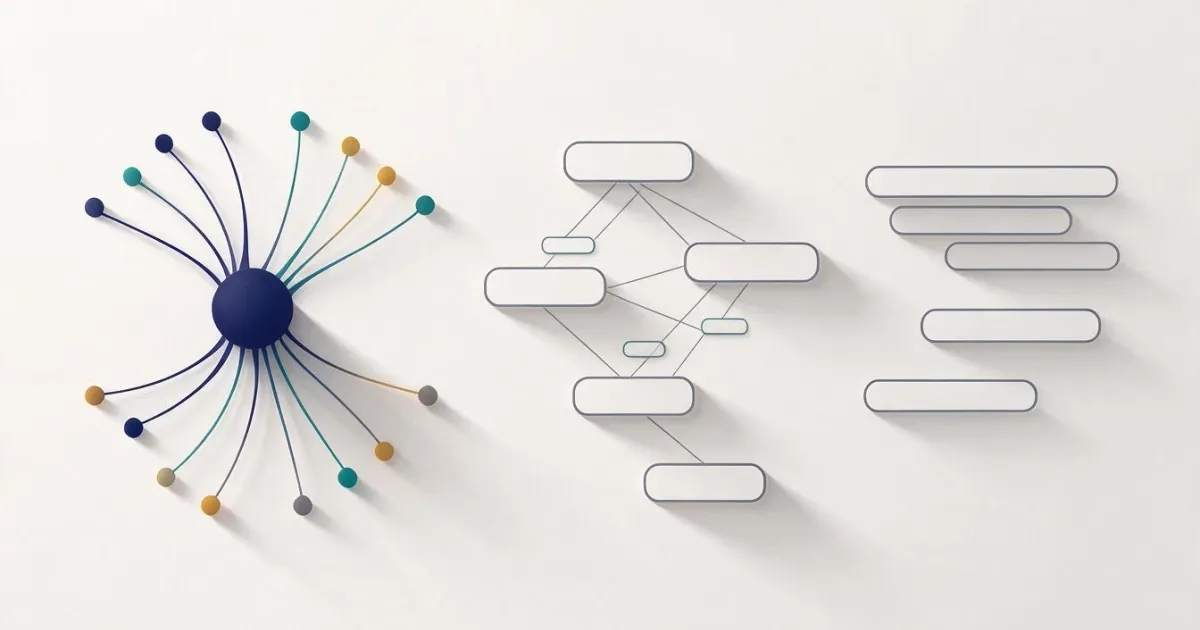
Mind map, concept map, and outline: differences and when to use each one

Why Your Car Insurance Increased in 2026: Average Premium of €1,412 and Historic Record

Discussing via WhatsApp or talking in person: what science says about couple conflicts through messages