 aiLinks
Quishing: how they change your business's QR code for a fake one (and how to avoid it)
Team at aiLinksWritten with AI assistance15 min readIn summary
- Spain is the second country in the world for quishing detections: it accounts for 17% of the total, just behind the United States (19%), according to the ESET Threat Report H1 2026, published on July 8, 2026, with telemetry from December 2025 to May 2026 and broken down by country by SecurityBrief on July 9.
- The QR code already appears in around 11% of detected phishing emails, with an average of 100,000 monthly detections and a peak in April 2026 (ESET, H1 2026).
- Microsoft went from 7.6 million QR attacks in January 2026 to 18.7 million in March, a +146% increase in one quarter, according to its Q1 2026 email threat landscape report (April 30, 2026).
- The physical vector is a sticker over the authentic QR: INCIBE and OCU have alerted to cases on parking meters, charging points, restaurant menus, and fake fines on windshields.
- The defense of a business has two halves: inviolable physical support (laminated, engraved, screwed) and control over the destination of the code, to be able to pause it or redirect it in seconds and see in the analytics if scans plummet.
If your business has a QR code on the street —in the window, on the table, in the parking meter of your parking lot, on the van— you have just become a cheap target. Fraud does not need to hack you: it needs a printer, a sticker, and ten seconds in front of your door. At aiLinks, the tool for short links and dynamic QR codes with editable destinations from AIsToHire, we see the other side of the problem daily: the printed QR is immutable, but the destination does not have to be. And that is precisely the only defense that works when the sign is already stuck to the wall.
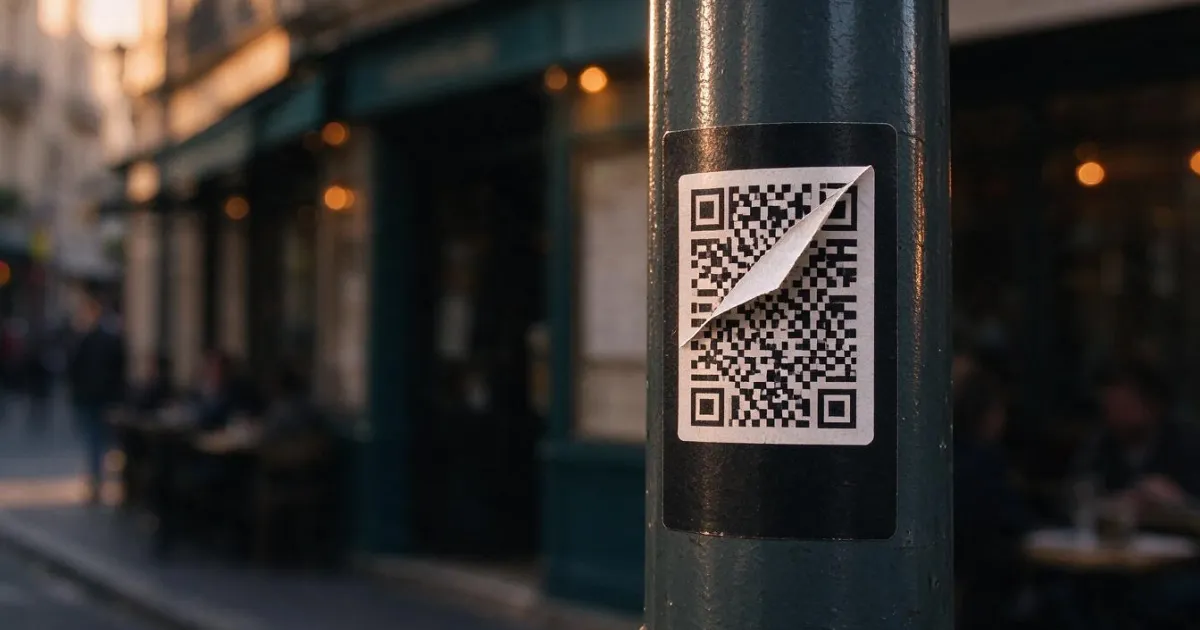
What is quishing and why has Spain become its second largest market in the world?
Quishing (from QR + phishing) is the fraud that uses a QR code as a vehicle to lead the victim to a fake website that asks for banking information or credentials. Spain accounts for 17% of all global detections, in second place behind the United States (19%) and ahead of Mexico (6%), according to the ESET Threat Report H1 2026 (July 8, 2026).
It is no coincidence. Spain is one of the countries where the QR was normalized earlier and more thoroughly: digital menus in hospitality, payment at parking meters, charging electric vehicles, shared bikes and scooters, tickets, procedures. Where there is a habit of scanning without thinking, there is business for those who stick a label.
The data that explains why filters do not stop it: a QR is an image, not a link. The anti-phishing engines that analyze URLs in text see nothing to analyze. That is why the QR already appears in nearly 11% of phishing emails detected by ESET, with an average of 100,000 detections per month and a maximum in April 2026.
| Source | Data | Period |
|---|---|---|
| ESET Threat Report H1 2026 | Spain, 2nd country: 17% of quishing detections (USA 19%, Mexico 6%) | Dec. 2025 – May 2026 |
| ESET Threat Report H1 2026 | The QR appears in ~11% of phishing emails; ~100,000 detections/month | Dec. 2025 – May 2026 |
| Microsoft, email threat landscape Q1 2026 | 7.6M QR attacks in January → 18.7M in March (+146%) | Jan. – Mar. 2026 |
| Microsoft, Q1 2026 | 8.3 billion phishing email threats detected | Q1 2026 |
| Barracuda, Email Threats Report 2026 | 70% of malicious PDFs led to a phishing website via a QR | 2026 |
This is how they change your business's QR for a fake one, step by step
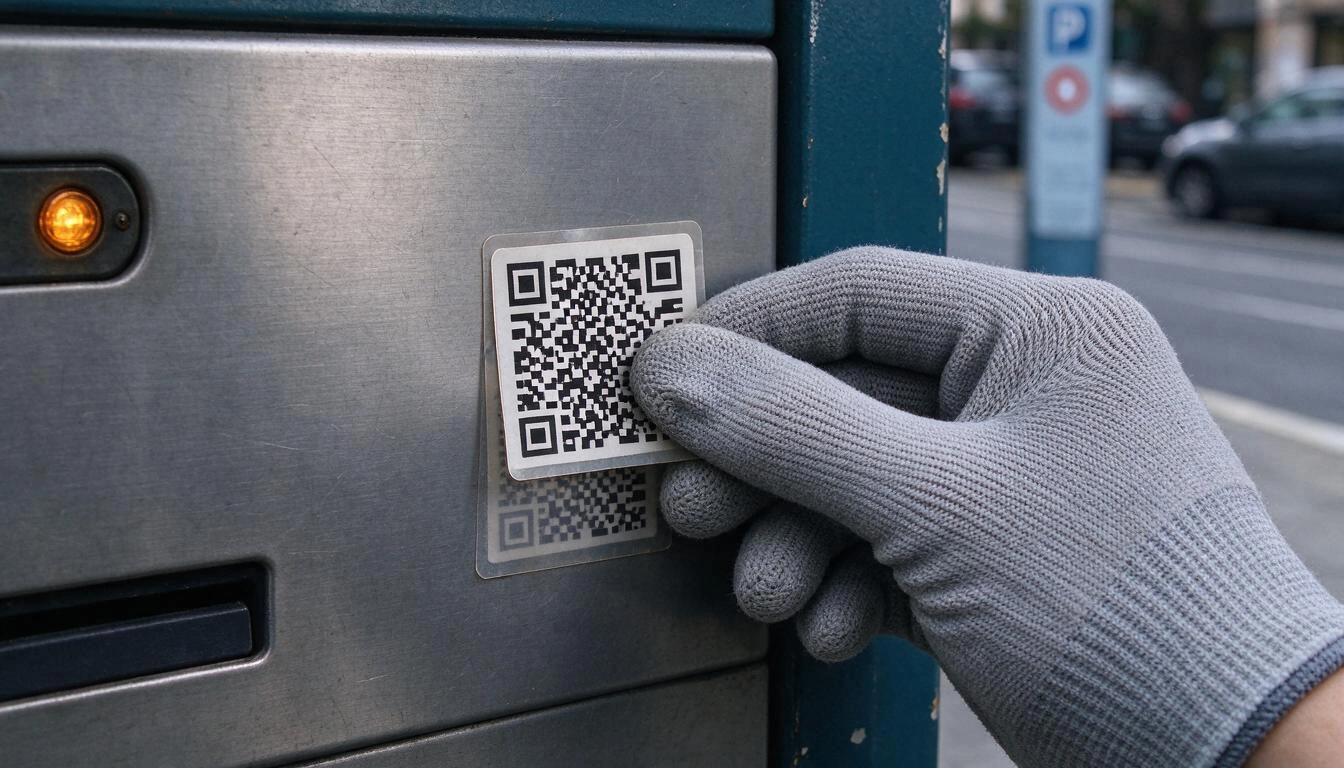
The physical attack has four moves and none require technical knowledge: print a QR that points to a cloned website, stick it over yours, wait for your customers to scan it, and collect the cards. The attacker does not enter your systems at any time; they use your facade and your reputation as bait.
- They clone your landing page. If your QR leads to a payment gateway, menu, or form, they replicate the appearance. In the case of the fake fines detected in Málaga, the domain used (
dgtmultamalaga.sbs) was registered with a low-cost Asian registrar, according to the analysis published by Xataka. - They print a sticker the exact size of your code. Sometimes they copy the frame and colors of the original support so that the patch is not noticeable.
- They place it on top, in seconds, during off-peak hours. Your sign remains intact to the eye: the only thing that has changed is the pattern of squares.
- They harvest. Every customer who scans provides card data, credentials, or an unwanted subscription. And they do so trusting you.
Why can't anyone see at a glance where a QR code leads?
Because a QR is not readable text: it is a matrix of black and white modules that encodes a string of characters, and the human eye cannot decipher it. Two codes that lead to two radically different sites are visually indistinguishable to any customer. This opacity —which is a technical virtue— is exactly what quishing exploits.
On top of that is the behavior of mobile devices. Many readers and cameras open the link directly or display it truncated for half a second, and on a narrow screen, a long domain gets cut off right where it starts to look suspicious. The OCU recommends, therefore, deactivating the automatic opening of links when scanning —on Android, from the Google Lens settings— to be able to read the URL before entering.
An uncomfortable conclusion for any business: you cannot ask the customer to verify the destination, because they have no means to do so. Verification has to reside on your side: in the support and in the domain that appears when the link is opened.
The three scenarios where it is most prevalent in Spain
The warnings from INCIBE and the OCU focus on three supports: payment machines in public spaces, restaurant menus, and fake documents that imitate the Administration. They share a pattern: the customer is standing, in a hurry, and assuming the code is official.
- Parking meters, recharges, and shared mobility. The OCU warned on July 10, 2025, about stickers with fake QR codes over the original codes at electric vehicle charging points, and warned that the same scheme applies to parking meters, bikes, and scooters. Media such as Merca2 documented in January 2026 the case of the parking meter with a cloned municipal website.
- Restaurant menus. On August 4, 2026, INCIBE published a real case handled by its 017 line: a customer scanned the QR code of a restaurant menu, accepted a pop-up window, and ended up with an active premium subscription that she had not requested, without a confirmation email or a way to unsubscribe on her own; other diners at the same establishment reported the same. This was reported, among others, by Leonoticias. According to QR TIGER, nearly 75% of restaurants worldwide already use QR codes for their digital menus: a huge attack surface.
- Fake fines on the windshield. In September 2026, INCIBE and the Local Police of Málaga alerted about papers that imitated the shield of the Ministry of the Interior and the DGT logo, with a QR that led to a fake payment website. The golden rule repeated by the DGT and automotive clubs and verified by Maldita.es on January 9, 2026: an authentic fine is never paid via a QR; it carries a reference number and details of the officer, the vehicle, and the infraction.
What the business loses when its QR is covered (and it's not just the customer)
It loses three things at once: the money of its customers, its reputation, and the traffic that QR code generated. The restaurant case is the perfect example: the victim does not blame the anonymous scammer, but calls the establishment. And the establishment had no way of knowing what had happened.
There is also a silent cost: while the sticker is in place, your QR stops working. Reservations, orders, downloads of the menu, or votes from the survey that the code brought go to zero, and no one realizes until someone complains. In a business whose main customer acquisition channel is a sign on the street, those are days of a broken funnel.
And there is a compliance risk: if the QR you printed leads —even if manipulated by a third party— to a form that collects personal data, the incident affects your customers and you will have to explain it. It is advisable to be able to reconstruct what destination your code had at each moment, with a date.
The defensive protocol: seven measures, from the cheapest to the most effective
Defense is not a product, it is a four-layer protocol: difficult-to-manipulate physical support, periodic visual inspection, destination under your control, and monitoring of scans. None of the four costs much; the combination is what makes the attack unprofitable at your doorstep.
| Measure | Cost | What attack it stops |
|---|---|---|
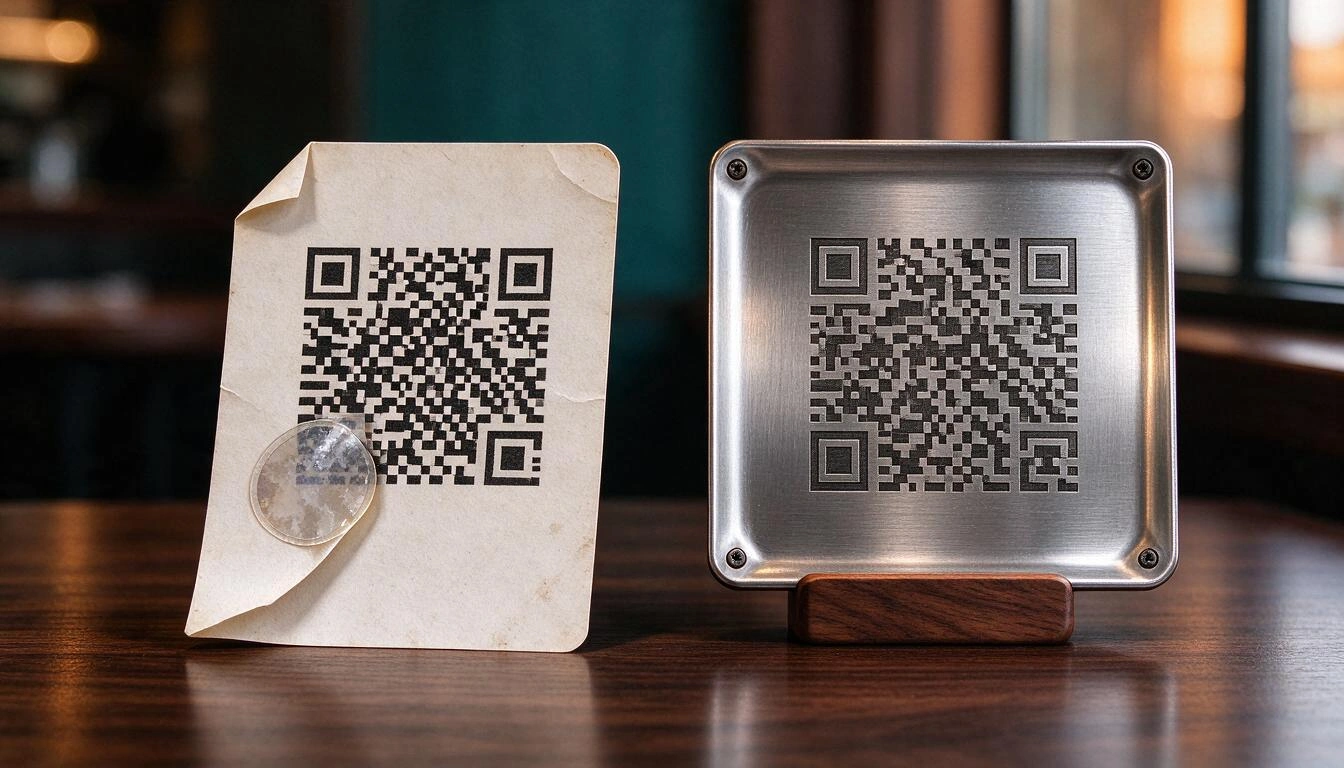
| Laminated, plasticized, or vinyl QR with permanent adhesive | Very low | Makes it difficult to stick over; the foreign sticker is noticeable and peels off |
| Laser-engraved, die-cut or screwed acrylic QR | Medium | Practically impossible to cover without leaving a trace |
| Frame or support with exact cutout for the code | Low | Any adhesive protrudes and is visible |
| Notice on the support indicating the domain it leads to | None | The customer can verify the URL that appears |
| Visual inspection upon opening and closing, with reference photo | None | Detects manipulation in hours, not weeks |
| Destination on a recognizable and stable domain, not on an anonymous shortener | Low | Makes the fake URL obvious; allows educating the customer |
| Ability to pause or redirect the code instantly | Low | Cuts the damage without reprinting anything |
Two nuances that matter more than they seem:
The visual inspection needs a reference. "Looking if it looks odd" is not a control. Take a photo of each support on the day it is installed, save it, and compare. A lifted corner, a different shine, a square of white whiter: that is what INCIBE asks to look for when recommending frequently checking that your business codes have not been changed and choosing a generator that offers security guarantees about where the code points.
The domain is the only clue left to the customer. If your QR leads to an anonymous and generic shortener, you are teaching your customer that it is normal to land on a domain they do not recognize, and with that, you disable the only alarm they had. If it always leads to a stable domain and a readable path —the type of short link with its own text, like /carta-bar-central, that you can define instead of a random code—, the cloned website of the scammer reveals itself.
How to detect in time that your code has been covered: the drop in scans is the alarm
The most reliable signal that someone has stuck something over your QR is that scans drop sharply overnight without anything else having changed. If your code averages 40 daily scans and drops to three, it is not that traffic has decreased: it is that your code has stopped being your code.
For that alarm to exist, scans need to go through a link that you measure. A QR that directly encodes the final URL (or a phone number, or a WhatsApp message) leaves no trace: you do not know how many scans you had yesterday, so you cannot notice that today you do not have them. A QR that points to your short link does: you have daily series, variation, country, city, device, and browser.
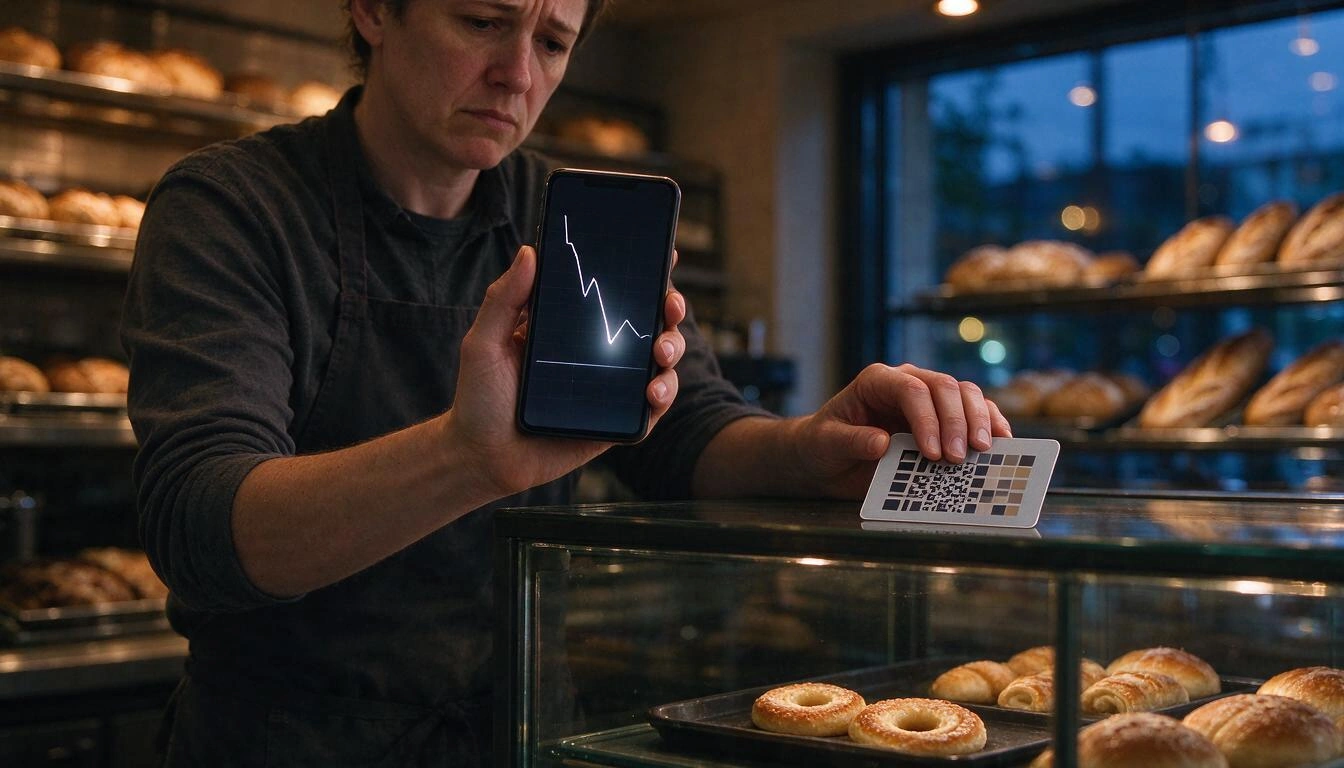
Three patterns to keep an eye on:
- Sharp and sustained drop in a specific support: suspicion of physical manipulation or removed poster.
- A support with zero scans for days while its siblings keep functioning: in aiLinks this is seen by comparing several links at once and locating the ones that are not scanned.
- Scans from a country or language that does not match with a poster that is in your window: a sign that the image of your QR is circulating elsewhere.
What to do in the first 24 hours if you discover a manipulated QR
First the physical support, then the digital destination, and in parallel the report. The order matters: removing the sticker stops new victims, but the warning to those who have already scanned can only be given if you control the page they reach.
- Remove the sticker and keep the adhesive in a bag: it is evidence. Photograph the support before touching anything.
- Pause your own code while you investigate. A paused short link stops redirecting and shows a warning page instead of sending anyone anywhere; if the support was not manipulable, you can also temporarily redirect it to a warning page for customers arriving there.
- Notify at the local and on your networks, with a specific message: what code, what the fake one looked like, and what those who scanned it should do.
- Tell the affected to call their bank and freeze their card, which is the first measure recommended by OCU, and to collect screenshots and statements.
- Report. INCIBE assists citizens and businesses at the toll-free number 017 and through its cybersecurity help service, and the formal report goes to the National Police or Civil Guard.
- Keep a record of the incident: date, support, destination your code had, and changes you made. A dated history of the destinations of each link saves you half a discussion later.
Frequently Asked Questions about Quishing and Business QR Codes
How do I know if a QR code is fake before scanning it?
At first glance, you can't read the destination, so look at the support, not the code: if there is a sticker on top of another, the edges don't match, the paper is lifted, or the texture is different from the rest of the poster, don't scan it. Once scanned, read the full domain before entering anything: disabling automatic link opening is the measure recommended by OCU precisely to be able to do this.
Do traffic fines have QR codes?
No. Neither the DGT nor the municipalities manage the payment of a fine through a QR left on the windshield: a genuine fine includes a reference number, details of the officer, the vehicle, and the infraction, and is paid through official channels. This is the warning repeated by INCIBE, the Local Police, and journalistic verifications of 2026.
My restaurant uses a QR for the menu, am I responsible if someone manipulates it?
The crime is of the scammer, but the affected customer will call you, and the reputational damage is yours. That’s why INCIBE directs its recommendations to businesses: frequently check that the codes in the establishment have not been changed and use a generation service that guarantees where the code points. Documenting the reviews and being able to verify what destination your QR had on each date is the best possible position.
Is a dynamic QR more secure than a static QR?
It is more defensible, which is not the same. A static QR encodes the destination within the image: if there is a problem, you can only reprint. A dynamic QR points to an intermediate short link, so you can pause it, redirect it to a notice page, or change the destination in seconds without touching what is printed, and you have analytics to notice that something is wrong. What it doesn’t prevent is someone sticking something else on top: that is combated with the physical support.
Do link shorteners help or worsen the problem?
It depends on one thing only: if the customer recognizes the domain. An anonymous and generic shortener usually gets people used to landing on unknown domains, which is exactly the habit that quishing exploits. A short link with a stable domain and a readable path —with the name of your business or the campaign— turns the URL into a verifiable clue.
How often should I check the QR codes of my business?
For codes in public spaces or on the facade, daily visual checks at opening and closing; for those on tables, when setting up the service. INCIBE does not set a specific frequency, but it does insist on frequent checking. Add a weekly review of the analytics: a drop in scans without explanation is the clue that arrives before the customer complaint.
What do I do with already printed posters if I have to change the destination?
If the QR points to a short link that you control, nothing: you change the destination from your mobile and the printed one is still valid. If it encodes the final URL, the poster is dead paper, and you have to reprint. That difference is the practical reason to always use an editable intermediary, even before the security reason.
A QR that you can turn off is the only one you can defend
Quishing is not won by shielding the code: it is won by controlling the destination and monitoring the scans. If your QR points to your short link, manipulation is a half-hour incident —pause, notify, redirect, document— instead of a batch of posters in the trash and an angry customer to whom you can't explain anything.
That’s exactly what aiLinks does, the app from AIsToHire to create editable short links and dynamic QR codes: the printed code always points to your short link, with a readable path that you can choose; the destination is changed in two taps with a dated history and a backtrack; the link can be paused instantly if you detect manipulation, and the scan analytics —total and unique per day, week, and month, with variation, country, city, and device— alert you to the drop before a customer tells you. You can download the QR in SVG to take it to print, and it is the last one you need to print.
Create your business's QR codes on a short link that you can pause, redirect, and measure. With aiLinks, you design the code, download it in SVG for printing, and if someone tampers with it, you can turn it off or redirect it from your phone without reprinting a single sign.
Create your business's QR codes on a short link that you can pause, redirect, and measure. With aiLinks, you design the code, download it in SVG for printing, and if someone tampers with it, you can turn it off or redirect it from your phone without reprinting a single sign.Keep reading
View all articles →
How to Change the Destination of an Already Printed QR Code (Without Reprinting Anything)

Why Your Car Insurance Increased in 2026: Average Premium of €1,412 and Historic Record

Discussing via WhatsApp or talking in person: what science says about couple conflicts through messages
