 WappLoveScore
Discussing via WhatsApp or talking in person: what science says about couple conflicts through messages
Team at WappLoveScoreWritten with AI assistance15 min readIn summary
- No channel wins by default. The systematic review on technology-mediated conflict management published in the Journal of Social and Personal Relationships (January 2026, 15 studies) found no systematic difference between discussing via messages and discussing face to face.
- Chat provides a real advantage: time to think before responding and avoiding impulsive reactions, as well as a record to refer back to.
- And a real disadvantage as well: without tone or body language, a brief message "seems cold" and ambiguity is interpreted negatively.
- What matters is not the channel, it's the topic and the habit. Habitually discussing serious matters via chat —complaints, apologies, trust— is associated with more conflictual face-to-face conversations afterward.
- There are measurable patterns that the discussion has gotten out of hand: absolutes ("always", "never"), increasingly short and curt messages, bursts of response in less than five minutes, and long silences right after the friction.
If you feel that "everything gets misinterpreted on WhatsApp," it is not just your impression or a character flaw: it is a documented effect of the channel, and research from the last two years has measured it quite accurately. At AIsToHire we have been working with analyses of real WhatsApp conversations for some time —that’s what WappLoveScore does, our love test that analyzes WhatsApp chat—, and the patterns described in the scientific literature are exactly what appears when reading thousands of messages in succession. This article reviews what science says today, with sources and dates, about discussing via messages versus discussing in person.
Is it worse to argue via WhatsApp than to talk in person?
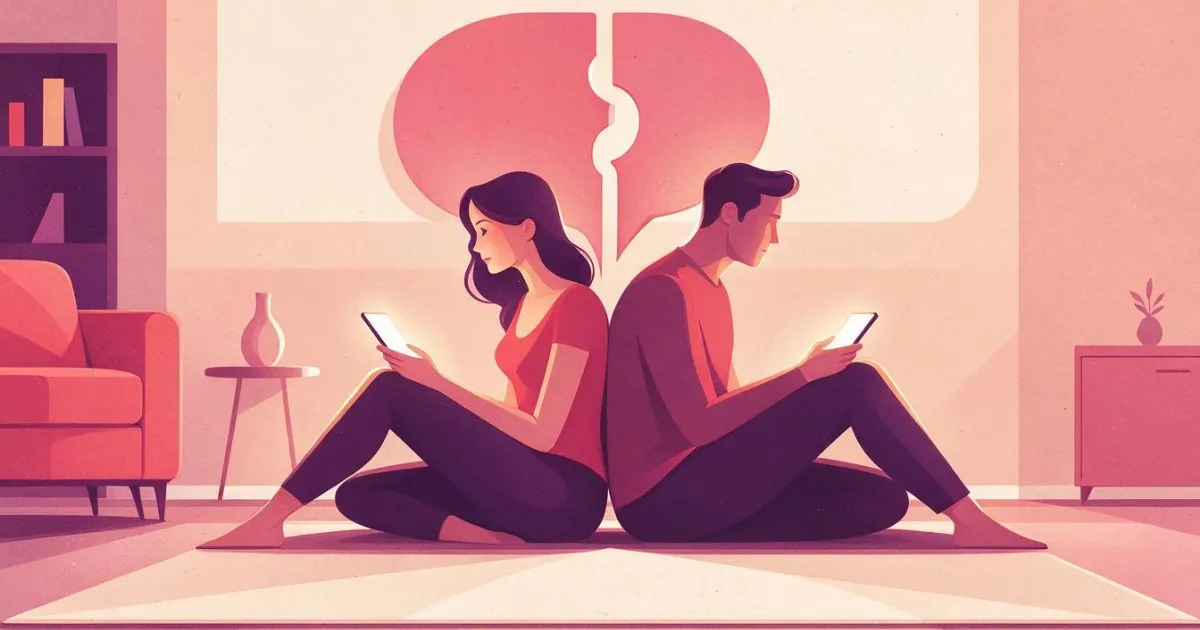
No, it is not worse in itself. The most recent systematic review on the topic —led by psychology professor Marie-Ève Daspe (University of Montreal) and published in the Journal of Social and Personal Relationships in January 2026— analyzed 15 studies that statistically compared face-to-face conflict with technology-mediated conflict (messages, voice notes, email, instant messaging, calls, and video calls). The conclusion was that the results do not support a systematic difference between one channel and another in terms of emotions during the conflict, perception of resolution, or relationship satisfaction.
What does appear are trends conditioned on who is arguing. According to the University of Montreal's note on the study (June 3, 2026), texting is associated with better communication quality in individuals with higher self-esteem, more familiarity with digital communication, lower initial relationship satisfaction, and in couples where both members score low on avoidant attachment.
"Digital communication lacks non-verbal cues, leading to greater ambiguity. A brief message can seem cold." — Marie-Ève Daspe, University of Montreal, June 2026.
The recommendation from the study itself is not "forbidden to argue via chat," but a multimodal approach: choose the channel based on the sensitivity of the topic and how each of you are.
What is gained and lost when a discussion moves from the living room to chat
Chat gains control and record; it loses tone, body, and rhythm. That is the entire trade-off, and understanding it helps to decide in each specific discussion whether the mobile helps or hinders.

| Dimension | Discussing via WhatsApp | Discussing face to face |
|---|---|---|
| Impulsivity | Allows stopping, deleting, and rewriting before sending | The reaction to disappointment is immediate |
| Non-verbal cues | Absent: no tone, no face, no posture | Available and decisive in emotional communication |
| Ambiguity | High: a short message reads as coldness | Low: the face corrects the text |
| Record of what was said | Remains written; can be reread where communication broke down | Reconstructed from memory, and each remembers a different version |
| Risk of escalation | High if it becomes a flurry of messages | High if there is physiological overflow |
| Repair | Easy to initiate, difficult to close | Difficult to initiate, easier to close |
| Asymmetry of time | One expects an immediate response; the other is not looking | Both are in the same conversation |
The advantages of the left column are not marketing: the 2026 review itself recognizes that text gives "time to digest what the partner has communicated" and that the written record allows for clearer visibility of where the misunderstanding occurred.
Why does a neutral message read as an attack?
Because by eliminating the non-verbal channel, the brain fills in the gaps, and in the midst of a conflict, it fills them in negatively. It is not a metaphor: there are neurophysiological measures of that loss.
A study published in Scientific Reports on February 1, 2024 measured interneuronal synchrony during face-to-face and text message conversations in 65 dyads. Both modalities generated significant brain synchrony, but eight fronto-temporal connections were significantly stronger face-to-face than by text, and the observed affective synchrony was 1.93 face-to-face versus 0.56 by messages. In other words: through chat you still connect, but with much less emotional bandwidth.
The practical counterpart is that small tone markers do work. A study by Eun Huh published in PLOS ONE on July 2, 2025, with 260 participants found that messages with emojis are perceived as more receptive than text-only messages (t(258) = 8.90; p < 0.001), and that this perception of receptiveness predicted greater closeness (b = 0.26) and greater relationship satisfaction (b = 0.15). The type of emoji didn’t matter: what mattered was that there was at least one. The emoji does not adorn; it acts as a tone of voice.
And the sources of misunderstanding go beyond the text itself. Clinical psychology points out, when reviewing the literature on why it’s advisable to think twice before resolving a conflict by text (March 2024), that misunderstanding in chats is also fueled by writing distractedly, by abbreviations, and by technical failures, in addition to the absence of tone and facial expression.
What topics are advisable not to discuss by chat
Issues that put trust, reproach, or apology at stake. The evidence here is older and more consistent than that of "chat is bad": what harms is not writing a lot, but writing about serious matters.
The study by Novak, Sandberg, Jeffrey, and Young-Davis, published in the Journal of Couple & Relationship Therapy in 2016 with over 4,000 couples at different stages (dating, engagement, marriage), found that discussing serious topics, bringing up conflictual issues, and apologizing by message was associated with perceiving subsequent face-to-face communication as more conflictual. The important nuance: writing more, in general, was associated with more satisfaction and less conflict. What mattered was the content, not the volume.
In the same vein, the work of Lori Schade and Jonathan Sandberg at Brigham Young University (276 young adults, released in October 2013) found that, in women, using messages to apologize, resolve differences, or make decisions was associated with lower relationship quality; in men, what was associated with lower quality was writing too frequently. And for all: expressing affection by message improved the relationship.
| Topic | Recommended channel by evidence | Why |
|---|---|---|
| Affection, gratitude, "I miss you" | Chat | Expressing affection by message is associated with better relationship quality |
| Logistics and small disagreements | Chat | The cost of a misunderstanding is low and repairable |
| Reproaches about the other’s character | Face to face | It is the territory of character criticism, not specific complaints |
| Apologies for something that hurt | Face to face | Apologizing by text is associated with a perception of subsequent conflict |
| Trust, jealousy, suspicions | Face to face | Maximum emotional load and maximum ambiguity of text |
| Important decisions (cohabitation, money, future) | Face to face or video call | They require real-time negotiation, not asynchronous turns |
| Resuming contact after a fight | Chat as a ramp, closure in person | Chat is easy to initiate; closure needs physical presence |
Five patterns that reveal a discussion that has gotten out of hand
There are five observable signals in the chat itself, without interpreting intentions: absolute language, shortening messages, rapid bursts, silence after a clash, and the cycle of one pressing and the other closing off.

1. Absolutes: "always", "never", "everything", "nothing"
This is the typical linguistic form of what the Gottman Institute calls criticism, the first of the four horsemen of couple communication: unlike a complaint, which speaks of a specific behavior, criticism attacks the character of the other. "You forgot to let me know" is a complaint. "You never let me know, you always do what you want" is a criticism, and the absolute is what marks the leap. In writing, the effect is amplified, because the absolute stays there and can be reread twenty times.
2. Messages that are shortening and sharpening
When a conversation starts with paragraphs and ends in "okay", "now", "whatever you say", what has changed is not the topic: it is the disposition. In text, brevity reads as coldness —there lies the ambiguity warned by the 2026 review—, and it usually coincides with the moment when one of the two just wants to finish.
3. Bursts: responding in less than five minutes
The SellCell survey on arguing via text (1,064 respondents, updated in January 2024) found that 30.37% respond in 1 to 4 minutes to a hostile message, that 36.85% admit to reacting impulsively when angry, and that 59.72% believe that chat prolongs the discussion. It is the pattern that the 2026 review describes as "burst exchanges" fueled by anger, where winning the fight is prioritized over understanding the underlying problem. The advantage of the channel —thinking before responding— disappears right here.
4. The long silence right after the clash
A gap of hours in a chat that had been continuous, right after the peak of tension, is the written equivalent of stonewalling or evasion: the listener shuts down and stops responding. It is usually accompanied by physiological overflow, and that is why it doesn’t get resolved by insisting.
5. The cycle of pressing and withdrawing
It is the most studied pattern and the most corrosive. The meta-analysis by Schrodt, Witt, and Shimkowski, published in Communication Monographs in 2014 on 74 studies and over 14,000 participants, found that the demand-withdrawal pattern was associated with lower couple satisfaction more intensely than any other communication pattern studied (mean association r = 0.36). And the effect sizes were similar in both gender directions, so it is not a "men's thing" or a "women's thing". In WhatsApp, the cycle is easy to see: a succession of messages from one person followed by nothing.
How much does this weigh in Spain
A lot, because the channel is almost universal and the limits are unspoken. In Spain, couple conflict is managed via WhatsApp simply because everything is managed via WhatsApp.
According to the CNMC Household Panel published on October 30, 2026, 95.3% of Internet users in Spain use WhatsApp to send messages, far ahead of Instagram (around 25%) and Telegram (16.8%); and 68.9% make calls or video calls through the app itself.
Regarding the effect on relationships, the Digital Love study by Unobravo (published on January 28, 2026, with residents in Spain who have a current or recent partner) provides these data:
| Data | Figure |
|---|---|
| Feels emotional distance associated with digital use | 55% |
| Aged 45 to 54, believes conflicts are exacerbated by messages | 46.7% |
| Aged 55 to 64, believes conflicts are exacerbated by messages | 50% |
| Has never talked with their partner about digital limits | Nearly 60% |
| Believes better management of digital would improve their relationship | 70% |
| Feels more emotionally connected via messages than in person | Less than 10% |
The data that is most important to retain is the penultimate crossed with the antepenultimate: almost six out of ten couples have never talked about how they use their phones with each other, and seven out of ten believe that doing so would be beneficial. The pending conversation is not about the conflict: it is about where the conflict is held.
How to take a discussion out of the chat without escalating it
There is a simple protocol that can be directly inferred from the evidence: name the channel, park the topic with a date, and not leave silence without explanation. Three phrases, in practice.
- Name the channel, not the content. "We're going to complicate this in writing. We'll talk about it when I see you." It's not about avoiding: it's about changing the medium. And it's best to do it before the third burst.
- Set a date for parking. Silence without a date is evasion; silence with a date is self-regulation. "We'll talk tonight" closes the waiting loop for a response that the SellCell survey shows to be so sensitive.
- Distinguish complaint from criticism before sending. If the message contains "always" or "never," rewrite it in terms of a specific fact and what you need. It's the antidote that the Gottman Institute itself proposes for criticism.
- Use chat for what chat does well. Repair, soften, resume contact, say you’re still there. The evidence from 2016 and 2013 agrees that written affection adds up.
- Add explicit tone. An emoji, a ten-second voice note, a "I say this without anger." The 2025 PLOS ONE study suggests that it’s enough to have a mark of receptivity.
- If there’s physiological closure, stop. No one negotiates well with a pulse at 110. Return when both have calmed down.
Love and friction are not the same measure
A relationship can have a lot of love and a lot of friction at the same time, and that is precisely what a single number does not account for. Research makes it clear: the pattern of demand and withdrawal predicts dissatisfaction regardless of the affection expressed, and expressing affection through messages improves the relationship even if the conflict is poorly managed. They are two axes, not one.
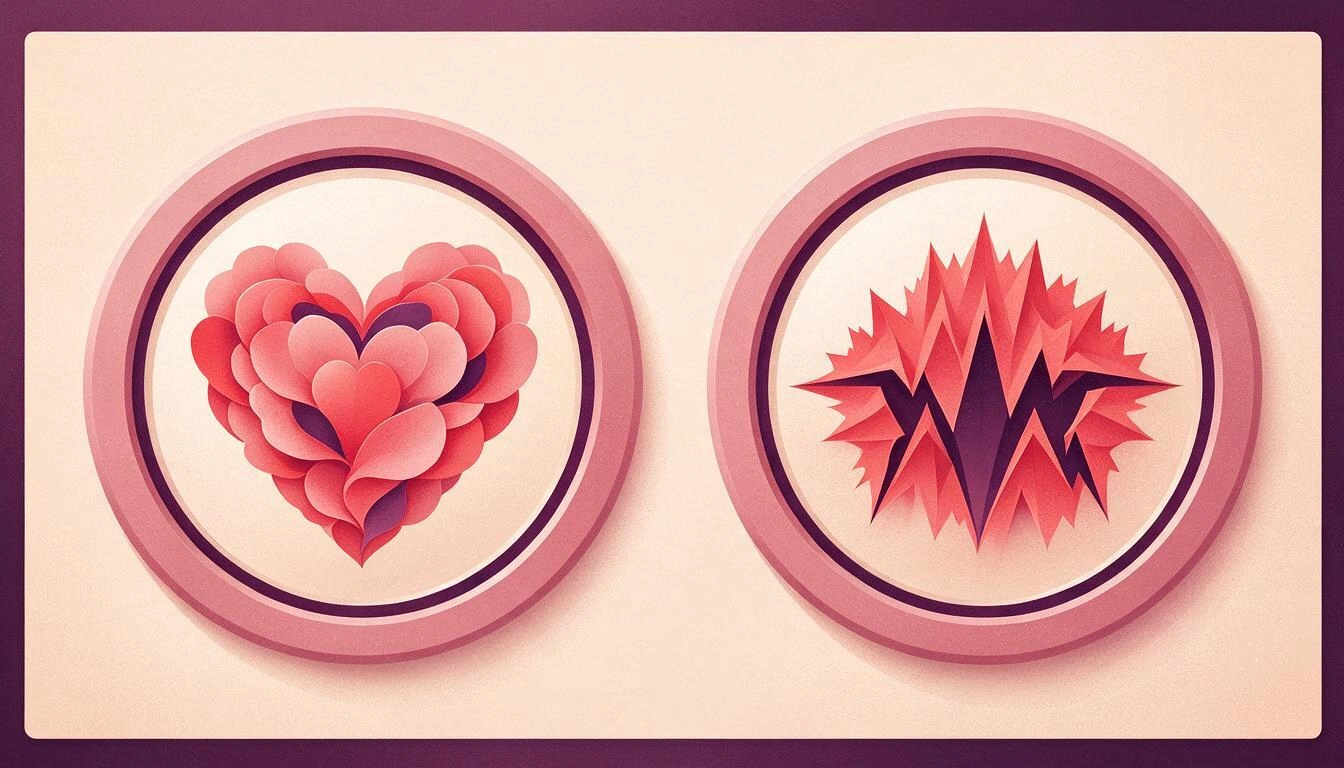
That’s why WappLoveScore, the conversation analysis app from AIsToHire, measures tension apart from the Love Score and presents it on its own thermometer, without the humorous tone of the rest of the report. You upload the export of your WhatsApp chat —the file is read in the browser and not sent to any server— and, in addition to a score from 0 to 100, you get the metrics this article describes: when was your most conversational time, which words are repeated, how many expressions of affection there are in each direction, what the longest silence is, and when the friction was concentrated. If you want to put data to the feeling that "everything gets misinterpreted over WhatsApp," you can start with the analysis of the level of love and tension in your WhatsApp chat.
Frequently Asked Questions
Is it better to argue over WhatsApp or in person?
It depends on the topic and on you, not on the channel. The systematic review in the Journal of Social and Personal Relationships from January 2026 found no channel to be systematically better than another. For issues of trust, accusations, or apologies, the evidence points to in-person conversation; for affection, logistics, and minor disagreements, chat works well and even adds up.
Why does my partner misinterpret my messages if I’m not saying anything bad?
Because text does not carry tone or facial expression, and in a context of tension, ambiguity is interpreted negatively. The February 2024 Scientific Reports study measured up to eight significantly stronger fronto-temporal brain connections face-to-face than through messages: the written channel transmits much less emotional information.
Do emojis help or detract from the seriousness of a conversation?
They help. The July 2025 PLOS ONE study found that messages with emojis are perceived as significantly more receptive than text-only messages, and that this receptivity predicts greater closeness and partner satisfaction. It didn’t matter what type of emoji, only that there was one.
What does it mean when my partner stops responding in the middle of a discussion?
Typically that they have closed off, not that they are ignoring you out of contempt. It’s the written equivalent of evasion: the listener blocks and stops responding, often with their body activated. Insisting reinforces it; setting a date to revisit it ("we'll talk tonight") deactivates it.
Is saying "always" and "never" in a discussion that serious?
As a signal, yes, it is relevant. It’s the usual form of criticism as defined by the Gottman Institute: an attack on character rather than a complaint about specific behavior. In writing, it weighs more because it is recorded and can be reread indefinitely.
Does arguing over messages mean the relationship is going badly?
Not by itself. 80% of adults have argued over messages at some point, according to the 2024 SellCell survey, and the 2026 review even found better communication quality by text in certain profiles. The alarm signal is not arguing over chat: it’s doing it always over chat and about all topics.
Can I know if my chat has too much tension?
Yes, with measurable patterns about the conversation itself: frequency of absolutes, average message length during conflict segments, response times in bursts, and duration of silences after friction. It’s exactly what the tension thermometer of WappLoveScore calculates, aside from the love score.
What to take with you
The science of the last two years does not say "do not discuss on WhatsApp": it says that the channel is a tool with a specific profile —good for thinking before speaking and for repairing, bad for ambiguity and for what hurts— and that the problem arises when it is used for everything by default. The useful decision is not which channel is better, but which topic goes to which channel.
And if you want to look at the data instead of the feelings, the chat you already have is the best available source. WappLoveScore, from AIsToHire, analyzes the export of your conversation in the browser itself and returns your Love Score, the tension thermometer, your golden age, and your secret language: you can try it on the page of WappLoveScore, the test that scores your relationship based on your WhatsApp chat.
Your chat already holds the answer: upload the export to WappLoveScore and discover your Love Score from 0 to 100, the tension thermometer, your peak conversation period, and your first 'I love you' with a date. It's analyzed on your mobile and the chat is not uploaded to any server.
Your chat already holds the answer: upload the export to WappLoveScore and discover your Love Score from 0 to 100, the tension thermometer, your peak conversation period, and your first 'I love you' with a date. It's analyzed on your mobile and the chat is not uploaded to any server.Keep reading
View all articles →
Toxic relationship? Here's what your WhatsApp chat can truly measure (and what it can't)
Why Your Car Insurance Increased in 2026: Average Premium of €1,412 and Historic Record
Mind map, concept map, and outline: differences and when to use each one