 aiPortrait
How to Label AI-Generated Images of People According to the AI Act: 2026 Guide
Team at aiPortraitWritten with AI assistance17 min readIn summary
- Since August 2, 2026, Article 50 of the Regulation (EU) 2024/1689, the AI Act, applies: synthetic content must be machine-detectable and, when it is an ultra-replacement, it must be visibly disclosed (European Commission, FAQ on Article 50).
- The Digital Omnibus —Regulation (EU) 2026/1744, in effect from July 27, 2026— delayed the deadlines for high-risk, but did not touch Article 50: the transparency date remains in August (Future of Privacy Forum, 2026).
- A photorealistic portrait of a person —even if that person does not exist— falls under the definition of ultra-replacement. A cartoon avatar or an obviously stylized illustration does not.
- These are two distinct obligations: the model provider marks the output in a machine-readable way (Article 50.2); the one who publishes the image labels it visibly (Article 50.4). The latter is not covered by anyone for you.
- Non-compliance with Article 50 falls under the up to 15 million euros or 3% of global turnover, whichever amount is higher (Article 99.4 of the AI Act).
If your team has been publishing AI-generated images on the web, in the catalog, and in campaigns for a year, something changed on August 2, 2026, that affects your daily work: those images are no longer just a creative decision; they are regulated content. And the part that concerns you —the visible label on the page— is not resolved by the tool you use to generate. At AIsToHire, we developed aiPortrait, an app for generating photorealistic portraits with AI, so we get this question every week. This guide answers it with the text of the regulation, the Commission's guidelines from July 2026, and the code of best practices in hand.

What does Article 50 require exactly since August 2, 2026?
Article 50 of the AI Act imposes two things on AI-generated content: that the machine can detect it and that the person can be informed. The first falls on the entity that puts the generative system on the market, which must mark the outputs "in a machine-readable format" and make them "detectable as artificially generated or manipulated" (Article 50.2). The second falls on the one who deploys the system and publishes the result: if it is an ultra-replacement, it must be disclosed (Article 50.4). It is applicable from August 2, 2026, according to the official FAQ of the European Commission on Article 50.
There is a single temporal nuance that should not be confused with a general extension: systems that were already on the market before August 2, 2026 have until December 2, 2026 to incorporate the machine-readable marking of Article 50.2. This window is only for that technical obligation and only for those systems. The visible label of Article 50.4, the one you put when publishing, has no transition.
And previous content is not retroactively labeled: content generated before August 2, 2026, does not require retroactive re-labeling, according to the same FAQ from the Commission. What you generate and publish afterward, does.
The Digital Omnibus was a huge source of confusion during the summer of 2026. It delayed much of the high-risk systems regime to 2027 and 2028, and many people deduced that "the AI Act has been delayed." Article 50 was not delayed. The analysis by Jones Walker on the Omnibus agreement summarizes it unambiguously: August 2 still mattered.
What images need to be labeled and which do not?
The line is not drawn by "if it was done by an AI", but if it looks real. Article 3.60 defines deepfakes as image, audio, or video content generated or manipulated by AI "that resembles existing people, objects, places, entities, or events and may lead a person to mistakenly believe that they are authentic or truthful" (text of article 50 and definitions). A portrait that looks like a photograph qualifies; a cartoon avatar does not.
The point that surprises marketing teams the most: the person in the portrait not existing does not exempt you from the obligation. The Commission's guidelines from July 2026 apply a plausibility criterion —whether that could exist or have existed— so a realistic representation of a fictional person but looking natural is still a deepfake, while a sphinx flying over the Eiffel Tower or a dragon driving a car are excluded because they contradict nature. The analysis by learnframe on synthetic presenters elaborates on this point with examples from the guidelines.
| What you publish | Is there a visible label when publishing? | Why |
|---|---|---|
| Photorealistic portrait of an invented person (model, testimonial, team face) | Yes | Realistic and plausible appearance: fits the definition of art. 3.60 |
| Catalog photo with a human model generated by AI | Yes | Same case: looks like an authentic photograph |
| Real face retouched or replaced with AI | Yes | Manipulation of an existing person |
| Cartoon avatar, flat illustration, stylized 3D mascot | No | It is evidently synthetic, does not induce belief that it is authentic |
| Caricatured version of a real person | No (as a deepfake) | The guidelines exclude it for not being realistic |
| AI-generated background or sky behind a real product | Depends on the context | If it does not represent people or mislead about authenticity, usually no |
| Standard retouching: levels, cropping, removing dust | No | Art. 50.2 excludes standard editing assistive functions that do not substantially alter the data |

A warning about the boundary of "background": the guidelines separately address scene elements and characters. The example they use is clear: an AI-generated background in a movie does not require disclosure, but an AI-generated actor does. Translated to a catalog: the virtual studio behind the product is one thing, the person holding the product is another.
Model provider or publisher: whose obligation is it?
There are two distinct roles with two obligations that do not substitute for each other. The provider of the generative system must embed the technical marking —signed metadata and imperceptible watermark— so that the content is detectable. The deployer and publisher must put the label that a person can see without tools. The code of good practices states this explicitly: the publisher cannot rely solely on the machine-readable mark of the provider.
The Code of Good Practices on Transparency of AI-Generated Content was published on June 10, 2026, the Commission and the AI Council declared it adequate on July 8 and 9, 2026, and by the end of July 2026, it had been signed by 190 organizations. It is voluntary, but signing it serves to demonstrate compliance with Article 50 paragraphs 2, 4, and 5. The final guidelines from the Commission on the scope of Article 50 were closed on July 20, 2026, after a draft was published on May 8, 2026 (Reed Smith, July 2026).
| Who | Obligation | Basis | How it is fulfilled in practice |
|---|---|---|---|
| Model or generation service provider | Machine-readable and detectable marking | Art. 50.2 | Multilayer approach: cryptographically signed metadata with timestamp + imperceptible watermark embedded in the pixel, surviving metadata deletion |
| Provider | Available detection tool | Code of good practices | Public specification, downloadable software or API; free, with limited exceptions for small providers, and always free for regulators, media, verifiers, and researchers |
| Provider | Interoperability of watermark detection | Code commitment | Committed date: February 2, 2027 |
| Publisher (deployer) | Visible disclosure of superseding content | Art. 50.4 | Perceptible label, at first exposure at most, without the need for technical tools |
| Publisher | Disclosure of AI-generated text on matters of public interest | Art. 50.4 | Except for human review or editorial control with assumed responsibility |
Source of technical measures and deadlines of the code: DLA Piper analysis on the code of good practices, July 2026.

There is an operational consequence that is often overlooked: your pipeline destroys the marking. If you pass the image through a crop, a recompression to WebP, a resizing for the CDN, or any editor that rewrites the file, the signed metadata is lost. That is why the second layer exists, the watermark in the pixel. But if your publishing flow preserves the metadata, better: it is the layer that a verification tool reads first. Check what your CMS and your CDN do with the image metadata before assuming compliance.
How is it signaled on a website, a product sheet, or an ad?
The practical rule is one: the label must be where it can be seen without searching for it and at most in the first exposure to the content. The code of good practices proposes the icon with the acronym "AI" as the central visual element —the Commission published a set of icons for this— and optionally allows adding a descriptor of the type "generated" or "modified". The recommended location: the upper corner of the image or next to the headline.

How this translates to the three places where you publish:
On a webpage. Overlay icon in the corner of the image, with sufficient contrast over the photo. If the image is a hero full-screen, the icon goes inside the frame, not in the footer. Also add the note in the alt or in a visible caption: it helps screen readers and is the natural place for the long phrase ("image generated with artificial intelligence"). The code requires compliance with European accessibility standards: high contrast, compatibility with screen readers, and audio descriptions when applicable.
On a product sheet. Here the critical point is the listing, not the sheet. If the thumbnail is already visible in the category grid, the notice must travel with the thumbnail: the first exposure occurs in the listing, not when opening the product. Two implementations that work: burning the icon into the served file (it survives any scraping, marketplace, or comparator) or painting it via CSS over the image container in all templates where it appears. The first is more robust; the second is easier to undo if the rule changes.
In an ad. This is the most delicate case, because the format is short, it gets cropped by platform, and goes through an ad server that re-encodes it. Place the icon in the creative itself, within the safe area of each ratio, and repeat it if the video is long or live: the code requires repetition "at intervals" in long video and a spoken notice at the beginning in audio. Do not delegate the notice to the copy of the ad, which gets truncated.
In a marketplace or a third-party channel. Fill in the AI disclosure field if the platform has it —YouTube, TikTok, Meta, and LinkedIn have had theirs for some time— and also keep your own icon in the creative. The platform's field complies with its policy; the icon fulfills your obligation under Article 50.
A detail about tone of voice: the code does not require you to draft a long legal disclaimer. The icon and, at most, two words. Teams that have tried to resolve it with a small print paragraph at the bottom have ended up with something that is not seen in the first exposure, which is exactly what the rule aims to avoid.
How much does it cost not to label?
Non-compliance with Article 50 falls within the mid-range of the sanctioning regime: up to 15 million euros or 3% of the total global turnover of the previous fiscal year, whichever amount is greater. This is established by Article 99.4 of the AI Act, which expressly cites the "transparency obligations for providers and deployers under Article 50". The 7% tier is reserved for prohibited practices, not for a labeling failure.
| Tier | Maximum Amount | Applicable To |
|---|---|---|
| Prohibited Practices (art. 5) | 35 M € or 7% of global turnover | Manipulation, social scoring, prohibited biometrics |
| Transparency under art. 50 | 15 M € or 3% | Marking of synthetic content and labeling of deepfakes |
| Incorrect information to authorities | 7.5 M € or 1% | False or incomplete data in requests |
In Spain, the market surveillance authority is AESIA. The national sanctioning regime was set out in the Draft Organic Law for the proper use and governance of artificial intelligence, approved in the Council of Ministers on May 26, 2026, and sent to the Cortes, where it lapsed on October 6, 2026 with their dissolution, without being approved (analysis of the draft law, 2026). The European obligation to label is directly applicable since August; what is pending is the national sanctioning framework. Planning on the hypothesis that "in Spain they still don't fine" is a bet with a short expiration date.
And there is a cost that does not appear in the BOE. The Cint report published on October 20, 2026 found that 74% of U.S. consumers believe brands should disclose AI use in advertising. The study The AI Ad Gap by IAB, 2026 also measures a perception gap that has widened: 82% of advertising executives believe that Generation Z and millennials view AI-generated ads positively, while only 45% of those consumers feel the same —a 37-point gap, compared to 32 in 2024.
Exceptions exist, but they are narrower than they seem
There are three exceptions in Article 50, and none of them apply to a normal catalog or commercial campaign. The most cited —that of works "manifestly artistic, creative, satirical, or fictional"— does not eliminate the disclosure: it reduces it to making it "in a manner that does not hinder the exhibition or enjoyment of the work," for example in the credits. And the Commission's guidelines request that it be interpreted strictly.
The three, one by one:
- Standard editing assistive function (art. 50.2). Excluded is the system that does not substantially alter the input data: color correction, noise removal, cropping. It does not cover generating a person from scratch or replacing a face.
- Manifestly artistic, creative, satirical, or fictional work (art. 50.4). Disclosure is mitigated, not absent, and in the credits or exhibition note. According to Reed Smith's analysis of the final guidelines, only "specific situations" qualify as manifestly creative in advertising. An advertisement is not fiction just because it has a storyboard.
- Human review or editorial control (art. 50.4). This exception is only for text on matters of public interest, and requires that a natural or legal person assumes editorial responsibility. It does not extend to images: reviewing a portrait before publishing it does not exempt it from labeling.
Checklist: what needs to be done this week
If you publish synthetic images in the EU, these seven points are the minimum operational. None require a long project; the one that takes the longest is the inventory.
- Inventory which published images are synthetic and which contain photorealistic people. Those are the ones that require labeling.
- Decide on a unique signal —the Commission's "AI" icon— and document it in the brand manual, with minimum size, position, and version for light and dark backgrounds.
- Put the label in the template, not in the manual flow: anything that depends on someone remembering will fail on the third release.
- Check the category listing, the carousel, and the open graph: the first exposure occurs where the thumbnail is seen.
- Audit what your pipeline does with the metadata when cropping, recompressing, or serving from CDN.
- Ask your generation provider if they have signed the code of good practices and what labeling applies; keep the response in writing.
- Record the origin of each image —prompt, date, tool, person responsible for approval— in a sheet or in the DAM. It is your proof if someone asks.
Frequently Asked Questions
Do I have to label an AI photo of a non-existent person?
Yes, if it is photorealistic. The fact that there is no real person behind it is not relevant: the definition in Article 3.60 of the AI Act is triggered when the content resembles something that exists or could plausibly exist and may lead one to believe it is authentic. A portrait with a photographic appearance of an invented person meets that criterion according to the Commission's guidelines from July 2026.
What if my image is a cartoon avatar?
It does not need to be labeled as ultra-substitution. A cartoon avatar, a flat illustration, or an obviously animated character does not lead one to believe that the image is an authentic photograph, and the guidelines expressly exclude them. There is still machine-readable labeling on the provider's side, but the visible label on your website is not mandatory for that content.
Is it enough for the tool to put the watermark?
No. They are two independent obligations: machine-readable labeling is the provider's (art. 50.2) and visible disclosure is that of the publisher (art. 50.4). The code of good practices explicitly states that whoever deploys the system cannot rely solely on the provider's label.
Do I have to re-label the images I published before August 2026?
No. The Commission's FAQ clarifies that content generated before August 2, 2026, does not require retroactive labeling. That said, if you are going to reuse that image in a new campaign, the sensible decision is to label it anyway: the consistency of the signal is worth more than the savings.
Didn't the Digital Omnibus delay all of this?
No. Regulation (EU) 2026/1744, in force on July 27, 2026, delayed much of the high-risk regime to 2027 and 2028, but left Article 50 intact with its date of August 2, 2026. The only window is the technical labeling of Article 50.2 for systems already marketed before that date, which expires on December 2, 2026.
What exactly do I put on the label?
The "AI" icon from the game published by the Commission, visible in the upper corner of the image or next to the headline, and optionally a word like "generated" or "modified." A long legal disclaimer is not necessary; it needs to be perceived at the first exposure and be accessible.
Can I be fined in Spain already?
The European obligation is directly applicable from August 2, 2026, and the sanctioning range of the AI Act for Article 50 reaches 15 million euros or 3% of global turnover. The national bill that specified AESIA's actions lapsed on October 6, 2026 with the dissolution of the Cortes, which affects the ability to impose economic sanctions in Spain, not the validity of the obligation.
Does this apply to images I use only internally?
Article 50.4 is triggered when publishing or making content available to people. An internal mockup, a design prototype, or a presentation that does not leave the company is not publication. As soon as that same image goes to the web, to an advertisement, or to a sheet, the obligation kicks in.
Generate the portrait knowing what you are going to declare
Labeling is not an argument against synthetic images: it is the condition for using them without surprises. And the correct flow is the same as always, with one more step at the end: decide what person you need, generate it, and when publishing it, put the label. At AIsToHire we built aiPortrait specifically for the first part of that flow: you describe the person —gender, age, ethnicity, traits, skin, hair— and choose from 27 outfits with uniforms from 7 sectors, 21 backgrounds and scenes, 4 lighting schemes, and 9 visual styles, with 14 editing tools to change the clothing, background, or hairstyle without starting over, and export in PNG, JPG, or WebP up to 4K. No one posed for those photos, so there are no image rights to negotiate; what there is, since August 2026, is a label to put. If you are setting up the flow, start with the tool for photorealistic portraits of non-existent people and leave the "AI" icon already embedded in the template.
Create your portraits with aiPortrait and publish them knowing exactly what to declare
Create your portraits with aiPortrait and publish them knowing exactly what to declareKeep reading
View all articles →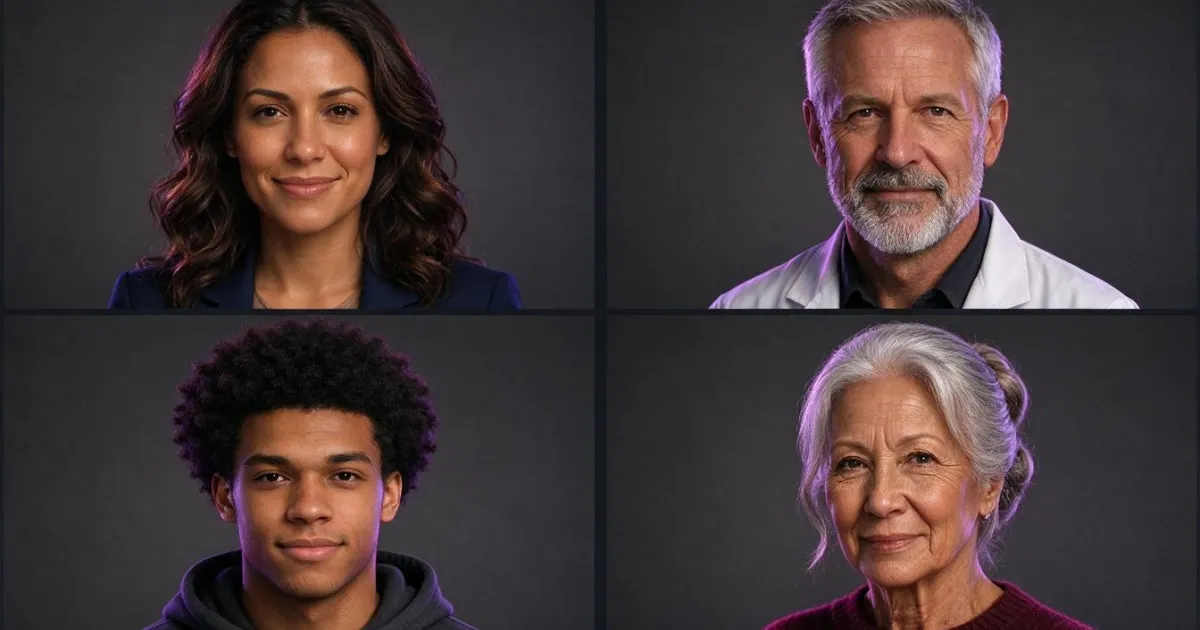
Photos of Non-Existent People: How to Create Realistic Portraits Without Image Rights

Discussing via WhatsApp or talking in person: what science says about couple conflicts through messages

Mind map, concept map, and outline: differences and when to use each one