 RoomStyle Studio
How much does it cost to furnish a living room: real prices, measurements that fail, and how to see it in your own photo
Team at RoomStyle StudioWritten with AI assistance15 min readIn summary
- Furnishing a living room from scratch with the basic basket (sofa, coffee table, two chairs, lamp, rug, and shelf) costs between €454 and €2,626 depending on the range you choose; the real median is €1,277. These are real prices from 370 products from IKEA and Sklum captured on July 13, 2026, in the RoomStyle Studio catalog.
- The sofa takes more than half of the budget: median of €679.45 across 110 models, compared to €39.95 for a lamp or €95.95 for a rug.
- What drives up the spending is not the catalog price, but buying twice: the piece that doesn't fit, the color that doesn't match the floor, and the rug that is too small.
- Before paying, check four measurements: sofa width, passageway widths, sofa-table distance, and rug size. These are the ones that cause almost all returns.
- RoomStyle Studio, the AI decoration app from AIsToHire, redesigns the photo of your living room in 8 styles without touching walls or windows and, with the Purchase Mode, integrates real IKEA and Sklum products into the image with their price, their link, and the total budget summed up.
No one searches for "how much does it cost to furnish a living room" out of curiosity. It is searched by those who have just moved into an empty apartment, those who have separated, those who have inherited a living room from the nineties, or those who have been looking at sofas for six months without deciding. The underlying question is always the same: how much is this really going to cost me, and how do I know I won't make a mistake? This article answers both with concrete data and uses as an example RoomStyle Studio, the interior decoration app with AI from AIsToHire, which transforms the photo of your living room into a redesign with real furniture and its budget.
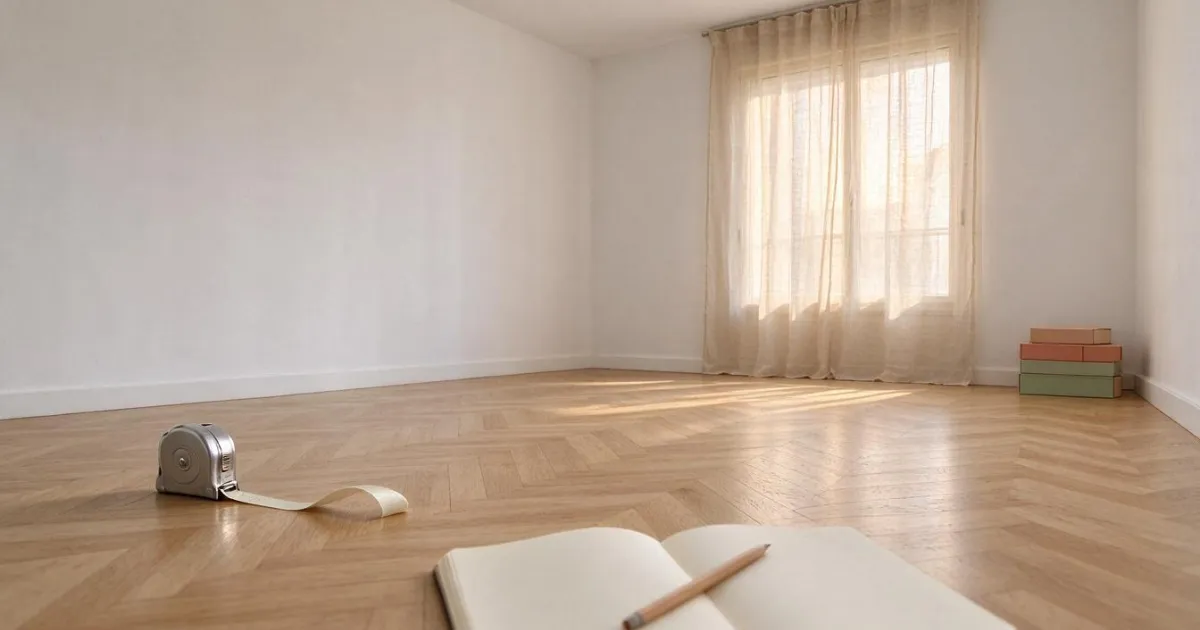
How much does it cost to furnish a living room from scratch in 2026?
Furnishing a living room from scratch costs between €454 and €2,626 if you shop at large retail stores like IKEA and Sklum, with a median of €1,277. The range does not depend so much on the number of pieces as on the range: the same listing of six pieces changes price by five if you choose the more expensive models instead of the cheaper ones.
These figures are not an estimate: they come from 370 real products (120 from IKEA and 250 from Sklum) that RoomStyle Studio has indexed with their price, captured on July 13, 2026. The basket that is budgeted is always the same: 1 sofa + 1 coffee table + 2 chairs + 1 lamp + 1 rug + 1 shelf.
| Level | How it is calculated | Total of the basket |
|---|---|---|
| Adjusted | Percentile 10 of each category (the cheapest in the catalog) | €454 |
| Content | Percentile 25 | €849 |
| Medium | Median of each category | €1,277 |
| Comfortable | Percentile 75 | €1,696 |
| High | Percentile 90 | €2,626 |
Two warnings before using these numbers. First: they are catalog prices captured on a specific date, and stores change them (discounts, increases, discontinued items). Second: the basket does not include curtains, television, paint, electricity, transport, or assembly. If your living room also needs paint and curtains, add those items separately.
What is the price of each piece of the living room separately?
The sofa is, by far, the piece that sets the budget: its median (€679.45) is seven times that of a coffee table and seventeen times that of a lamp. If you want to cut the total spending, the sofa is the only lever that truly moves the needle; downgrading lamps and rugs barely changes anything.
This is the real distribution of prices by category, based on the same 370 products (IKEA and Sklum, July 13, 2026):
| Piece | No. of models | Cheapest | Median | Most expensive |
|---|---|---|---|---|
| Sofa | 110 | €119.00 | €679.45 | €2,149.00 |
| Table (coffee or side) | 60 | €7.99 | €97.00 | €398.00 |
| Chair | 50 | €26.95 | €119.95 | €174.95 |
| Lamp | 50 | €7.95 | €39.95 | €149.95 |
| Rug | 50 | €6.95 | €95.95 | €214.95 |
| Shelf | 50 | €10.95 | €124.95 | €719.95 |
What this table teaches, and which does not appear in any average budget online: the dispersion within the same category is brutal. There are shelves for €10.95 and for €719.95, and both are "a shelf". That is why an honest budget is never a single figure: it is a range with a declared level of quality.
Why does the real budget always end up being more expensive than expected?
Because the money does not go to the catalog price, but to buying twice. The three most common deviations are the piece that doesn't fit, the piece that doesn't match what you already have, and the piece that is too small in the scene. All three can be detected before paying, and all three cost zero to detect.
- The one that doesn't fit. A three-seater sofa typically measures between 200 and 230 cm wide and between 85 and 100 cm deep. If the wall space is 240 cm, it fits; if there are also two circulation paths on the sides, it is livable. It's not the same.
- The one that doesn't match. The floor, the color of the doors, and the window carpentry are already in place. A beautiful sofa in the store's photo, on a light herringbone floor and with white lacquered doors, may look bad: the store photographs it in another context.
- The one that is too small. The classic mistake is the rug. A rug that does not reach the front legs of the sofa makes the living room look smaller and uncoordinated, even if each piece is well chosen individually.
The cost of making a mistake is not just money: it is the return transport, the wasted assembly, and the three weeks with the living room in limbo.
What measurements should be checked before buying furniture?
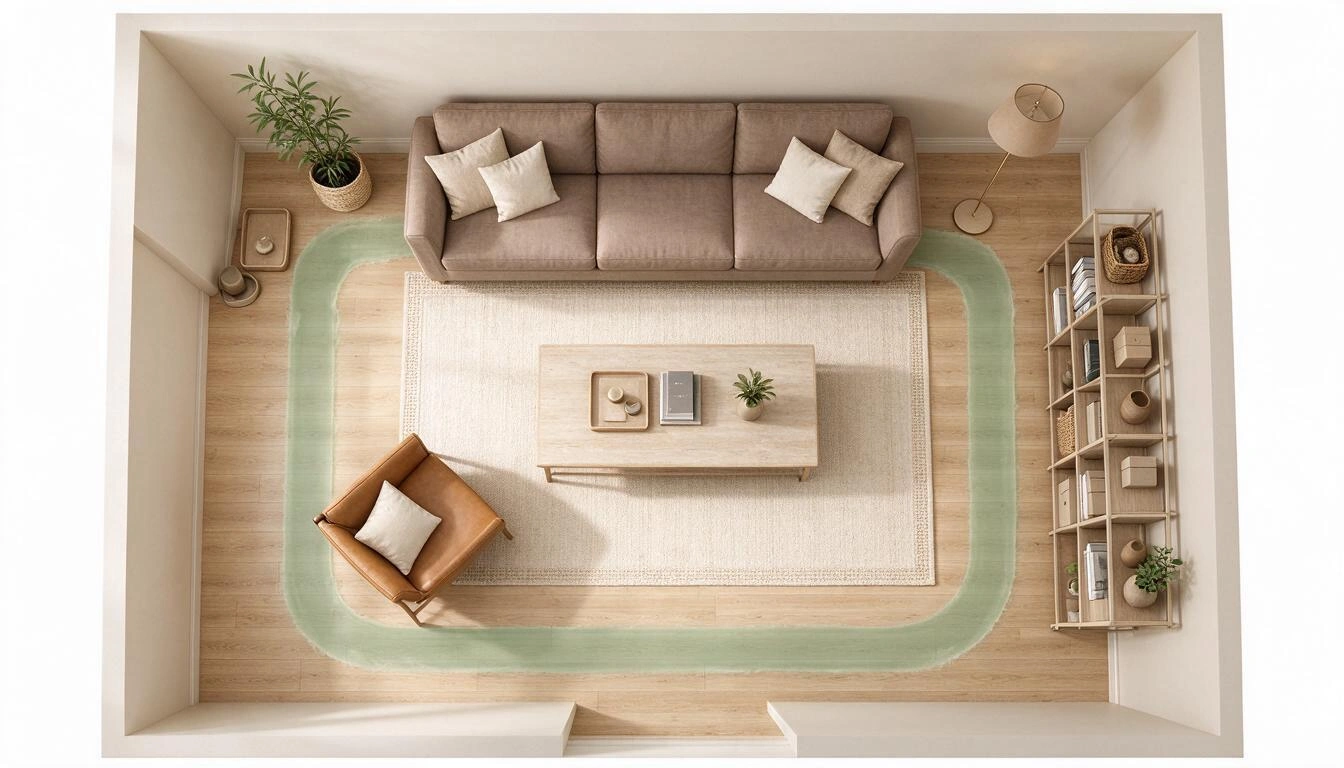
There are four measurements that explain almost all returns of living room furniture. They are not regulations: they are industry conventions used by interior designers and sellers, and you can check them yourself with a tape measure in ten minutes.
| What you measure | Common convention | Why it matters |
|---|---|---|
| Main circulation hallway | 90 cm of free passage | It allows crossing the living room with a tray or a cart without dodging |
| Secondary hallway (between furniture and wall) | 60-70 cm | Below this, you brush against the furniture when passing |
| Distance sofa - coffee table | 40-45 cm | Enough to stretch your legs and to pass in front of someone sitting |
| Rug under the sofa | That the front legs rest on it | If the rug "floats" loose, the seating area visually disassembles |
Add two logistical checks that no one looks at until it's too late: the width of the entrance door and the staircase or elevator opening (a sofa 100 cm deep won't fit through a door 72 cm wide if it can't be tilted) and the ceiling height if you are going to place a tall bookshelf or a hanging lamp.
Can you see how the living room will look before buying anything?
Yes, and it is the cheapest way to avoid a second purchase. With a photo of the empty living room (or the current living room), a realistic proposal can be generated of how it would look furnished in a specific style, keeping your walls, your windows, and your perspective. That is exactly what RoomStyle Studio does.
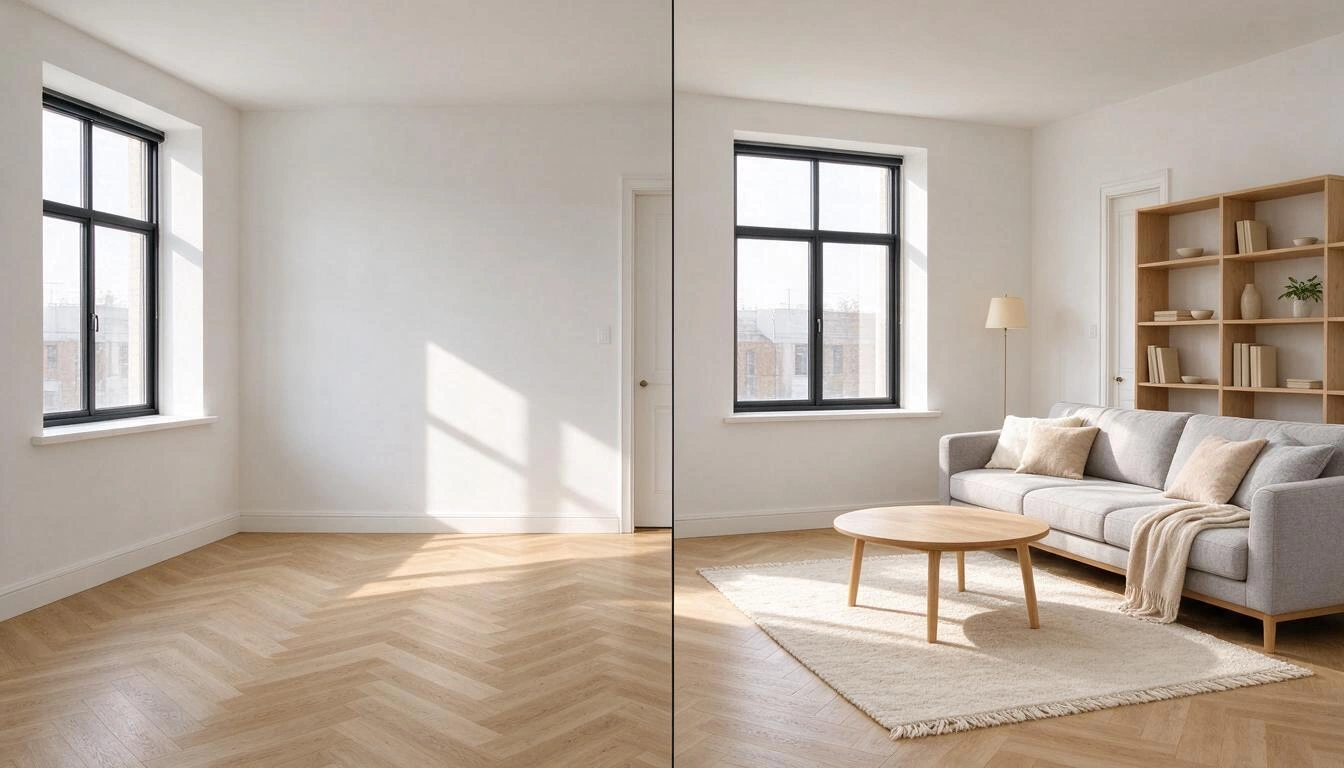
The process has three steps:
- You create the project and upload the photo. You choose the type of room (living room, bedroom, kitchen, bathroom, office, dining room, children's room, or outdoor) and take the photo with your phone or select it from the gallery. Each project saves the original photo and all the redesigns you make on it.
- You choose a style and, if you want, Purchase Mode. There are 8 styles: Nordic, industrial, Japandi, Mediterranean, boho, minimalist, classic, and rustic. You can add extra text instructions (up to 500 characters) like "warm tones" or "keep the current sofa." If you activate Purchase Mode, you also choose the stores.
- You receive the redesign. The image maintains the architecture of your photo —walls, windows, doors, ceiling, and camera angle— and changes furniture, textiles, lighting, and finishes. With Purchase Mode, you also receive the infographic with the marked products and the budget.
The difference with a Pinterest moodboard is that the starting point is your real room, not a pretty room of someone else. And the difference with a 3D render is that nothing needs to be modeled: it starts from a photo.
What is Purchase Mode and what products can it propose to you today?
Purchase Mode searches for real products in the catalog before generating the image and passes them to the AI as reference photos, so the furniture you see in the redesign is what you can buy. It then numbers each one over the scene and lists name, store, price, and link, with the total summed.
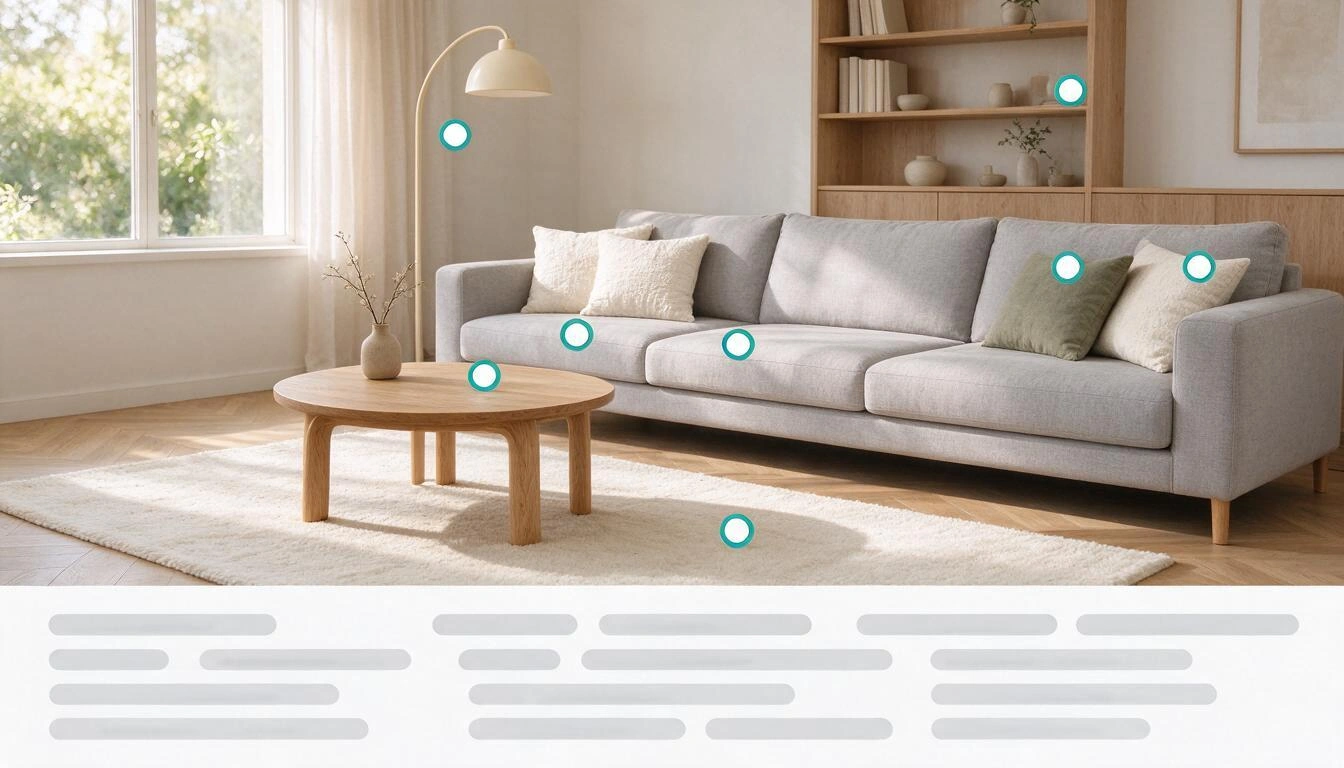
The real limit is the catalog that is indexed today. As of October 25, 2026, there are 370 products from IKEA and Sklum spread across six categories: sofas (110), tables (60), chairs (50), lamps (50), rugs (50), and bookshelves (50). Each product is classified by style with an AI vision step, and those that work for any style are marked as "neutral" (133 of the 370).
This has a practical consequence that is good to know before starting: Purchase Mode performs much better in some rooms than in others.
| Room | Categories it can propose today | Products per redesign |
|---|---|---|
| Living Room | sofa, table, lamp, rug | up to 8 |
| Dining Room | table, chair, lamp, rug | up to 8 |
| Kitchen | table, chair, bookshelf, lamp | up to 8 |
| Outdoor | sofa, table, chair, lamp | up to 8 |
| Office | chair, bookshelf, lamp | up to 6 |
| Children's Room | chair, rug, lamp | up to 6 |
| Bedroom | table, lamp, rug | up to 6 |
| Bathroom | bookshelf, lamp | up to 4 |
The table assumes you select both stores. With only one, the number of available categories decreases (IKEA provides sofas and tables; Sklum, sofas, chairs, lamps, rugs, and bookshelves).
The default engine (Nano Banana Pro) supports up to 8 integrated products; if you choose the other available engine (gpt-image-2), the maximum drops to 5. In all cases, a maximum of 2 products per category is integrated, so you don't end up with a living room with four lamps.
If there are not enough products for the style and stores you have chosen, the app will inform you and generate nothing: it will not invent a sofa that does not exist in the catalog.
What does RoomStyle Studio do and what does it not do?
It makes a photorealistic visual proposal based on your photo and a budget with real products. It does not measure your room, does not draw plans, and does not buy anything for you. This is the exact boundary, so there are no surprises:
| Does do | Does not do |
|---|---|
| Redesigns the photo in 8 styles while maintaining walls, windows, doors, and perspective | Does not measure the space or check if a piece of furniture fits: you measure that yourself |
| Integrates up to 8 real products from IKEA and Sklum into the image | It is not a scale plan, a 3D render, or an interior design project |
| Lists each product with store, price, and link to the sheet | Does not sell, does not reserve, and does not manage the order: the link takes you to the store |
| Totals the budget and allows you to download the infographic in JPG | The price is the one captured in the catalog: always check it in the store before paying |
| Saves each room as a project with all its redesigns | Does not do construction or renovations: does not change distribution, partitions, or installations |
| Allows adding the shopping list to an already generated redesign without regenerating the image | In that case, the products do not appear painted in the image: they are only marked on it |
A note on spending: each redesign consumes one image generation, whether it has Purchase Mode or not. The search for products, the budget calculation, and the placement of markers do not consume anything extra.
And what if I make a mistake anyway? What the law says about returning furniture
If you buy online, you have 14 calendar days to withdraw without giving explanations, counted from when you receive the product (articles 102 and 104 of Royal Legislative Decree 1/2007, consolidated text of the General Law for the Defense of Consumers and Users). If you buy in a physical store, that right does not exist: you only have the return policy that the store decides to offer.
Two nuances that directly affect furniture:
- The right of withdrawal does not apply to goods made to order or clearly personalized (article 103.c of the same text). A sofa with custom upholstery or a shelf cut to your space may be excluded.
- The cost of the return may be borne by the consumer if the seller informed it beforehand; for bulky furniture, that transport is not trivial.
This is general information with its source, not legal advice: the specific policy of each store and the conditions of your purchase prevail.
Checklist: from budget to purchase, in seven steps
- Measure the living room and note: width of each free wall, width of the entrance door, and height of the ceiling.
- Take the photo from a corner, with natural light and without people or clutter in front. It is the photo that conditions everything.
- Choose the style before the furniture. It is what prevents the "collector" living room where nothing matches anything.
- Generate the redesign with the real photo of your living room and see if the scene convinces you with your windows and your floor.
- Activate Purchase Mode and review the list: name, store, price, and total. There is your starting budget.
- Cross-check each price in the store and, above all, cross-check the measurements of the product with those you noted in step 1.
- Buy in phases: first the sofa and the rug (which define the living area), then lighting and storage. Splitting the purchase reduces the risk of making mistakes with everything at once.
Frequently Asked Questions
How much does it cost to furnish a 20 m2 living room?
The size in square meters influences less than it seems: what determines the price is the number of pieces and the range. With the standard basket of six pieces, a living room of that size costs about €850 in low range, €1,277 in mid range, and €1,700 or more in high range, according to the actual prices of IKEA and Sklum captured on July 13, 2026. In larger living rooms, the cost increases mainly due to the carpet (you need a larger size) and sometimes a second light source is necessary.
Can I see how my living room looks with furniture before buying it?
Yes. You upload a photo of your living room to RoomStyle Studio, choose one of the 8 styles, and the AI returns the same room furnished, with your walls and windows intact. If you activate Purchase Mode, the furniture that appears in the image are real products from IKEA and Sklum, with their price and link.
Will the AI change the walls or windows of the photo?
No. The redesign starts from your photo and maintains the architecture: walls, windows, doors, ceiling, and the angle from which you took the photo. What changes are the furniture, textiles, finishes, color, and lighting. It is a visual proposal, not a plan: the app does not measure the room.
Can the furniture shown in the image be actually purchased?
With Purchase Mode, yes: they are selected from the catalog before generating the image and are integrated into the scene based on their real photos. Each one is numbered on the redesign and listed with its store, price, and link to the product sheet. The price is what it was when the catalog was captured, so it’s advisable to check it in the store before paying.
Which stores are included?
Currently, IKEA and Sklum, with 370 products including sofas, tables, chairs, lamps, rugs, and shelves. There are no beds, wardrobes, desks, or mirrors in the current catalog, which is why in bedrooms or bathrooms, Purchase Mode suggests fewer pieces than in living or dining rooms.
Do I need to know about decoration to use it?
No. You choose the type of room and the style, and the app takes care of the rest. If you want to fine-tune, there is an extra instruction field of up to 500 characters where you can request things like "warm tones", "no plants", or "keep the gray sofa I already have".
Can I try several styles in the same room?
Yes. Each project saves the original photo and all the redesigns you generate on it, so you can compare the same living room in Nordic, Japandi, and Mediterranean styles and keep the one that works best with your floor and light. Each redesign is an independent generation.
Is it useful for showing an apartment I am selling or renting?
It serves to show the potential of a room based on its real photo, which is what is sought in a virtual home staging. Keep in mind two things: the result is a proposal generated by AI, not a photo of the actual state of the property, and it is advisable to indicate this clearly in any advertisement to avoid misleading the buyer or tenant.
RoomStyle Studio is the interior decoration app with AI from AIsToHire: upload a photo of a room, choose one of the 8 styles, and it returns the redesigned room while keeping walls, windows, and perspective; with Purchase Mode, it integrates real products from IKEA and Sklum into the image and provides the list with prices, links, and the total budget. It is available at RoomStyle Studio — AI Interior Design.
Upload a photo of your living room and see how it looks furnished before spending a euro
Upload a photo of your living room and see how it looks furnished before spending a euroKeep reading
View all articles →
2027 Decoration Trends: How to Turn Your Living Room into a 'Refuge Home' Without Renovation (and What It Really Costs)

Why Your Car Insurance Increased in 2026: Average Premium of €1,412 and Historic Record
Discussing via WhatsApp or talking in person: what science says about couple conflicts through messages