 RoomStyle Studio
2027 Decoration Trends: How to Turn Your Living Room into a 'Refuge Home' Without Renovation (and What It Really Costs)
Team at RoomStyle StudioWritten with AI assistance17 min readIn summary
- The Spanish interior designers consulted by the decoration press agree that 2027 is about refuge home: visual calm, warm materials that age well, and a rejection of living rooms that look like a render. This is well summarized by the report decoration trends for 2027 published by que.es on November 6, 2026: "the great luxury of 2027 is tactile imperfection".
- The good news for those living in rental properties: these five keys require criteria more than money and can be applied without renovation: textiles, rugs, layered lighting, a divider that isn’t a wall, and exposed wood.
- Intelligent compartmentalization returns in contrast to open space. Interior designer Sigfrido Serra stated in this trends review (February 18, 2026): "the large open space is starting to wear out".
- In color, the reference is the forecast Pantone View Home + Interiors 2027 with seven palettes —including Hush, Grounded, and Honest— presented in March 2026. The Color of the Year 2027 will be revealed in Miami on December 3, 2026.
- With €300 you can change the temperature of a living room (light + textiles). With €800 you can add a large rug and a divider. With €1,500 you can get into upholstery and wood. The three budgets are broken down below with prices from IKEA and Sklum consulted on November 12, 2026.
If you’ve read any headlines about decoration trends for 2027 recently and thought, "very nice, but I live in a rental and can’t knock down a wall," this article is exactly for you. The good part is that the five keys that Spanish interior designers are giving for next year are, almost all, reversible: they can be assembled and disassembled, taken from apartment to apartment, and fit into a three-digit budget. The uncomfortable part is that they require making decisions, and making them well, because the mistake of €1,200 on the wrong sofa can’t be fixed by any cushion. For that, there are tools like RoomStyle Studio, the AI decoration studio from AIsToHire that redesigns the photo of your living room before you spend a euro; but first, let’s get to what will really define 2027.
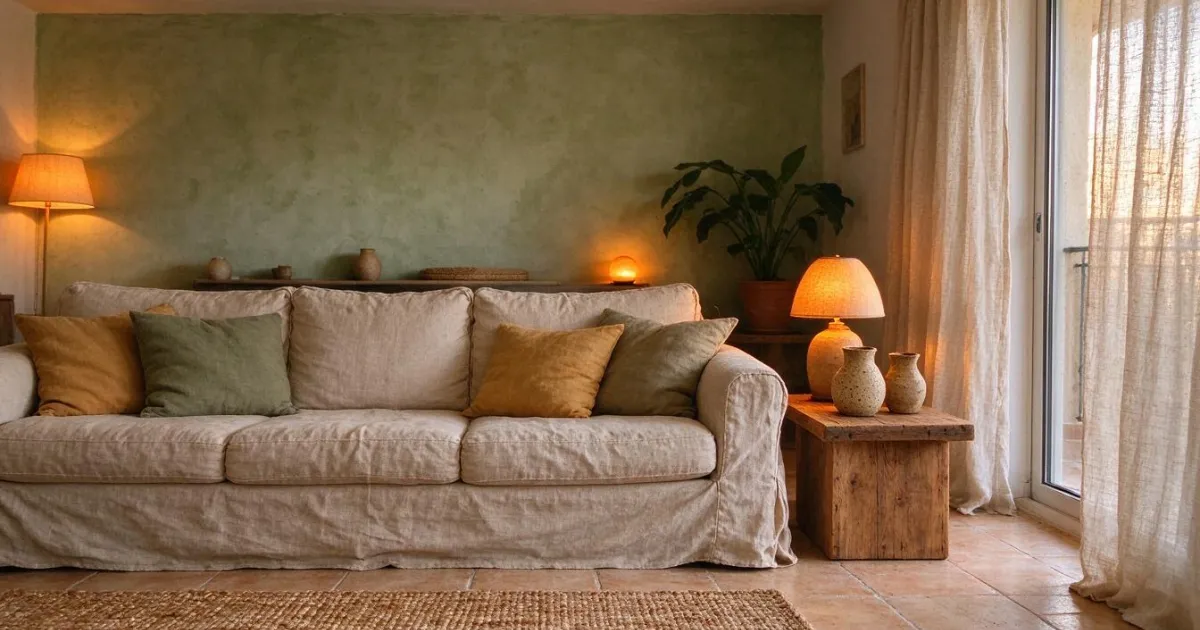
What are the decoration trends for 2027?
The decoration trends for 2027 revolve around one idea: the home as a refuge against overstimulation. According to the report from que.es on November 6, 2026, which includes contributions from Spanish studios like Ignacio Frade, María Santos, Marcos Catalán, and Marta García Orte, BETA Ø, Peris+Toral, and Beatriz Ramo (STAR strategies + architecture), what’s coming is not a new style but a change of criteria: less perfection, more tactility, materials that age well, and spaces with clear functions.
Translated into five operational keys:
- Refuge home and visual disconnection. Less stimulation, less clutter in sight, more visual silence.
- Goodbye to render-like interiors. Gains what the report calls "tactile imperfection": textured surfaces versus ultra-smooth and shiny ones.
- Warm materials that age well. Wood, stone, linen, lime, handcrafted ceramics, and natural fibers, ahead of plastics and technological finishes.
- Objects with history and patina. Homes that are built "little by little, with experiences, travels, and pieces that are incorporated over the years," versus the set bought all at once.
- Spatial flexibility. Compartmentalizing without walls: screens, curtains, open shelves, folding tables.
It’s important not to confuse this list with another that has circulated these days. The article on the five trends that will shape homes in 2027 (que.es, November 2, 2026) includes four interior designers consulted by the American magazine Real Simple —Ellie Christopher, Jeanne Hayes, Sandy Baisley, and Natasia Smith— and points to the same thing from another angle: vintage chairs with character instead of the "interchangeable accent chair," a mix of materials because "identical furniture sets have already completed their cycle," reupholsterable fabrics after ten years, patterns that disguise daily use, and multi-use furniture (the desk that also serves as an entry table). Two sources, one message: durability and character over catalog coherence.
Can the 2027 trends be applied in a rental apartment?
Yes, and that's exactly what makes them interesting this year. Four out of the five keys can be resolved with elements that do not touch the structure: textiles, rugs, lamps, free dividers, and furniture. The only one that usually requires the owner's permission is painting, and even then, many contracts allow it if the original color is returned.
This is not a minor detail in Spain: according to data from Eurostat collected by the Rental Observatory, 26.3% of the Spanish population lives in a rental home, compared to an EU average of 31.6%, with a steady increase from 19.4% in 2007. There are millions of living rooms where any trend that requires construction is immediately ruled out.
The table, key by key:
| Key 2027 | Does it require construction? | How to resolve it without touching anything |
|---|---|---|
| Refuge house / visual calm | No | Reduce visible objects, close storage, unify palette |
| Tactile imperfection | No | Washed linen, jute, artisanal ceramics, untreated wood |
| Warm materials | No (except for painting) | Textiles, rug, exposed wood furniture; lime only if they allow you to paint |
| Objects with patina | No | Second hand, inheritances, flea markets; group instead of scatter |
| Spatial flexibility | No | Screen, pass-through shelf, curtain on a rail, folding table |
What is the first change with the most effect? Light
If you're only going to do one thing, change the light. Switching from a single central ceiling fixture to three warm light points at different heights is the change that most transforms the perception of an average Spanish living room, and it is also the cheapest and most reversible: no drill, no permission. The very report from que.es places "layered warm lighting" as the first applicable measure without construction.
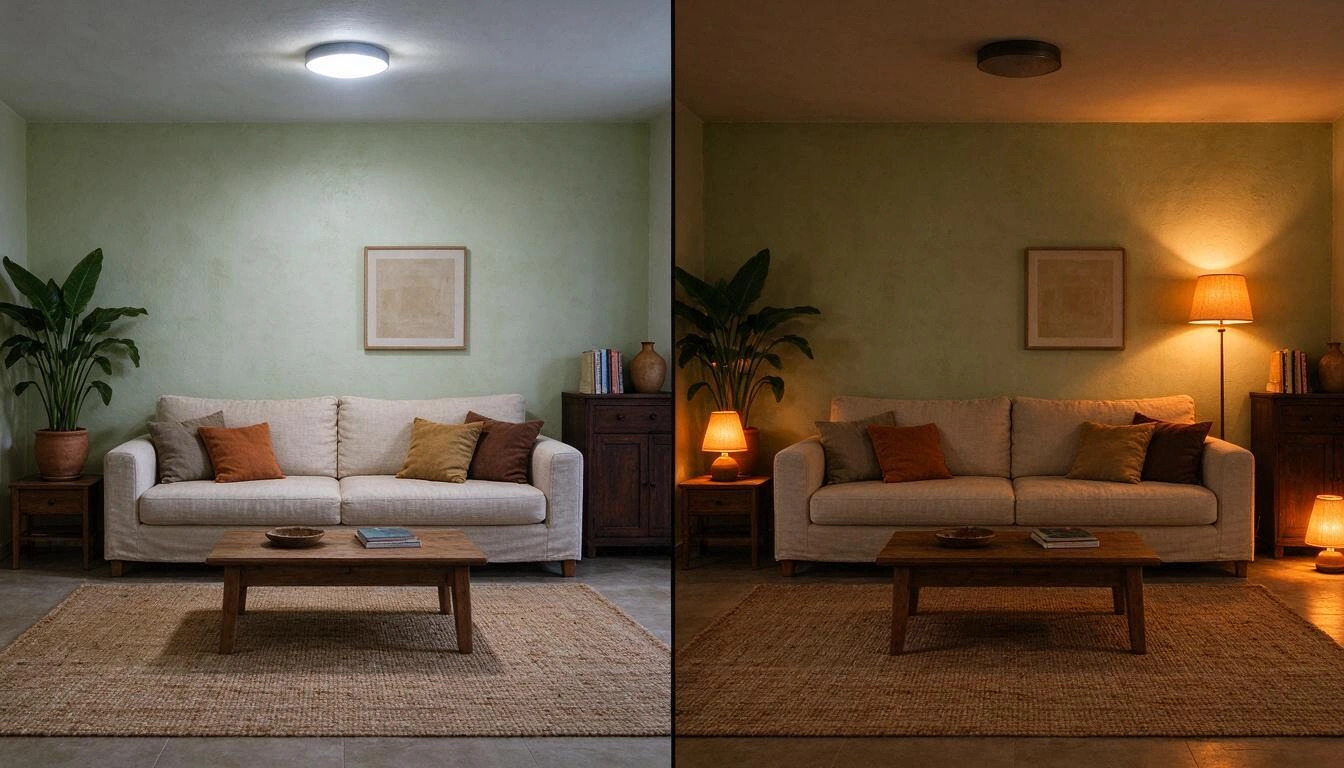
The scheme that works:
- High point: floor lamp behind or next to the sofa. The HEKTAR floor lamp is priced at €69.99 in the IKEA Spain catalog (bulb not included).
- Medium point: table lamp on an auxiliary piece of furniture or shelf, between €15 and €40 depending on the model.
- Low point: a small lamp at floor level or on a stack of books; this is the one that gives the feeling of refuge.
- Temperature: below 2,700 K. A pack of two warm LED E27 SOLHETTA bulbs from IKEA costs €2.99, so correcting the temperature of the whole house costs less than a dinner.
- Practical rule: turn off the central fixture after nine at night and you will see the effect before buying anything.
Total cost to redo the lighting in a living room: between €90 and €180.
What materials are trending in 2027 and how much do they cost?
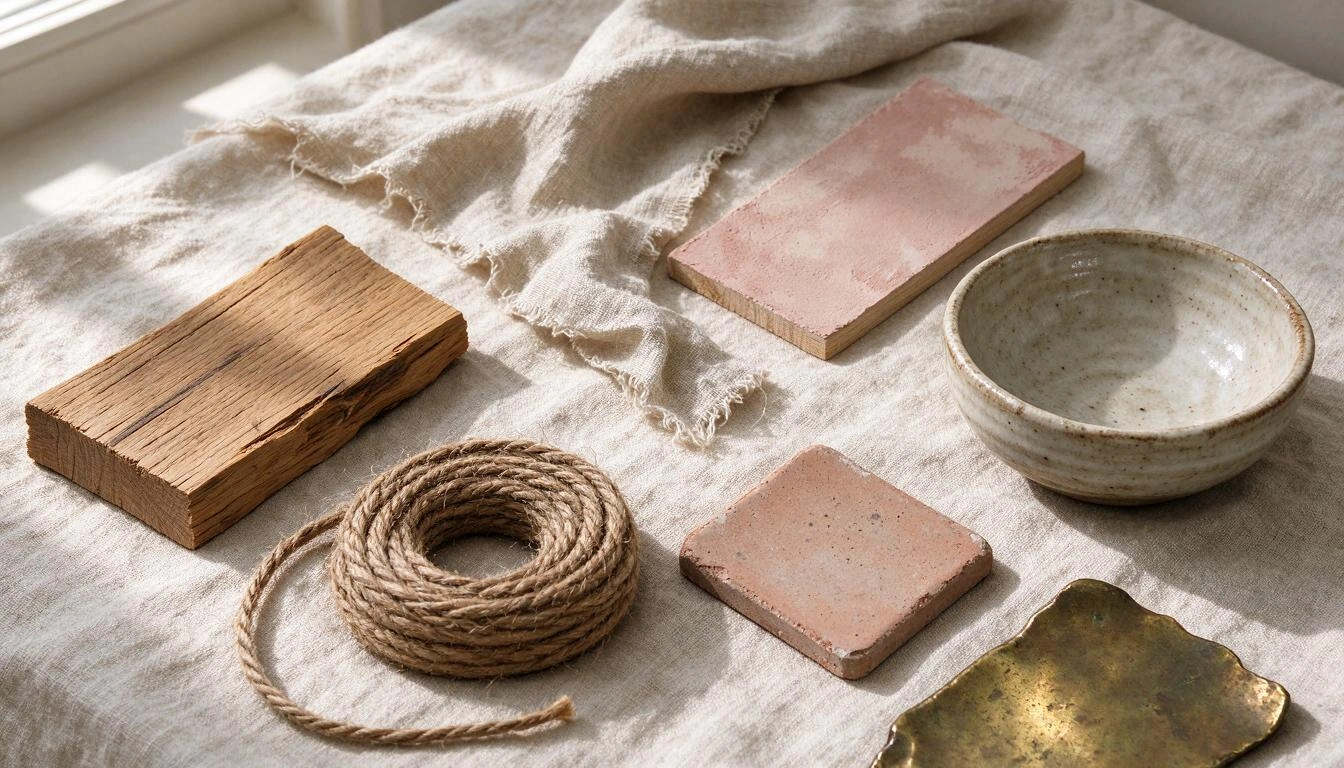
Wood, linen, lime, artisanal ceramics, and natural fibers: materials that gain with use instead of losing. The practical translation in a rental living room is simple —natural fiber rug, washed linen or cotton textiles, and pieces of untreated ceramics or wood—, and the expense is well within what a Spanish home already allocates to decoration.
To size the budget: the Cetelem Observatory, in its Consumption Study Spain 2025, estimates the average declared spending by those who bought furniture or decoration in the last twelve months at €741, 14% more than in 2024, with the decoration category growing by 37%. And the retail furniture sector generated €4.16 billion in 2025, an increase of 3.1%, according to the Sectoral Observatory DBK of INFORMA reported by Bezzia. In other words: the average living room already spends that amount; the question is spending it on what lasts.
Reference prices (catalog consulted on November 12, 2026):
| Item | Store and model | Price |
|---|---|---|
| Jute rug 185x230 cm | Plamena, jute and fabric (Sklum) | €72.95 |
| Jute rug 160x230 cm | Kalina, polyester and jute (Sklum) | €94.95 |
| Natural fiber rugs | Natural fibers catalog (IKEA) | from €34.99 |
| Semi-opaque curtains 145x300 cm | MERETE, 1 pair (IKEA) | €34 (was €65) |
| Bamboo screen | Alfred Screen (Sklum) | €84.95 |
| Shelf 77x147 cm | KALLAX white (IKEA) | €54.99 |
| Floor lamp | HEKTAR dark gray (IKEA) | €69.99 |
| Warm LED E27 bulbs | SOLHETTA, pack of 2 (IKEA) | €2.99 |
Prices at IKEA and Sklum change with promotions; take them as a magnitude order, not as a fixed budget.
How to compartmentalize a living room without raising a partition?
With three resources: an open bookshelf placed perpendicular, a screen, and a curtain hung from a ceiling rail. All three divide functions without blocking the light and can be dismantled the day you leave the apartment. It is the 2027 answer to the open space that dominated the previous decade.
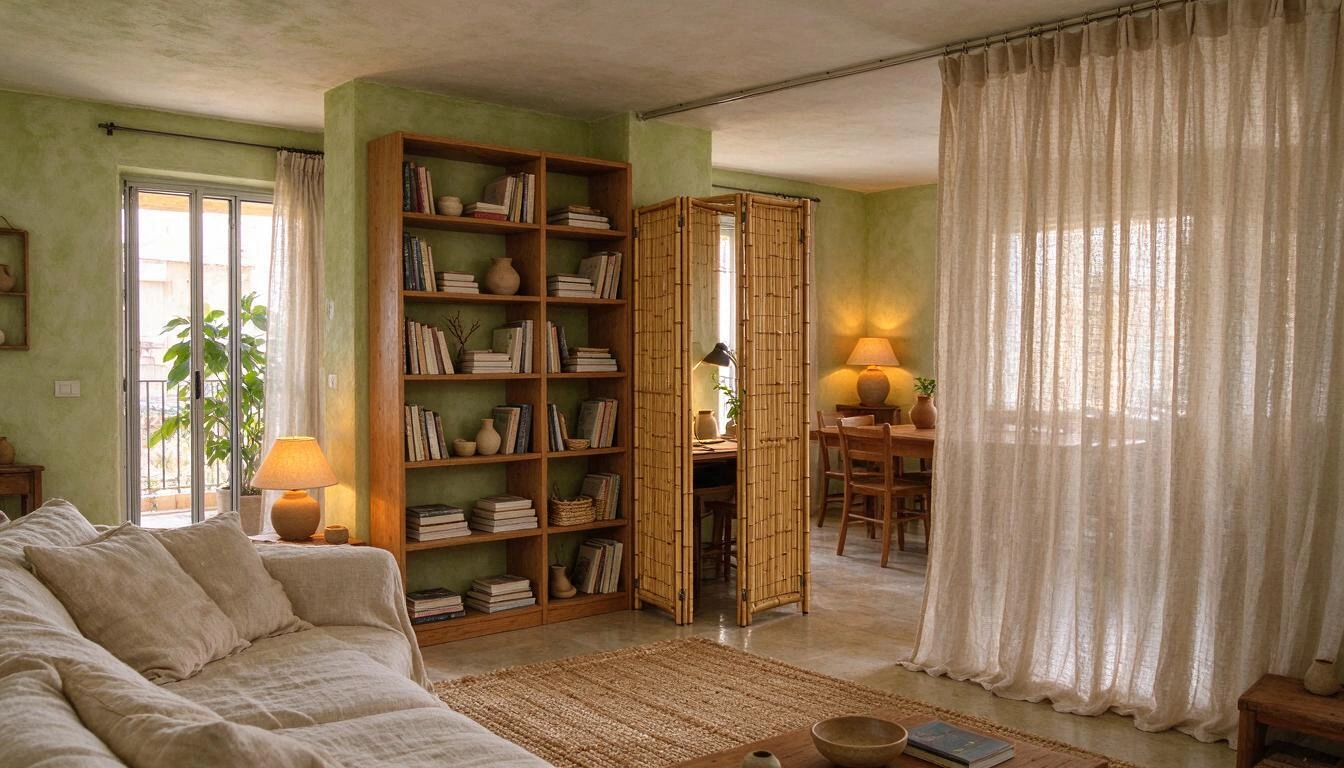
The diagnosis is signed by the interior designers themselves. In the review published by Trendencias Decoración on February 18, 2026, the Valencian Sigfrido Serra argues that "the large open space is starting to wear out" and that "intelligent compartmentalization" is returning because "homes demand intimacy, control, and spaces with clear functions"; he proposes sliding panels, latticework, curtains, and level changes. In that same article, Laura Carrillo, Manuel Espejo, Alejandro Cateto, and Virginia Albuja agree on rejecting neutral minimalism.
How to choose the divider according to your living room:
- Elongated living room with dining area at the back: low and passing bookshelf perpendicular to the long wall (from €54.99). It separates without darkening.
- Telecommuting corner within the living room: folding screen (€84.95 in bamboo). It closes at the end of the day, which is half the trick.
- Living room where the door opens directly to the sofa: linen curtain on ceiling rail (from €34 per pair plus the rail). The refuge effect is immediate.
- Just enough meters: folding table or multifunctional furniture instead of a fixed divider. Each element serves two functions.
What colors are expected for 2027 and when is the Color of the Year known?
The reference forecast has already been published: Pantone View Home + Interiors 2027 proposes seven palettes —Delight, Allure, Lucid, Hush, Honest, Grounded, and Elation— under the concept "Sense-Abilities", and the three that fit with the refuge home are Hush (calm medium tones oriented towards well-being), Grounded (organic shades and earth tones), and Honest (browns, reds, and kitchen oranges). The Color of the Year 2027, on the other hand, is still unknown.
The forecast was presented by Leatrice Eiseman, executive director of the Pantone Color Institute, at The Inspired Home Show 2026, according to the report from Interempresas on March 12, 2026, with the idea of offering tranquility and joy "in a noisy world".
| Milestone | Date | Status as of 12/11/2026 |
|---|---|---|
| Pantone View Home + Interiors 2027 (7 palettes) | Presented in March 2026 | Published |
| Color of the Year 2026: Cloud Dancer | Announced on December 4, 2025 | Current |
| Color of the Year 2027 | Event at the Rubell Museum in Miami, December 3, 2026 | Pending announcement |
The dates of the Miami event and the announcement of Cloud Dancer appear in the prediction follow-up from Homes & Gardens and in the agenda of the Pantone Color of the Year 2027 experience.
The practical recommendation, and it is the most important of the entire article: when the color is announced, incorporate it into replaceable elements —cushions, a blanket, a throw, a piece of ceramics, a lamp shade, a reupholstered chair— and not into a renovation. A Color of the Year lasts twelve months in conversation; a sofa lasts ten years. And if you live in a rental, painting an entire wall in the trendy shade is the quickest way to pay twice: once for buying the paint and again for returning it to its original color.
Three real budgets: €300, €800, and €1,500
With €300 you can change the atmosphere of a living room (light and textiles); with €800 you can add a large rug and compartmentalization; with €1,500 you enter upholstery and wooden furniture. None of the three require construction work or landlord approval, beyond painting if you decide to include it.
| Item | €300 | €800 | €1,500 |
|---|---|---|---|
| Warm bulbs (throughout the house) | €12 | €12 | €12 |
| Floor lamp | €70 | €70 | €70 |
| Table lamp + low lamp | €55 | €95 | €120 |
| Cushions and blanket in earth tones | €90 | €120 | €150 |
| Curtains | €35 | €70 | €110 |
| Natural fiber rug | €35 (small) | €95 (160x230) | €147 (200x300) |
| Divider (screen or bookshelf) | — | €85 | €140 |
| Handmade ceramics / patina objects | — | €60 | €120 |
| Auxiliary wooden furniture | — | €90 | €200 |
| Reupholster or custom sofa cover | — | — | €350 |
| Matte paint in earth tone (one wall) | — | — | €60 |
| Approximate total | €297 | €797 | €1,479 |
What you achieve with each:
- €300: the living room stops looking like an office at night. It is 80% of the "refuge home" effect for 20% of the budget.
- €800: zoning appears. The dining area stops being "the back of the living room" and the work corner can be closed off.
- €1,500: you enter materials. A reupholstered sofa or one with a linen cover and an exposed wooden piece change the feel of the room, which is exactly what the trends for 2027 demand.
Beware of a trap: adding all eleven items at once in the same week produces the "catalog living room" that these trends precisely reject. The report from que.es insists that homes with soul are built "little by little". Buying in two or three batches, leaving room for second-hand finds, is not only cheaper: it is more coherent with the result you are looking for.
How to avoid the "catalog" living room
The catalog living room is recognized by three symptoms: everything bought in the same month, everything from the same collection, and no object with history. The solution is not to spend more, but to mix eras, materials, and origins, leaving at least one piece with visible patina.
- Break the sets. The interior designers quoted in que.es say it bluntly: "identical furniture sets have already completed their cycle." Different chairs around the same table, cohesive by color or material.
- At least one inherited or second-hand piece. An armchair, a trunk, a lamp from the seventies. It's what distinguishes your living room from the one in the photo.
- Choose classic shapes for the expensive items. If the sofa has a timeless shape, it can be reupholstered in ten years instead of going to the dumpster.
- Group, don’t scatter. Three objects together on a tray read as intention; twelve spread out read as disorder, and disorder is the opposite of a refuge home.
- Textiles with patterns where there is use. Prints and patterned rugs disguise daily life much better than plain beige.
How to see your living room already decorated before buying anything
This is where an AI tool really saves money: by not buying the wrong thing. With RoomStyle Studio, the AI interior design studio from AIsToHire, you take a photo of the living room as it is, choose a style —Nordic, Japandi, Mediterranean, rustic, industrial, boho, minimalist, or classic— and the AI redesigns the space maintaining the architecture: the walls, windows, and perspective remain yours, so what you see is your living room, not a magazine photo.
Two things fit especially well with all of the above:
- The before/after slider, which is the honest way to judge if the change is worth the expense.
- The Purchase Mode, which integrates real products from the IKEA and Sklum catalog into the image itself, with numbered markers, real prices, and an estimated total budget exportable as a shopping list. That is: the table of 300/800/1,500 € that you just read, but with your living room and your measurements.
Trying a Japandi, a Mediterranean, and a Nordic style on the same photo takes a few minutes. Making a mistake with a sofa costs ten years.
Frequently Asked Questions
What are the decoration trends for 2027?
Refuge home and visual calm, rejection of render-type interiors in favor of "tactile imperfection," warm materials that age well (wood, linen, lime, artisanal ceramics), objects with history and patina, and spatial flexibility versus open space. This is how the report from que.es on November 6, 2026 summarizes it with contributions from Spanish studios.
How much does it cost to redecorate a living room without construction?
Between 300 € and 1,500 € depending on the scope. With 300 €, lighting and textiles are redone; with 800 €, a large rug and a divider are added; with 1,500 €, upholstery and wooden furniture come into play. As a market reference, the average declared spending on furniture and decoration in Spain was 741 € in the last twelve months, 14% more than the previous year, according to the Cetelem Consumption Study 2025.
What is a "refuge home" in decoration?
It is the home understood as a space for disconnection and visual calm against overstimulation: fewer objects in view, warm layered light, natural materials with texture, and areas with clear functions. It is not a specific style, but a criterion that can be applied to a Nordic, Japandi, or Mediterranean living room.
When is the Pantone Color of the Year 2027 announced?
The event is scheduled for December 3, 2026 at the Rubell Museum in Miami. The Color of the Year 2026 was Cloud Dancer, announced on December 4, 2025. The forecast for home, Pantone View Home + Interiors 2027, was presented in March 2026 with seven palettes, including Hush, Grounded, and Honest.
Can I decorate according to the 2027 trends if I live in a rental?
Yes. Four of the five keys (visual calm, texture, warm materials, and flexible partitioning) can be resolved with lamps, textiles, rugs, screens, and free-standing furniture, without touching the structure. The only one that usually requires permission is painting; if you don’t have it, bring the color into cushions, throws, and ceramics.
Is it worth painting the wall the Color of the Year?
Usually not, especially in rentals. A trendy color lasts a few months in conversation, and a painted wall has to be returned to the original color when moving out. The recommendation from the interior designers themselves is to bring the color into replaceable elements: cushions, throws, lamp shades, a reupholstered chair.
How do I divide the living room from the dining room without construction?
With an open shelf perpendicular to the wall (from 54.99 € at IKEA), a folding screen (from 84.95 € at Sklum), or a linen curtain hung from a ceiling rail. All three separate functions without blocking light and can be disassembled when you move out.
How do I know if a style will look good in my living room before buying?
By taking a photo and trying it in a redesign tool with AI. In RoomStyle Studio, you upload the photo of the space, choose the style, and the AI redesigns it while preserving walls, windows, and perspective, with a before/after slider and a Purchase Mode that places real products from IKEA and Sklum in the image with prices and total budget.
The closing: criteria over budget
If there is one thing that unites the interior designers who have talked about 2027, it is that none of them ask for money: they ask for criteria. Warm light in three spots costs less than €180, the screen that restores privacy costs less than €90, and the piece with patina that saves the living room from looking like a catalog can be free if it was in your grandmother's house. What is expensive is not the trend; what is expensive is choosing the wrong sofa.
That’s why it makes sense to see the result before paying for it. RoomStyle Studio, from AIsToHire, turns a photo of your living room into a realistic redesign in the styles that will dominate in 2027 —Nordic, Japandi, Mediterranean, or Rustic—, with the before and after side by side and, if you activate it, with the actual products from IKEA and Sklum already placed and budgeted. You can start here: redesign your living room with AI without construction.
Take a photo of your living room and see how it would look in Japandi, Nordic, Mediterranean, or Rustic styles before spending a dime: RoomStyle Studio redesigns it while keeping your walls and windows, featuring a before/after slider and a Shopping Mode that places real products from IKEA and Sklum with prices and total budget.
Take a photo of your living room and see how it would look in Japandi, Nordic, Mediterranean, or Rustic styles before spending a dime: RoomStyle Studio redesigns it while keeping your walls and windows, featuring a before/after slider and a Shopping Mode that places real products from IKEA and Sklum with prices and total budget.Keep reading
View all articles →
How much does it cost to furnish a living room: real prices, measurements that fail, and how to see it in your own photo

Why Your Car Insurance Increased in 2026: Average Premium of €1,412 and Historic Record

Discussing via WhatsApp or talking in person: what science says about couple conflicts through messages