 KDP Story Books
Amazon KDP Limits to 2 New Titles Per Week: What Changes If You Publish Children's Stories
Team at KDP Story BooksWritten with AI assistance14 min readIn summary
- Since September 21, 2026, Amazon KDP only allows creating 2 new titles per format and week. The previous limit was 10, so this is an 80% cut (Publishers Lunch, Sept. 2026).
- Since October 5, 2026, there is a second limit: 2 submissions for publication per format and week, and the first time you submit a title counts even if you had it saved as a draft weeks ago (eBookPbook, Oct 9, 2026).
- The two counters are maintained by format: ebook, paperback, and hardcover do not compete against each other. And they reset on Sundays at 00:00 UTC, without accumulating unused slots.
- Titles already published are untouched: changing price, cover, interior, description, or keywords of a live book does not consume any slot.
- The illustrated children's niche is the most exposed, because titles with AI-generated content declaration and a lot of images undergo longer reviews: from 3 to 7 business days compared to the 24-72 hours of a text-only book (Univers Studio).

If you publish illustrated children's stories on Amazon KDP, the fall of 2026 has changed your way of working more than any algorithm in recent years. Not because you sell less, but because you can no longer test things in volume: each week you have two slots per format and that's it. This article precisely explains how those slots are counted, what mistakes burn them without you realizing it, and how to decide which two books deserve to go through. At AIsToHire, we bring that change to the practical field from the tool with which we work in this niche, KDP Story Books, designed precisely for a story to be ready at the moment of uploading it.
What exactly does the KDP title limit say and since when
Amazon KDP applies two independent weekly limits. The first, effective since September 21, 2026, limits to 2 the creation of new titles per format and week; replacing the previous limit of 10. The second, effective since October 5, 2026, limits to 2 submissions for publication per format and week, counting the first submission of each title. Both reset on Sundays at 00:00 UTC and are not accumulative.
Amazon's official justification is brief: it updates the limits "to help maintain a positive publishing experience for all authors," according to the wording collected by Publishers Lunch from the announcement in the KDP community. In practice, the platform's stated goal is to curb spam, stolen material, author impersonation, and mass-produced books.
| What | Limit | Since | How it is counted |
|---|---|---|---|
| Create new title | 2 per format and week | Sep 21, 2026 | When opening the record; saving a draft already consumes a slot |
| Submit for publication | 2 per format and week | Oct 5, 2026 | The first time you submit that title, even if it was created another week |
| Reset | — | — | Sunday 00:00 UTC, without accumulating |
| Edit title already submitted or published | No limit | — | Cover, interior, price, description, and keywords do not count |
Sources: official KDP announcement; eBookPbook (Oct 9, 2026); Vappingo.
Are there 2 books in total or 2 for each format?
There are 2 for each format, not 2 in total. Kindle (ebook), paperback, and hardcover have separate counters, so in one week you can open up to six new records: two of each. What you cannot do is open three paperback records, even if you have the ebook counters intact.

For an illustrated children's story, this has a very specific consequence. If your standard is to release each book in the three versions —ebook for Kindle, paperback, and hardcover as a gift—, one single title consumes one slot from each of the three counters. That is: with the current limit, you can launch a maximum of two complete stories per week if you want them in all three formats. Not six.
There is a nuance that is important to clarify for planning: creation and submission are different counters, and that gives you leeway. As summarized in the rules guide of Bookbird, "creating 2 titles and submitting another 2 in the same week is allowed": you can dedicate one week to opening records and the following weeks to submitting what you already had prepared. The limit organizes the calendar, it does not force you to work in isolated blocks.
A word of caution: the note from Vappingo regarding the limit states that Amazon has not published a phrase that defines the exact technical trigger of the counter nor if deleting a draft returns the slot. Until they clarify, assume that opening a record consumes capacity and that deleting it does not return it to you.
Why the most expensive mistake now is to spend a slot on a half-finished draft
Because the slot is consumed at the beginning of the process, not at the end. Opening the listing and saving it as a draft already uses a creation slot, and the first time you submit it, it also uses a submission slot —even if the draft had been sitting for weeks—. If that submission is rejected due to a poorly bleed PDF or a miscalculated spine, you've burned your turn of the week on a book that wasn't ready.
Before, with ten slots per format, making a mistake was cheap: you created the listing to see what Amazon required, uploaded a provisional interior, iterated. With two, each failed submission costs you half the week. And if you add the rejection to the time for enhanced review of illustrated and AI-declared titles, the queue gets longer: according to the review of the KDP AI content policy in 2026, a text-only book is reviewed in 24-72 hours, one marked as AI-generated takes 3 to 5 business days, and one with a lot of images and AI declaration takes 3 to 7 business days.
The type of defect that triggers those reviews is precisely that of the children's story made in a hurry. KDP's content guidelines allow a book to be removed for "poor customer experience," and the examples that circulate in the niche practice are recognizable: illegible text within the illustration, hands with six fingers, and a protagonist who changes face between page 3 and 12.
Checklist: how to know if a story is really "ready for KDP"
A story is ready when you can answer yes to nine checks, four of which are technical and verifiable with the figures published by KDP. If even one fails, don't spend the slot: wait until the following week.
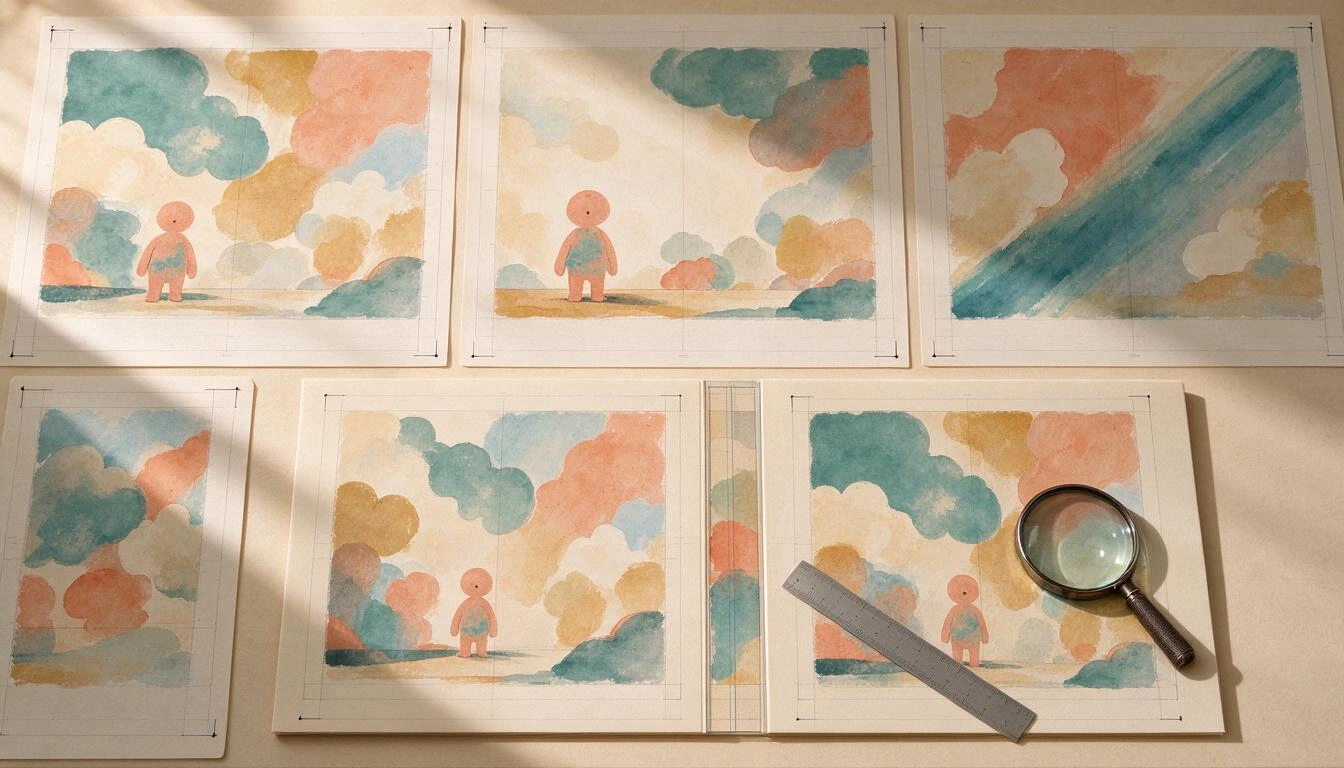
- Consistent characters on all pages. The protagonist is recognizable from the first to the last illustration: same face, same hair, same clothes, same proportions. This is the most cited failure in the withdrawals of illustrated children's books.
- Text adjusted to age range. Vocabulary and sentence length appropriate for the range (3-5, 6-8, 9-12), and number of words per page compatible with the space left by the illustration.
- Interior PDF with bleed. KDP requires 0.125 inches (3.2 mm) of bleed on all sides when the illustration reaches the edge, according to their size, bleed, and margin specifications. In a full-page story, that's always.
- Correct margins for the number of pages. The interior margin (spine) of KDP increases with thickness: 0.375" for 24-150 pages, 0.5" for 151-300, 0.625" for 301-500. The minimum exterior is 0.25" without bleed and 0.375" with bleed.
- Complete cover with calculated spine. A single PDF with back cover, spine, and cover. The width of the spine comes from KDP's formula: pages × 0.002252" in white paper, × 0.0025" in cream paper, and × 0.002347" in premium color (softcover cover specifications). Note: KDP only prints text on the spine starting from 79 pages, a threshold that many 24 or 32-page children's albums do not reach.
- Decided and constant page size. The chosen trim size (8.5 × 8.5" and 8.5 × 11" are common in illustrated albums) must be the same in the interior and in the cover template.
- EPUB reviewed on screen. The Kindle version does not inherit the paper layout: check the page order and that the illustrations are not cut off.
- Metadata and keywords written before opening the listing. Title, subtitle, description, categories, and the seven keywords, drafted and copyable. This is what most lengthens the process when improvising within the form.
- AI declaration filled out and correct. KDP distinguishes between content generated by AI —text, images, or translations created by the tool, and this must be declared— and content assisted by AI, which is not declared: brainstorming, proofreading, keywords, or the book description. The declaration is internal and, according to the same guide, does not affect ranking or royalties.
This is exactly where a tool like KDP Story Books fits: it works by projects, one project per book, with character sheets and a canonical image used as a reference when illustrating each scene —hence the consistency of point 1—, paginated stories with their moral adjusted to the age range, and an export that leaves the interior PDF with bleed and margins, the complete cover with the spine calculated according to pages and paper type, and the EPUB before you touch the Amazon form. You do the upload; what changes is that you arrive with the files ready.
How to organize a quarterly publishing calendar with the new ceiling
With two submissions per format and week, a quarter gives about 26 submissions per format (13 weeks × 2). If you publish each story in the three formats, that's a maximum theoretical of 13 complete books; in practice, plan for 8 or 9 and leave buffer weeks for rejections and long revisions.
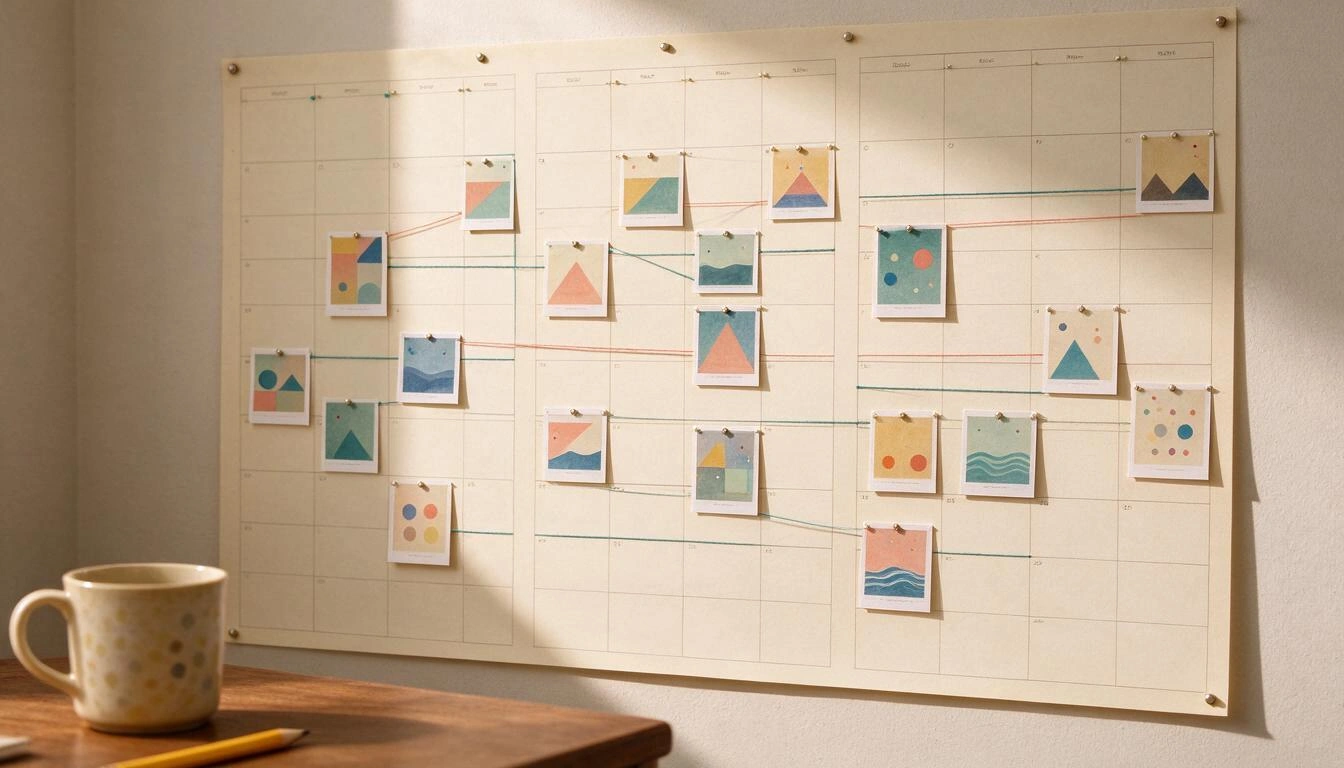
A simple way to spread it out:
| Week of the quarter | What you do | Slots you spend |
|---|---|---|
| 1-2 | You close and send the two stories you already had ready from the previous quarter | 2 submissions/format per week |
| 3-10 | Steady pace: one new story per week in all three formats | 1 creation and 1 submission of each format |
| 11 | Buffer week: no new submissions, only corrections of the rejected | 0 |
| 12-13 | Double submission to close the quarter and leave two stories ready for the next | 2 submissions/format |
Two rules that make this calendar hold up:
- Separate production from publication. Produce comfortably for three or four weeks and publish at a steady pace. Since creation and submission are different counters, you can have three or four finished books waiting in line without getting blocked.
- Reserve the last week of the quarter for campaign, not for launches. If a rejection falls in that week, you have no margin to try again before the date you promised.
- Count the calendar in UTC. The reset is Sunday at 00:00 UTC, which in Spain corresponds to Saturday night (01:00 in summer time, 00:00 in winter) and in America to Saturday afternoon. If you plan for "Sunday morning," you're actually hours into the new counter.
What not to do: three shortcuts that now cost dearly
There are three intuitive reactions to the limit that worsen the situation: creating empty titles "to reserve a slot," duplicating formats to scrape counters, and opening parallel accounts. The first two waste real capacity without returning anything; the third is what could cost you the account.
- Creating titles "to reserve a slot." There is no such reservation: opening the entry consumes the creation slot at the moment, and no one has confirmed that deleting the draft returns it. Reserving is, literally, spending.
- Duplicating formats to bypass the limit. Putting out a hardcover that you weren't planning to just because "the hardcover counter is free" doesn't give you more softcover slots. What it gives you is one more format to maintain, review, and declare.
- Opening additional accounts. The limits apply per account and the reduction was announced to precisely curb mass production. Multiplying accounts to dodge anti-fraud control is the short road to a suspension.
- Submitting to "see what Amazon says." It was a reasonable tactic with ten slots. With two, and with reviews taking 3 to 7 business days on illustrated books declared with AI, the cost of an exploratory rejection is half a week plus the wait.
The crux of the matter was well summarized by part of the community: the problem is low-effort publishing, not low-content publishing, and a flat cap does not distinguish between a book farm and a small publisher that works seriously (aiweaf). If you are among the latter, the answer is not to fight the cap, it's to arrive at each submission with the finished book.
Frequently Asked Questions about the 2 Titles per Week Limit on KDP
How many books can I publish per week on Amazon KDP in 2026?
You can create 2 new titles and submit 2 titles for publication for each format and week: up to 6 new entries in total if you work with ebook, paperback, and hardcover. If you publish each story in all three formats, the actual ceiling is 2 complete books per week.
Does the limit affect the books I already have published?
No. Already published titles are not affected and updates do not consume slots: you can change the price, cover, interior, description, categories, and keywords of a live book without touching either of the two counters.
Does saving a draft in KDP count as one of the two slots?
Yes, in practice. Saving a draft consumes one creation slot, and its first submission for publication also consumes one submission slot, even if you created it weeks earlier (eBookPbook, Oct 9, 2026). Amazon has not confirmed if deleting the draft recovers the capacity, so it is advisable to assume that it does not.
When does the KDP weekly counter reset?
Sundays at 00:00 UTC. Unused slots do not carry over to the following week. In Spain, this falls on Saturday night; on the East Coast of the U.S., it is Saturday early afternoon-evening.
Can I request an exception if I need to publish more than 2 titles?
Industry guidelines do not document an exception procedure: if you run out of slots, the only described way is to wait for the Sunday reset (Bookbird).
Do I have to declare that the illustrations in my story are AI-generated?
Yes, if the AI generated the image that appears in the published book. KDP requires declaring AI-generated content in three categories —text, images, and translation— while content that is merely AI-assisted (correcting, editing, searching for keywords, writing the description) does not need to be declared (KDP 2026 AI Content Policy Guide).
Does declaring AI delay the publication of an illustrated children's book?
It usually prolongs it. Compared to the 24-72 hours for a text-only book, a title marked as AI-generated takes 3 to 5 business days, and one with a lot of images and an AI declaration takes 3 to 7 business days, with a review of visual artifacts, consistency between pages, and print quality.
How much bleed and what margins does the interior of a children's album need?
0.125" (3.2 mm) of bleed on all four sides if the illustration goes to the edge, an interior margin of 0.375" for books of 24-150 pages, and a minimum outer margin of 0.375" with bleed, according to the KDP specifications.
Prepare Your Next Story to Get It Right the First Time
The limit of two titles per format and week does not reward those who publish faster, but rather those who publish finished. With the schedule reduced to two weekly slots, valuable work has shifted from the Amazon form to what happens beforehand: characters that do not change appearance, text tailored to the reader, an interior PDF with the bleed and margins that KDP requires, a cover with the spine well calculated, and a reviewed EPUB.
That is precisely what KDP Story Books solves, the AIsToHire tool for creating illustrated children's stories with AI: one project per book, characters with canonical images that maintain their appearance on all pages, paginated stories with morals adjusted to the age range, and the export of the interior PDF, the complete cover with spine, and the EPUB for Kindle. You upload it to Amazon from your KDP account; what you take away is arriving at that moment with the book finished and without using a slot on a test.
Prepare your next story to make it in the first: create the book, keep your characters consistent on all pages, and download the interior PDF, the cover with the calculated spine, and the EPUB before using one of your two weekly slots on KDP.
Prepare your next story to make it in the first: create the book, keep your characters consistent on all pages, and download the interior PDF, the cover with the calculated spine, and the EPUB before using one of your two weekly slots on KDP.Keep reading
View all articles →
How to Publish an Illustrated Children's Book on Amazon KDP: Dimensions, Spine, and the Mistakes That Can Get Your File Rejected

Discussing via WhatsApp or talking in person: what science says about couple conflicts through messages
Mind map, concept map, and outline: differences and when to use each one