 Coloring Book Studio
Amazon KDP only allows you to publish 2 new books per week: what it means for coloring books in 2026
Team at Coloring Book StudioWritten with AI assistance14 min readIn summary:
- Since September 21, 2026, KDP allows creating only 2 new titles per format per week, and since October 5, 2026, it also limits 2 submissions for publication per format per week; the counter resets on Sundays at 00:00 UTC (Kindle Direct Publishing, "Create a Book").
- The previous limit was 10 titles per format per week: the cut is 80% (PublishFlow, 09/2026).
- Updates to an already submitted title do not count against the limit: price, description, keywords, categories, cover, or corrected manuscript (Vappingo, 24/09/2026).
- For coloring books, the ebook limit does not apply: KDP's quality guidelines consider that books intended for coloring or writing on do not fit Kindle and may be rejected or removed, so your real ceiling is 2 paperback + 2 hardcover per week, which means about 8 new books a month if you publish each title in both formats.
- With only two attempts per week and format, a rejection for quality costs half a week of quota. Those who upload fewer and better-reviewed books win: closed lines, pure white, minimum 24 pages, and trim of 8.5 × 11".
If you make a living publishing coloring books on Amazon, the fall of 2026 has changed your work calendar more than any algorithm update: the spigot for mass publishing has been turned off to two titles per format per week. This article reviews what the rule says exactly, which part particularly affects the niche of coloring books, and how to work now that each publication slot is a scarce resource. In Coloring Book Studio, the AIsToHire app for creating AI-ready coloring books for Amazon KDP, this change is noticeable in one thing: it's no longer about producing more books, it's about ensuring the one you upload meets the standards on the first try.
What does the new KDP title limit say exactly?
Amazon KDP has been applying two distinct weekly limits since late 2026: you can create up to 2 new titles per format each week (effective since September 21, 2026) and submit for publication up to 2 new titles per format each week, counted the first time you submit each title (effective since October 5, 2026). Both counters reset every Sunday at 00:00 UTC and do not accumulate what you do not spend, according to the Kindle Direct Publishing help page on book creation.
The important detail is that formats are counted separately: Kindle ebook, paperback, and hardcover each have their own quota of two. In theory, that allows for six title registrations per week.
| Concept | Before | Since 09-10/2026 |
|---|---|---|
| Creation of new titles | 10 per format per week | 2 per format per week (21/09/2026) |
| Submission for publication | no specific limit | 2 per format per week (05/10/2026) |
| Formats | counted separately | counted separately (ebook, paperback, hardcover) |
| Counter reset | — | Sundays 00:00 UTC, no accumulation |
| Exceptions for high volume | could be requested | the text inviting to request them has disappeared |
Amazon's official justification is brief: the change aims to "maintain a positive publishing experience for all authors," without mentioning AI. Industry press does mention it: the cut is interpreted as a measure to curb the massive rise of automated and low-quality content (Printed Word Reviews, 09/2026). It is worth remembering that when Amazon implemented the first limit in 2023, it did explicitly cite "generative AI and the impact it is having on reading, writing, and publishing" (FeelFish, 26/09/2026).
What DOESN'T count towards the weekly limit
Nothing you do on a title you have already submitted consumes quota: changing the price, rewriting the description, changing keywords or categories, adjusting territories, correcting the manuscript, or replacing the cover. The limit only affects new titles, and your already published books are not affected (Vappingo, 24/09/2026).
The exception to keep clear: a new edition is treated as a distinct title and does consume quota (eBookPbook, 09/10/2026). That is, republishing "the expanded second edition" of a book that was already selling is not free in terms of quota.
This asymmetry is the key to the new strategy: optimizing what you already have published is unlimited; creating new things is not.
In coloring books the real ceiling is 2 titles per week, not 6
The ebook quota does not work in this niche. KDP's content quality guidelines state that books intended for the reader to write or color on the page — coloring books, hobby books, blank notebooks, pattern books — are not suitable for Kindle and may be rejected or removed from sale. That’s why coloring books are published as print on demand in paperback and, optionally, hardcover (InkChamps, 2026).
Translated into numbers: of the theoretical six weekly slots, in practice you use four, and since it is normal to publish the same book in paperback and hardcover, your real pace is 2 new books per week, about 8 per month at best.
| Format | Weekly Quota | Suitable for coloring books? |
|---|---|---|
| Kindle Ebook | 2 | No: may be rejected or removed |
| Paperback | 2 | Yes, it’s the main format |
| Hardcover | 2 | Yes, as a secondary edition of the same title |
| Real new books | 2 per week (≈8 per month) | publishing each title in both formats |
For a volume publisher used to launching ten or fifteen references weekly, this is not an adjustment: it’s a different business model.

Why the strategy of flooding the catalog has ended
The volume strategy worked because the cost of making mistakes was almost nil: you uploaded twenty rehashes of 24 pages, two would stick and the other eighteen wouldn’t bother. With two titles per week, each slot has an opportunity cost and the catalog stops being a sweeping lottery. What replaces it is more akin to editing: fewer niches, chosen with proven demand, and longer, thematic books.
Market signals point in the same direction. The 2026 analysis by Tinge World on what is actually selling in adult coloring books summarizes it this way: "the center of generic merchandise has collapsed, and value has moved to the two extremes: genuinely specific content and genuinely well-made items". Examples of specificity they cite: audiences that almost no one caters to (coloring for left-handed people), hybrid notebook + activity, and undated products, which sell all year instead of dying in January.
And be careful to base niche decisions on market reports: valuations of the adult coloring book market range from 152.6 million dollars (TechSci Research, projecting an annual growth of 9.71% between 2026 and 2031) to several billion depending on the firm issuing the report, sometimes for the same year. For choosing a niche, Amazon's own data — searches, results, and reviews in the category — are more useful than a global figure.
Three practical consequences:
- Fewer titles, more pages. A thematically focused book of 60 or 80 pages defends its price better than three interchangeable 24-page books.
- One solid bet per week, well chosen. Prioritize by sales potential, not by the order in which you finished the files.
- Weeks without quota are not dead weeks. They are the weeks to iterate cover, description, keywords, and price of what has already been published, which does not consume quota.
The new cost of failure: a rejection burns your quota
Previously, a quality rejection was a nuisance; now it consumes half of your weekly quota for that format. That's why the pre-upload review has shifted from optional to mandatory, and it's important to memorize what Amazon most often rejects in AI-generated coloring books: broken or double lines, grays that can't be colored, deformed hands and faces, details too fine for a child, nearly duplicated pages, and characters or brands with third-party rights (InkChamps, 2026).
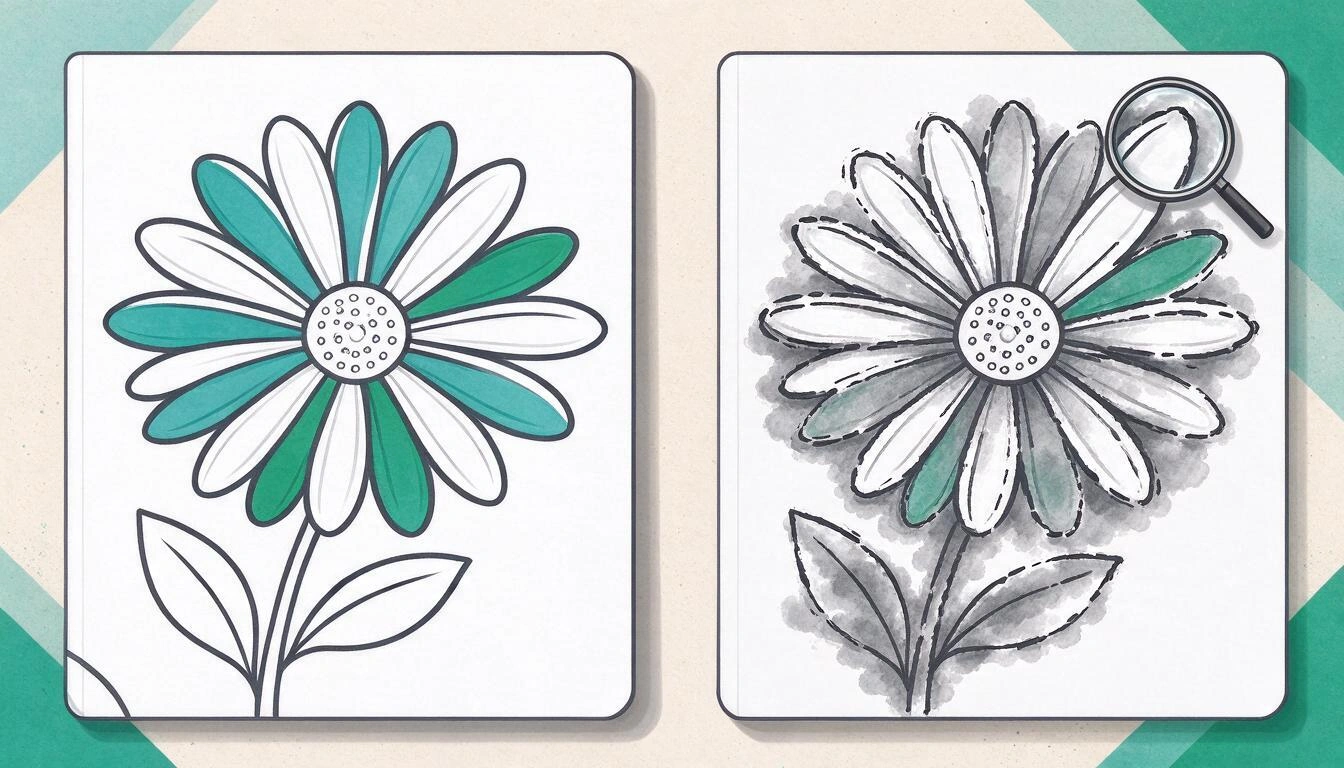
The most repeated mistake is gray. The line art must be pure black on white: gray fills "print dirty and generate returns" (Midas Tools, 2026). And regarding the thickness of the book: KDP requires a minimum of 24 pages, but be careful, the blank pages on the back count, so 12 drawings with their blank backs just meet the minimum.
| Frequent rejection reason | What KDP requires |
|---|---|
| Bleed that does not match the PDF | Decide before formatting: with bleed, 0.125" on the outer, top, and bottom edges |
| Art placed in the gutter | Minimum gutter of 0.375" between 24 and 150 pages; 0.5" from 151 to 300 |
| Insufficient resolution | 300 DPI at final print size |
| Grays and shading | Pure black on white, grayscale mode (not RGB) |
| Book too short | Minimum 24 interior pages (blank backs count) |
| Too many consecutive blank pages | No more than 4 consecutive blanks in the interior |
| PDF with layers or transparencies | A single flat PDF, embedded fonts, less than 650 MB |
| Spine text on thin books | No text on the spine for fewer than 79 interior pages |
| Template remnants | No filler text on the cover or title page |
Source of specifications: KDP trim size, bleed, and rejection guide for coloring books (2026).
The two standard trim sizes for the niche are 8.5 × 11" and 8.5 × 8.5"; straying from them is not prohibited, but it takes you out of the format that the buyer recognizes and requires redoing the layout if you make a bleed mistake.
AI is not the problem: the problem is not declaring it
Publishing coloring books with pages generated by AI is still allowed on KDP. The obligation is to declare it: you must mark the text, images (interior and cover), and translations created by a tool based on your instructions as AI-generated content, even if you have thoroughly edited them afterward. What KDP calls "AI-assisted" —using AI to generate ideas, titles, or correct your own work— does not need to be declared (KDP Builder, 10/07/2026).
Regarding what concerns creators the most: the declaration is not shown to the buyer on the product page. There is no public label of "generated with AI" on the book page, unlike what happens with synthetic narration on Audible ("Narrated By: Virtual Voice").
It is important to be precise about what Amazon has said and what it hasn't. Some industry guides claim that declaring does not imply penalties on ranking, advertising eligibility, or royalties (AI disclosure guide for coloring books, 06/2026). Others remind us that Amazon has not confirmed anything in either direction: "it has not said that declared books are suppressed, but it also has not guaranteed that the declaration is irrelevant for search, recommendations, or discovery" (Writers of the West, updated 11/09/2026). What is verifiable is this: there is no documented penalty for declaring, and there are documented consequences for not declaring, which range from title removal to account measures in case of recurrence.
In other words: AI is not what Amazon is pursuing. What it is pursuing is the bad product uploaded in industrial quantities.
Pre-upload checklist to avoid wasting quota
Before hitting "Publish," and knowing that you have two attempts per format and week, review these nine points:
- Correct format: paperback (and hardcover if applicable). Never ebook for a coloring book.
- Consistent trim: 8.5 × 11" (or 8.5 × 8.5") and the bleed decision made before formatting.
- Clean line art: closed black outlines, no broken or double lines, without a single residual gray.
- True pure white: white background, grayscale, not RGB.
- Minimum of 24 interior pages, counting blank backs, and no more than 4 consecutive blank pages.
- Zero nearly duplicated pages: if two drawings look too similar, change one.
- 300 DPI at final size and single flat PDF, with embedded fonts.
- Nothing with third-party rights: no characters, no trademarks, no recognizable styles from another artist, even if drawn by AI.
- AI declaration marked in the AI-generated content section, also when republishing with changes.
This is where a specific niche tool saves quota instead of saving time: in Coloring Book Studio each book is a project where you generate the line-art pages one by one by describing the scene —with clean lines and a completely white background, designed for printing— or in batches, indicating a theme and how many pages you want for the AI to propose the scenes, edit them or discard those that don’t fit before generating them. That’s what makes a themed 60-page book viable instead of a rehash of 24. The cover is refined by versions: you request changes in plain language, each attempt is saved, and you choose which one is final. And the export comes out in PDF of 8.5 × 11" with KDP margins and a blank page after each drawing, in addition to the complete book with the cover in front or the cover with bleed, with a counter that tells you how many printed pages the book will have before exporting, so you don’t fall short of the minimum of 24.
Frequently Asked Questions
How many books can I publish per week on Amazon KDP in 2026?
Two new titles per format and week: 2 ebooks, 2 paperbacks, and 2 hardcovers. The creation limit has been in effect since September 21, 2026, and the submission to publication limit since October 5, 2026, with the counter resetting on Sundays at 00:00 UTC.
Can I publish a coloring book as an ebook on Kindle?
It is not recommended. KDP's quality guidelines indicate that books intended for the reader to write or color on the page are not suitable for Kindle and may be rejected or removed from sale. Coloring books are published in paperback and, if you want, also in hardcover.
Do updates to a published book consume quota?
No. Changing the price, description, keywords, categories, territories, the manuscript, or the cover of a title you have already submitted does not count toward the weekly limit. Publishing a new edition does count, as KDP treats it as a different title.
If my book is rejected, do I lose the attempt?
In practice, yes: with only two submissions per format and week, a quality rejection consumes half of your quota for that week in that format. That’s why it’s advisable to check line, whites, page numbers, and trim before uploading, not after.
Does Amazon prohibit coloring books made with AI?
No. They are still allowed, but you must declare images and texts created by a tool as AI-generated content, even if you edit them afterward. This declaration is not shown to the buyer on the book listing; what does have documented consequences —removal of the title and actions on the account if it is repeated— is not declaring it.
How many pages should a coloring book have for KDP?
The technical minimum is 24 interior pages, and the blank pages on the back of each drawing count toward that total. With the new weekly limit, it’s reasonable to go well above that floor: a longer thematic book performs better than several short and interchangeable ones.
What trim size should I use?
The two standards in the niche are 8.5 × 11" and 8.5 × 8.5". Letter size, 8.5 × 11", is the most recognizable for the coloring book buyer. Also decide before formatting if the interior will have bleed (0.125" on the outer, top, and bottom edges) or not.
Two attempts per week: don’t waste them on poorly prepared files
KDP's cut does not penalize publishing with AI; it penalizes publishing poorly and in quantity. If your catalog depended on volume, the work you had spread over twenty titles weekly now fits into two, and the difference between growing and stagnating lies in those two passing the filter on the first try and surviving the reviews. Fewer niches, better chosen; longer books; compliant files before hitting "Publish."
Coloring Book Studio, by AIsToHire, is designed exactly for that scenario: a studio to generate line-art pages with AI, design the cover, and export the PDF for Amazon KDP without knowing how to draw or format, with a niche advisory chat to decide where to spend your two slots for the week.
Prepare your next coloring book to pass the KDP filter on the first try: create your project for free at Coloring Book Studio
Prepare your next coloring book to pass the KDP filter on the first try: create your project for free at Coloring Book StudioKeep reading
View all articles →
How to Create a Coloring Book with AI and Prepare the PDF for Amazon KDP

Why Your Car Insurance Increased in 2026: Average Premium of €1,412 and Historic Record

Discussing via WhatsApp or talking in person: what science says about couple conflicts through messages