 aiFitBalance
Preclinical obesity and clinical obesity: how the definition has changed (and what to do with your BMI)
Team at aiFitBalanceWritten with AI assistance19 min readIn summary
- The Lancet Commission on Clinical Obesity, published on January 14, 2025, in The Lancet Diabetes & Endocrinology and supported by more than 75 medical organizations, separates obesity into two categories: preclinical (excess fat with organs functioning well) and clinical (excess fat that has already damaged an organ or limits daily life).
- BMI becomes a screening tool, not an individual diagnosis: your number alone is no longer enough to say if you are sick. It is necessary to confirm the excess fat with a second measure —almost always the waist— and then assess whether there is damage or not.
- A validation study published on November 11, 2026, in Nature with 844,108 adults from China, the United Kingdom, the United States, and Spain found that clinical obesity is only 23–31% of all obesity cases, and that between 77.4% and 91.3% of people with preclinical obesity did not progress to clinical obesity in ten years.
- That same work quantifies the error of BMI alone: it overestimates obesity in 1.2–3.1% of the population and underestimates it in 5.2–8.6%. In other words, it fails more often by underestimation than by overestimation.
- For the average reader, the practical consequence is simple: your BMI is still useful, but only when paired. Measure your waist, calculate your waist-to-height ratio, and bring both to your appointment.
If you've heard that "BMI no longer counts" and you are left with a number in hand not knowing what to do with it, this article is for you. We wrote it from aiFitBalance, the BMI calculator from AIsToHire, because it is exactly the question we receive every week: does my 27.4 mean anything or not? Spoiler: it means something, but not what you thought. And the way to make sense of it is what you will see below — combining your index with your waist and your risk ratios in a single BMI and healthy weight calculator instead of being left with the loose number.
What exactly does the new definition of obesity say
The Lancet Commission on Clinical Obesity, coordinated by Professor Francesco Rubino (King's College London) and published on January 14, 2025, proposes to stop treating obesity as a yes/no and understand it as a continuum with two distinct diagnostic states: preclinical obesity and clinical obesity. The difference between the two is not how many kilos you weigh, but whether that excess fat is already causing harm.
The definitions, as set by the document:
- Preclinical obesity: excess adiposity with preserved organ and tissue function, accompanied by an increased risk of progressing to clinical obesity or other non-communicable diseases. It is not a disease in itself: it is a risk state.
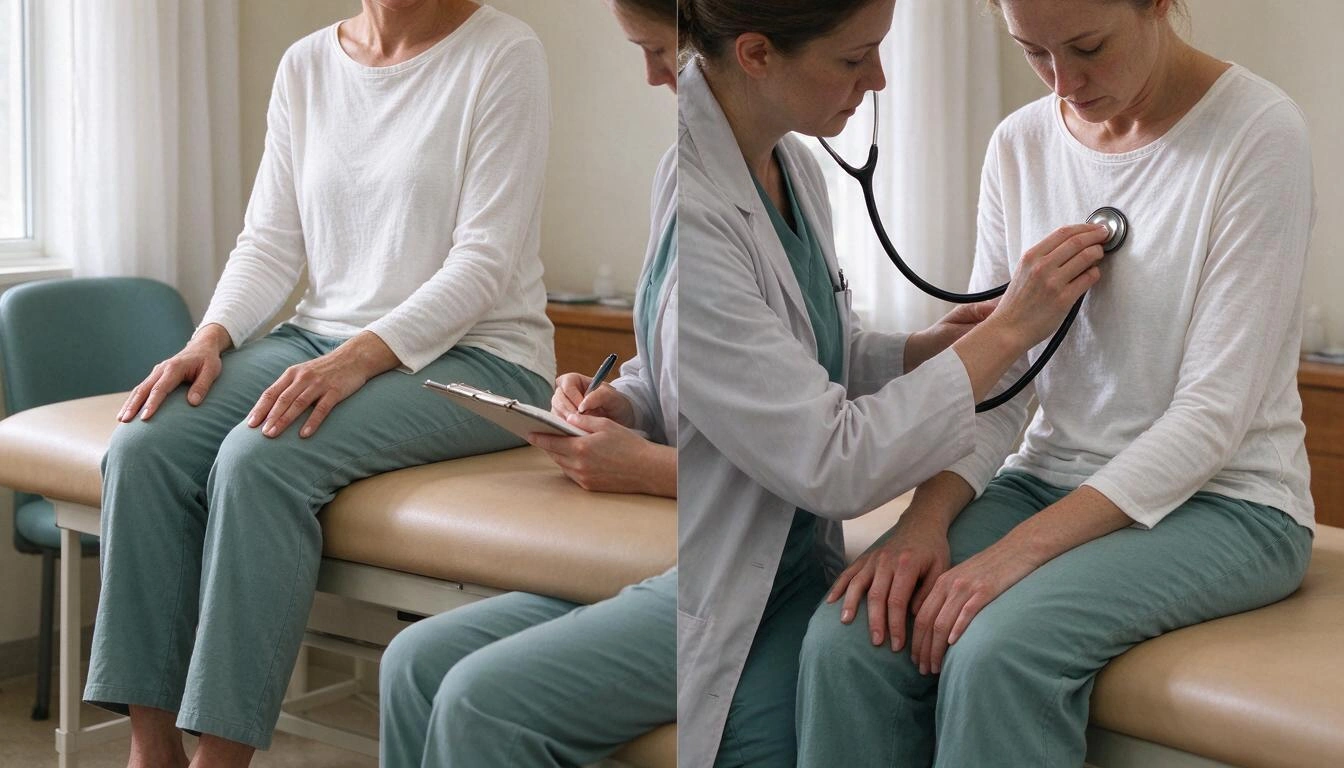
- Clinical obesity: excess adiposity plus at least one objective sign of organ dysfunction caused by that fat, or a significant limitation for daily activities —bathing, dressing, eating, continence— directly attributable to excess body fat. This is a disease, with diagnosis, treatment, and coverage.
The Commission sets 18 diagnostic criteria for clinical obesity in adults and 13 specific for children and adolescents. It is enough to meet one of them, based on already confirmed excess fat, to move from preclinical to clinical. Among the examples included in the Commission's own statement are dyspnea due to the effect of fat on the lung, obesity-induced heart failure, and knee or hip pain with stiffness and loss of joint mobility due to mechanical load. Signs of kidney dysfunction, upper airway, metabolic, nervous, urinary, reproductive, and lymphatic dysfunction (lymphedema in legs) are also included.
"Some people with obesity can maintain normal function of their organs and good overall health, even in the long term, while others present signs and symptoms of serious illness here and now." — Francesco Rubino, Chair of the Commission.
Why BMI Stops Being a Diagnosis and Becomes a Screening
Because BMI does not measure fat: it measures weight in relation to height. It does not distinguish muscle from fat, it does not say where that fat is, and, above all, it does not say if the person is sick. The Commission does not discard it —it remains the cheapest, fastest, and most comparable tool available for screening populations— but it degrades it from "diagnosis" to "first filter".
Rubino himself summarized it when presenting the 2026 validation study: BMI "does not allow us to know if a person is already sick or at risk of becoming so," and this can lead to both insufficient treatment and excessive treatment, as reported by Infobae on November 11, 2026.
And there is a number that is important to keep in mind, because it goes against popular intuition: when BMI is compared only with BMI plus waist measurements, isolated BMI underestimates obesity in 5.2–8.6% of people and overestimates it in only 1.2–3.1%. In other words: the most frequent problem with BMI is not labeling a bodybuilder as obese, but excluding people with real excess fat and an apparently normal BMI. This is known as normal weight obesity.
| What it measures | What it does not measure | What it is used for today |
|---|---|---|
| BMI | Fat, fat distribution, muscle, organ health | Initial population screening; individual first filter |
| Waist circumference | Visceral fat versus subcutaneous fat | Confirm central adiposity excess |
| Waist-to-height ratio | Organ function | Confirm adiposity with an almost universal threshold |
| DEXA / densitometry | Organ function | Direct measurement of fat when available |
| Clinical examination | — | Decide if it is preclinical or clinical obesity |
How Excess Fat is Confirmed: The Five Pathways
The Commission does not require anyone to undergo a densitometry. It presents five measurement pathways to confirm that there is excess adiposity, as detailed in the synthesis of the framework published in Diabetes & Primary Care, and it is not necessary to go through them all. The first three are tape measurements, the fourth is a shortcut for very high BMIs, and the fifth is the direct measurement of fat when equipment is available.
| Pathway | What it consists of | Realism in consultation |
|---|---|---|
| 1 | Waist circumference, with thresholds adjusted by age, sex, and ethnicity | High: only tape measure |
| 2 | Waist-to-hip ratio, with the same adjustments | High |
| 3 | Waist-to-height ratio, with the same adjustments | High: the easiest to remember |
| 4 | BMI > 40 kg/m²: excess fat is pragmatically assumed, without further measurements | Immediate |
| 5 | Direct measurement of body fat (DEXA, CT, or bioimpedance) | Low: requires equipment |
How these pathways are combined is the part that is important to understand well, because it is where the different readings of the document differ. The Commission's own formulation groups the confirmation into three alternative routes —direct measurement of fat; at least one anthropometric measure added to BMI; or at least two anthropometric measures independently of BMI— and adds the shortcut that, above 40 kg/m², excess fat is assumed and does not need to be confirmed. That is why you will see the framework summarized sometimes in five measurement pathways, other times in four routes, and other times in three options: it is the same thing told with different granularity, not a contradiction. What does not change in any version is the bottom line: nothing is confirmed with BMI alone, except above 40.
An important and little-known nuance: the Commission did not endorse specific numerical thresholds for waist, waist-to-hip, or waist-to-height, and noted their validation as a pending research need. Studies that have applied the framework have operationalized the classic thresholds: waist ≥102 cm in men and ≥88 cm in women, or waist-to-height ratio ≥0.5. That 0.5 is the easiest practical rule to remember: your waist should measure less than half of your height.
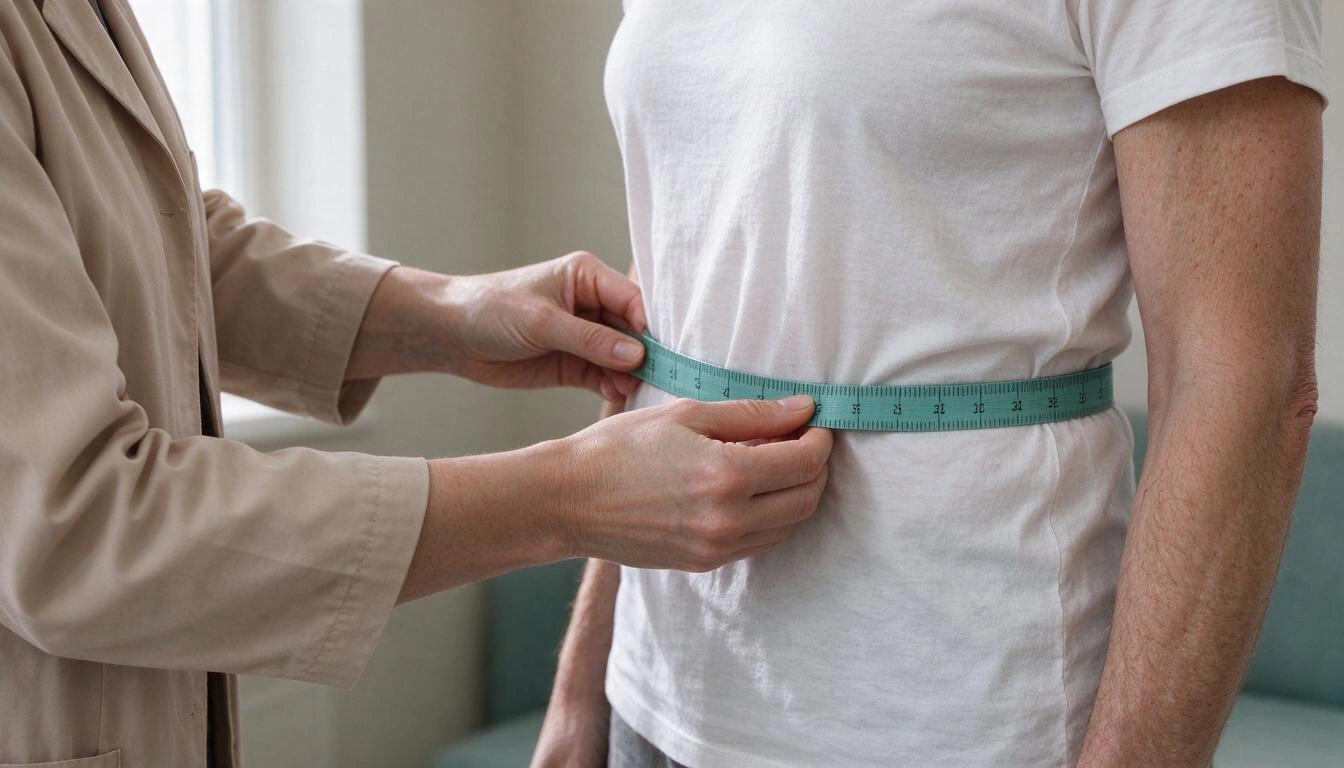
How to measure your waist correctly, which is where almost everyone goes wrong:
- Standing, barefoot, at the end of a normal expiration (do not suck in your stomach, do not puff out).
- The tape horizontal, at the midpoint between the last rib and the top edge of the hip —not over the navel by default, nor over the waistband of the pants.
- Adjusted without compressing the skin. If it leaves a mark, it is too tight.
- Measure yourself twice and average. Always at the same time of day.
Preclinical obesity and clinical obesity: what do they really differ in?
The operational difference is what happens after diagnosis. In preclinical obesity, the Commission recommends risk reduction strategies —health advice, monitoring, and, if the risk is substantially high, active treatment— not automatically treating the person as sick. In clinical obesity, it recommends timely evidence-based treatment (lifestyle, medications, or surgery), with a goal of restoring organ function, not just weight loss, and explicitly asks that coverage not depend on having additional comorbidities.
| Preclinical obesity | Clinical obesity | |
|---|---|---|
| Confirmed excess fat | Yes | Yes |
| Organ function | Preserved | Altered (≥1 of 18 criteria in adults; 13 in minors) |
| Limitation of daily life | No | Possible and sufficient on its own |
| Is it a disease? | No: risk state | Yes |
| What is recommended | Advice, monitoring, and risk reduction; active treatment if the risk is very high | Timely treatment aimed at restoring function |
| Frequency (Nature, 2026) | 69–77% of obesity cases | 23–31% of obesity cases |
There is a phrase from Rubino, dated November 12, 2026, that summarizes well the balance that the framework seeks: "preclinical obesity should not be automatically treated as an active disease nor considered harmless".
What the November 2026 validation study contributes
So far, the framework was a consensus proposal; since November 11, 2026, it has epidemiological validation. A study published in Nature —with participation from the University of Girona on the Spanish side— applied the criteria to 844,108 adults from four cohorts in China, the United Kingdom, the United States, and Spain, measuring prevalence, incidence, and mortality. It is, to date, the best proof that the preclinical/clinical distinction separates real risks and not just labels.
What it found, in figures:
- Clinical obesity accounts for between 23% and 31% of all obesity cases, with a population prevalence of 5.6% to 10.9%.
- Clinical obesity was associated with substantially greater mortality from all causes and obesity-related causes. Preclinical, only to a modest excess risk.
- Between 77.4% and 91.3% of people with preclinical obesity at the start did not progress to clinical obesity in ten years of follow-up.
- The greatest risk of death was identified only when obesity was defined by combining waist and BMI, not with BMI alone.
That last point is what should change your routine: it’s not that BMI is wrong, it’s that BMI alone does not discriminate who dies earlier. Adding waist measurement does.
How many people change category with the new criteria
It greatly depends on how the criteria are operationalized, and it is worth saying it bluntly: the published estimates do not agree with each other. In the United States, an analysis of NHANES published in February 2026 in the journal Obesity calculated that, with criteria of excess adiposity instead of BMI alone, adult obesity rose from 42.9% to 61.0% in 2021-2023, incorporating about 45 million adults with normal or overweight BMI (6.2 million with normal BMI and 39.5 million with overweight).
| Study | Date | Population | Obesity with BMI only | Obesity with adiposity criteria |
|---|---|---|---|---|
| NHANES, journal Obesity | Feb. 2026 | U.S. Adults 2021-2023 | 42.9% | 61.0% |
| JAMA Network Open | Aug. 7, 2026 | 1,900 U.S. adults aged 20-59 | 37.0% | 69.0% (complete Lancet definition) |
| Nature (4 cohorts) | Nov. 11, 2026 | 844,108 adults (CN, UK, US, ES) | — | Clinical: 5.6-10.9% of the population |
The ratio between preclinical and clinical also varies greatly: the NHANES analysis classified 54.8% of the population as clinical and only 6.2% as preclinical, a nearly inverse distribution to that of the Nature study. The explanation lies in what is counted as "organ dysfunction": if metabolic criteria are broadly accepted, almost everyone with excess fat falls into the clinical category. That ambiguity is the main open issue of the framework, and it is the reason why it is advisable not to read any single percentage as definitive.
Not everyone agrees: criticisms of the new framework
The framework has broad support —more than 75 medical societies— but there are also serious objections, and they fall into two categories: feasibility and diagnostic performance. Ignoring them would be selling the change as cleaner than it is.
Feasibility. A conceptual and clinical appraisal published in The Journal of Clinical Endocrinology & Metabolism points out that many primary care consultations lack training, time, and infrastructure for accurate anthropometry, and that requiring routine confirmation of excess fat plus a systematic assessment of organ function exceeds the actual diagnostic capacity of much of primary care. In practice, waist measurement is infrequent, patients usually do not like having it measured, and it takes time to do it correctly.
Performance. The aforementioned study from JAMA Network Open (August 7, 2026) compared five definitions against body fat measured by DEXA in 1,900 American adults. The complete Lancet definition calibrated better the prevalence (69.0% versus the actual 68.5% by DEXA), but the simple approach "BMI or waist" achieved greater diagnostic accuracy (AUROC 0.818, with higher specificity, 89.5%) and fewer false positives. Conclusion of its authors: for clinical practice, BMI or waist may suffice, without the complete apparatus.
Translated into street language: no one disputes the need to look at the waist. What is debated is how much additional machinery needs to be set up on top.
How many people are we talking about: Spain and the world
In Spain, according to the 2025 Health Survey of Spain published by the INE on October 20, 2026 —with data collected between April 2025 and March 2026 in about 21,000 households— obesity affects 17.2% of the population aged 18 and over, compared to 15.2% in 2023. 54.4% of adults are overweight.
| Indicator (Spain, ESdE 2025) | Value |
|---|---|
| Obesity in adults (18+) | 17.2% (was 15.2% in 2023) |
| Overweight in adults | 37.2% |
| Total overweight in adults | 54.4% (men 61.4%; women 47.6%) |
| Overweight in the population aged 2 to 17 | 25.4% (boys 28.1%; girls 22.4%) |
| Childhood obesity/overweight | 7.6% / 17.8% |
| Communities with the highest adult obesity | Canary Islands 21.8%; Castilla-La Mancha 20.8%; Murcia 18.9% |
Globally, the WHO fact sheet on obesity and overweight, updated on October 7, 2026, with data from 2024, estimates that 2.6 billion adults are overweight (45%), of which 940 million live with obesity (16%). Among those aged 5 to 19, 400 million are overweight and 170 million are obese.
If the new framework were applied to these figures, the reading would change radically: most of those 940 million would be in preclinical obesity —risk, monitoring, advice— and a minority in clinical obesity, which is where the healthcare system should concentrate treatment. That is precisely what the Commission aims for: to stop treating everyone the same for sharing a number.
In Spain, the professional conversation has been underway for a year and a half: the Spanish Society of Obesity (SEEDO) dedicated a pre-congress symposium to the new diagnostic and management framework for obesity on May 11, 2025, and the Spanish Society of Endocrinology and Nutrition (SEEN) published in April 2025 a commentary on the definition and diagnostic criteria for clinical obesity.
What to do with your number this week
None of this means you should ignore your BMI. It means you have to accompany it: with waist circumference, with your waist-to-height ratio, and with an honest reading of whether you notice symptoms. That is exactly the "complete picture" that the new criteria ask for, and you can put it together in ten minutes with a measuring tape.
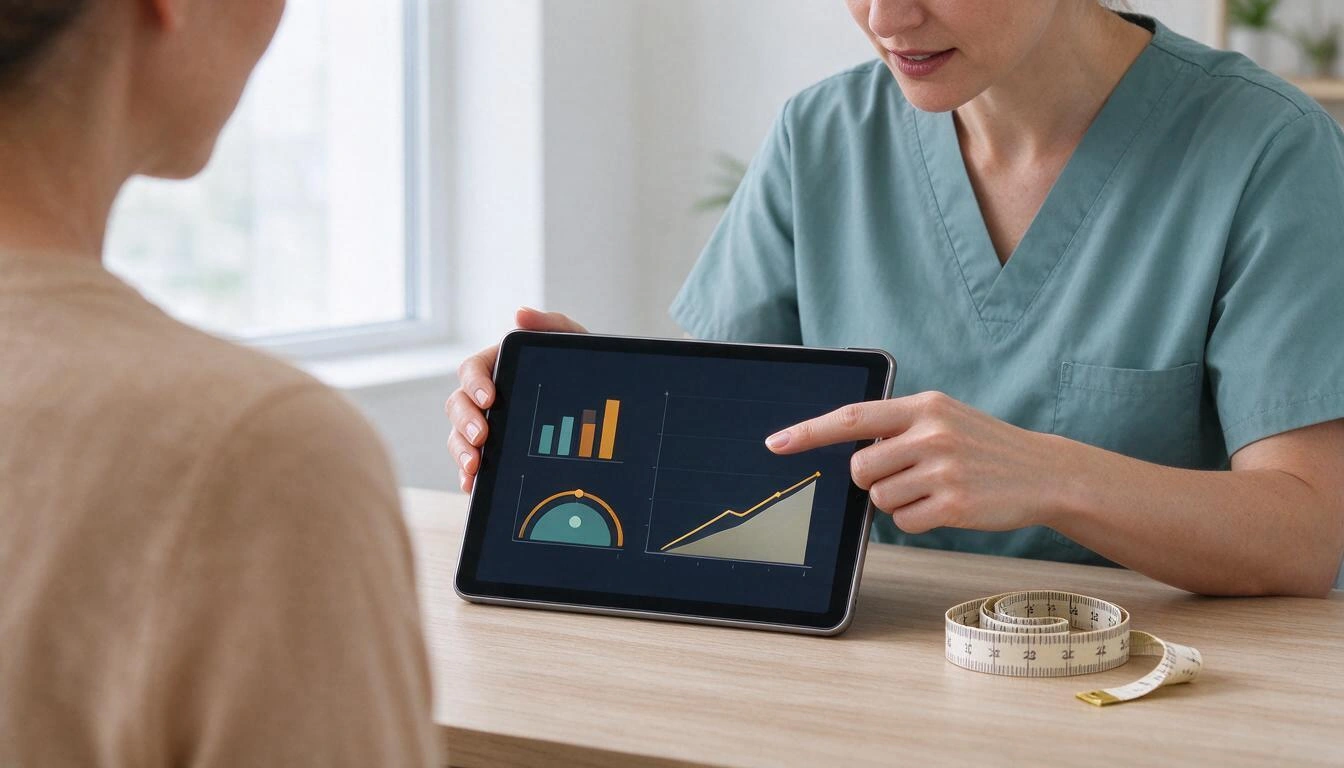
A reasonable workflow, for you or for those caring for others:
- Calculate the BMI and place the value in the WHO ranges. It is your screening, not your diagnosis.
- Measure the waist with the technique above and calculate the waist-to-height ratio. Does it exceed 0.5? It is the signal of central adiposity that the Commission accepts as confirmation alongside your BMI.
- Add hip and neck if you want an estimate of body fat percentage, which refines much more than BMI alone.
- Take an inventory of symptoms: do you get short of breath climbing stairs more than before? Do you snore or have apneas? Do your knees or hips hurt with stiffness? Have you had high blood pressure or glucose levels? That is what turns preclinical into clinical, and only a professional confirms it.
- Repeat the measurement every few weeks and look at the trend, not the isolated data.
For steps 1, 2, and 3, aiFitBalance does the work at once: based on sex, age, weight, height, activity level, and goal, it calculates your BMI with the WHO category, your healthy weight range for your height, the kilos that separate you from it, your ideal weight according to the formulas of Devine, Robinson, Miller, and Hamwi, your Prime BMI, and your approximate percentile. And if you add waist, hip, and neck, it estimates your body fat percentage by the Navy method —or from BMI and age if you don’t have the measurements— and provides you with the waist-to-hip ratio, the waist-to-height ratio, and the associated risk for each: the three indicators that the The Lancet framework places ahead of BMI alone.
It also has special modes that matter a lot here, because the thresholds are not universal: Asian population, individuals over 65, athletes, pregnancy, and children and adolescents aged 2 to 17 years, which change the thresholds and the interpretation of the result. And it saves each measurement with its date so you can see the evolution in a graph and export the history in CSV or as a printable report —useful if you want to take it to your consultation. It is an educational tool: it does not diagnose, and it alerts you when it is advisable to consult a professional. Which is exactly what the new framework asks of a calculator: to provide context, not to dictate judgments.
Frequently Asked Questions
Does BMI no longer serve any purpose?
It does serve, but as a screening tool, not as an individual diagnosis. The Lancet Commission maintains it as the first filter and adds that a second measure —waist, waist-to-hip ratio, or waist-to-height ratio— is needed to confirm excess fat. In fact, the 2026 data shows that BMI only underestimates obesity more than it overestimates it (5.2-8.6% versus 1.2-3.1%).
What is preclinical obesity in simple terms?
It is having excess body fat with organs functioning well. It is not a disease; it is a state of increased risk. According to the Nature study from November 2026, between 77.4% and 91.3% of people with preclinical obesity did not progress to clinical obesity within ten years.
How do I know if I have clinical obesity?
You cannot self-diagnose: it requires a professional to confirm excess fat and detect at least one of the 18 criteria for organ dysfunction in adults (or 13 in minors), or a significant limitation of your daily activities attributable to fat. What you can do is come to the appointment with your BMI, your waist, your ratios, and a list of symptoms.
What is the normal waist circumference?
The thresholds that have been applied are 102 cm for men and 88 cm for women, or a waist-to-height ratio of 0.5 (your waist, less than half your height). Important: the Lancet Commission did not endorse specific numerical thresholds and left their validation as a pending research task, so take them as a guideline reference.
With the new criteria, are there more or fewer people with obesity?
It depends on how the criteria are applied, and the estimates vary greatly. Among adults in the U.S., the adiposity criteria raised the prevalence from 42.9% to 61.0% (Obesity, February 2026), because they include people with normal or overweight BMI but excess fat. In contrast, the category of disease —clinical obesity— is reduced to a minority of cases according to the Nature study.
If I have preclinical obesity, will I be given treatment?
The Commission's recommendation for preclinical obesity is risk reduction strategies: health counseling, monitoring, and only if the risk is substantially elevated, active treatment. Timely treatment —lifestyle changes, medications, or surgery— is reserved for clinical obesity, and the Commission requests that its coverage does not require additional comorbidities.
Does this framework apply to children and adolescents?
Yes. The Commission sets 13 specific diagnostic criteria for children and adolescents, different from the 18 for adults, and in that age group, classification is done using percentiles from growth references, not with adult thresholds. In Spain, 25.4% of the population aged 2 to 17 is overweight (ESdE 2025).
Can I measure all this at home?
You can measure and calculate the anthropometric: weight, height, BMI, waist, hip, neck, and the derived ratios, as well as an estimate of body fat. What you cannot do at home is the clinical part —the assessment of organ function— which is precisely what separates preclinical from clinical. Take the measurements to the professional; that is the reasonable division of labor.
What you take away from here
The change in criteria does not take away the number: it puts it in its place. BMI was a shortcut used for decades as if it were a diagnosis, and the Lancet Commission returns it to what it always was, a screening tool. What makes it useful information is what you add to it: waist, ratios, and honesty about your symptoms. The good news, according to the Nature data from November 2026, is that most people with obesity are in the preclinical range —risk, yes; disease, not yet— and that is where changing habits pays off the most.
If you want to put together that complete picture without spreadsheets, aiFitBalance, from AIsToHire, is the tool that brings it together: the BMI calculator with waist and risk ratios gives you the index, the WHO category, your healthy weight range, the estimated body fat percentage, and the waist-to-hip and waist-to-height ratios with their risk, all on one screen and with the history saved to see the trend. Six questions. The number, and finally the context.
Calculate your BMI along with your waist and risk ratios, and get the complete picture that the new criteria ask for, not just the number. Go to aiFitBalance, answer six questions, and receive your index with the WHO category, your healthy weight range, your estimated body fat, and your waist-to-hip and waist-to-height ratios with the associated risk.
Calculate your BMI along with your waist and risk ratios, and get the complete picture that the new criteria ask for, not just the number. Go to aiFitBalance, answer six questions, and receive your index with the WHO category, your healthy weight range, your estimated body fat, and your waist-to-hip and waist-to-height ratios with the associated risk.Keep reading
View all articles →
What your BMI really means (and the two measurements that complete it)

Discussing via WhatsApp or talking in person: what science says about couple conflicts through messages

Mind map, concept map, and outline: differences and when to use each one