 aiShades
Which sunglasses look good on me: a guide by face shape (with the measurements that really matter)
Team at aiShadesWritten with AI assistance20 min readIn summary
- The shape of the face is determined by four measurements (forehead, cheekbones, jaw, and length) and a sewing tape: five minutes in front of the mirror and you stop guessing.
- The rule used by opticians is that of contrast: angular frames for round faces, curved frames for square faces, and visual weight on top for wide jaws.
- Fit matters more than shape: the frame should not extend beyond your temples, it should not touch your cheekbones when you smile, and the top edge should not cover your eyebrows.
- The tint of the lens is functional, not decorative: brown increases contrast, gray maintains true colors, and yellow is only useful in low light. What really protects is the UV filter and the CE mark, not the color or the price.
- aiShades, the mini app from AIsToHire, performs this analysis from a selfie: it detects face shape and skin undertone and returns an infographic with the frames, colors, and tints that suit you, plus an image of you wearing the recommended glasses.
You tried on fifteen models in the store, all seemed "weird" to you, and in the end, you took the usual ones. Or worse: you bought online, they arrived, you put them on, and they made your face look different. The problem is almost never your face: it's that you are comparing models without a criterion, and the visual memory between one model and the next lasts about ten seconds.
This guide gives you that criterion. First, you measure, then you choose the frame family, then the lens color, and only at the end the specific model. Finally, I will tell you how aiShades, the AI sunglasses study from AIsToHire, follows the same path from a photo of you, and what it does not do (which also matters).
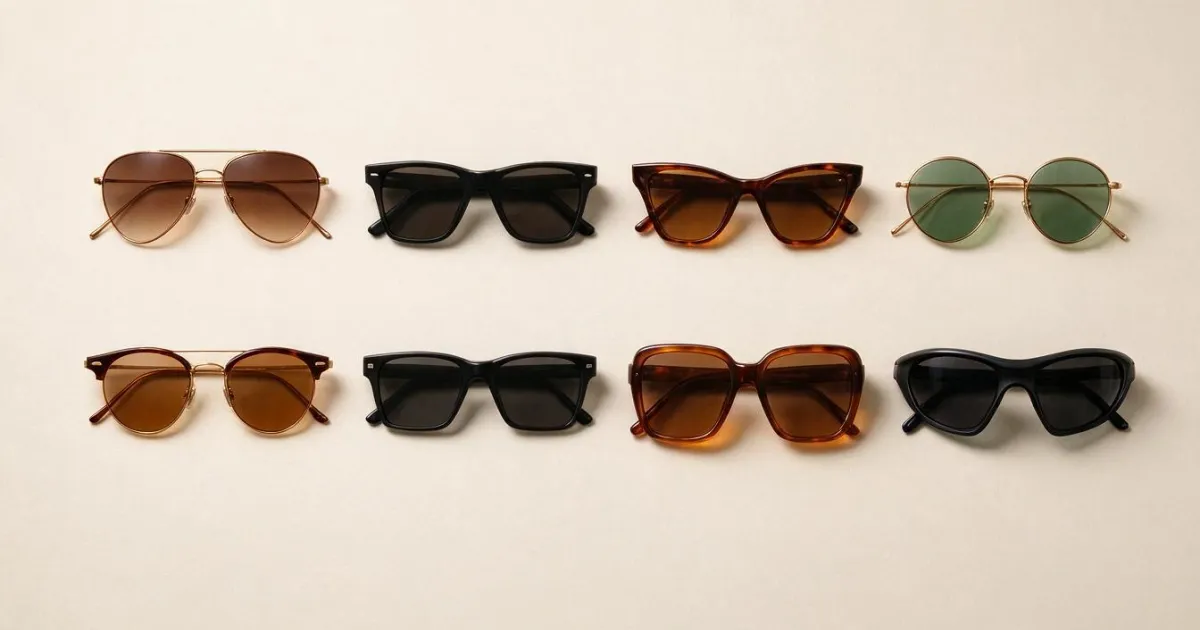
What sunglasses look good on me? The answer fits in one sentence
The frame that flatters you is the one whose outline contrasts with the outline of your face and whose total width matches the width of your temples. If your face has curved lines, an angular frame structures it; if your face has marked angles, a curved frame softens them. Everything else —color, material, brand— is a secondary layer.
That contrast rule is what an optician applies in thirty seconds while looking at you head-on, and it is also the logic with which aiShades generates its recommendations. But to apply it, you need to know what face shape you have, and most people make mistakes estimating it by eye: we see ourselves in the mirror with our hair done, which completely changes the perceived outline of the forehead and jaw.
How to know your face shape in five minutes with a sewing tape
Tie your hair back, face the mirror, and take four measurements with a flexible sewing tape, recording them in centimeters. You do not need help or a photo: all four are taken on your own face.
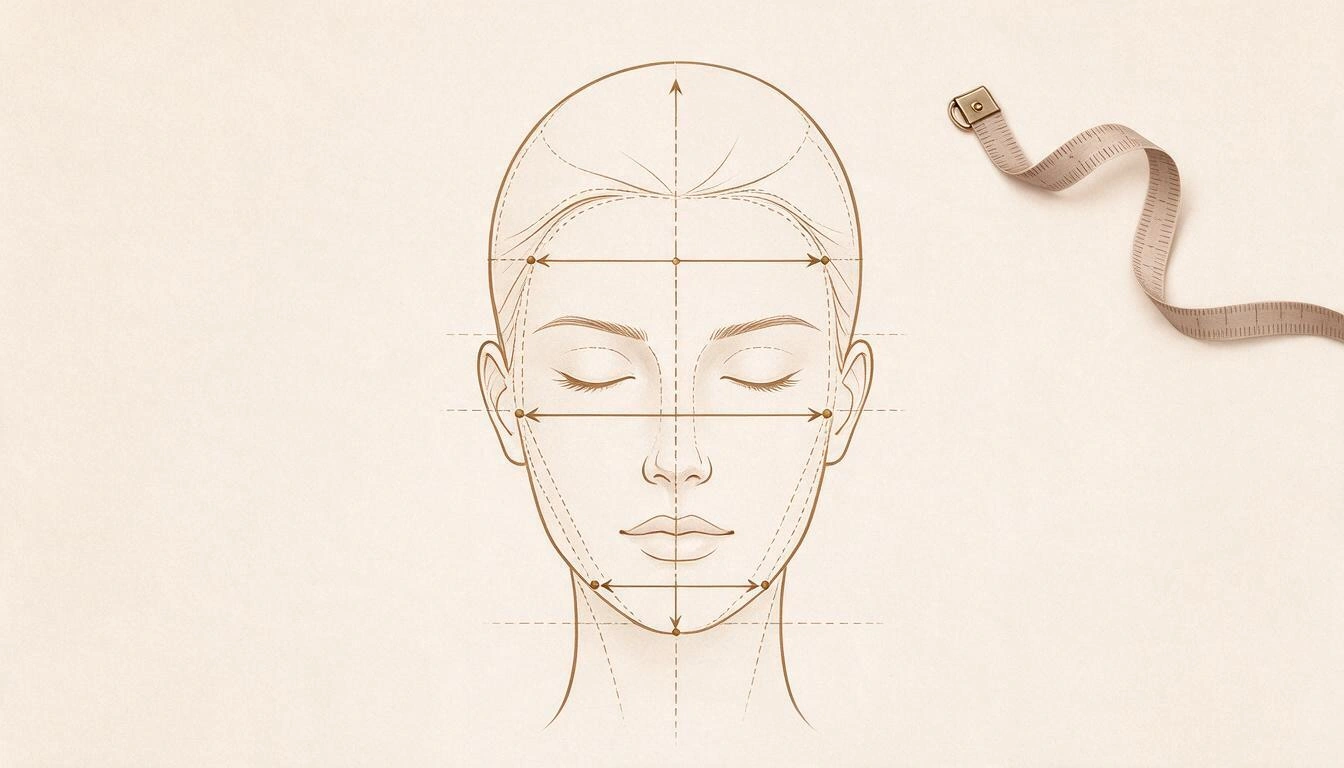
- Forehead width: side to side, at the widest point, approximately halfway between the eyebrows and the hairline.
- Cheekbone width: side to side at the most prominent part, just below the outermost point of the eyes.
- Jaw width: from one jaw angle to the other, below the ears (not over the chin).
- Face length: from the center of the hairline to the tip of the chin, vertically.
Now compare them. These are the decision rules used by optical styling guides, ordered from most specific to most general:
| If your measurements say… | Your shape is | How to recognize it |
|---|---|---|
| Length ≈ 1.5 × cheekbones, and cheekbones is the largest width | Oval | Soft outline, a bit longer than wide, without marked angles |
| The three widths are almost equal (±1 cm), length ≈ width, rounded jaw | Round | Full cheeks, short and curved chin |
| The three widths are almost equal, length ≈ width, but angular jaw | Square | Wide and marked jaw, straight forehead |
| Cheekbones the largest, forehead larger than jaw, pointed chin | Heart | Wide forehead that narrows downwards |
| Cheekbones clearly the largest, narrow forehead and jaw | Diamond | High and prominent cheekbones, angular face |
| Length exceeds more than 1.5 × any width, similar widths | Long (oblong) | Long and narrow face, high forehead |
| Jaw the largest width, forehead the smallest | Triangular | Wide base, narrow upper part |
Two honest warnings. The first: many faces fall between two categories ("oval tending to square" is the most common), and that's not a measurement error, it's reality. In that case, the recommendations from both apply, prioritizing those that appear in both lists. The second: from here on, we talk about aesthetics, not optics; none of this affects the health of your eyes, which depends on the filter we talk about below.
Table: which frame flatters each face shape
With the shape already identified, this table translates the contrast rule into specific frame families. Treat it as a starting point, not as law: a frame that you love and makes you feel good wins over any styling rule.
| Face Shape | Visual Goal | Frames that usually flatter | Best to avoid |
|---|---|---|---|
| Round | Add angles and elongate | Wayfarer, rectangular, browline/clubmaster, soft square | Small round, very curved oval, unstructured frames |
| Square | Soften the jawline | Aviator, round, oval, light cat-eye | Wide angular rectangles, hard geometric shapes |
| Oval | Maintain balance | Almost everything: aviator, wayfarer, round, browline | Oversized that cover eyebrows and cheekbones, or very narrow frames |
| Heart | Balance a wide forehead | Aviator, round, low bridge, discreet cat-eye, no lower rim | Very thick or decorated frames on the top |
| Diamond | Widen forehead and chin | Oval, cat-eye, browline/clubmaster | Narrow and angular frames that emphasize the cheekbone even more |
| Long (oblong) | Visually shorten | High frames, oversized, screen type, low bridge, wide temples | Low and narrow frames like slim |
| Triangular | Add visual weight at the top | Browline/clubmaster, cat-eye, aviator | Frames with weight at the bottom or very wide at the base |
The pattern, if you notice, is always the same: the frame compensates for what the face already has in excess. An elongated face asks for height in the lens; a wide jaw asks for weight above; a wide forehead asks not to add more weight above.
The three measurements that matter more than the shape of your face
The most expensive mistake when buying online is not getting the shape wrong, it's getting the size wrong. Glasses have three numbers printed on the inner side of a temple, in the format 52□18 140: width of each lens, width of the bridge, and length of the temple, always in millimeters. If a pair of glasses fits you well, note those three numbers and use them as a reference for all the following ones.
- Lens width (the first number, typically 40–62 mm). Together with the bridge, it determines the total width of the frame.
- Bridge (the number after the square, 14–24 mm). It is the distance between lenses: too narrow and the glasses pinch your nose and ride up; too wide and they slip off.
- Temple (the third, 135–150 mm). It should reach the ear and curve behind without pressing the temple.
And these are the three fit checks you can do in thirty seconds in front of a mirror:
- Total width: the outer edges of the frame should align with your temples, neither sticking out nor sinking inward.
- Eyebrows: the top edge of the frame should follow the line of your eyebrows or sit just below; completely covering them usually indicates a frame that is too large.
- Cheekbones: smile. If the frame rests on your cheekbones and rises, it will annoy you and fill the lens with makeup or marks.
A pair of glasses in the "correct shape" but the wrong size looks bad. A pair of the correct size and questionable shape looks much better than you expected.
Lens color is not aesthetics: it changes what you see
The tint of a sunglass lens modifies the contrast and color fidelity of what you look at, so the choice depends on what you will use them for. Two pairs with the same darkness category can give you very different visual experiences depending on the color of the filter.
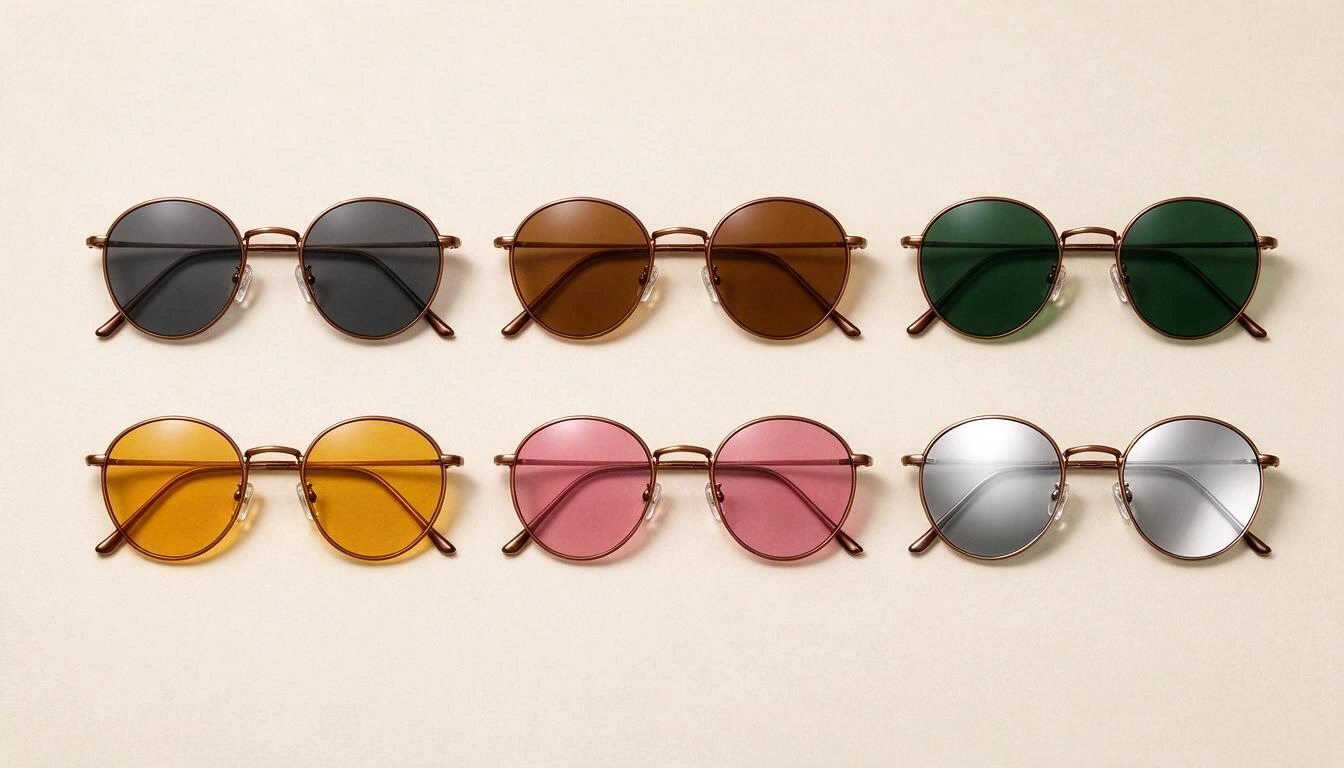
| Tint | What it does | Where it works best | Trade-off |
|---|---|---|---|
| Neutral gray | Reduces light without altering colors | General use, beach, city, very strong sun | Almost does not increase contrast |
| Brown / amber | Increases contrast and relief by filtering some blue | Daytime driving, mountains, golf, variable days | Tints everything you see warm |
| Green (G15 type) | Middle ground between neutrality and contrast | General use with intense sun | Slight tint in warm tones |
| Yellow / orange | Increases contrast in low light | Fog, gray days, cycling, shooting | Poor choice in strong sun; usually category 0–1 |
| Pink / reddish | Contrast in green environments, less fatigued vision | Long driving, mountain sports | Alters color perception quite a bit |
| Mirrored | Reflects part of the light before it enters | Snow, nautical, high mountains | Scratches easily and shows fingerprints |
| Gradient | Darker on top, lighter on bottom | City: you can look at your phone or the dashboard | Less filtering in the lower area |
| Polarized (not a tint) | Eliminates glare from horizontal surfaces | Water, snow, wet asphalt | Can darken LCD screens and certain windshields |
The color that flatters you is another question, and there your skin undertone rules: warm tints (brown, amber, olive green) pair better with warm undertone skin, and cool tints (gray, bluish, cool pink) with cool undertone skin. It's precisely the intersection that aiShades resolves along with that of the shape.
Filter Categories 0 to 4: What the Standard Says and What It Doesn't
In the European Union, sunglasses are personal protective equipment of category I according to the Regulation (EU) 2016/425, applicable since April 21, 2018: they must have CE marking and include a EU declaration of conformity. The harmonized standard for general use sunglasses is EN ISO 12312-1:2013+A1:2015, which classifies filters into five categories based on the visible light they allow to pass through (data consulted on October 25, 2026).
| Category | Visible Light Transmitted | Intended Use | Driving |
|---|---|---|---|
| 0 | 80–100 % | Aesthetic, indoors, very low light | Yes, also at night |
| 1 | 43–80 % | Cloudy days, soft light | Yes, also at night |
| 2 | 18–43 % | Medium light, mid-mountain | Yes during the day; not recommended at night |
| 3 | 8–18 % | Strong sun: beach, summer, water | Yes during the day; not at night |
| 4 | 3–8 % | Extreme light: high mountain, glacier | Not suitable for driving; the standard requires a warning about it |
Three things to keep clear that no app can check for you:
- Dark does not equal protective. The category indicates how much visible light the lens blocks, not how much ultraviolet radiation. A very dark lens without adequate UV filter causes the pupil to dilate and let in more radiation: it’s worse than not wearing glasses. Look for the CE marking and the reference to UV protection up to 400 nm ("UV400").
- Category 4 is not suitable for driving. That’s why the standard requires the corresponding pictogram or warning on the product or in the brochure.
- Children's sunglasses are not a toy. They follow the same standard and the same CE marking; it’s advisable to check them just like adult ones.
This section is informative about product regulations, not health advice. For any questions about your eye health, prescription, or the protection you need, consult an optician-optometrist or your ophthalmologist. aiShades does not measure UV protection or evaluate actual lenses.
Skin Undertone: Three Home Tests to Choose the Frame Color
The undertone is the background temperature of your skin and does not change when you tan. It determines whether you look better in gold metals and tortoiseshell acetates (warm undertone) or silver metals and black, gray, and bluish acetates (cool undertone). These three tests, done in natural light, almost always match:
- The veins on your wrist. Greenish → warm. Blue or purplish → cool. A mix of both → neutral.
- The white paper. Hold a white sheet of paper up to your face without makeup: if your skin looks yellow or peachy, warm; if it looks pink or bluish, cool.
- Gold or silver. Put a gold piece of jewelry on one wrist and a silver one on the other. The one that makes your skin look luminous rather than dull marks your undertone.
| Undertone | Frame Colors That Usually Flatter | Lens Tints That Accompany |
|---|---|---|
| Warm | Tortoiseshell, honey, gold, bronze, khaki, cream, warm brown | Brown, amber, olive green |
| Cool | Black, gunmetal, silver, gray, blue, cool burgundy, white | Gray, bluish, cool pink, silver mirrored |
| Neutral | Almost everything; medium earth tones and dark tortoiseshell work well | Gray and brown equally, G15 green |
How aiShades does this same analysis from a photo
aiShades is the mini app from AIsToHire that automatically goes through all the above: you upload a frontal selfie and the AI detects your face shape, your features, your skin undertone, and your personal color palette, and from there generates two images with the frames, colors, and tints recommended for you. It is available at aistohire.com/aishades-estudio-gafas-de-sol-montura-ideal-ia-145.
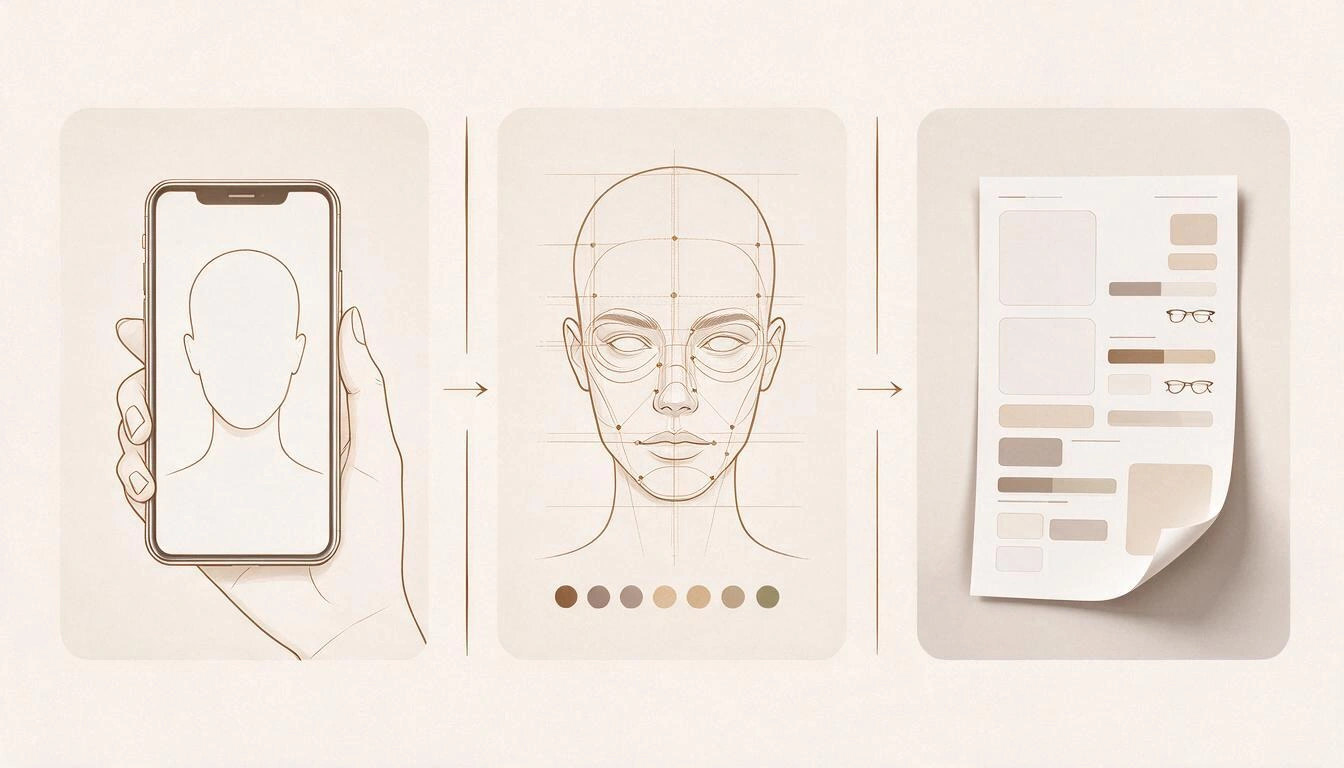
The process has three steps:
- You upload the photo. On mobile, the front camera opens directly; on the computer, the file explorer. It accepts images up to 12 MB and automatically corrects the orientation of the photo.
- The AI analyzes your face. It returns, in one step: face shape, three or four facial features, skin undertone, color season, an ideal palette of six colors, jewelry and clothing colors that suit you, recommended frame shapes, three frame colors, several lens tints with one main, lens finish, overall style, and three frame shapes to avoid in your case.
- You receive two images. One vertical infographic style guide, with panels for face shape, features, palette, frame shapes, lens tints, a comparison of three frames that suit you versus three that do not, and up to five recommended styles. And a try-on: a portrait of you wearing the first recommended frame and a few tags with key data.
Details that make a difference in real use:
- The labels appear in your language: the app is in Spanish, English, French, Italian, Portuguese, and German, and the labels of the images are generated in the language you have configured.
- You can close the app halfway. The generation is asynchronous and the result is saved on the server: when you return, your analysis is finished and waiting for you in the history.
- The two images are downloaded. On mobile, the system's share sheet opens to save them directly to Photos, so you can show the infographic at the optical store or consult it while shopping online.
- It saves the history of all your analyses within the app, so you can repeat it with another photo and compare.
For the photo to work well: natural light in front, looking at the camera, no glasses on, hair tied back, and the mobile somewhat away (the wide-angle at short distance enlarges the nose and narrows the ears, distorting the proportions that the AI will measure).
What aiShades DOES NOT do
aiShades is a style advisor, not an optical store or a shop. It is important to know where the limit is before using it, because outside of it you need a professional or a business:
- It does not sell glasses or show real products. The images are generated by AI: the frames you see are representations of a shape, a color, and a tint, not specific models from any brand, nor do they have a price or purchase link.
- It does not measure in millimeters. It does not give you your frame size, your interpupillary distance, or the exact width of your face. Those measurements are taken by an optician, or you can get them from glasses you already have (the numbers on the temple).
- It is not a real-time virtual try-on. The try-on is an image generated from your photo, not a camera with augmented reality.
- It only covers sunglasses. It does not analyze prescription glasses or contact lenses, nor does it know anything about your prescription.
- It does not provide health advice. It does not verify the UV filter, nor the category, nor the CE marking of any glasses, and it does not replace the opinion of an optician-optometrist or an ophthalmologist.
- The recommendations are indicative. They are the classic styling criteria applied to your features, not an objective truth. The "avoid" list is a guide, not a prohibition.
Checklist before buying your next sunglasses
If you take away only one thing from this article, let it be this list. It works the same in-store as when buying online:
- Know your face shape (measured, not estimated by eye) and have noted the family of frame that corresponds to you.
- Bring the three numbers from glasses that already fit you well:
lens width □ bridge temple. - Check the CE marking and UV400 protection on the product or on the seller's sheet.
- Choose the category according to use: 3 for strong sun and beach, 2 for the city, and discard 4 if you are going to drive.
- Choose the tint by function (gray for true color, brown for contrast) and then by skin undertone.
- Make the three fit tests: width at the temples, eyebrow line, and smile to see if they touch the cheekbones.
- Look at yourself in profile, not just from the front: there you can see the temples, the tilt, and whether the frame separates from the face.
- Check the return policy if buying online, and take a photo with them on before deciding.
Frequently Asked Questions
How do I know which sunglasses look good on me if I don't know the shape of my face?
Measure four things with a sewing tape and your hair tied back: forehead width, cheekbone width, jaw width, and face length. By comparing those four numbers, you can determine your shape with the table in this article. If you prefer not to measure, aiShades deduces it from a frontal selfie and directly returns the frames that suit you.
What sunglasses look good on a round face?
Round faces are usually complemented by angular frames, which provide the structure that the face lacks: wayfarer, rectangular, browline or clubmaster, and square with softened corners. What works the least are small round and very curved oval frames, as they repeat the curve of the face instead of contrasting it.
Should sunglasses cover the eyebrows or not?
Typically, the top edge of the frame should follow the eyebrow line or sit just below it. If the glasses completely cover the eyebrows, it usually indicates that the frame is too large for your face, except in oversized models where that effect is intentional.
Is it true that square glasses don't suit square faces?
It's not a prohibition; it's the rule of contrast: a face with an angular jawline is softened by curved frames (aviator, round, oval) and hardened by wide angular rectangles. If you love a square frame, look for one with rounded corners and slightly narrower than your face.
What color should the lens be for driving?
For daytime driving, brown, amber, and gray tints in category 2 or 3 work well, as brown increases contrast and gray maintains true colors (important for signs and traffic lights). Category 4 is not suitable for driving, and the regulation requires a warning; at night, you should not use category 3 or 4 lenses.
Are polarized sunglasses better?
They are better in situations with glare on horizontal surfaces: water, snow, wet roads. They eliminate that glare and reduce eye strain. The downside is that they can darken LCD screens and certain treated windshields, so they are not automatically the best option for everyone. Polarization and UV protection are different things: a polarized lens does not protect from ultraviolet just by being polarized.
What do the numbers on the inside of the temple of the glasses mean?
They are the three measurements of the frame in millimeters, in the format 52□18 140: width of each lens, width of the bridge between lenses, and length of the temple. If you have a pair of glasses that fit you perfectly, note those three numbers: it's the most reliable way to get it right when buying online.
Do cheap sunglasses offer the same protection as expensive ones?
What determines protection is the ultraviolet filter and compliance with the standard, not the price. In the EU, sunglasses are personal protective equipment (PPE) of category I and must carry the CE marking in accordance with Regulation (EU) 2016/425. A dark lens without an appropriate UV filter is worse than not wearing glasses, as the pupil dilates and more radiation enters. Always check for the CE marking and reference to UV400.
Does aiShades tell me what model to buy and where?
No. aiShades tells you what frame shape, what colors, and what lens tint suit you, and shows it to you in an infographic and an image of you wearing the glasses. It has no catalog, prices, or links to stores: the glasses you see in the images are generated by AI and represent a shape and a color, not a real product.
Can I try on glasses virtually with my photo?
aiShades generates a portrait of you with the first recommended frame on, based on the photo you uploaded, plus several thumbnails with different tints and styles within the infographic. It is not augmented reality in real time with the camera: they are generated images, designed for you to see how that shape and color look on you before going to the store.
What happens to my photo?
The photo is uploaded to our storage via an encrypted connection and is used to generate your analysis and your two images. It is saved in the history of your account within the app, so you can reopen previous analyses. For details on processing and storage, please refer to AIsToHire's privacy policy.
Does aiShades also work for prescription glasses?
No: aiShades only covers sunglasses, with their tints and lens finishes. It does not analyze prescription glasses frames nor knows anything about your prescription, which is the domain of an optician-optometrist.
What if my face is between two shapes?
This is the most common situation. In that case, use the recommendations from both lists and prioritize the frames that appear in both: they tend to work best. As a reference, a face "oval with a tendency to square" fits well with almost everything except very angular and wide frames.
In a nutshell: what is aiShades and where is it?
aiShades is the mini app from AIsToHire that analyzes a selfie with AI and returns what frame shapes, colors, and tints of sunglasses suit you, in a downloadable infographic and an image of you wearing the glasses. It is available at aistohire.com/aishades-estudio-gafas-de-sol-montura-ideal-ia-145. It does not sell glasses nor replaces an optician: it gives you the criteria so that when you enter the store or open the website, you already know what you are looking for.
Stop trying on sunglasses blindly: upload a selfie to aiShades and discover in minutes which frame shapes, colors, and lens tints suit you, with a downloadable infographic and an image of you wearing the glasses.
Stop trying on sunglasses blindly: upload a selfie to aiShades and discover in minutes which frame shapes, colors, and lens tints suit you, with a downloadable infographic and an image of you wearing the glasses.Keep reading
View all articles →
Sunglasses Trends 2027: Which Shapes Flatter Your Face (and Which to Avoid)

Discussing via WhatsApp or talking in person: what science says about couple conflicts through messages

Mind map, concept map, and outline: differences and when to use each one