 aiShades
Sunglasses Trends 2027: Which Shapes Flatter Your Face (and Which to Avoid)
Team at aiShadesWritten with AI assistance18 min readIn summary
- SILMO Paris 2026 (September 25–28, Paris Nord Villepinte) concluded with 32,108 professionals, over 950 exhibitors, and 1,500 brands from nearly 150 countries, and its awards are today the best indicator of what will sell in 2027.
- The four silhouettes that define the 2027 season are the shield or mono-screen, the soft and warm aviator, the fine cat-eye, and the minimal oval, with lightweight titanium and new volume acetates as dominant materials.
- None of these shapes flatters everyone: the shield requires narrow temples, the warm aviator suits square and heart-shaped faces, the fine cat-eye balances angular jaws, and the minimal oval shortens elongated faces.
- The big twist for 2027 is clear or lightly tinted lenses (pink, amber, soft blue, green). Note: darkness, mirroring, and UV protection are independent things; one must demand UV400, CE marking, and ISO 12312-1.
- Category 4 is prohibited for driving even during the day —it can cost up to €200 in fines according to RACE—: behind the wheel, category 2 or 3 in brown, green, or gray.
Every autumn, the same thing happens: the sunglasses trends for the following year are finalized at the September fairs, hit the store shelves in spring, and in the meantime, November is filled with discounts on the outgoing collection. This article translates what was seen and awarded at SILMO Paris 2026 into a practical decision: which 2027 shapes flatter your face and which ones to avoid, plus the technical warning that almost no one gives now that clear lenses are taking over. If you want to skip the theory and see it applied to your face, AIsToHire has a tool for that: aiShades, an AI sunglasses study that analyzes your face and your palette from a photo.
What SILMO Paris 2026 made clear about 2027 sunglasses
SILMO Paris 2026 was held from September 25 to 28 at Paris Nord Villepinte and brought together 32,108 professionals, over 950 exhibitors, and 1,500 brands from nearly 150 countries over 80,000 m², with 53% of international visitors, according to the fair's report collected by Optimoda. In its 33rd edition, the SILMO d'Or awarded in solar pieces that summarize the direction of 2027: metallic mono-screen, mask geometry, monoblock titanium, and sculpted acetate.
The award list is concrete and worth reading as a seasonal brief. According to Lookvision, which published all the winners of the SILMO d'Or 2026:
- Victoria Beckham VB 7015/S (Safilo), winner in sunglasses, with a sophisticated aesthetic of metal mono-frame and oversized temples.
- Caroline Abram Sakura, with a mask geometry that "projects a band of color on the face, like a highlighter".
- Brett Ferdinand Sun C06, in Japanese titanium with a highly precise monoblock front.
- Paloceras Pebble RX, Special Jury Award, carved in solid Mazzucchelli acetate of 8 mm with sculpted volumes and a mineral look.
The other signal from the fair was material and sustainability: Andy Wolf received the award for the committed company and already manufactures 85% of its acetate frames with Acetate Renew, also according to Optimoda. And the calendar is already set: SILMO Paris 2027 will celebrate its 60th anniversary from September 24 to 27, 2027.
The four silhouettes that mark 2027 (and which face shapes they flatter)
In 2027, no single silhouette dominates but rather four families with updated proportions: shield/mono-screen, soft aviator, fine cat-eye, and minimal oval. The trend analysis from Eyewear Beyond on 2027 sunglasses summarizes it well: familiar shapes return with slightly greater curvature, flatter lines, sharper and lower cat-eyes, and a lot of mix of materials (acetate front with metal temples).
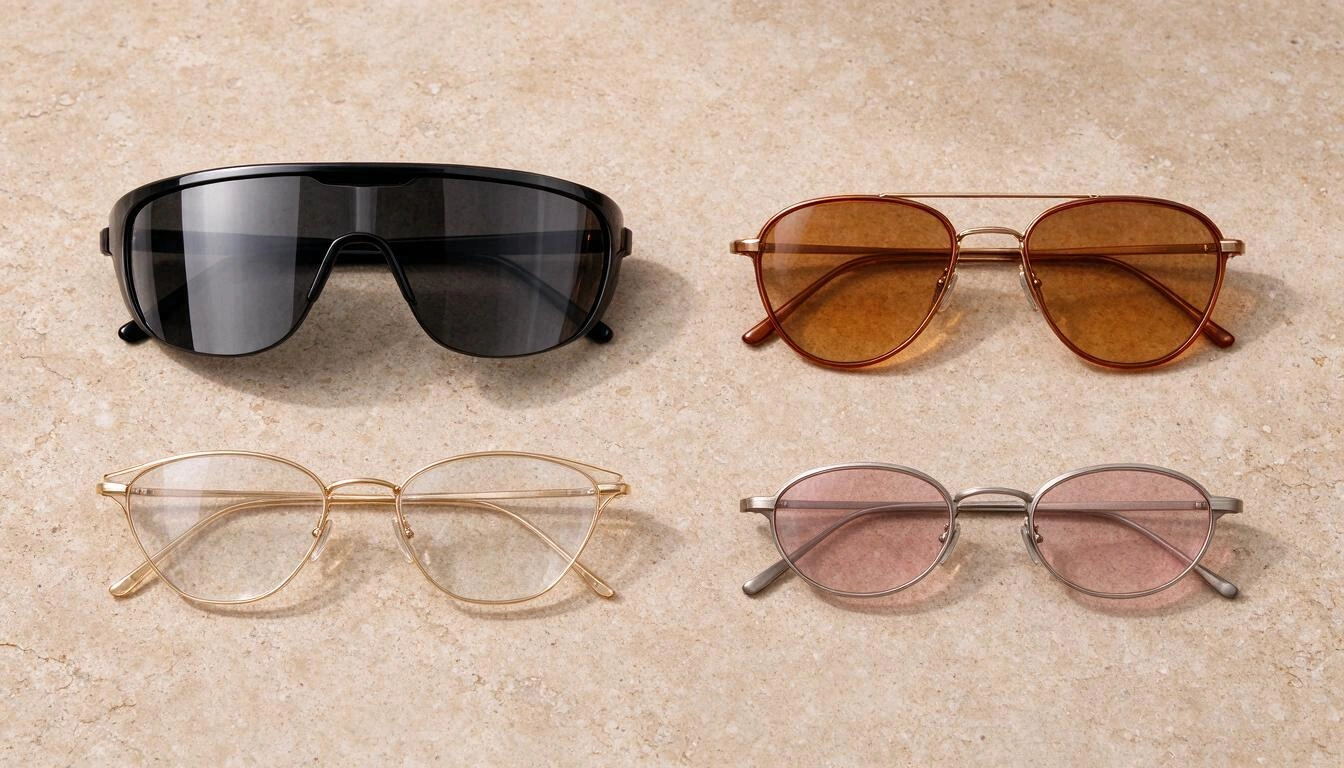
The rule that any optician uses to combine trend and face is simple: contrast and proportion. An angular shape balances a round face; a curved shape softens a square face; a wide frame optically broadens a narrow face, and a frame that exceeds the width of the temples makes the face appear larger, not more streamlined.
| Trend 2027 | What it is | Flattering for | Avoid if your face is |
|---|---|---|---|
| Shield / mono-screen | Single curved lens, visor type, rimless or with integrated front | Round, oval, heart (narrow temples) | Wide or square: the screen exceeds the temples |
| Soft and warm aviator | Rounded drop, flatter line, cognac or gold metal, amber lens | Square, heart, oblong | Very marked round: adds curves on curves |
| Fine cat-eye | Narrow acetate or metal, gentle lift at the corners | Square, rectangle, diamond, angular jaw | Heart with very wide forehead: reinforces the upper part |
| Minimal oval | Rounded geometry, compact proportion, fine metal or titanium | Elongated, oblong, rectangle | Round: blurs the contour instead of structuring it |
Shield and single-lens: the award-winning but most selective trend
The shield or single-lens is the strongest trend of 2027 —it’s the category that won Victoria Beckham at the SILMO d'Or 2026— and also the most demanding with morphology: it works on round and oval faces because it introduces a clean horizontal line that structures, and fails on wide or square faces, where the lens exceeds the temples and turns the face into a block.
The technical key is a single measure: the total width of the frame against the width of your face at the level of the temples. If the lens sticks out beyond the temples, the glasses are sending the opposite message to what you want. Two corrections that do work:
- Choose a shield with high curvature and narrow front instead of a flat and wide one.
- Look for rimless versions, which visually weigh less and reduce the block effect.
Finewell classifies the oversized shield as a style of fashion-forward and streetwear brands, with high-contrast mirror finishes, in its review of seven sunglasses styles for 2027 published on October 23, 2026. Translation for the buyer: it’s a shape with a lot of personality and little margin for error.
Softened and warm aviator: the wildcard for square and heart-shaped faces
The aviator of 2027 is not the usual one: it comes with flatter lens profiles, double bridge, warm metals (cognac, antique gold) and brown or amber gradient lenses. That combination of rounded drop and warm tone is what makes it the best wildcard for square faces —the curve breaks the angularity of the jaw— and for heart-shaped faces, because the width is concentrated at the top and the drop tapers down.
What you need to watch is the lens size: in 2027 the aviator comes in large versions, and a drop that falls below the cheekbone visually drags down the lower half of the face. If your face is small or very round, look for a short lens aviator with a high bridge.
Thin cat-eye: the shape that balances an angular jaw
The cat-eye of 2027 thins out: narrow acetate or fine metal, soft lift at the corners, and clean rod profile, according to the same Finewell report. It is the most effective shape for square and rectangular faces, because the lift at the corners elevates the gaze and diverts attention from an angular jaw; it also works very well on diamond faces, adding volume to the upper area.
Where it’s advisable to hold back is on the heart-shaped face with a wide forehead: the cat-eye adds visual weight exactly where there is already too much. If this is your case and you like the trend, choose a nearly flat lift and a frame whose widest point is below the eyebrow line.
Minimal oval and lightweight titanium: the answer for elongated faces
The minimal oval —rounded geometry, compact proportion, fine metal or titanium— is the trend designed for elongated, oblong, and rectangular faces: being taller than wide in visual proportion and with a curved contour, it cuts verticality and optically shortens the face. Titanium arrived endorsed from the fair: the SILMO d'Or for sunglasses recognized a monoblock front of Japanese titanium (Brett Ferdinand Sun C06).
What doesn’t work is the oval on a round face: curve over curve blurs the contour instead of structuring it. And at the opposite end of the catalog are the new volume acetates —like the Paloceras Pebble RX, carved from solid 8 mm acetate—, which provide exactly the opposite: mass and sculpture, ideal for those who need to add presence to the middle third of the face.
How to choose the color of the frame according to your skin undertone
The shape decides if the glasses suit you; the color decides if it lights you up or dulls you. The practical rule is to cross the trend with your undertone (warm, cool, or neutral) and, if you know it, with your sub-color station: warm undertones call for Havana, cognac, antique gold, and amber; cool undertones call for gunmetal, smoke gray, blue, and cool pinks like blush; neutrals can take both and win with translucent tortoise.
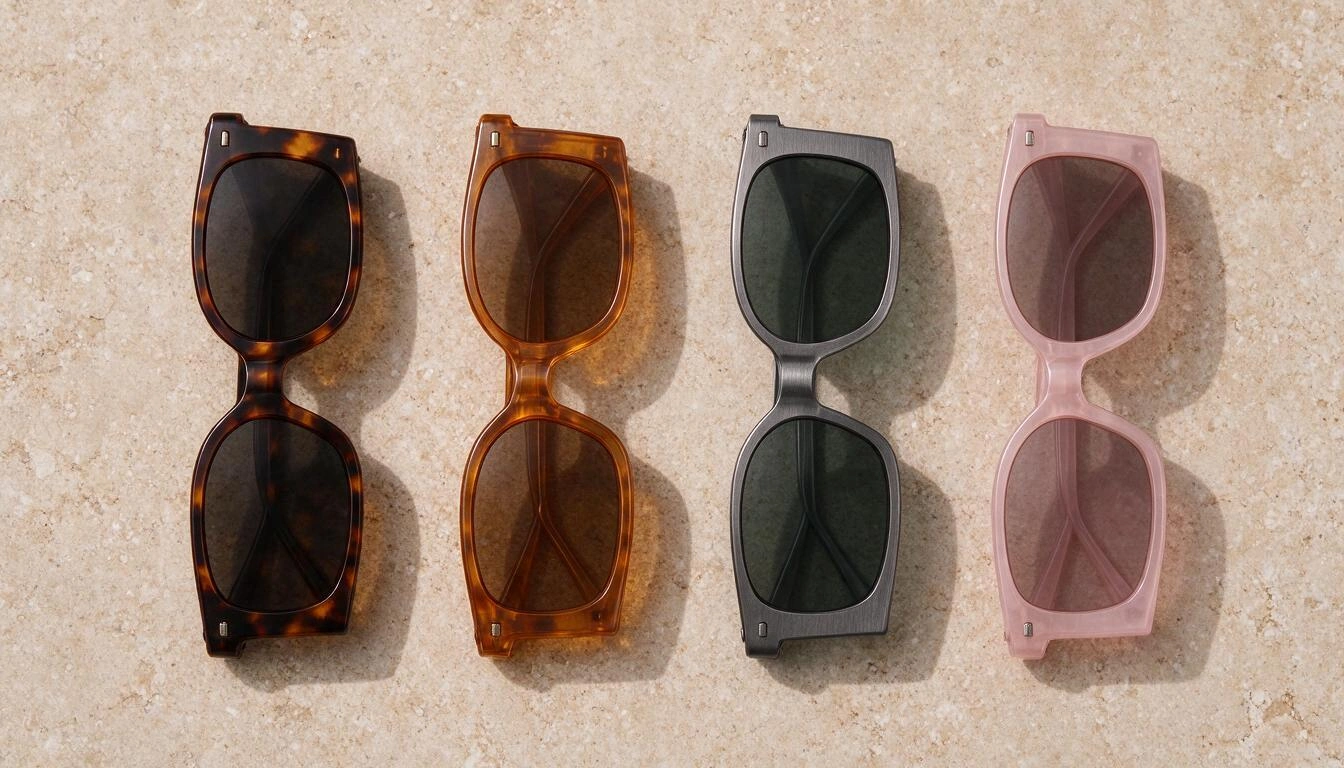
Eyewear Beyond points out for 2027 the tinted transparencies (smoke crystal, champagne, tea, amber crystal), the marbled acetates with a natural or fossil effect, and fine and rimless metal as color and material axes. They are very appreciated palettes because they allow some of the skin tone to show through the frame and do not compete with the face.
| Color 2027 | Illuminating undertone | Trend it combines with | Risk |
|---|---|---|---|
| Havana / tortoise | Warm and neutral | Warm aviator, thin cat-eye | On very cool skin, it can dull and yellow |
| Translucent cognac | Warm | Aviator, minimal oval, volume acetates | If your hair and skin are the same tone, it disappears |
| Gunmetal | Cool and neutral | Shield, minimal titanium oval | On warm skin, it hardens and highlights dark circles |
| Blush / powdery pink | Cool and neutral | Thin cat-eye, minimal oval | On very pink skin, it reddens the face |
Quick rule: if trying on a frame makes your dark circles look more pronounced or your skin look grayer, the color is poorly chosen even if the shape is perfect.
Clear lenses are the big novelty of 2027 (and here’s the catch)
The most visible change of 2027 is the shift from very dark lenses to clear or lightly tinted lenses: pink, amber, soft blue, and green, often in gradient. The catch is that many people associate "dark" with "protects," and that's false: darkness, mirroring, and ultraviolet protection are independent characteristics.
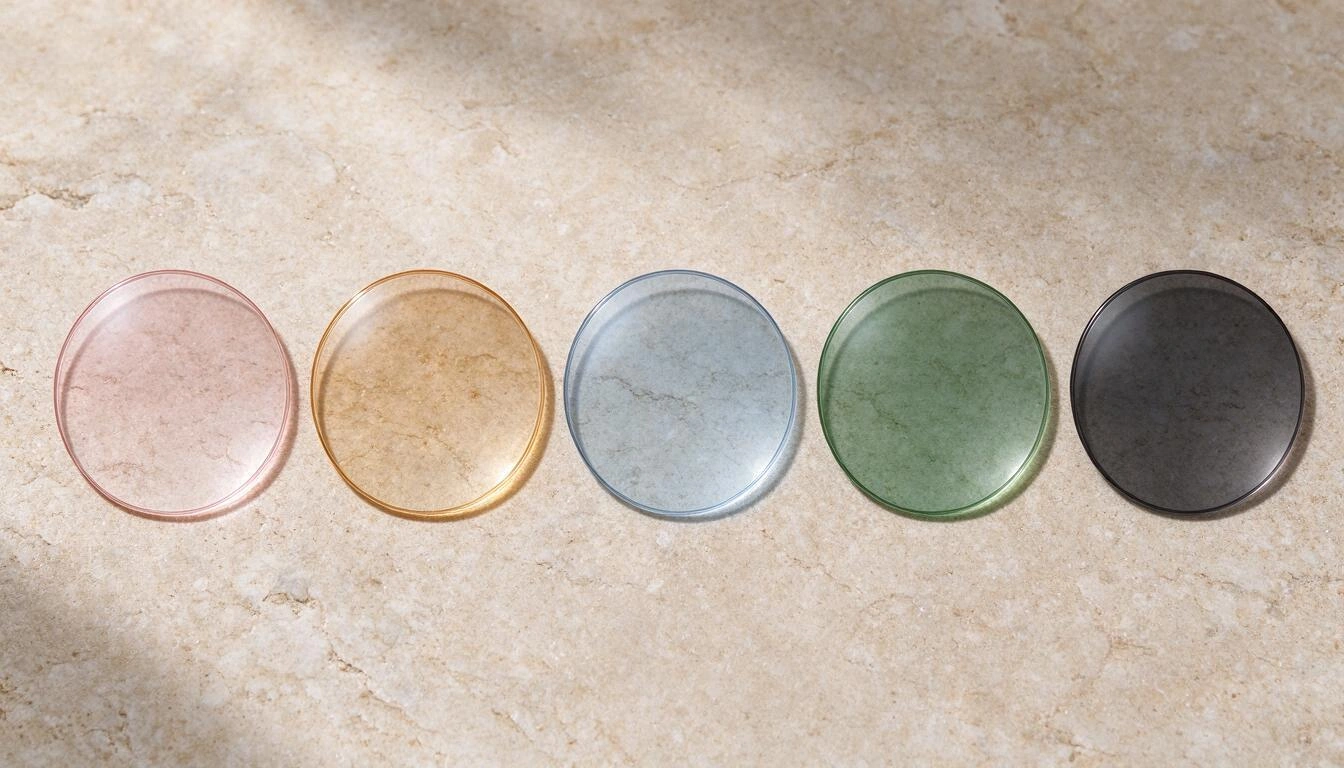
The technical blog of Solextrem explains what UV400 means straightforwardly in an article from September 16, 2026: "a very black lens may provide little protection against ultraviolet radiation, while a clear lens can block it excellently if it has an appropriate filter." Darkness reduces visible light; the UV filter is a separate treatment. Polarization, in turn, reduces glare but also does not guarantee UV400.
The real risk is not the certified clear lens, but the uncertified dark lens. The European Consumer Centre in Spain warns that poor-quality glasses "can be more harmful to the eyes than not using any protection," because the dark lens dilates the pupil and lets in more radiation. Its regulatory reference is Regulation (EU) 2016/425 on personal protective equipment and the ISO 12312-1:2013 standard.
In the same vein, Dr. Emilio Dorronzoro, head of the Ophthalmology Service at Sanitas La Moraleja University Hospital in Madrid, recommended on September 3, 2026, in Libertad Digital to check for 100% UVA and UVB blocking or the UV400 filter, use wraparound and large-sized frames to reduce side light entry, not to rely solely on contact lenses, and also to protect oneself on cloudy days, because radiation reflects off water, sand, or asphalt. In other words: the trend of the wraparound shield, well-certified, is also the healthiest.
Which filter category to choose (and why category 4 is not suitable for driving)
Filter categories range from 0 to 4 and describe how much visible light passes through, not UV protection. For urban and city use, the usual is category 2; for countryside, beach, and intense sun, category 3; category 4 is for high mountains and water sports and is not allowed for driving, not even during the day.
| Category | Level of light filtered | Typical use | Driving |
|---|---|---|---|
| 0 | Very low protection | Aesthetic, indoors | Allowed during the day |
| 1 | Low | Low brightness, cloudy days | Allowed during the day |
| 2 | Good | City, sports, normal light | Allowed and recommended |
| 3 | High | Countryside, beach, intense sun | Allowed and recommended in summer |
| 4 | Very high | High mountains, water sports | Prohibited, even during the day |
Source of the categories: European Consumer Centre in Spain (Regulation EU 2016/425 and ISO 12312-1:2013) and RACE, which in an article from May 15, 2026, reminds that category 4 lenses block between 93% and 96% of light, that their use while driving can incur up to €200 in fines and that the most suitable colors for driving are brown or amber (improves contrast and depth perception), green (reduces glare without altering colors), and gray. Category 4 lenses also have a pictogram of a car crossed out.
This has a direct consequence on the trend of 2027: a pale pink or clear amber lens can indeed be UV400 and perfectly valid for driving, while a very dark category 4 shield bought at a bazaar is, at the same time, useless for the car and potentially worse than not wearing anything.
Checklist: what to demand on the label before paying
Before paying for trendy sunglasses, check five things on the label and on the arm. If any of them are missing, the glasses are an accessory, not protection.
- Visible CE marking, in accordance with Regulation (EU) 2016/425 on personal protective equipment.
- UV400 or "100% UVA/UVB protection" explicitly stated, not inferred from the lens color.
- Reference to ISO 12312-1 and filter category (0–4) indicated.
- That the category matches your actual use: 2–3 if you are going to drive, never 4.
- Buy at optical or specialized establishments, not at gas stations or bazaars, as recommended by the European Consumer Centre.
Why November is a Good Time to Renew and Plan for the 2027 Season
November concentrates discounts on the outgoing collection just when the directions for the following year are known: you can buy the 2027 trend that is already on the market in the previous season's version, or wait until spring knowing exactly what to look for. What is not advisable is to buy blindly, because sunglasses have become more expensive.
Data from the Spanish market confirms this. According to the White Paper on Vision 2026 from FEDAO, reported by Optimoda in its analysis of the optical market on October 9, 2026, in 2025, 3,674,542 sunglasses (–0.77 %) were sold in Spain for €315.6 million (+3.74 %), with an average price of €85.88 (+4.54 %). In other words: fewer units are sold, but at higher prices. Making a mistake in shape or color costs a little more each year.
| Indicator (Spain, 2025) | Value | Variation |
|---|---|---|
| Units of sunglasses sold | 3,674,542 | –0.77 % |
| Revenue | €315.6 M | +3.74 % |
| Average price per pair | €85.88 | +4.54 % |
How to Know Which 2027 Trend Really Suits You Before Buying
The problem with any face shape guide is the first step: almost no one knows for sure if their face is oval, diamond, or pear-shaped, and most self-classify incorrectly. To solve this, AIsToHire offers aiShades, a study with AI of the ideal frame and tint for your face: you upload a photo and it returns an infographic with the frame shapes, tint and lens color, finish, and style that suit you best.
Specifically, according to what the app does:
- It classifies your face into 9 categories (oval, round, square, heart, diamond, oblong, rectangle, triangle, and pear) by crossing measured proportions with AI analysis.
- It maps 478 facial points on your photo, and the geometry is calculated on your own device.
- If your face is between two shapes, it states: it returns the primary shape and the secondary ("oval tending to heart") and adjusts the recommendations accordingly.
- It gives you your color palette —tint and lens color, finish— so that the frame color does not wash out your face.
- It includes a try-on feature to see how the frames look before buying, and it also tells you which shapes and colors to avoid.
With that, the question "Will the 2027 shield look good on me?" stops being an average €85 gamble.
Frequently Asked Questions About 2027 Sunglasses Trends
What shape of sunglasses will be in style in 2027?
Four families at once: the shield or mono-screen, the softened aviator with warm metals and amber lenses, the fine cat-eye, and the minimal oval. There is no single dominant silhouette; what changes are the proportions (greater curvature, flatter lines, thinner frames) and materials, with lightweight titanium and sculpted volume acetates.
Do clear lens sunglasses provide less sun protection?
Not necessarily. The darkness of the lens filters visible light, but ultraviolet protection depends on the applied filter, not the color: a clear lens with UV400 blocks UV radiation better than a very dark lens without certification. The dangerous one is the dark lens without a filter, because it dilates the pupil and lets in more radiation.
Can you drive with category 4 sunglasses?
No. Category 4 is not permitted for driving, not even during the day, because it blocks between 93% and 96% of light; according to RACE, using them while driving can result in a fine of up to €200. Categories 2 and 3 are recommended for driving, in brown, green, or gray.
What sunglasses suit me if I have a round face?
Shapes that add structure and lines: the shield with its clean horizontal line, the fine cat-eye, or a square with soft corners. It is advisable to avoid the minimal oval and small round shapes, as they add curves on curves and blur the outline.
What if I have a square face or a very defined jawline?
The softened aviator and the fine cat-eye are the two best bets for 2027: the rounded drop breaks the angularity, and the lift of the cat-eye elevates the gaze, diverting attention from the jawline. What usually fails is the wide shield, which, by exceeding the temples, reinforces the block effect.
How do I know if Havana, cognac, gunmetal, or blush suits me best?
It depends on your skin's undertone: Havana and cognac brighten warm undertones; gunmetal and blush work for cool and neutral undertones. The practical test is to look in the mirror with the frame on: if the dark circles are more pronounced or the skin looks grayish, the color is poorly chosen even if the shape is correct.
What do UV400, CE, and ISO 12312-1 mean exactly?
UV400 indicates that the lens blocks ultraviolet radiation up to 400 nanometers, meaning UVA and UVB. The CE marking certifies compliance with Regulation (EU) 2016/425 on personal protective equipment, and ISO 12312-1:2013 is the technical standard that defines the requirements for solar filters and their categories from 0 to 4.
Is it worth buying sunglasses in November?
Yes, if you know what you are looking for: in November there are discounts on the outgoing collection, and the directions for 2027 are already known, so you can buy a shape that will remain relevant. With an average price of €85.88 per pair in Spain in 2025 according to FEDAO, the cost of making a mistake in shape or color is not trivial.
Conclusion: the trend that suits you is the one that respects your face and your eyes
From SILMO Paris 2026, two lists emerge: the one of shapes that will be sold in 2027 —shield, warm aviator, fine cat-eye, minimal oval, titanium, and sculpted acetate— and the one of shapes that will look good on you, which is much shorter and depends on your morphology, your undertone, and increasingly, that the clear lens you like is actually certified. Check UV400, CE, and ISO 12312-1, don’t take a category 4 if you are going to drive, and measure the frame against the width of your temples before paying.
And for the first step, to truly know what shape of face you have, AIsToHire offers you aiShades: their sunglasses analysis by face shape and colorimetry tells you your shape among 9 categories with 478 facial points, your personal palette, which trends of 2027 suit you and which to avoid, and lets you see them on in a try-on before spending a euro.
Upload a photo to aiShades and discover your face shape among 9 categories, your personal palette, and which 2027 sunglasses trends truly flatter you: including shapes and colors to avoid and a try-on feature to see them on before you buy.
Upload a photo to aiShades and discover your face shape among 9 categories, your personal palette, and which 2027 sunglasses trends truly flatter you: including shapes and colors to avoid and a try-on feature to see them on before you buy.Keep reading
View all articles →
Which sunglasses look good on me: a guide by face shape (with the measurements that really matter)

Discussing via WhatsApp or talking in person: what science says about couple conflicts through messages

Mind map, concept map, and outline: differences and when to use each one