 Zuki Trace & Read
Where to start each letter: stroke order and how to teach the alphabet
Team at Zuki Trace & ReadWritten with AI assistance20 min readIn summary
- There is no official stroke order rule for the Latin alphabet. Unlike Chinese or Japanese, where the order is standardized and examined, here each school method chooses its own. However, there is consensus on two rules: top to bottom and left to right.
- The order matters because it becomes automated, not because it looks better. A letter copied starting from the bottom looks similar at 4 years old and becomes slow and illegible by age 8, when one has to write and think at the same time.
- Uppercase letters are taught first because almost all start in the same place. In the model used by Zuki Traza y Lee, 24 out of 27 uppercase letters start at the top line, fit between two lines, and have no descenders. There are 53 strokes in total, 1.96 per letter.
- The order of the letters is not the alphabet. The usual sequence in Spanish starts with the five vowels and continues with M, P, S, L: letters with simple strokes and continuous sounds that can already form real words.
- Zuki Traza y Lee, the children's app from AIsToHire, marks the numbered starting points and the direction of each stroke, cuts the ink to the silhouette of the letter, and checks that the child has gone through all the strokes, not just that they have colored the area. See the app
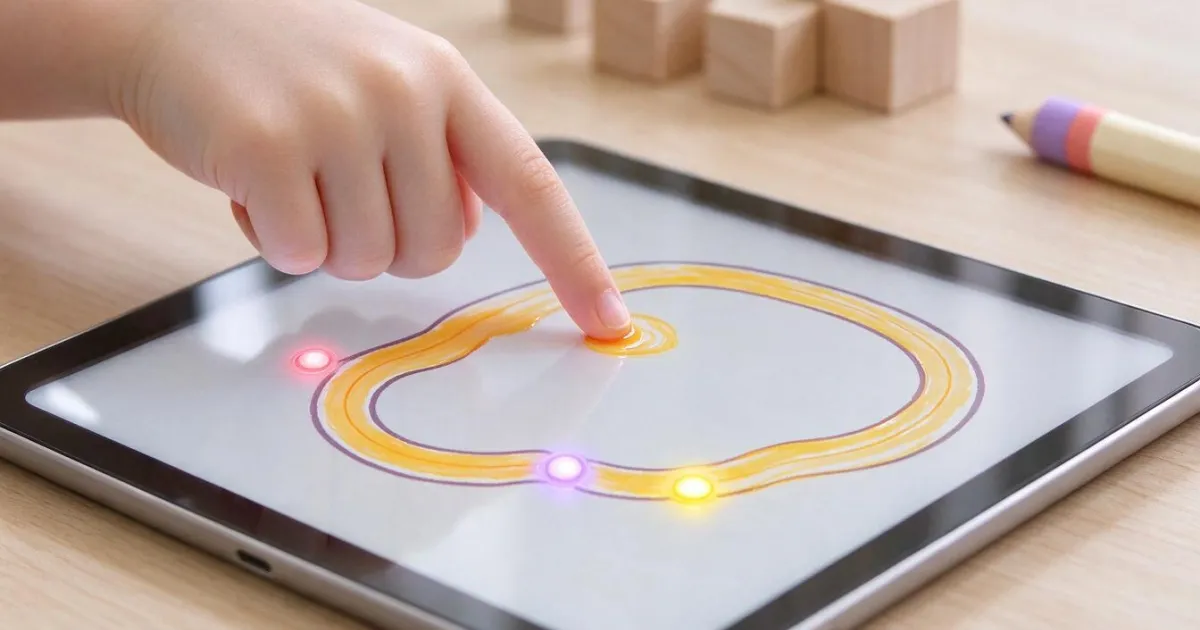
If you've made it this far, it's because your son or daughter is starting with letters and the same question always arises at home: does the M start from the top or the bottom?, does the A start with the stick or the line first?, does it matter if they do it backwards and the letter looks fine?. This guide answers that with concrete data: how many strokes each letter has, where each one starts, in what order it is best to present them, and what errors truly cause problems later on. At the end, you'll see how to practice without worksheets with Zuki Traza y Lee, the literacy app for children aged 3 to 12 from AIsToHire.
This guide is educational material for families and educators. It is not a clinical assessment: if you suspect a learning or motor skill problem, a professional is the one who evaluates it.
Does it matter where you start a letter, or is it enough that it looks good?
It matters, but not for aesthetics: it matters because the stroke becomes automated. A 4-year-old can draw a perfect A starting from the bottom and from the right, and no one will notice the difference when looking at the paper. The problem arises at 7 or 8 years old, when they have to write an entire sentence while thinking about what they want to say: if each letter requires them to decide where to start, they run out of attention before they finish the sentence.
Handwriting works through automatic motor blocks. When the stroke order is always the same, the hand executes it on its own and the mind is free for spelling and content. When each letter is made differently depending on the day, the hand never manages to automate anything.
There are three practical consequences of a poorly established stroke order, and all three are seen in class much earlier than at home:
- Slowness. The child writes well but doesn’t finish. They copy half the board while others finish.
- Degraded handwriting when gaining speed. Calmly it is legible; in a dictation, it falls apart.
- Impossible connections. If the letter starts where it should end, the pen ends up in the wrong place and connecting letters becomes a mess.
Useful fact to avoid getting overwhelmed: in Spain, Early Childhood Education is not mandatory and the curriculum for ages 3-6 (Royal Decree 95/2022, of February 1, BOE of February 2, 2022) presents writing as an approximation to written language, without establishing a sequence of letters or a stroke order. Writing as an assessable objective appears in Primary Education, starting at age 6 (Royal Decree 157/2022, of March 1, BOE of March 2, 2022). If your 4-year-old daughter still doesn’t write her name, she is not behind: she is at her age.
The rules of directionality that almost all methods agree on
There are four, and they apply to almost all printed letters: start at the top, go from left to right, make the long stroke first, and lift the finger or pencil as little as possible. With these four, you cover the vast majority of uppercase letters without having to memorize 27 recipes.
| Rule | What it means | Clear examples |
|---|---|---|
| From top to bottom | The vertical stroke goes down, never up | L, T, P, B, D, F, E, H |
| From left to right | Horizontal bars are made to the right | E (its three bars), F, H, T |
| First the skeleton, then the detail | The long stroke marks the size; the rest fits inside | B, P, R (first the stick, then the bellies) |
| Fewer lifts, better | If it can be done in one continuous stroke, better | C, O, S, U, V, W, Z, M, N |
And two important warnings about what there is no consensus on:
- Closed ovals (O, a, d, g, q, 0). Most Spanish school methods teach them counterclockwise, starting towards the "two o'clock" position, because this prepares for the connection of the joined letter. Other methods and traditions do them clockwise from above. It is not a battle worth fighting at home: what matters is that the child always does it the same way. If they are taught a specific one at school, that is the one to reinforce.
- The M and the N. Some methods start them from the top left going down, and some methods start them from the bottom going up, to be able to do them in one stroke without lifting the hand. Both options are defensible; mixing them is not.
How many strokes does each uppercase letter have
In the stroke model used by Zuki Traza and Lee, the 27 uppercase letters of Spanish are written with 53 strokes in total, an average of 1.96 per letter, and 24 of the 27 start at the top line. That last fact is the real reason why uppercase letters come before lowercase: it’s not that they have fewer strokes, it’s that almost all are approached from the same point and all fit between two lines.
| Strokes | Letters | How many |
|---|---|---|
| 1 stroke (without lifting the hand) | C · J · M · N · O · S · U · V · W · Z | 10 |
| 2 strokes | D · G · L · P · Q · T · X · Y · Ñ | 9 |
| 3 strokes | A · B · F · H · I · K · R | 7 |
| 4 strokes | E | 1 |
Two practical readings of this table:
- The ones with a single stroke are the first candidates. C, O, S, U, V, Z do not require lifting the hand or repositioning it: for a hand of 3-4 years, that’s half the difficulty.
- The E is the most expensive of all (four strokes: the stick and three bars) and yet it is usually one of the first taught because it is a vowel. It’s good to know this so as not to be surprised that it costs more than the O.
In lowercase, the distribution changes: the same 27 letters total 48 strokes, five fewer than in uppercase because many (c, e, l, o, s, u, v, w, z) are resolved in a single pass. And even with fewer strokes, they are more difficult because the points of i and j appear, the descenders that go below the baseline (g, j, p, q, y), and three different heights to fit into the pattern instead of one.
In what order are the letters taught? Not by the alphabet
The alphabet is useful for looking up in the dictionary, not for learning to write. The usual sequence in Spanish starts with the five vowels and continues with consonants that have continuous sound and simple strokes —M, P, S, L— because with them real words can already be formed (MAMÁ, PAPÁ, SOPA, MESA) in the second week. Writing something that means something is what sustains motivation.
This is the seven-chapter plan that Zuki Traza and Lee use for Spanish, and it works just as well with pencil and paper:
| Chapter | Letters | Why they go together |
|---|---|---|
| 1 | A · E · I · O · U | The vowels: without them, no possible syllable |
| 2 | M · P · S · L | Continuous consonants and simple strokes: first real words |
| 3 | T · D · N · F | They remain stable sounds and straight strokes |
| 4 | C · B · V · R | The first sound confusions appear (b/v) and the double r |
| 5 | G · J · H · Ñ | Letters with variable or silent sounds: need explanation |
| 6 | Q · Y · Z · CH · LL | Digraphs and fixed combinations |
| 7 | K · W · X | The rarely used ones in Spanish, at the end |
The criterion for moving from chapter to chapter is not the calendar, it’s mastery. In the app, a chapter is considered passed when 80% of its letters are in green, and a letter only turns green with at least 3 attempts, 90% accuracy, and an average stroke coverage of 90% (or two correct on the first try). At home, the non-technology version is the same idea: don’t move on to the next letter just because it’s time, move on when it’s done three different days without help.
The five mistakes that turn letters into a problem
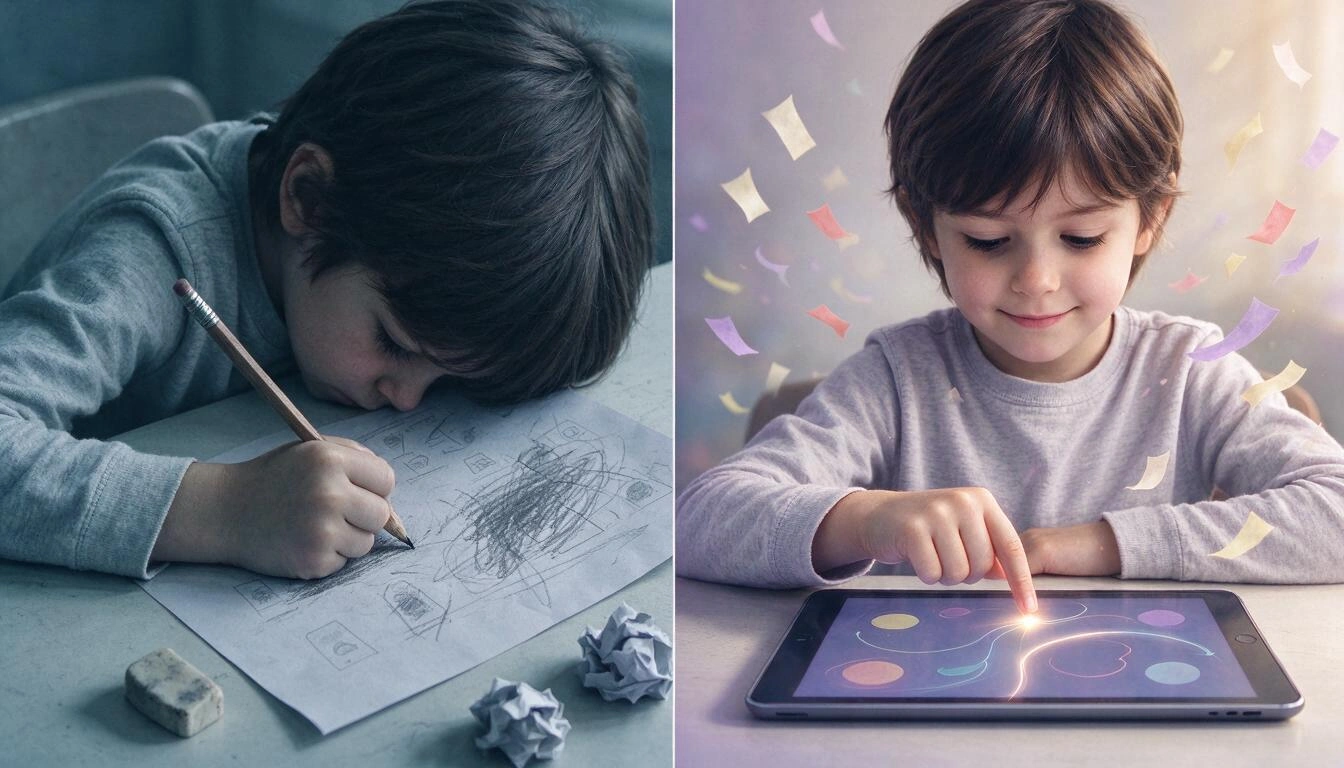
The most costly mistake is not tracing a letter wrong: it’s correcting aloud while the child traces. Immediate correction breaks the motor execution just when it is forming, and also associates writing with "they are going to tell me it’s wrong." These are the five that are most repeated, with their alternative.
| Common mistake | Why it fails | What to do instead |
|---|---|---|
| Saying "no, not like that" in the middle of the stroke | Cuts the motor gesture and loads the moment with tension | Let them finish, and then do it yourself in front, slowly, without comments |
| Starting with lowercase or cursive | Different heights, descenders, and links: three difficulties at once | Print uppercase first; lowercase when they master 10-12 uppercase |
| Using the sheet of "trace 20 times the A" | By the fourth repetition, they no longer look at the model, repeat their own mistake | Few repetitions (4-6) with the model in front and a break |
| Starting with their name if it has difficult letters | "Guillermo" has G, LL, and R too soon | Start with the vowels of their name and add letters as they come up |
| Presenting the letter alone, without sound or word | The letter remains a drawing and does not connect with reading | Say the sound (/mmm/, not "eme") and a word that starts with it |
And one mistake from adults, not the child: measuring progress by the number of sheets. Ten minutes well done are worth more than an hour of sheets. The World Health Organization, in its guidelines from April 2019 on physical activity, sedentary behavior, and sleep in children under 5 years, recommends not exceeding 1 hour a day of sedentary screen time between ages 2 and 4, and the less, the better. The American Academy of Pediatrics has maintained a similar limit of 1 hour daily of quality content between ages 2 and 5 since 2016. To practice letters, 10-15 minutes is more than enough.
How to practice stroke order with Zuki Trace and Read
Zuki Trace and Read solves stroke order with three things that a piece of paper cannot do: it marks the starting point of each stroke with a number and its direction, cuts the ink to the silhouette of the letter —the scribble outside simply does not paint— and checks at the end that the child has gone through all the strokes, not just that they have darkened an area.
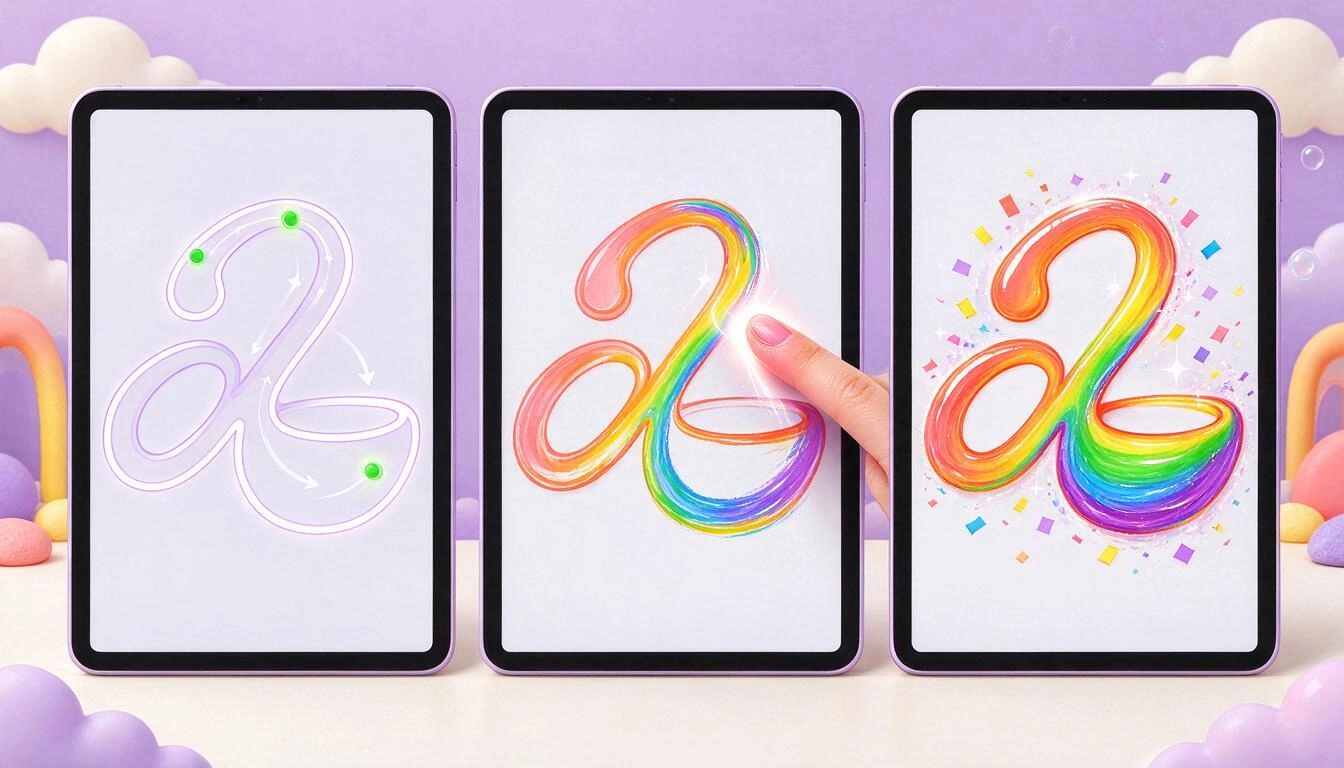
The session is always 6 items and works like this:
- The hollow letter appears with the numbered starting points and, if activated, an animated guide that travels the correct path once.
- The child fills in with their finger. The ink is cut against a tolerance area around the stroke: a shaky pulse counts, going outside does not penalize, there is no error message.
- It validates upon release. If an area is missing, the gaps light up; if it is complete, confetti and the next item. It is never said that they did it wrong: it is tried again.
The aids are not fixed: there are three levels of demand, and the adult changes them from the settings (behind a 3-second gesture, so the child does not enter).
| Easy | Normal | Hard | |
|---|---|---|---|
| Minimum coverage to consider the letter good | 70 % | 82 % | 90 % |
| Tolerance margin outside the stroke | 24 px | 12 px | 4 px |
| Letter silhouette visible | 100 % | 70 % | 20 % |
| Numbered starting points | Yes | Yes | No |
| Animated guide | Yes | Yes | No |
| Requires ink on all strokes | No | Yes (25 % of each stroke) | Yes (45 % of each stroke) |
| Final step "from memory", without silhouette | No | No | Yes |
The tutorial for the first time uses an even lower threshold (60 % coverage and 30 px margin) and celebrates the same even if it doesn't work out: the first experience cannot be a failure.
In addition to letters, the app practices syllables, words, numbers, pre-writing shapes (vertical line, horizontal line, circle, cross, square, triangle, zigzag, and wave) and word lists that the adult writes —up to 12 lists of 30 words— which is the way to input the words that are actually being taught in class that week. The vocabulary for each session is generated by AI according to age, language, and chosen topic (animals, colors, family, body, food, house, school), without repeating what was in the previous session and revisiting the letters that are struggling the most.
What the adult sees, and the sheet to transition from screen to paper
The adult panel provides four things: points and time played, session history, a mastery map letter by letter in four colors (green, blue, yellow, red), and a list of weak items. That is what turns the game into useful information: not "has played 20 minutes", but "S and R are in red".
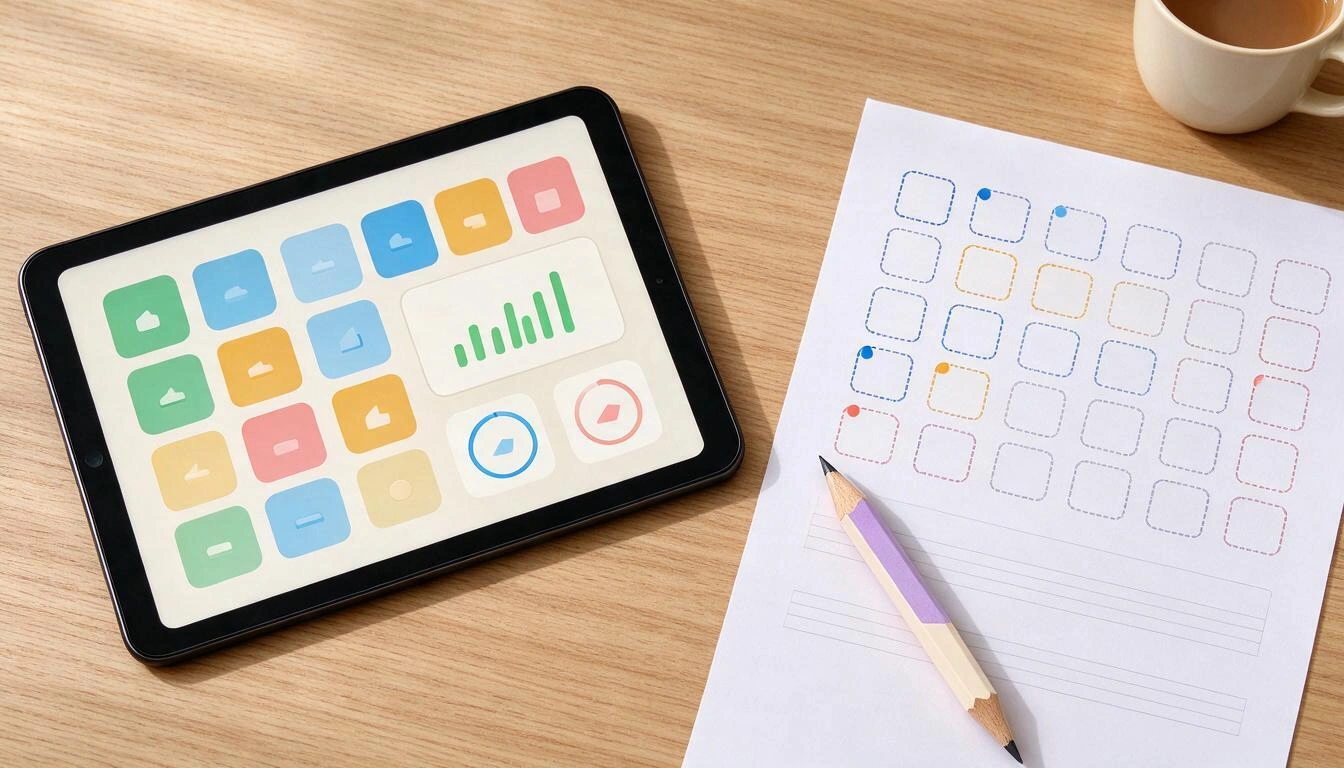
And there is one piece that matters much more than it seems: the printable sheet. At the end of a session, an A4 sheet (a PNG image at about 150 ppi, 1240 × 1754 px) can be generated with the same items just practiced, in three blocks:
- The model of each letter with its numbered starting points, the same as on the screen.
- Two dotted rows to review on top with a pencil.
- One blank row with guidelines to write it alone.
Thus the finger and the pencil practice the same thing, with the same stroke order. The app does not replace the pencil: it prepares the way. The grip of the pencil, the pressure, and the posture can only be trained with a real pencil.
The difficulty also adjusts itself between sessions if you leave it activated: a perfect session with average coverage above 90 % goes up a level (up to two), and three skipped items go down one. And there are settings designed so that the app does not interfere: uppercase, lowercase, or both; three types of font (school, rounded, bold); left-handed mode; voice speed; daily play time of 8, 15, 20, or 30 minutes with a break reminder; posture reminder; and three support presets (dyslexia, ASD, motor skills) that group the recommended comfort adjustments —these are accessibility adjustments, not a treatment or diagnosis.
What the app does not do (and it is good to know this beforehand)
Zuki Trace and Read practices the tracing of print letters and reading aloud; it does not teach cursive or connected letters, does not diagnose anything, and does not replace school or the pencil.
I say it explicitly so that no one is surprised:
- There is no cursive or connected letters. The stroke model is of print letters (uppercase and lowercase). If they work on cursive in school, the app does not cover that part.
- It is not a diagnostic tool. The mastery map indicates which letters are difficult for them in the app, nothing more. A suspicion of dysgraphia, dyslexia, or motor difficulty is evaluated by a professional, not a screen.
- It does not record the child's voice. In reading mode, voice recognition is done by the device itself; only whether it guessed right or not travels to the server. There are also no ads, external links, or chat.
- It does not train grip or pencil pressure. That is finger on glass; the other is pencil on paper. That is why the printable sheet exists.
- It does not replace reading with them. No app does.
A 10-minute-a-day plan that actually works
This is what I would do with a 4-5 year old who is just starting, splitting ten minutes between screen and paper:
- Minute 0-1 · Choose two letters. Those from the current chapter, or those that appear in red on the domain map. Two, not eight.
- Minute 1-2 · Say the sound, not the name. /sss/, not "ese". And a word that starts that way, theirs: the dog's name is worth more than "snake".
- Minute 2-6 · A session of 6 items in the app, with the starting points and guidance activated. Four minutes, no more.
- Minute 6-9 · The printed sheet. Two dotted rows with a pencil and a single row. This is where grip is worked on.
- Minute 9-10 · Write something useful. Their name on a drawing, the shopping list, a note for grandma. Writing has to serve a purpose or it stays as an exercise.
And the golden rule: if they don’t want to today, today it’s not happening. A lost day is nothing; associating letters with anger takes months to undo.
Frequently Asked Questions
Where do you start writing the A?
In the stroke model of Zuki Traza y Lee, the uppercase A has three strokes and all three are done from top to bottom or from left to right: first the left diagonal from the top vertex to the base, then the right diagonal from the same vertex, and finally the middle horizontal bar, from left to right. This is the most common order in Spanish school methods. The essential thing is not which of the two diagonals comes first, but that it starts from the top vertex and goes down, and that the bar is last.
Is it true that the M starts from the bottom?
It depends on the method, and both exist. There are methods that start it from the top left going down, and methods —like the model used in the app— that start it at the baseline and go up, because this way the entire M comes out in one stroke without lifting the hand. Neither is "the incorrect one". What is a problem is if the child changes criteria every day: choose the one they are taught at school and stick with it.
Are uppercase or lowercase letters taught first?
Almost always uppercase print letters first, and for a measurable reason: 24 of the 27 start in the same place, the top line, and all fit between two lines, without descenders or intermediate heights. It’s not a matter of the number of strokes —uppercase letters total 53 and lowercase 48— but of how many different decisions the hand has to make. Lowercase letters fit well when they have already mastered 10-12 uppercase letters, usually around 5 years old.
At what age should they know how to write their name?
There is no mandatory age. In Spain, the Early Childhood Education curriculum (Royal Decree 95/2022) considers writing from 3 to 6 years as an approximation, without specific letter objectives, and assessable writing starts in Primary School, at 6 years (Royal Decree 157/2022). In practice, many children write their name in uppercase between 4 and 5, but the normal range is very wide. If by the age of 6 they still can’t and also struggle with the strokes, consult with their tutor.
Does tracing with a finger on a tablet help, or is it a waste of time?
It serves a specific part: the sequence and direction of the stroke, which is what automates the shape of the letter. What it does not train is the grip of the pencil, the pressure, or the hand posture, which can only be achieved with a real pencil. That’s why it makes sense to combine: the screen to fix the path and the paper for the hand. Zuki Traza y Lee generates a printable A4 sheet with the same items from the session just for that.
How much screen time per day is reasonable for this?
Little, and for health recommendations, not whims. The WHO, in its guidelines from April 2019, recommends not exceeding 1 hour of sedentary screen time between ages 2 and 4; the American Academy of Pediatrics has maintained a limit of 1 hour of quality content between ages 2 and 5 since 2016. For practicing letters, 10-15 minutes is sufficient. The app allows setting a daily limit of 8, 15, 20, or 30 minutes and alerts when it’s time to take a break.
My child writes some letters backwards, is it dyslexia?
Reversing letters (the E, the S, the 3) is normal until well into 6-7 years: at that age the brain is still learning that, unlike an object, a letter changes identity if you turn it. It is not, by itself, a sign of dyslexia. What does deserve a consultation with the tutor or a professional is if the reversal clearly persists past 7 years, or if it comes with significant difficulty recognizing the sounds of the letters. An app does not diagnose this; a professional does.
Is it suitable for a left-handed child?
Yes. In the settings, there is a left-handed mode, and tracing with a finger avoids the classic problem left-handers have with pencils: covering what they just wrote with their hand. The stroke order is the same for both left-handed and right-handed; what changes is the placement of the paper and the tilt of the hand, and that is worked on with a pencil.
Does it work in other languages besides Spanish?
Yes: the content can be practiced in Spanish, English, French, German, Italian, and Portuguese, and each language has its own letter plan. The app’s language and the language practiced are chosen separately, so a child can have the interface in Spanish and practice letters in English.
And what if I have two or three children?
Up to 8 profiles can fit per account, each with their age, avatar, progress, chapter plan, and settings. Nothing gets mixed: one’s domain map does not contaminate the other’s.
In a nutshell
Zuki Trace and Read is the children's reading and writing app from AIsToHire for kids aged 3 to 12: it teaches the order and direction of strokes with numbered starting points and animated guidance, checks that the stroke covers the entire letter, adapts the vocabulary to the age and language, and generates a printable A4 sheet for continued practice with a pencil. It is available at aistohire.com/es/zuki-trace-read-aprender-escribir-leer-153.
Last reviewed: October 25, 2026. The stroke data per letter and the chapter plan come from the glyph model of the app itself; the cited regulations are Royal Decree 95/2022 (BOE 2-Feb-2022) and Royal Decree 157/2022 (BOE 2-Mar-2022); the screen time recommendations, the WHO guidelines from April 2019, and the statement from the American Academy of Pediatrics from 2016.
Try Zuki Traza y Lee for free: create your child's profile in one minute, complete a session of 6 letters with the starting points marked, and see on the mastery map which ones they have mastered and which ones need review. At the end, you can print the A4 sheet and continue with a pencil.
Try Zuki Traza y Lee for free: create your child's profile in one minute, complete a session of 6 letters with the starting points marked, and see on the mastery map which ones they have mastered and which ones need review. At the end, you can print the A4 sheet and continue with a pencil.Keep reading
View all articles →
Zero screen in Early Childhood and Primary: how many minutes of tablet make sense at home to learn to read and write
Why Your Car Insurance Increased in 2026: Average Premium of €1,412 and Historic Record
Discussing via WhatsApp or talking in person: what science says about couple conflicts through messages