 Zuki Match
Attention Games for Kids: What Really Works and How to Set Up a 5-Minute Routine
Team at Zuki MatchWritten with AI assistance16 min readIn summary
- Attention games reliably improve the task they train; evidence that this improvement transfers to class or homework is scarce (Simons et al., Psychological Science in the Public Interest, October 2016).
- Anyone promising otherwise is on sanctionable ground: the FTC fined Lumosity 2 million dollars on January 5, 2016, for advertising improvements in school and work without sufficient evidence.
- "Attention" is not a single thing. Searching for a drawing among similar ones trains visual search and selective attention, not the ability to hold out for half an hour with a math worksheet.
- The rule of "2-3 minutes of concentration per year of age" is a saying from a popular manual, not a measured fact. What the WHO (2019) and AAP (2016) do recommend is limiting passive screen time for children under 5 years old and accompanying the child while they play.
- Zuki Match, the observation game from AIsToHire, is a concrete way to make that time together: games of 20 cards lasting one or two minutes, two-player mode on the same mobile device, and English mode. It is a game, not an assessment or treatment tool.
If you arrived here searching for "attention games for children" or "exercises for my child to concentrate", you have most likely already seen fifty identical lists. This article goes another way: first what research supports and what it does not, then a five-minute routine that can truly be maintained, and finally how Zuki Match, the observation game for children from AIsToHire (sheet and access to the game). No promises of results: a game does not cure distraction or diagnose anything.
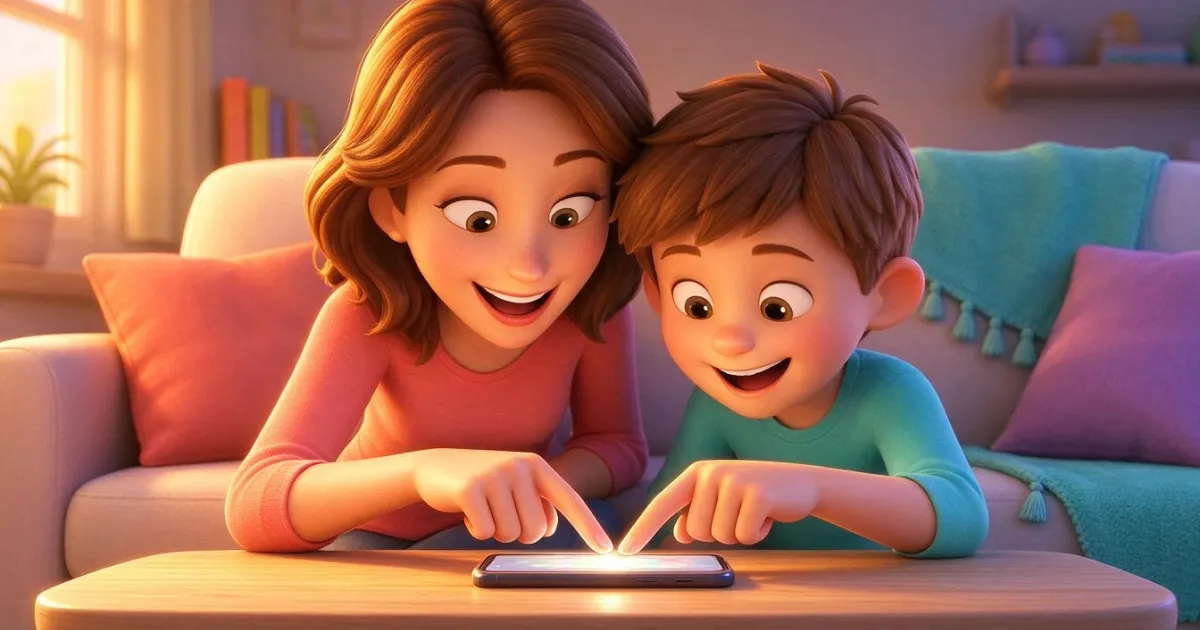
An attention game improves what it trains, not the child's entire life
The most cited review on the subject concludes that there is abundant evidence that cognitive training programs improve trained tasks, less evidence that they improve similar tasks, and very little that they improve distant tasks or everyday cognitive performance (Simons, Boot, Charness, Gathercole, Chabris, Hambrick, and Stine-Morrow, Psychological Science in the Public Interest, 17(3), October 2016). In other words: your child will become quick at searching for symbols, and that does not automatically mean they will finish their homework faster.
This is not a blog opinion. On January 5, 2016, the Federal Trade Commission (FTC) reached a 2 million dollar settlement with Lumos Labs, the company behind Lumosity, for false advertising: their ads suggested that playing a few times a week improved performance in school and work, and even delayed cognitive decline. The FTC determined that there was not enough evidence for those claims.
| What is usually promised | What the evidence supports |
|---|---|
| "Improves concentration in class" | Not proven. Transfer to daily life is precisely what is lacking (Simons et al., 2016) |
| "Trains your child's brain" | Measurable improvement yes, but in the trained task and in very similar tasks |
| "Increases IQ / intelligence" | Working memory training does not improve intelligence measures (Melby-Lervåg, Redick, and Hulme, Perspectives on Psychological Science, 2016) |
| "Prevents or treats ADHD" | A consumer game is not a clinical device. It does not diagnose or treat |
| "Is fun and played together" | This is supported, and it's not insignificant: it’s the part recommended by pediatrics |
The useful question is not "Will this game help my child concentrate?", but "Is this time better than the time they would have had anyway?".
"Attention" is not a single thing, and school demands the hardest one
In the clinic, various types of attention are worked with, not just one. The classic model of Sohlberg and Mateer (1987), still standard in neuropsychological rehabilitation, distinguishes focused, sustained, selective, alternating, and divided attention. A drawing search game touches on some and not others, and it is important to know which before buying expectations.
| Type of attention | What it is, in one sentence | Everyday example | Does a drawing search game train it? |
|---|---|---|---|
| Focused | Responding to a stimulus that appears | Turning when called | Occasionally |
| Sustained | Staying on the same task for minutes | Completing a worksheet of 20 sums | Little: games are short by design |
| Selective | Finding the relevant while ignoring distractions | Locating their name on a list | Yes, it is the core |
| Alternating | Switching from one task to another without getting lost | Moving from copying from a book to listening | Somewhat, when changing cards |
| Divided | Two things at once | Writing while the teacher dictates | No |
What parents usually call "not concentrating" is almost always sustained attention on unmotivating tasks, and that is exactly what a quick and rewarding game does not train. It is important to be clear about this from the start.
Finding a drawing among similar ones has been a lab-measured task since 1980
What a child does when searching for the repeated symbol has a technical name: visual search. Anne Treisman and Garry Gelade described in 1980 (Cognitive Psychology, 12, 97-136) that when the target is distinguished by a single feature —the only green element among reds— it "jumps out" and the search time barely depends on how many distractors there are. When searching for a combination of features (this shape and this color), the search becomes serial and the time increases with the number of distractors.

That’s why a good observation game doesn’t put a drawing alone on a huge card: it puts several different symbols on each card and forces comparison. In Zuki Match, each card has 6 symbols and shares exactly one with the central card: neither zero (frustration) nor two (ambiguity). That restriction is what turns the game into a search task and not into a "point out the drawing".
A practical takeaway from the above that helps in choosing any material: if your child always gets it right instantly, the material no longer trains anything. It needs enough similar distractors so that there is something to look at.
The "2-3 minutes per year of age" rule is a saying, not a measure
It circulates on parenting websites and in school guidance that a child can stay focused for between two and five minutes per year of age. It does not come from solid research: it is a clinical approximation repeated until it became a figure. A child's attention span depends greatly on the task: on how interesting it is, how difficult it is, and whether they chose it themselves.
Practical consequence, and this is the good news: it makes no sense to chase a number of minutes. It makes much more sense to set up a short session, with a clear ending and chosen by the child, and repeat it. It’s the logic of a game of 20 cards: it starts, ends, and the result is seen.
How much screen time and what type: what the WHO and AAP say
The two international references that anyone can consult agree on limiting passive screen time for young children and emphasize that an adult should accompany them. Neither of them prohibits games, and neither of them speaks of "good screen" or "bad screen" without further context.
| Source | Date | What it literally says summarized |
|---|---|---|
| WHO, Guidelines on physical activity, sedentary behaviour and sleep for children under 5 years of age | April 24, 2019 | Under 1 year: no sedentary screen time. 1 year: not recommended. 2 to 4 years: no more than 1 hour per day, and the less, the better |
| AAP (American Academy of Pediatrics), Media and Young Minds | 2016 | 2 to 5 years: limit to 1 hour daily of quality programming, and parents should watch with the child and connect it to the real world |
| AAP, Family Media Plan | Current tool at healthychildren.org | From 6 years old it does not set a number: it proposes consistent limits and screen-free zones (bedroom, table, car) |
Note what they do not say: they do not say "no games". They say less passive screen time and more shared screen time. A two-minute game that you play with your child clearly falls on the good side of that line; an hour of looping videos does not.
The advice both guides repeat is to play WITH the child, not give them the mobile
The AAP recommendation about accompanying is not just an ornament: it is the part that changes the nature of the activity. A mobile in a child’s hands is only consumption; the same mobile on the table between two people is a board game. And there’s a real limitation of almost all children’s apps: they are designed for a child alone.
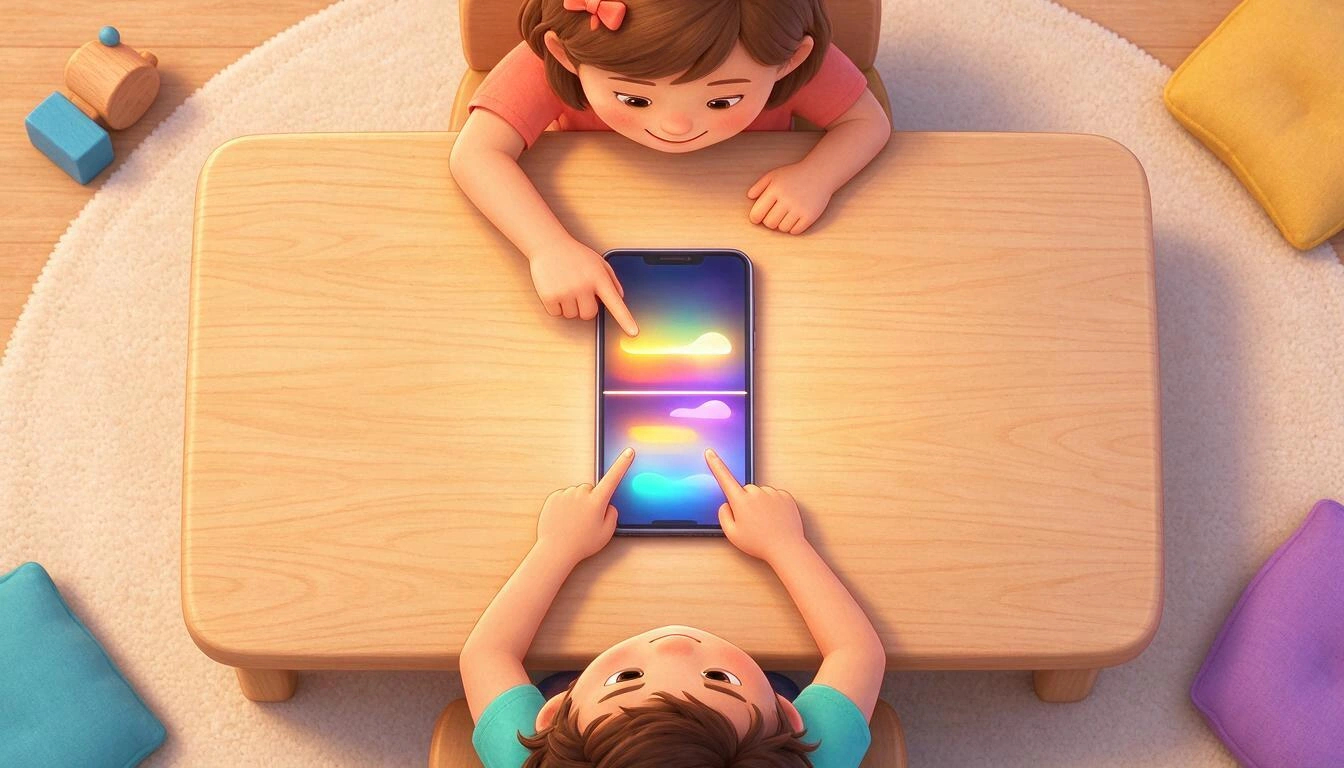
There’s a cheap way to solve it that almost no one uses: split the screen and rotate the top half 180°. The mobile rests on the table, each player sits on one side, and both see their right side. It’s exactly what the 2-player mode of Zuki Match does, and it’s the reason it works with two siblings without turns or waits: each has their stack of 20 cards and their counter, and the first one to run out of cards wins.
A design detail that matters more than it seems: when either of them gets it right, the central card changes for both. This way, no one can memorize the central card while the other plays, and the one who is losing never falls behind due to memorization.
A five-minute daily routine that actually sticks
This is the actionable part. It’s not a training program —we’ve already seen that can’t be promised— but a way to schedule five minutes that can be repeated without a fight.
Step 1. Fixed time and visible end
Choose a moment that already exists (after snack time, before bath time) and a task that ends on its own: a game, a round, an hourglass. No "let's play for a bit". The child needs to see the end from the beginning; this prevents the negotiation of five more minutes.
Step 2. Let him choose the content, not you the difficulty
Let him choose the theme. Animals, food, transportation, whatever. Engagement increases when he has chosen the task, and in terms of attention, engagement weighs more than any fine-tuning. In Zuki Match there are 11 themes (the Classic theme of geometric shapes and 10 drawing themes: fruits and vegetables, animals, human body, food, transportation, nature, clothing, sports, the house, and school) and, if none of them convince him, he can write a theme and the AI will create the deck with icons from the gallery.
Step 3. Sit across and play yourself too
This is the step that most changes the outcome and the one that everyone skips. Playing in parallel turns five minutes of screen time into five minutes of shared play, which is exactly what the AAP recommends. If you don’t want to compete, play first and let him beat your time.
Step 4. Two days a week, no screen
Alternate. The same mechanics work with cards, buttons, and a table, and there’s no discussion about screen time there.
Four attention exercises without a screen using the same mechanism
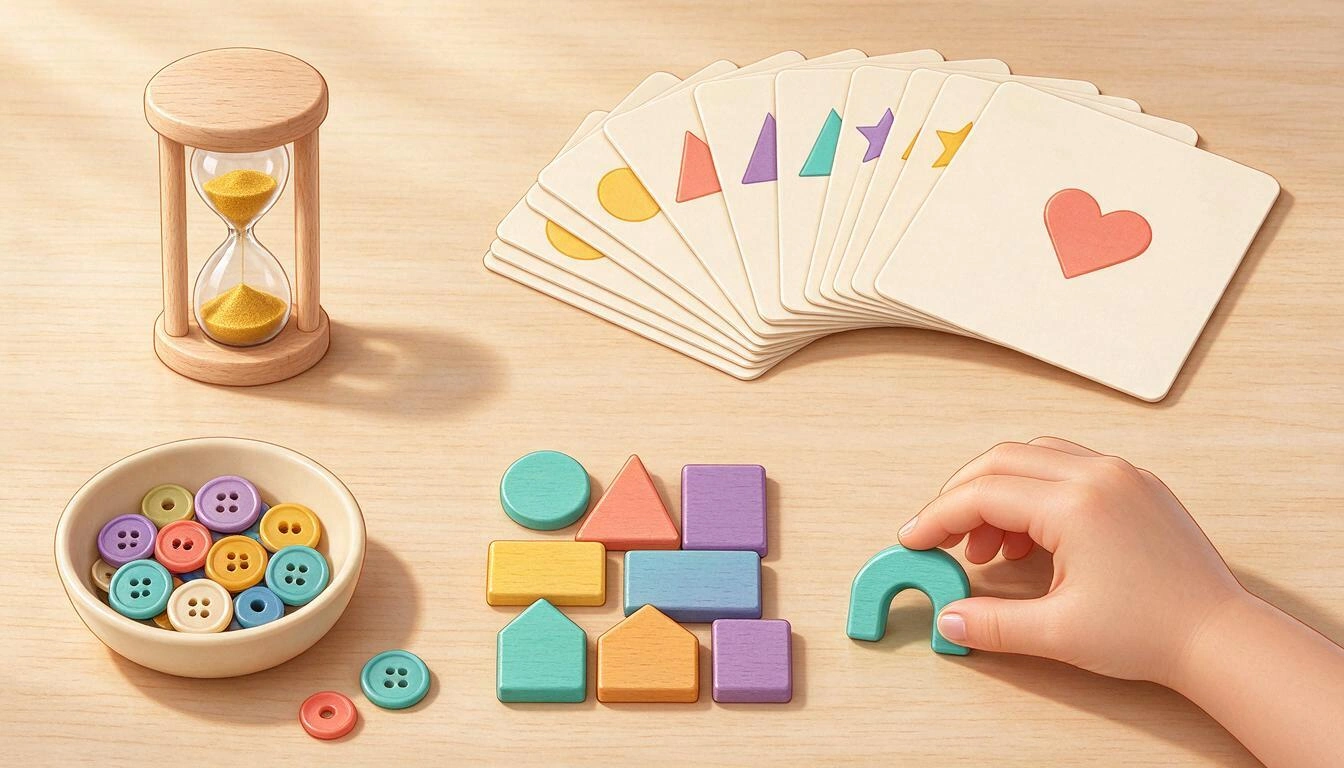
All use the same principle as visual search: a goal, several similar distractors, clear end.
- The bowl of buttons. Empty a bowl of mixed colored and shaped buttons onto the table. Ask for a specific button ("the blue one with four holes") and time it. Increase the difficulty by adding blue buttons with two holes: the trick is in the distractors that share one trait with the goal.
- The intruder card. Place six picture cards face up, let the child look at them for ten seconds, cover them, and change one. It works on comparison, not pure memorization, if you let him see both versions.
- The crossed-out shopping list. Give him a supermarket flyer and have him cross out all the apples in one minute with an hourglass. Cheap, repeatable, and with a visible end.
- Find the pair with two hands. Two equal piles of face-up cards, one for each, and see who finds the card that matches the one in the center first. It’s the analog version of the two-player mode.
None of these four require buying anything. If you do them two days a week, you already have half the routine sorted without a screen.
What Zuki Match does exactly, and what it does not do
Zuki Match is an observation game for children from about 4 years old: the central card and your card share exactly one drawing, you find it and touch it. It is played in the mobile browser, vertically and with one hand. This is all it does, without frills:
| Function | How it works exactly |
|---|---|
| 1 player mode | Against the clock. 20 cards, the timer goes up, each mistake adds +2 seconds and blocks the touch 0.75 s. At the end, your time against your record |
| 2 player mode | Same split screen, the top half rotated 180°. 20 cards each. A mistake blocks 0.75 s only for the one who made the mistake; there’s no time penalty here. The first to empty their pile wins |
| Themes | 11 in total: the Classic theme (14 geometric shapes in 8 colors) and 10 decks of drawings |
| AI themes | You write a theme and the AI selects between 16 and 24 icons from a gallery of about 200 to create the deck. Up to 10 custom themes can be saved and deleted whenever you want |
| English mode | When you get it right, a card opens with the drawing, the word in English, a button that pronounces it (browser voice, en-US), and the translation into Spanish. The timer stops while the card is open |
| Profiles | Up to 12 profiles with name and emoji, each with their best time by theme. Profiles are used in 1 player mode |
And this is what it does not do, stated plainly:
- It does not diagnose or evaluate anything. The time marked by the timer is the time of a game, not a measure of attention or a percentile.
- It is not a therapy nor a complement to any therapy. If there is a suspicion or diagnosis, the decision lies with the professional handling the case.
- It does not have difficulty levels or automatic adjustment: all games consist of 20 cards with 6 symbols per card.
- It does not have a family panel or progress reports. Only the best time by theme within each profile.
- It does not work offline, because it loads from the browser.
- It does not teach English by itself. The English mode shows and pronounces the word of the drawing you just got right; it is exposure to vocabulary, not a course.
Signs that a game is not effective and it's time to consult
If attention difficulties appear in several places at once —home, school, activities—, last for months, and are affecting learning or social interactions, this cannot be resolved with an app. You should consult a pediatrician, who will refer if necessary.
To put it in perspective: the reference meta-analysis by Polanczyk, de Lima, Horta, Biederman, and Rohde (American Journal of Psychiatry, 164(6), 2007), with 102 studies and 171,756 participants, places the global pooled prevalence of ADHD at 5.29%. In other words: the vast majority of children who "get distracted" do not have ADHD, and none of those who do are diagnosed with a stopwatch from a game. Nothing in this article substitutes for a professional evaluation.
Frequently Asked Questions
Do attention games for children really work or is it just marketing?
They work for what they train and for spending a good time together. The evidence that this improvement transfers to school is scarce (Simons et al., 2016), and promising otherwise cost Lumosity 2 million dollars with the FTC in January 2016. An observation game is a good shared time and a visual search task; that alone justifies five minutes, without needing to invent anything else.
At what age can my child play?
From about 4 years old with the drawing decks, because you only need to recognize the figure and there is no need to know how to read. The Classic topic of geometric shapes also works, and the timer and record by theme maintain the interest of older children and adults in the house.
How long does a game last?
A game of 20 cards usually resolves in one or two minutes. That is the format: it starts, ends, and you see the result, which is exactly what makes a short time repeatable without negotiation.
Can my child and their sibling play at the same time on the same phone?
Yes, it is the 2-player mode. The screen is split in half and the top half is shown rotated 180° for the person sitting opposite, so it is best to place the phone on the table. Each has their stack of 20 cards and their counter, they share the central card, and the first to run out of cards wins. There are no turns or waits.
Will the English mode teach them English?
It will give them exposure to vocabulary, which is not the same. Each time they correctly identify a drawing, a card opens with the word in English, a button that pronounces it with the voice of the browser, and the translation into Spanish. The game pauses while the card is open, so stopping to read and listen to it doesn't take time. It's a good classroom complement; it's not a course.
Can I create a theme based on what my child likes?
Yes. You write the theme —dinosaurs, things from the sea, space— and the AI selects between 16 and 24 icons from the gallery to create the deck, with its word in English included for the English mode. Up to 10 custom themes can be saved and deleted whenever you want.
Is it useful for children with ADHD?
We cannot assert that, and we will not assert it. Zuki Match is a consumer game: it does not diagnose, evaluate, or treat anything. If there is suspicion or diagnosis, the decision is made by the professional handling the case, and any use of a game within a therapeutic plan is determined by them.
Do I need to install anything?
No. It opens in the browser on the mobile, tablet, or computer from the AIsToHire account. It does need an internet connection, because the game loads upon entry.
How do I know if it's getting too easy for them and no longer provides any benefit?
Look at the record by theme in their profile. If they have played several games without approaching their best time, the theme still has potential; if they beat it effortlessly game after game, change the theme or create a new one. The practical signal is the same as always: if they get it right instantly without looking, the material is no longer training anything.
Zuki Match is the observation game for children from AIsToHire: you find the only drawing that two cards share, solo against the timer or face to face with another person on the same screen, with 11 themes, AI-created topics, and English mode with pronunciation. It is available at Zuki Match — Observation game for kids. It is a game, not an evaluation or treatment tool: what it provides are five short, shared minutes with a clear ending, which is exactly what pediatric guidelines recommend when there is a screen involved.
Try Zuki Match for free: choose a theme, sit across from your child, and play a 20-card game.
Try Zuki Match for free: choose a theme, sit across from your child, and play a 20-card game.Keep reading
View all articles →
Screen Time for Children Aged 4 to 10 in 2026: What Changed and How to Choose How to Spend Those Minutes
Discussing via WhatsApp or talking in person: what science says about couple conflicts through messages
Mind map, concept map, and outline: differences and when to use each one