 AI Chef
What to cook with what's in the fridge: the 4-step method (and how to do it with AI)
Team at AI ChefWritten with AI assistance16 min readIn summary:
- 77.5% of the food thrown away in Spanish households isn't leftovers from cooked dishes: it's food that was bought and never got used (2025 Food Waste Report, MAPA, published 10-09-2026).
- Cooking with what you already have is a method, not inspiration: quick inventory → technique → dish structure → specific recipe.
- The request matters more than the ingredient: "I have chicken and rice" gives generic recipes; "half a chicken, 2 tomatoes, cooked rice, for 4, 30 minutes, lactose-free" gives a recipe you can cook today.
- AI Chef, AIsToHire's AI cooking app, returns 3 recipes for each list of ingredients, with quantities, steps, which ingredients it uses and which ones you're missing.
- If improvising tires you out, the app's weekly menu generates 7 days × 5 meals and a shopping list grouped by supermarket sections, adding up repeated quantities.
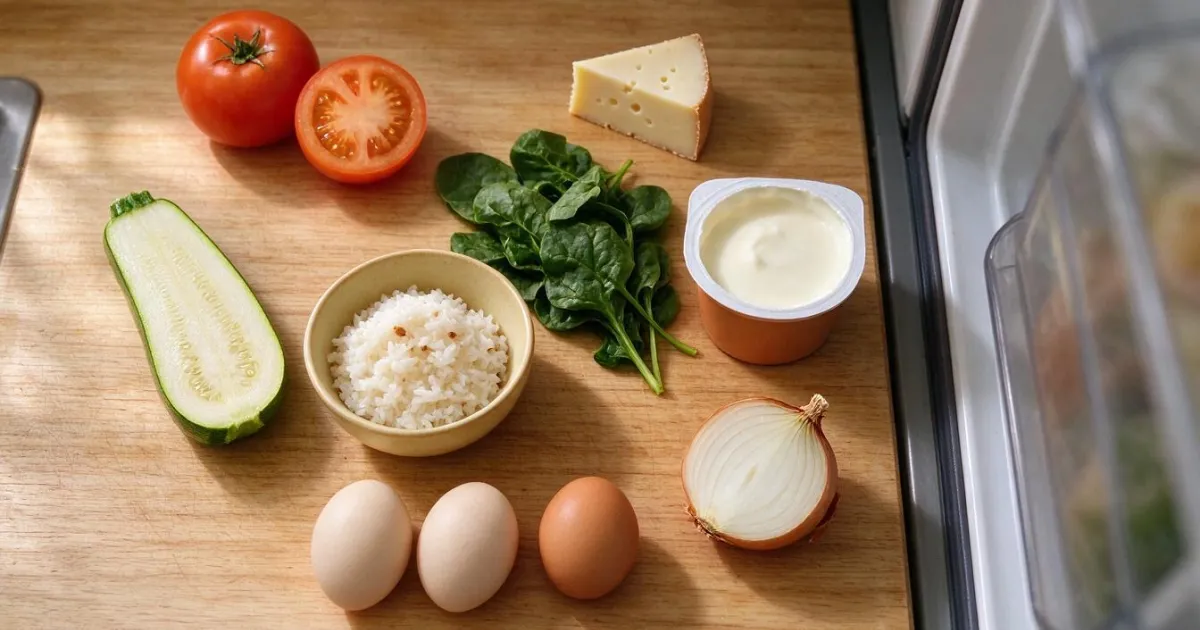
You open the fridge at half past eight, there's half a zucchini, three eggs, a tub of rice cooked yesterday and some spinach that's giving up. The question isn't "what do I feel like eating?", but "what can I cook with this without going to the supermarket?". This article is the method that answers that question in four steps, with substitution and scaling tables you can use even without installing anything — and, at the end, how AI Chef, AIsToHire's AI cooking assistant, solves it in a minute.
What gets thrown away at home most isn't leftovers: it's food that was never used
In Spanish households, 77.5% of food waste corresponds to bought products that are thrown away without having been cooked, and only 22.5% to leftovers from dishes already prepared. In other words: the problem isn't in the recipe, it's in the shopping and the fridge. That's according to the 2025 Food Waste Report from the Ministry of Agriculture, Fisheries and Food (MAPA), published on September 10, 2026.
| Data (MAPA, 2025 report, published 10-09-2026) | Figure |
|---|---|
| Food and drink wasted in Spain in 2025 | 1,129.91 million kg/l (+0.4% vs 2024) |
| Per person per year | 24.3 kg/l (−0.3% vs 2024) |
| Share thrown away in households | 97.5% of the total → 1,101.8 million kg/l |
| Food thrown away unused at home | 77.5% |
| Leftovers from already-cooked dishes | 22.5% |
| Weight of fresh fruit, vegetables and produce in what's unused | 46% |
| Change since 2020 | −19.2% |
The same report lists the causes that consumers themselves report: 26% shop without planning, 21% buy "just in case", 43% admit they don't organize food well in the fridge and 50% say they don't have enough information on how to store it (data collected by El Español on 29-09-2026).
In practical terms: cooking with what you already have isn't a savings trick, it's the way to bring those 24.3 kilos per person down. And it's also the question most typed into Google at half past eight in the evening.
The 4-step method for cooking with what you have
The method consists of listing what's perishable, choosing the technique first (not the recipe), building the dish with a fixed formula and only then asking for a specific recipe. It works because it reverses the usual order: you don't look for a recipe and then buy what's missing, you start from what expires soonest and build toward the dish.
Step 1 — Three-minute inventory, starting with what expires soonest
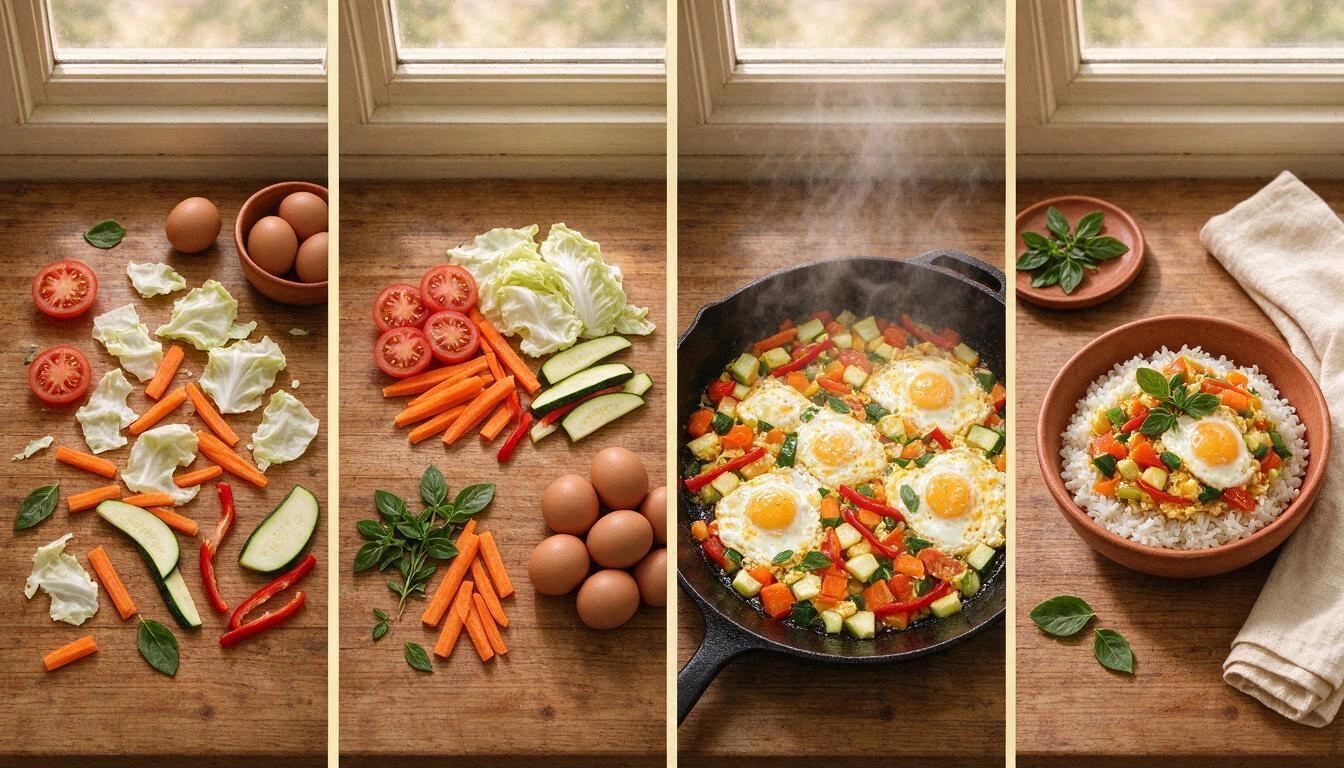
Take out onto the counter only what's at risk this week and sort it by urgency. You don't need to empty the fridge: what's open, what's fresh and what's already gone a bit soft is enough.
| Urgency | Typical foods | Rough margin chilled (≤4°C) |
|---|---|---|
| Today or tomorrow | Fresh fish, ground meat, cooked seafood | 1-2 days |
| Today or tomorrow | Already-cooked rice, pasta and legumes | 1-2 days, cooled quickly and refrigerated within 2 hours |
| This week | Raw chicken or turkey, washed leafy greens, mushrooms | 2-3 days |
| This week | Red meat in a piece, milk and opened dairy | 3-5 days |
| Holds on | Zucchini, carrot, pepper, cabbage, potato | 1-2 weeks |
| Holds on | Eggs, aged cheeses, opened jarred preserves | Per the package date |
These margins are a rough guide for prioritizing, not for deciding whether something is still good: the expiry date on the package always rules, along with your own judgment of smell and appearance. Neither this article nor the app make food safety assessments.
Step 2 — Choose the technique before the recipe
Each leftover calls for a different technique. If you choose the technique first, the recipe practically writes itself and you stop looking for impossible dishes.
| What you have leftover | Technique that saves it | Example dish |
|---|---|---|
| Vegetables starting to wrinkle | Oven at 200°C with oil and salt | Tray of roasted vegetables + fried egg |
| Soft vegetables or too much of them | Cream or soup with a blender | Zucchini and potato cream soup |
| Already-cooked rice or pasta | Hard sauté in a pan | Fried rice with egg and whatever's around |
| Small, varied leftovers | Omelette, scramble or frittata | Spinach and cheese omelette |
| Cooked chicken or meat from the day before | Filling or shredded | Tacos, empanadas, warm salad |
| Yesterday's bread | Dry and crumble, or soak | Breadcrumbs, migas, garlic soup, French toast |
| Very ripe fruit | Heat or cold | Compote, cake, frozen smoothie |
| Leftover cooked legumes | Mash or sauté | Hummus, crispy roasted chickpeas |
Step 3 — Build the dish with a fixed formula
A dish that almost always works has five parts. If you're missing one, the dish comes out bland or incomplete, and that's when people decide "there's nothing for dinner."
- Carb base: rice, pasta, potato, bread, legumes, couscous.
- Protein: egg, chicken, canned tuna, legumes, cheese, tofu.
- Vegetable: whatever's in the fridge, raw or roasted.
- Flavorful fat: olive oil, butter, a bit of cheese, nuts.
- Acidic or aromatic touch: lemon, vinegar, mustard, garlic, herbs, paprika.
That fifth point is what separates a sad stir-fry from a good one, and it almost never requires buying anything.
Step 4 — Ask for the recipe with the three restrictions that actually matter
Once you know what you have and which technique you'll use, asking for the recipe comes down to three pieces of data: how many people, how much time you have and what you can't or don't want to eat. Without those three, any recipe — from a book, a search engine or an AI — will be generic.
How to ask AI Chef so the recipe comes out usable
In AI Chef you write the ingredients you have in the Ingredients tab, adjust the options and the app returns three complete recipes: title, description, estimated time, difficulty, ingredients with quantities, steps, tips, which of your ingredients it uses and which ones you're missing. Each recipe also comes with a separately generated photo of the dish, while you can already read the recipe.
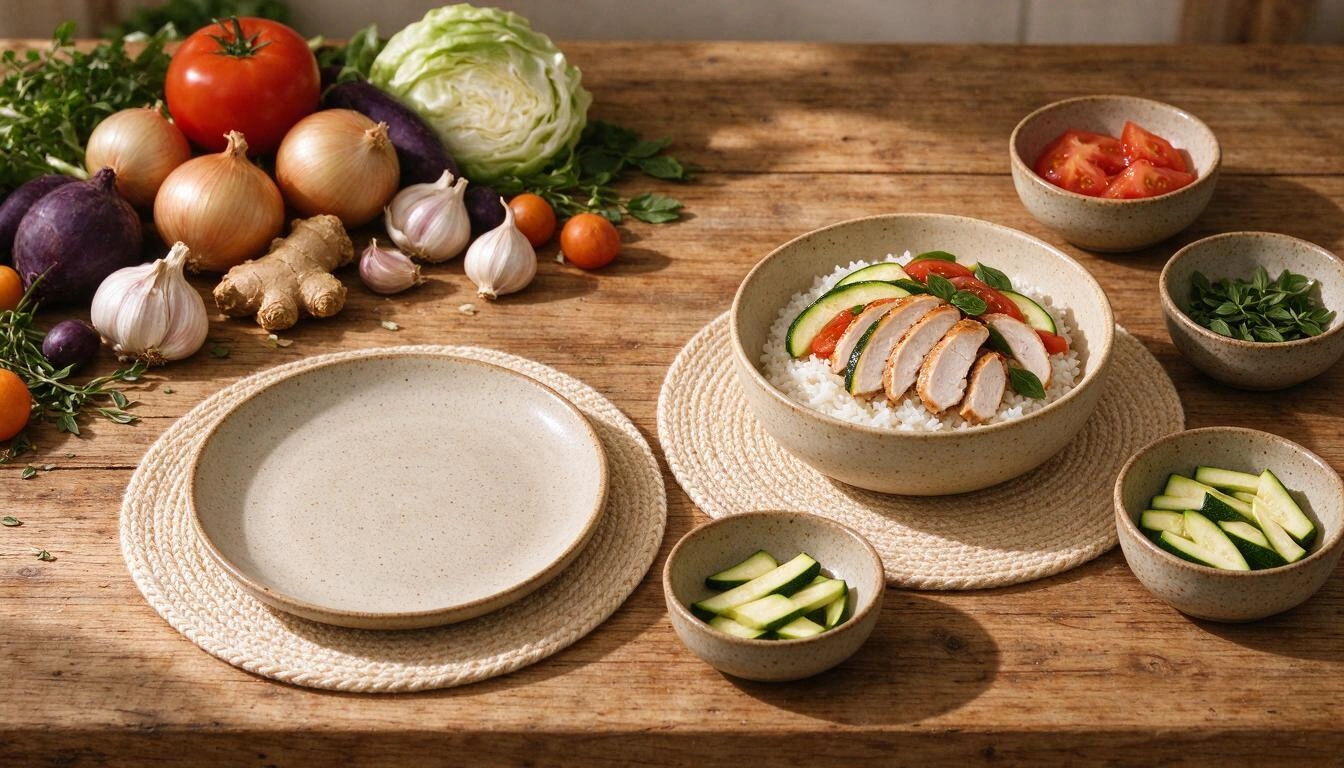
The difference between a weak request and a good one is huge, and it doesn't depend on the tool:
| Weak request | Specific request | Why it changes the result |
|---|---|---|
| "I have chicken and rice" | "Half a roast chicken from yesterday, a bowl of cooked rice, 2 tomatoes, grated cheese" | The AI knows what's already cooked and doesn't tell you to cook it again |
| "Something quick" | Maximum time: 25 minutes | Rules out stews and long oven times |
| "For the family" | 2 adults and 2 kids → 4 servings, Kid-friendly style | Adjusts quantities and softens the spice |
| "Lactose-free, I think" | Restrictions: "lactose intolerance" | Enters as an explicit restriction in the generation |
| "Nothing complicated" | Notes: "no oven, one pan only" | Shapes the technique, not just the ingredients |
The settings the app lets you fix before generating are:
- People: from 1 to 50 servings.
- Style (several can be combined): healthy, quick, family, budget, gourmet, kid-friendly, vegetarian, vegan, Mediterranean, high-protein, low-carb and gluten-free.
- Difficulty: any, easy, medium or advanced.
- Maximum time in minutes.
- Restrictions, allergies or intolerances, in free text (for example, "nut allergy").
- Notes, also in free text ("no oven", "no cilantro").
If you'd rather talk than fill in fields, the Chat tab does the same thing conversationally: you tell it what you have, it suggests ideas, and then you ask it "make it for 2", "I don't have cream" or "it turned out too salty, what do I do?". The chat keeps the thread of the conversation, so you don't have to repeat the context in every message, and when the answer contains a recipe it shows it as a card you can save to your recipe book.
The substitutions that solve almost every "I'm missing an ingredient"
Most recipes get abandoned because of a single missing ingredient, and almost all of them have a substitute that's already in your kitchen. This table covers the most common ones in everyday savory cooking:
| You're missing | Use instead | Note |
|---|---|---|
| 200 ml cooking cream | 200 ml evaporated milk | Lighter, same body |
| 200 ml cooking cream | 150 g cream cheese + 50 ml milk | For creamy sauces |
| 200 ml cream | 200 g Greek yogurt | Add it off the heat so it doesn't curdle |
| 1 tablespoon cornstarch (thickening) | 2 tablespoons wheat flour | Flour needs longer cooking to lose its taste |
| 100 ml white wine | 100 ml stock + 1 teaspoon vinegar or lemon | Replaces the acidity the wine would add |
| Vegetable stock | The water from boiling vegetables or pasta | Save it instead of pouring it out |
| Sour cream or crème fraîche | Greek yogurt + a few drops of lemon | Very similar texture |
| 250 ml buttermilk | 250 ml milk + 1 tablespoon vinegar or lemon, rest 10 min | For cakes and batters |
| Breadcrumbs | Crushed oat flakes or grated stale bread | Also works as a binder |
| 1 egg as a binder (meatballs, burgers) | 2 tablespoons breadcrumbs + 2 of milk | Doesn't work for light, airy baking |
| 100 g butter for sautéing | 80 ml olive oil | Butter has water; oil doesn't |
| Butter in a lactose-free béchamel | Mild olive oil + unsweetened plant milk | Cook the flour well before adding the liquid |
In the AI Chef chat you can just ask it directly ("I don't have cream, what can I swap it for in a carbonara pasta?") and the answer takes the specific recipe into account, which these generic tables can't do.
How to change the servings without the recipe turning out too salty
Multiplying every ingredient by the same number is the most common scaling mistake. The main ingredients scale linearly; salt, spices, chili, garlic and oil don't. These are the rules worth applying always, whether by hand or with an app:
- Scale linearly: pasta, rice, legumes, meat, fish, main vegetables, stock.
- Scale down: salt, pepper, spices, chili, garlic, oil and strong sauces. Increase by between half and two-thirds of what the exact proportion would suggest, then taste and adjust at the end.
- Doesn't scale: cooking time. What changes is the container. Double the quantity in the same pan doesn't brown, it steams: use two pans or a bigger tray.
- Round to real quantities: "half an onion" is useful; "0.33 onions" isn't. Same with eggs, which go in whole.
- What evaporates falls short: when doubling a saucy stew, don't double the liquid all at once; add the last third only if needed.
In AI Chef this is built into each recipe's detail view: you change the number of servings with the − and + buttons (from 1 to 50) and the app recalculates the quantities applying exactly these rules — linear for the main ingredients, careful with spices and seasonings, rounded to practical quantities and leaving "to taste" whatever was already like that. Times aren't touched: the recipe decides them, not the number of diners.
If improvising tires you out: the weekly menu and the list by section
Improvising well is great on a Tuesday, but what really cuts down on waste is shopping from a plan: remember that 26% of consumers admit to shopping without planning. AI Chef's weekly menu generates 7 days with 5 meals each — breakfast, mid-morning snack, lunch, afternoon snack and dinner, 35 recipes in total — and from there pulls together an already-consolidated shopping list.
When you generate the menu you set the number of people, one or more styles (family, healthy, quick, budget, vegetarian, Mediterranean, high-protein, vegan, low-carb, gluten-free), what you want to avoid, any restrictions or allergies and any notes. The menu is built with variety rules: it alternates meat, fish, eggs, legumes, pasta, rice and vegetables, doesn't repeat the same main ingredient two days running, keeps weeknight dinners lighter and quicker than lunches, and saves the more elaborate recipes for the weekend.
If a particular meal doesn't convince you, you regenerate just that one: Thursday dinner, for example, without touching the rest of the week. The new recipe is generated looking at the whole menu, so it doesn't repeat what's already there.
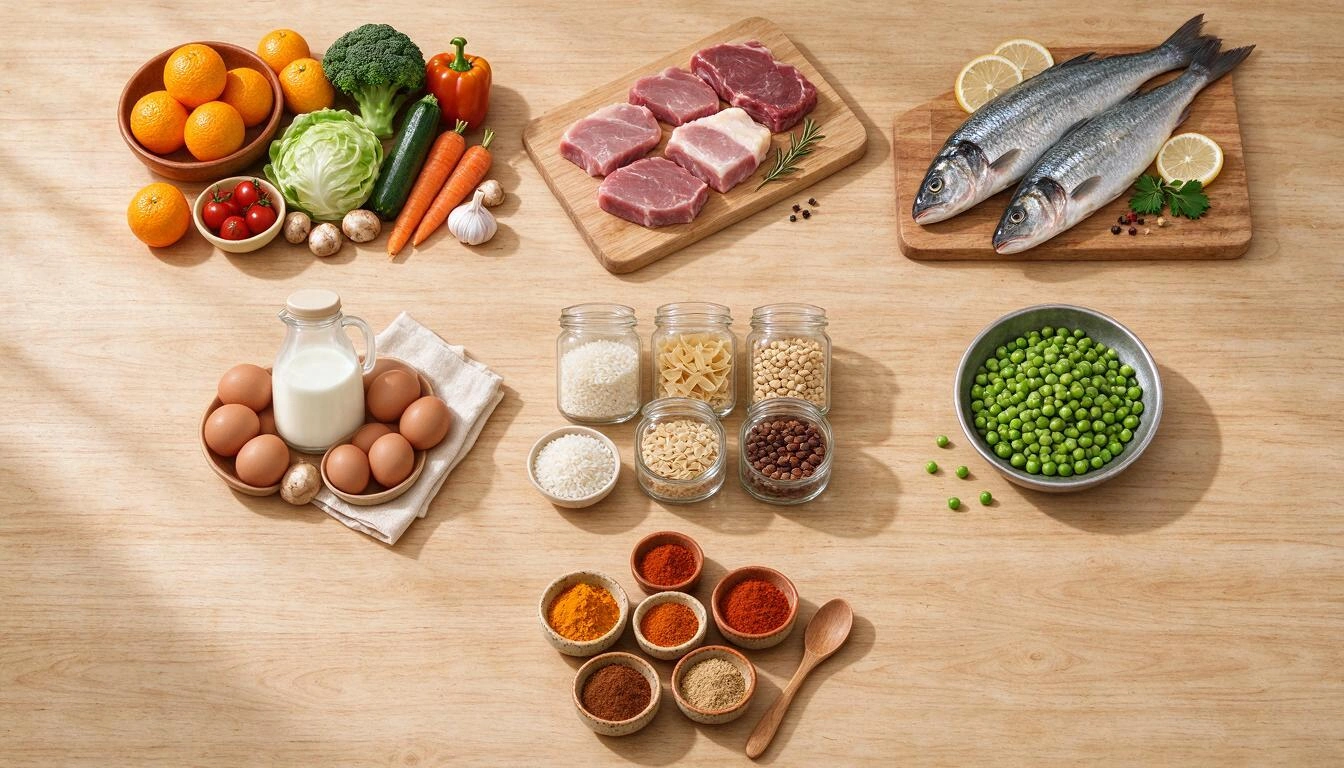
The shopping list is generated from the menu and groups everything into seven categories, adding up quantities that appear across several recipes (if Monday calls for 200 g of rice and Thursday for 300 g, the list shows 500 g) and rounding to real shopping quantities. It leaves out water, basic salt and basic oil, since those are assumed to already be on hand.
| List category | What's included |
|---|---|
| Fruit and vegetables | Fruit, vegetables, fresh herbs |
| Meat | Chicken, pork, beef, cured meats |
| Fish | Fish and seafood |
| Dairy and eggs | Milk, yogurt, cheese, eggs |
| Pantry | Rice, pasta, legumes, canned goods, flours |
| Frozen | Frozen vegetables, fish or dough |
| Spices | Specific condiments and spices from the recipes |
While you shop you can tick off what you've already got and see how many items you've covered out of the total, which is what saves you the two trips down the same aisle.
What AI Chef does and doesn't do
AI Chef generates recipes, menus and lists with artificial intelligence based on what you tell it. It doesn't scan your fridge on its own, doesn't do nutritional calculations and doesn't give health recommendations. This table is the exact boundary, so no one gets a surprise:
| It does | It doesn't do |
|---|---|
| Generates 3 recipes from the ingredients you type in | Doesn't scan your fridge with a camera or read barcodes |
| Converses in natural language and keeps the context of the conversation | Doesn't keep a permanent inventory of your pantry: you type the ingredients each time |
| Recalculates quantities from 1 to 50 servings | Doesn't calculate calories, macronutrients or nutritional values |
| Saves your recipes and the history of generated ones | Doesn't replace a dietitian-nutritionist or a doctor |
| Creates a 7-day × 5-meal menu and regenerates individual meals | Doesn't do the shopping or connect with supermarkets |
| Consolidates the shopping list into 7 categories | Doesn't assess whether a food in your fridge is still good |
| Works in metric or imperial units, your choice | Doesn't guarantee a recipe is safe for a specific allergy |
That last line matters and the app itself shows it before you start: the results are indicative and may contain errors, so if there are allergies, intolerances or other dietary restrictions, you must always check the recipe's ingredients before cooking or eating. The AI applies the restrictions you give it, but the final check is yours.
Frequently asked questions
What can I cook with what I have in the fridge?
The fastest way is to sort what you have by urgency (fish and ground meat first; hard vegetables last), choose a technique that rescues that leftover — oven, cream soup, sauté or omelette — and complete the dish with a carb base, a protein, a vegetable, a flavorful fat and an acidic touch. If you want to skip the reasoning, type the ingredients into AI Chef and it returns three recipes with quantities and steps.
Is there an app that tells me what to cook with the ingredients I have?
Yes. AI Chef, by AIsToHire, is built exactly for that: you type in the ingredients you have at home, say how many people and how much time you have, and it generates three complete recipes pointing out which of your ingredients each one uses and which ones you'd be missing. It's at aistohire.com/guia-preparar-recetas-5.
Can I enter my allergies so they don't show up in the recipes?
You can write them in the restrictions, allergies or intolerances field, both when generating recipes and when creating the weekly menu, and they're treated as a mandatory condition of the generation. That said, the app explicitly warns that results are indicative: with an allergy involved, always check the ingredient list before cooking.
How do I change a recipe from 2 to 6 people without it coming out wrong?
Scale the main ingredients linearly (pasta, rice, meat, vegetables), increase the salt and spices by only half to two-thirds of that proportion and adjust at the end, and don't touch the cooking times: what you need to change is the size of the container. In AI Chef the app itself does this when you move the servings selector, which goes from 1 to 50.
Can it build me a weekly menu with the shopping list?
Yes: it generates seven days with five meals each (breakfast, two snacks, lunch and dinner) and, from that menu, a shopping list grouped into seven categories that adds up quantities repeated across recipes. It doesn't include water, salt or basic oil because it assumes you already have them at home.
Can I change just one dinner in the menu without redoing the whole thing?
Yes. You can regenerate a specific meal on a specific day — Thursday dinner, for example — and the rest of the menu stays as it is. The new recipe is generated taking the whole menu into account, so it doesn't repeat that day's main ingredient or resemble anything else already in that week.
Does the app count the calories in the recipes?
No. AI Chef doesn't calculate calories or macronutrients and doesn't offer nutritional or medical advice. It generates recipes, adjusts servings, plans menus and builds the shopping list; any dietary goal with health implications should be reviewed by a professional.
Does it work if I cook in cups and ounces instead of grams?
Yes. In Settings you can choose between the metric system (g, kg, ml) and imperial (oz, lbs, cups), and the recipes generated from then on will use that measurement system.
What if I don't even know where to start and would rather just ask?
That's what the chat tab is for: you write "I want something quick for dinner" and the chef asks just enough to suggest specific options, instead of giving you a generic list. From there you can ask it to adapt it — for kids, without one ingredient, cheaper — without starting from scratch, because it keeps the thread of the conversation.
AI Chef, in one sentence
AI Chef is AIsToHire's artificial intelligence cooking app: you type in the ingredients you have at home and it gives you recipes with quantities and steps, adjusts servings from 1 to 50, plans weekly menus of 7 days × 5 meals and generates a shopping list grouped by supermarket sections. You can try it at aistohire.com/guia-preparar-recetas-5.
Sources cited: 2025 Food Waste Report, Ministry of Agriculture, Fisheries and Food (MAPA), published 10-09-2026 (press release from La Moncloa); breakdown of causes and composition of waste collected by El Español on 29-09-2026.
Write down what you have in the fridge and let AI Chef suggest three recipes with quantities, steps, and a list of what you're missing. Try it for free.
Write down what you have in the fridge and let AI Chef suggest three recipes with quantities, steps, and a list of what you're missing. Try it for free.Keep reading
View all articles →
97.5% of food waste occurs at home: the 2026 data and how to avoid it

Why Your Car Insurance Increased in 2026: Average Premium of €1,412 and Historic Record

Discussing via WhatsApp or talking in person: what science says about couple conflicts through messages