 aiToHealth
Digital medical record: what reports of yours are not shared between communities (or with the private sector) and how to store them yourself
Team at aiToHealthWritten with AI assistance19 min readIn summary
- The Digital Clinical History of the SNS (HCDSNS) shares a closed catalog of reports among autonomous communities —the nine types from Royal Decree 1093/2010—, and each community decides how many of those types it publishes: in the last public breakdown by regions, there were communities that shared only one of the nine agreed documents.
- Private healthcare and mutual societies are not included in the HCDSNS. Extending the clinical history to the private sector is precisely the goal of the draft Digital Health Law, which as of November 12, 2026, has not passed through the Council of Ministers and remains uncertain with the elections on November 29.
- Neither does it include: what predates computerization, a large part of the imaging tests (the pixel, not the report) and, above all, what the doctor told you in consultation, which is not recorded for you anywhere.
- That Madrid implements the unique clinical history in all its hospitals before February is good news, but "unique in one community" is not "complete for you".
- The Regulation (EU) 2025/327 of the European Health Data Space mandates the cross-border exchange of the summarized clinical history from March 2029 and of laboratory, imaging, and discharge data from March 2031. Until then, the only complete file of your history is the one you compile yourself.
If you have ever arrived at a consultation in another community, or to an emergency on a Sunday, and they asked you "what did your last lab test show?", you already know what this article is about. The honest answer is almost never "I don't remember": it's that no one ever gave you an organized copy. This text explains, without technical jargon, what the public system truly shares among communities, what is left out, and how to compile the missing file yourself. At AIsToHire, we have built aiToHealth precisely for that last part: a family medical history with a profile per person where reports are scanned, explained, and linked. A warning upfront: neither this article nor the app diagnose or provide medical advice; they organize and explain reports, not substitute for healthcare professionals.
What does the Digital Clinical History of the SNS really share among communities?
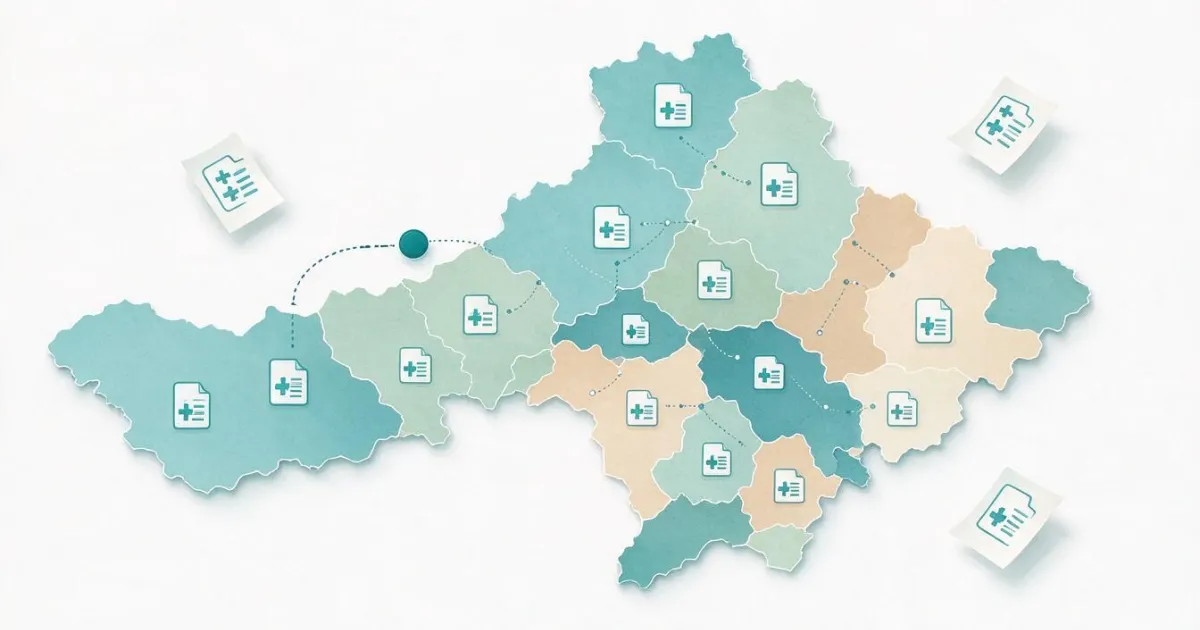
The HCDSNS does not share "your clinical history": it shares documents from a closed catalog. That catalog is the minimum data set of clinical reports established by the Royal Decree 1093/2010, with nine types of reports, and each health service publishes those that it has computerized and standardized. If a type of report is not published by your community, for the rest of Spain, it is as if it does not exist.
The nine types of the catalog are as follows:
| Type of report | What it includes |
|---|---|
| Summary clinical history (HCR) | The live summary of the patient: active diagnoses, allergies, medication |
| Discharge clinical report | Each hospital admission |
| Outpatient clinical report | What the specialist says after seeing you |
| Emergency clinical report | The emergency episode |
| Primary care clinical report | What the family doctor says |
| Laboratory test results report | Lab tests |
| Imaging test results report | The report from the radiologist, not the image |
| Results report of other diagnostic tests | Other tests |
| Nursing care report | Care and follow-up |
The system works, and increasingly so: according to the Annual Report of the SNS for 2024, collected by diariofarma on December 4, 2025, 1,335,741 consultations were made to reports of the Digital Clinical History, a 60% increase from the previous year. The interoperable electronic prescription, its older sibling, moved more than 17.4 million packages and was used by 2.4 million different citizens. In other words: what is published is consulted. The problem is what is not published.
Why do I see the history of one community and not another?
Because publishing reports in the HCDSNS is the responsibility of each autonomous community, and the degree of compliance has been very uneven. The Ministry of Health coordinates, but it is the regional health services that implement the technical requirements. The result: two patients with the same disease have a very different interoperable history depending on where they live.
The latest public breakdown community by community comes from data from the Ministry of Health provided in parliamentary response and published by ConSalud on September 24, 2021. These are 2021 data —not from today— but they are the only detailed official distribution available, and they explain why the map remains irregular:
| Community | % of the 9 agreed documents shared (2021 data) |
|---|---|
| Balearic Islands, Madrid | 100 % |
| Valencia, La Rioja | 89 % |
| Extremadura | 78 % |
| Castile and León | 67 % |
| Murcia, Navarra, INGESA (Ceuta and Melilla) | 56 % |
| Asturias, Canary Islands | 44 % |
| Andalusia | 33 % |
| Aragon, Basque Country | 22 % |
| Cantabria, Castile-La Mancha, Catalonia, Galicia | 11 % |
Since then, the situation has improved with successive additions: the Ministry of Health itself registers new reports in 2025 (Asturias with summarized clinical history and primary care; Catalonia with outpatient care and laboratory; Murcia, Navarra, and INGESA) and in 2026 (Basque Country with laboratory). But "improved" does not mean "complete," and the practical consequence does not change: before moving, traveling, or going to an appointment outside, assume that the doctor will see less than you think.
Practical rule: if the report you need is from before 2015, from an imaging test, or from a category that your community does not publish, do not count on seeing it from another region.
Is my history from private healthcare or mutual insurance there?
No. Private healthcare and mutuals are not part of the Digital Clinical History of the SNS today. If you have surgery in a private clinic, have a blood test in a private laboratory, or undergo a check-up through your company insurance, that report exists only in the systems of that provider —and, if you downloaded it, in your email.
The gap is not small. At the VII Symposium of the Health Observatory, reported by El Español on October 8, 2026, the general director of the IDIS Foundation, Marta Villanueva, estimated that 12.6 million Spaniards (25% of the population) have double health coverage, a segment that generates more than 20% of the clinical histories in the country. One in four patients, therefore, has their history split in two by design.
The integration between public and private, when it exists, is regional and partial. The most detailed comparative data published is from Redacción Médica, on December 21, 2022: only Madrid and Galicia then shared data fully between public and private (23% of active doctors), while Navarra, Aragon, Extremadura, Murcia, and Andalusia did so only with contracted centers and the rest kept the information exclusively in the public network. It is a 2022 data, but nothing subsequent has changed the framework: the state regulation is still missing.
Will the Digital Health Law fix it? What happens with the elections on November 29?
The Digital Health Law is exactly the regulation that would extend the interoperable digital clinical history to the private sector. The problem is its timeline: as of November 12, 2026, it is still a draft and the general elections on November 29 leave it up in the air.
The timeline, in dates:
| Milestone | Date | Source |
|---|---|---|
| Prior public consultation of the draft | Until October 20, 2025 | Draft Digital Health Law |
| Health announces that "it could be ready by the end of the year" | March 3, 2026 | El Debate |
| Health "finalizes" the draft before public hearing | September 17, 2026 | Infosalus |
| Call for general elections | November 29, 2026 | 2026 general elections |
| Legislative initiatives that fall with the advance | Around 300 | La Gaceta del Opositor |
What the draft proposes is substantial: integrating private healthcare centers into the exchange of clinical data, a standardized and accessible summarized clinical history across the country, and explicit rights of access, rectification, and portability of health data. But a draft that does not reach the Council of Ministers does not obligate anyone. Translation for the patient: in 2027, you will still be the one who combines public and private records.
"Unique medical record" in Madrid: does that mean I'll have everything?
No: it means that hospitals in that community will see the same information among themselves. The Community of Madrid will implement the unique medical record in all its hospitals by February 2027, as reported by Libertad Digital on November 3, 2026; the rollout has already begun at Ramón y Cajal, Clínico, and Alcorcón. It is a real advancement in continuity of care within Madrid.
The numbers of the project give the scale: the director of Digital Health in Madrid, Nuria Ruiz, estimated more than 160 operational artificial intelligence models already in hospitals in the region, more than 16,000 million data points in the regional data lake, and more than 400 different information sources feeding it, with voice transcription in primary care and clinical documentation assisted by AI that always requires validation from the professional.
But it is important to read the headline precisely. "Unique" here means one per community, not one per patient:
| What it does resolve | What it does not resolve |
|---|---|
| That two public hospitals in Madrid see the same record | That a hospital from another community sees it (that depends on what is published in the HCDSNS) |
| That you don’t have to repeat tests within the region | What the private or mutual did to you |
| Access for the professional to dispersed regional data | Your copy, on your mobile, when the system is down or you are out of town |
| AI-assisted documentation validated by the doctor | What the doctor explained to you in person during the consultation |
What is excluded from any digital medical record?
There are five gaps that no interoperability between administrations covers today, and they are precisely the ones that hurt the most when the data is needed.
- Private healthcare and mutuals. Outside the HCDSNS, as we have seen.
- What predates computerization. What is on paper in a hospital archive does not get published on its own. If your father's diagnosis is from 2003, it is in a folder.
- The real imaging tests. The catalog shares the report from the radiologist; the images (the MRI, the CT scan) reside in imaging systems that do not travel the same way. Always request the media or download link at the time.
- The categories that your community does not publish. With the distribution above, a nursing report or "other diagnostic tests" may simply not exist outside your region.
- What the doctor told you in consultation. This is the most important and least recognized: the report captures the diagnosis and treatment, not the "if the ferritin doesn’t rise, we repeat in three months" or the "this doesn’t worry me, the other does". For the system, it remains in the professional's note; for you, it is not recorded anywhere. And six months later, when you return, it has been lost.
Where does the European Health Data Space lead?
It leads to your summarized medical record being required across the EU, but with long timelines. The Regulation (EU) 2025/327, published on March 5, 2025, and in force since March 26, 2025, applies generally from March 26, 2027, and deploys its key obligations in phases.
| Date | What becomes mandatory |
|---|---|
| March 26, 2027 | General application of the Regulation; national digital health authority |
| March 26, 2029 | Mandatory cross-border exchange of summarized medical records and electronic prescriptions and dispensations via MyHealth@EU |
| March 26, 2031 | Laboratory results, imaging tests, and discharge reports are added |
Source: summary of the European Health Data Space from EUR-Lex and the European Health Data Space area from the Ministry of Health. At the same symposium mentioned earlier, the IDIS Foundation reminded that Europe has set that by 2030, European citizens will have to have a summarized medical record. It is excellent news looking five years ahead. For next month's appointment, it is not useful.
The method: how to keep your medical history, step by step
The goal is not to distrust the public system, but to have a complete and organized copy for yourself, which includes what the system does not keep. Five steps, in order.
1. Request a copy of your medical history (and that of the person you care for)
It is a right, not a favor. Article 18 of Law 41/2002, on patient autonomy, recognizes "the right of access […] to the documentation of the medical history and to obtain a copy of the data contained therein," and allows it to be exercised by accredited representation — the way to request it for an elderly parent or a minor child. Two caveats: it does not apply to third-party data or the subjective notes of professionals. The state law does not set a delivery time; it is regulated by the procedures of each health center or service, so request it in writing and through the registry.
Do it in three places at once: your regional health service, the HCDSNS of the Ministry (with electronic ID, certificate, or Cl@ve) and each clinic, laboratory, or private mutual that you have visited. If you have lived in several communities, one request per community.
2. One profile per person, from the beginning
The typical mistake of someone managing the family's paperwork is a single folder. Then you don't know whose lab results were which. One profile per person — you, your partner, each child, each elderly parent — with their date of birth and their color, because reference ranges depend on age and sex, and because the base record (allergies, chronic conditions, surgeries, vaccinations, family history, current medication) is only useful if it is separated by individual.
3. Scan each report as soon as it comes out of the consultation
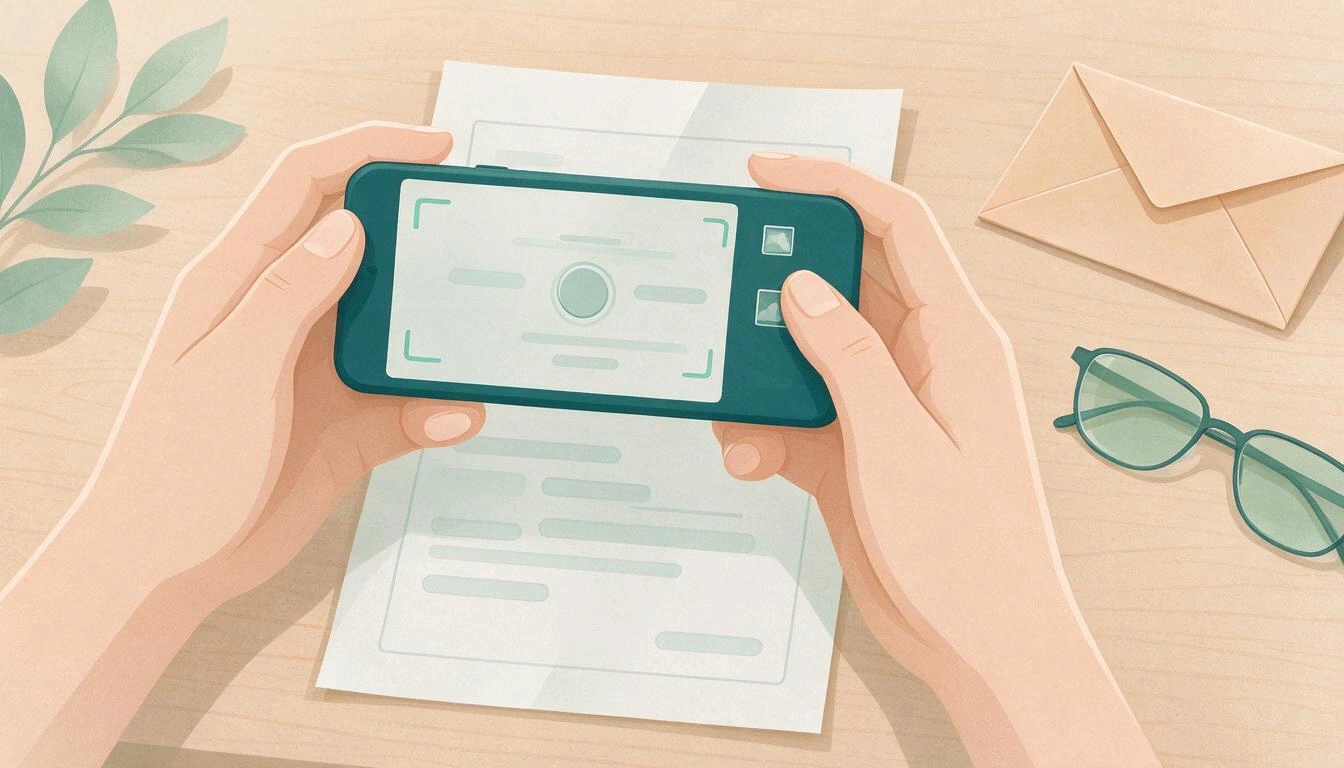
The window is thirty seconds: at the consultation table or in the waiting room. After that, the paper gets folded, ends up in a drawer, and the PDF gets lost in the email. One photo, with the date and the correct profile, and that's it. And take advantage of the same moment for what truly is not kept anywhere: what you were just told. Dictating it right after leaving — what was discussed, what treatment, what tests have been requested, when the follow-up is — is the difference between arriving at the next appointment with context or with goodwill.
4. Keep track of each value's evolution, even if you change laboratories
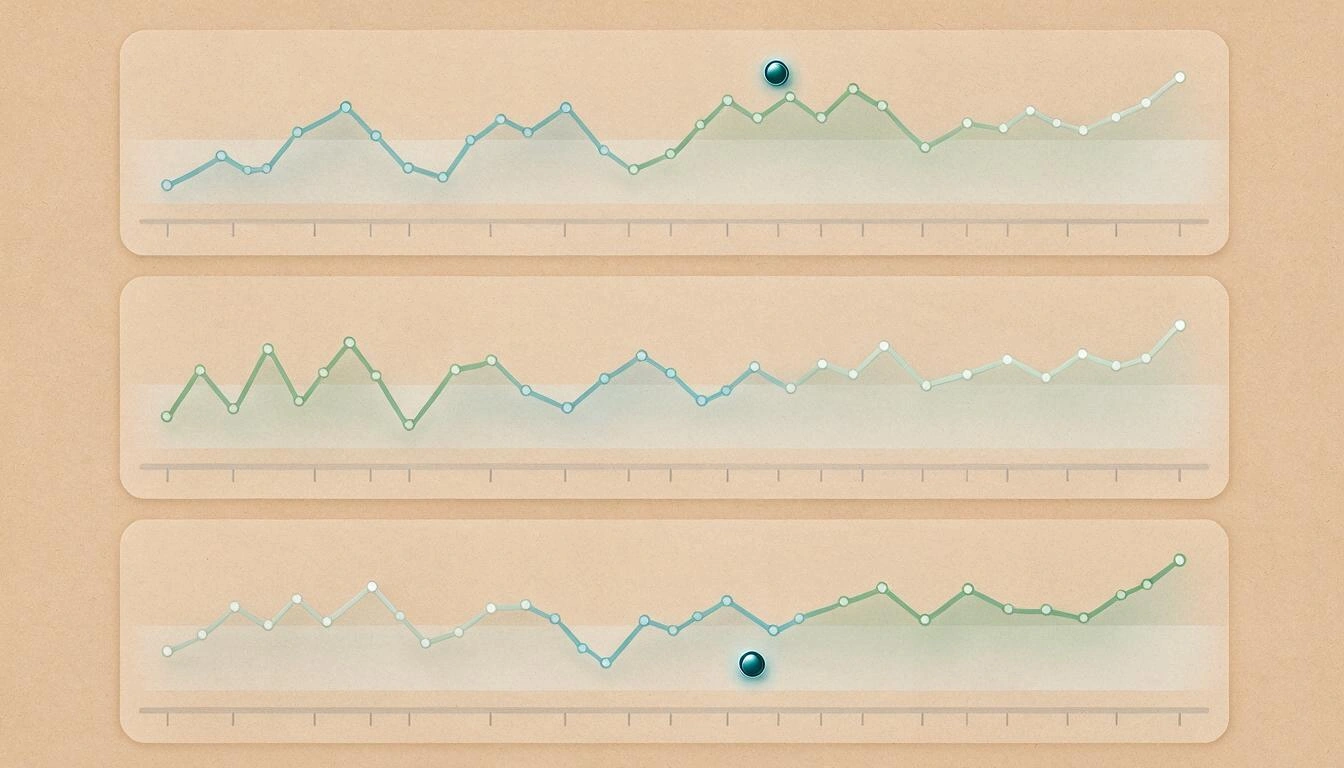
Here is the real value of your own file. An isolated value says little; three consecutive analyses of the same parameter say a lot. The practical obstacle is that each laboratory calls things differently and uses different units, so the series breaks just when you change centers or move from public to private. The rule: always keep the original value and unit from the report, and unify above, without rewriting the paper. And note on the line the milestones — a change in medication, a surgery — because a moving value usually has a dated cause.
5. Have a one-page summary for emergencies
In an emergency, no one is going to read forty PDFs. What is useful is one sheet: allergies, chronic conditions, current medication with dosages, relevant surgeries, and the latest out-of-range values. Printable and also on your mobile. If you care for an elderly person, keep theirs updated and have a copy in their wallet. It is the document that turns a private file into something useful at three in the morning.
How aiToHealth fits into this method
The five steps can be done with a folder, a scanner, and a spreadsheet; many people do it this way. aiToHealth, the family health app from AIsToHire, exists so that it is not abandoned after the third month, which is what happens with the spreadsheet.
Regarding the above, point by point: you create one profile per family member with their base record; you scan the report with a photo and the AI identifies the type of document, the date, the laboratory, and each parameter with its value, its unit, and its range, and shows it to you for you to correct before saving it, so that no misread data enters the history; the evolution of each parameter is drawn with the shaded range band and milestones on top, and a catalog of 88 parameters recognizes the synonyms from each center and converts the units while always preserving the original value, so the series does not break when changing laboratories; the appointment calendar for the whole house alerts you by email 24 hours and 1 hour before, prepares a sheet with what is relevant for that specialty, and, upon leaving, collects by dictation what was discussed; and the PDF "Summary for the doctor" generates that one-page sheet to take to emergencies. You can also ask the assistant about the history, and it responds by citing the original report.
What it does not do, and it is deliberate: it does not diagnose or prescribe medication. Everything generated by the AI is labeled as AI-generated and is not a diagnosis; nothing enters the history without human review. It organizes and explains reports so that you arrive at the consultation with complete information; the clinical decision is up to your doctor.
Frequently Asked Questions
Can I see my medical history from another autonomous community?
Partially. Through the Digital Clinical History of the SNS, you can consult the reports that your community and others have published in the system, identifying yourself with an electronic ID, digital certificate, or Cl@ve at the access to the HCDSNS of your health service. You will see the types of reports that that community publishes, not necessarily the nine from the catalog of the Royal Decree 1093/2010, and you will not see anything prior to digitization or generated in private healthcare.
How do I request my complete clinical history?
In writing and in several places. Article 18 of Law 41/2002 grants you the right to access and obtain a copy, and you can exercise it yourself or through someone with accredited representation. Submit the request to the health service of each community where you have been, also consult the HCDSNS, and separately request a copy from each clinic, laboratory, or private mutual. The deadline is set by the procedure of each center, not by state law.
Is the clinical history of private healthcare in the public system?
Not today. Private healthcare and mutuals are not part of the HCDSNS. Extending it is the goal of the draft Law on Digital Health, which as of November 2026 has not been approved. Some communities have partial integrations with contracted centers, and the private sector maintains its own platform, but there is no general right: if you are treated privately, you must download and keep each report yourself.
What is interoperable digital clinical history and when will I truly have it?
It is the ability for a professional treating you to see your clinical information regardless of where it was generated. In Spain, it has existed since 2010 with uneven coverage; in the EU, Regulation (EU) 2025/327 makes it mandatory in phases: summarized clinical history and electronic prescription starting March 26, 2029, and laboratory, imaging, and hospital discharges starting March 26, 2031.
If Madrid has a unique clinical history, why should I keep my reports?
Because "unique" means unique within that community. The deployment that Madrid will complete before February 2027, according to Libertad Digital, unifies the record among its public hospitals. It does not include what was done in the private sector, nor does it follow you if you are treated in another community, nor does it collect what the doctor explained to you verbally.
My doctor changed the dosage and it doesn't appear in any report. Is that normal?
It is very common. The clinical report includes diagnosis and plan, but the nuances of the consultation —adjustments, conditions, "if it doesn't improve in three weeks, we come back"— often do not make it to a document that you can consult. That’s why it’s advisable to record it yourself the same day, in writing or dictated, along with the date and the professional. It does not replace the report: it complements it.
What reports should I always request at the moment?
Imaging tests (request the medium or download link, not just the radiologist's report), hospital discharge reports, outpatient reports from each specialist, and complete lab analyses with their reference ranges. These are the hardest to recover years later and the ones that travel poorly between communities and between public and private.
Is this medical advice?
No. Neither this article nor aiToHealth diagnose, clinically interpret, or prescribe treatments or dosages. The information is organized and explained in clear language so that you can communicate better with your doctor, who is the one who decides.
Start with the copy you are missing
Interoperability between administrations will gradually arrive: Madrid in February, the Digital Health Law when the legislature allows, Europe in 2029 and 2031. In the meantime, the only history that is complete on the day you need it is the one you have. And the part that no law will return to you —what the doctor told you— only exists if you write it down the same day.
Start today with something small: create your account on aiToHealth, the AIsToHire app to organize the medical history of the whole family, register a profile for each family member, scan the first report you have on hand, and generate the one-page PDF "Summary for the Doctor." Print it and keep it in your wallet. The next time someone in your household ends up in the emergency room, that sheet will be worth more than the entire rest of the file.
Create your account on aiToHealth, register a profile for each family member, scan the first report you have on hand, and generate the one-page PDF 'Summary for the doctor' to take to emergencies.
Create your account on aiToHealth, register a profile for each family member, scan the first report you have on hand, and generate the one-page PDF 'Summary for the doctor' to take to emergencies.Keep reading
View all articles →
Out-of-range blood test results: what they really mean (and how to track them over time)

Why Your Car Insurance Increased in 2026: Average Premium of €1,412 and Historic Record

Discussing via WhatsApp or talking in person: what science says about couple conflicts through messages
