 AIsToCV
How to Tailor Your Resume for Each Job Offer in 2026 (Without Making Anything Up)
Team at AIsToCVWritten with AI assistance17 min readIn summary
- In 2025, each InfoJobs vacancy received an average of 56 applicants (52 in 2024) and the platform accumulated over 136 million applications (InfoJobs–Esade Report, March 26, 2026). The generic CV competes against that volume.
- 97.4% of Fortune 500 companies use a detectable ATS, and Workday accounts for over 40% of those installations (Jobscan, August 20, 2026). The first reader of your CV is almost never a person.
- Adapting is not rewriting: in practice, they change the headline, the order of the bullet points, and the vocabulary. The experience is left untouched, because making it up is the quickest way to fail in the interview.
- Regulatory novelty: the AEPD warned a company on September 23, 2026 for using AI to screen applications without sufficient guarantees, and Royal Decree 723/2026 requires, since October 5, 2026, written notification of the algorithms that decide on the workforce.
- What saves the most time is not having ten saved CVs, but rather a unique master profile from which all versions emerge. This is exactly the approach of AIsToCV.
If you have spent an entire Saturday rearranging phrases in a Word document to send the same application to five different job offers, you already know that adapting the CV to each offer works, but it is laborious. This guide explains what is really happening on the other side of "Submit application" in 2026 —how many competitors there are, what an ATS reads, what Spanish law says from this month—and proposes a specific six-step method. In the end, you will see how AIsToCV, the AIsToHire app to adapt your CV to each job offer, fits into that method without asking you to make anything up.

Why does a generic CV hardly pass the first filter anymore?
Because the competition for vacancies has increased and the volume has overwhelmed the selection templates. In Spain, each InfoJobs offer received an average of 56 applicants in 2025 compared to 52 in 2024, with 2,460,405 vacancies published and over 136 million applications registered (InfoJobs–Esade Report, 16th edition, published on March 26, 2026). With those numbers, the screening stops being a reading and becomes an ordering.
The picture is better understood with the data from those on the other side. According to the Benchmark Report by Greenhouse published in May 2026, the number of applications per position rose from about 115 in 2022 to 244 in 2025 (+111%), while selection teams decreased by 55% during that same period. And LinkedIn reported receiving 11,000 applications per minute, 45% more than the previous year (data published by The New York Times in July 2025).
In addition, there is the macro context: the EPA for the second quarter of 2026 (INE, published on July 28, 2026) puts unemployment at 9.87%, with 2,495,300 unemployed people. There are fewer human eyes per application than ever and more people sending applications than ever.
| Data | Figure | Source and date |
|---|---|---|
| Applicants per vacancy in Spain (2025) | 56 (52 in 2024) | InfoJobs–Esade, 26/03/2026 |
| Vacancies published on InfoJobs (2025) | 2,460,405 | InfoJobs–Esade, 26/03/2026 |
| Total applications on InfoJobs (2025) | +136 million (+7%) | InfoJobs–Esade, 26/03/2026 |
| Applications per position (Greenhouse clients, 2025) | 244 (≈115 in 2022) | Greenhouse Benchmark Report, 05/2026 |
| Reduction of selection teams since 2022 | −55% | Greenhouse Benchmark Report, 05/2026 |
| Applications per minute on LinkedIn | 11,000 (+45% year-on-year) | The New York Times, 07/2025 |
| Unemployment rate in Spain (Q2 2026) | 9.87% | INE, EPA Q2 2026, 28/07/2026 |
What does an ATS really do with your resume?
An ATS (Applicant Tracking System) does not "score your worth": it first extracts text from your file and places it into structured fields —name, position, company, dates, degree, skills— and then allows the recruiter to search and sort candidates by those fields. If the extraction goes wrong, your experience exists in the PDF but not in the database being searched.
Adoption is nearly universal among large companies: Jobscan detected an ATS in 97.4% of Fortune 500 companies (487 out of 500) in its report from August 20, 2026, with data collected in June 2026; Workday accounts for over 40% market share among them, and SAP SuccessFactors is around 12%. Outside of the Fortune 500, the distribution is much more fragmented (Greenhouse 19.0%, Workday 17.5%, Lever 15.6%, iCIMS 14.4% out of more than 13,000 companies analyzed).
The practical consequence is not glamorous: the enemy is not "AI", it is the formatting. Columns, tables, icons, language level bars, and text placed in headers or images are precisely what survives extraction the worst.
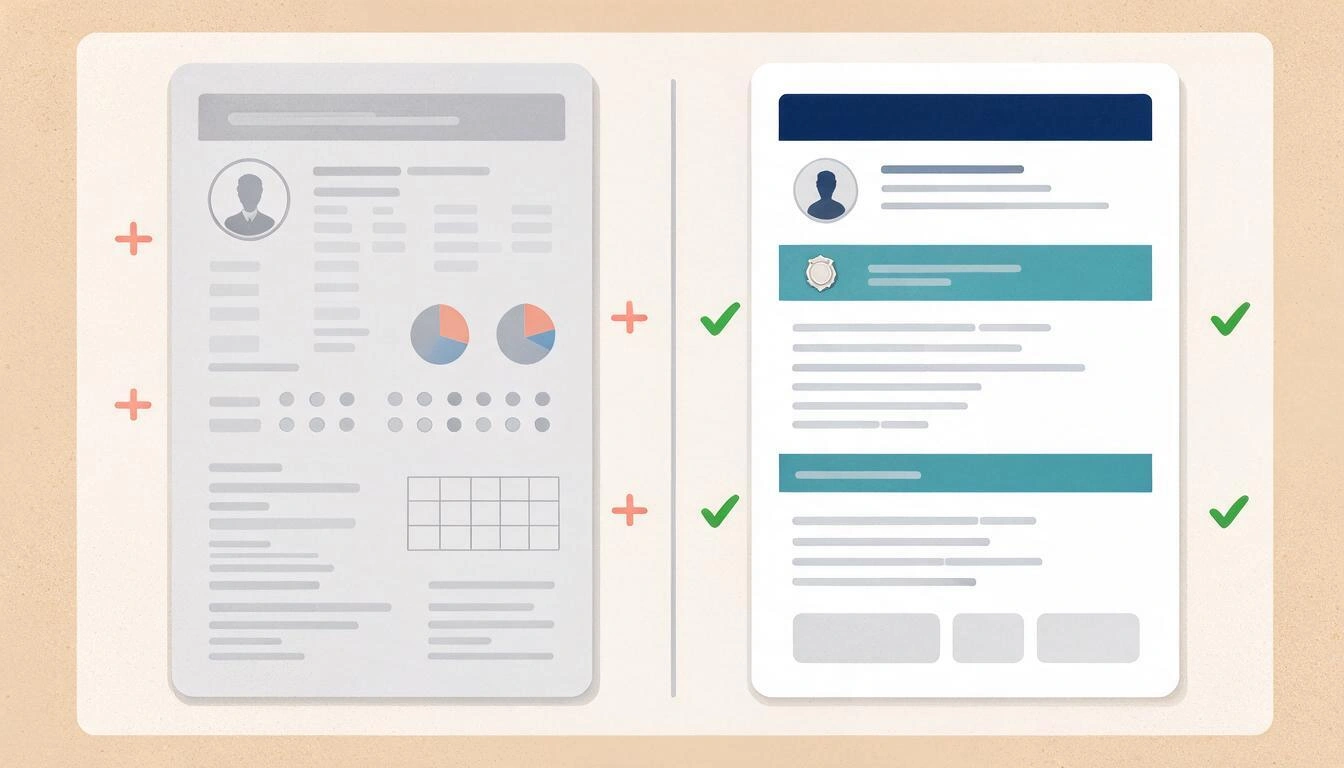
| CV Element | How it usually appears in extraction | Safe alternative |
|---|---|---|
| Two columns | Text gets mixed up or loses order | A single column, top to bottom |
| Tables and grids | Cells separated or merged nonsensically | Lists with bullets |
| Contact information in header or footer | Sometimes not extracted | Contact in the body, first line |
| Bars, stars, and level graphics | Do not generate text: disappear | "English C1", "SQL: advanced level" |
| Logos and text within images | Invisible except for OCR | Plain text |
| Creative section names ("My journey") | Do not map to a field | "Experience", "Education", "Skills" |
| Abbreviations not expanded (or vice versa) | Searching one of the two forms does not find you | "Business Intelligence (BI)" both times |
Operational rule: if you copy your CV into a notepad and what comes out is disordered or incomplete, that is roughly what the system will read.
What changed in 2026 in Spain with AI and personnel selection?
Three things, and it is important not to mix them: the AEPD has already formally warned about the automatic screening of resumes, Royal Decree 723/2026 requires written notification of the algorithms that decide on the workforce, and the "high-risk" obligations of the European AI Regulation have been postponed to December 2027.
- AEPD, September 23, 2026 (file AI-00009-2026-Warning): the Agency reminds of the guarantees for using AI in resume analysis. It demands data protection by design, impact assessment when processing is high risk, understandable transparency towards candidates, and effective human intervention: it is not enough to have a person at the end if they accept the system's ranking without critically evaluating it (AEPD press release).
- Royal Decree 723/2026 (BOE of September 15, 2026, in effect from October 5, 2026): transposes Directive (EU) 2019/1152 and, in its article 3.2.k), requires written notification of the existence of algorithmic or automated decision systems and their guidelines, criteria, and rules when affecting working conditions. Note the scope: it protects already hired individuals, not those in a selection process.
- Regulation (EU) 2024/1689 (AI Act): employment and selection AI systems are high risk (Annex III), but the Digital Omnibus package —approved by the European Parliament on June 16, 2026, adopted by the Council on June 29, and in effect since July 27, 2026— delayed these obligations from August 2, 2026, to December 2, 2027.
| Regulation | What it requires | Since when | Who it protects |
|---|---|---|---|
| GDPR, art. 22 | Right not to be subject to a decision based solely on automated processing with significant effects | In effect | Candidates and workers |
| Law 15/2022 (equality of treatment) | Non-discriminatory selection criteria; promotion of anonymized CVs in public employment services and placement agencies | 07/13/2022 | Candidates |
| Warning AEPD AI-00009-2026 | Transparency, impact assessment, and real human intervention in AI screening | 09/23/2026 | Candidates and workers |
| RD 723/2026, art. 3.2.k) | Written information about algorithms that decide working conditions | 10/05/2026 | Hired individuals |
| AI Act, Annex III (employment) | Data governance, documentation, human oversight, bias management | 12/02/2027 (postponed) | Candidates and workers |
This is general information about published regulations, not legal advice. For a specific case, consult a professional.
What can you demand if an AI discards your application?
You can request understandable information about the processing of your data and the role of the tool, and you can invoke Article 22 of the GDPR against decisions based solely on automated processing that produce significant effects. The AEPD expressly reminded this in its note of September 23, 2026.
What you cannot demand is a position, nor the exact "formula" of the ranking. And in practice, the asymmetry remains enormous: in the candidate report from Greenhouse published on October 20, 2026 (over 2,800 people in the U.S., U.K., Ireland, Germany, and Australia), 81% say they were rejected without any human contact and 88% want transparency about AI in selection to be a legal obligation.
That’s why the sensible strategy is not to fight the filter, but not to give it reasons to discard you: let your CV say, in the vocabulary of the job offer and in the first few centimeters of the page, what that offer asks for.
How to tailor your CV to a job offer in 6 steps (without rewriting it entirely)
Effectively tailoring a CV takes 10-15 minutes if you already have a solid base profile, and it affects four areas: the headline, the summary, the order of the bullet points, and the words. Not your history, which is what it is.
- Capture the entire offer. Paste the complete text (or take a photo of it) instead of relying on what you remember. Long offers hide in the last paragraph the requirement that truly filters.
- Separate must-haves from nice-to-haves. Make two lists. "Must-have: 3 years with SQL". "Nice-to-have: retail sector". If you lack two hard and certifiable must-haves, that offer is not for you: save your time for another.
- Map your profile against that list. Three buckets: what you have and is written, what you have but does not appear in your CV (this is the bucket that wins offers) and what you do not have.
- Reorder, don’t rewrite. Let the headline be the name of the position from the offer —if it truly is yours— and let the first 3-5 bullet points respond to the must-haves. What does not contribute to that offer is lowered or trimmed.
- Use the words from the offer, when they are true. If the offer says "Power BI" and you wrote "dashboards", put both:
Dashboards in Power BI. Expand the acronyms once. No keyword paragraphs or blank text: today that is detected and it leaves you out. - Check the extraction and save the file properly. Copy the text to a notepad and see if it reads entirely. Name the file
First-Last-Position.pdf, in text PDF (not scanned).
An example of the difference between step 4 and step 5 done poorly and done well:
Before:  Responsible for improving online channel sales.
After: Led online channel analytics (Power BI + SQL):
         +15% sales in 6 months on a base of 1,200 orders/month.
The second bullet point is not "more AI": it is the same experience with the data that you already had and had not written. That figure must be real, because it is exactly what they will ask you in the interview.
What adapts in each offer and what is never touched?
The presentation is adapted —headline, summary, order, vocabulary, what is trimmed—; the truth is not adapted: dates, companies, qualifications, language levels, and figures. That boundary is what separates "tailored CV" from "invented CV".
| Element | Is it adapted? | How |
|---|---|---|
| Headline / desired position | Always | The name of the position from the offer, if it fits your real profile |
| Summary of 2-3 lines | Always | Rewritten towards the must-haves of the offer |
| Order of bullet points | Always | The relevant ones for that offer, at the top |
| Vocabulary and acronyms | Always | The words from the offer, only if they are true |
| What experiences are trimmed | Often | The old or irrelevant ones are summarized in one line |
| Listed skills | Often | First those that the offer asks for |
| Dates, companies, qualifications | Never | They are verifiable: an inconsistency eliminates you |
| Figures and achievements | Never | They are added if they exist; they are not "rounded" |
| Sensitive personal data | Never mandatory | Photo, age, or marital status are not necessary in Spain |
Regarding the last point, Law 15/2022, of July 12, comprehensive for equality of treatment and non-discrimination (BOE of July 13, 2022) considers discriminatory the criteria and selection systems that produce indirect discrimination for protected causes, and promotes the use of anonymized resumes in public employment services and placement agencies. Translated to your document: if a personal data does not contribute anything to the position, it does not have to be there.
And what if the recruiter thinks my CV was written by an AI?
It is a real and measurable risk, and it is avoided with specificity, not with rare synonyms. The Greenhouse report from October 20, 2026 found that 77% of U.S. candidates used AI in their job search last year, that 60% have changed or considered changing how they write to not seem like AI (63% among Generation Z) and that 62% have attempted some tactic to bypass automated filters.
What reveals a generated text is not the tool: it is the absence of concrete data. "Results-oriented professional with excellent communication skills" could be anyone; "I managed 40 critical incidents/month with a 4-hour SLA in a team of 6 people" can only be yours. AI is useful for organizing and questioning; the verifiable content you provide.
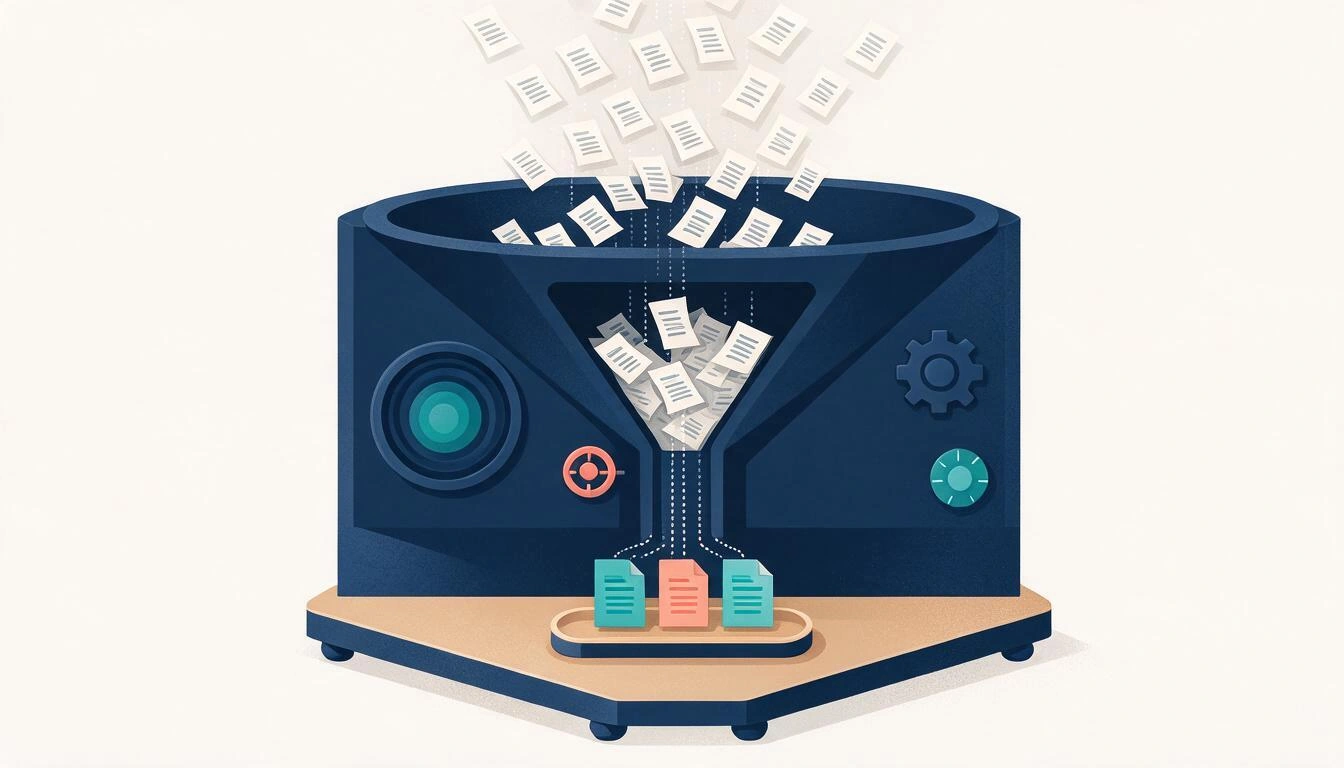
The real shortcut: a master profile instead of twelve loose CVs
The bottleneck of adapting is not writing: it is going back to search which version of the CV had that project, that certification, or that figure. The solution is to have a single repository with all your history —more than what fits in a CV— and generate each version from there.
That is what AIsToCV does, the mini-app from AIsToHire to adapt the CV to each job offer. It works through conversation, designed for mobile, and its design rule is the same as this article advocates: no inventing; everything that appears in a CV exists beforehand in your profile.
Specifically:
- Start without forms: you upload a CV that you already have —PDF, DOCX, or a photo of the document— and the app extracts and structures the information into blocks (identity, experience, education, skills, languages, certifications, projects, achievements). If you don’t have a CV, you start from scratch by talking.
- Interview by blocks: a chat that only asks what’s missing, without repeating what it already knows, with the option to skip a block and come back later. A completeness bar shows which blocks are covered and which are not.
- Impact bullet points with brakes: when you say "I improved sales," the app asks for the metric, the timeframe, and the scope before suggesting wording. If you truly don’t have the figure, it formulates it in verifiable qualitative terms, but does not make it up.
- Living master profile: a single profile per user that enriches with everything you discover in any flow, and that you can export and delete.
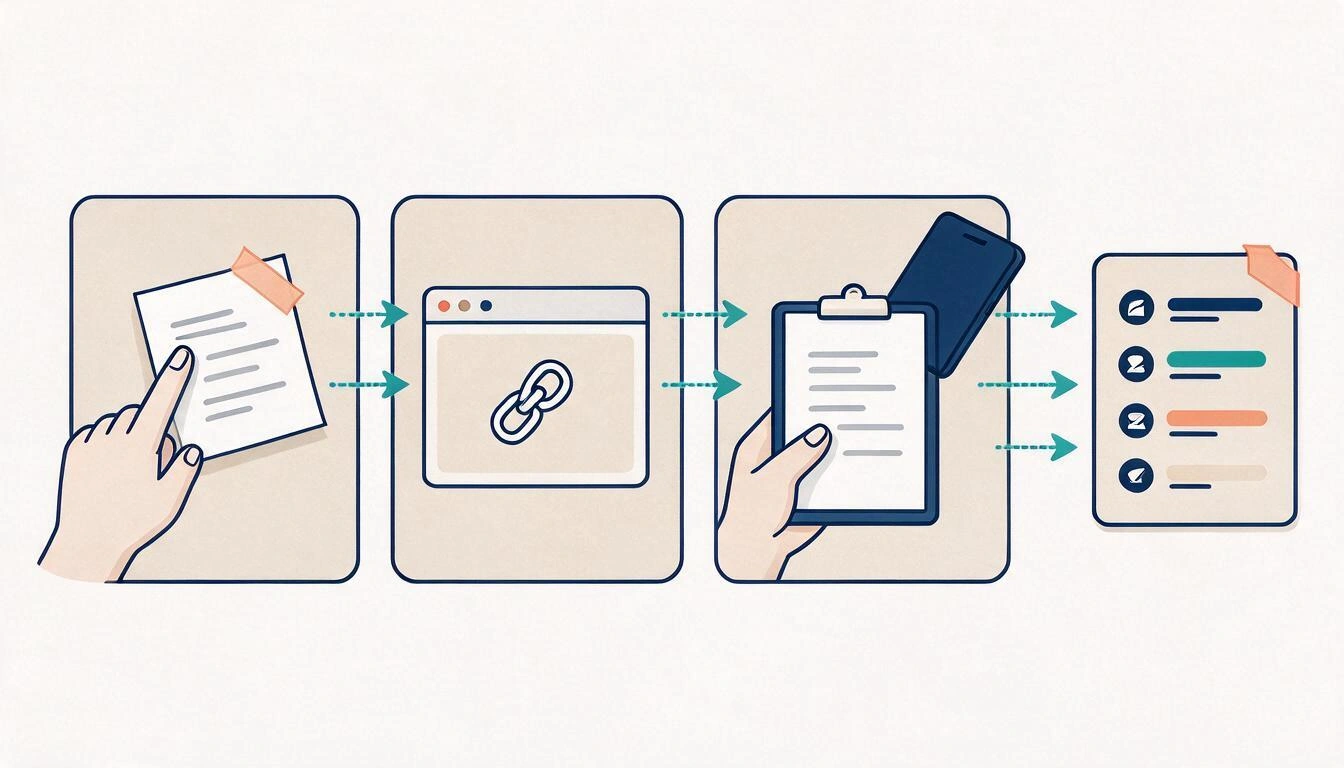
- Job offers through three channels: pasting the text, by URL (when the portal allows it; many block access) or uploading a screenshot of the offer, which is natural on mobile. From there, it extracts the requirements to work with.
- Sensitive data under control: personal information that you do not want to publish is saved marked and remains deactivated by default in the output.
No tool —this one included— can guarantee you an interview: the decision is made by the company, and neither the ATS nor the AI is the final criterion. What you can control is arriving with a readable CV, organized towards what the offer asks for and backed by facts that you can defend face to face.
Frequently Asked Questions
How long does it take to tailor a CV to a job offer?
Between 10 and 15 minutes if you already have a solid base CV and your information gathered in one place. Most of that time is spent reading the job offer carefully and deciding the order, not writing. If you take an hour each time, the problem is not the adaptation: it's that your history is scattered.
Is it true that ATS automatically reject my resume?
They usually do not "reject": they extract the text and allow the recruiter to search and sort. The actual rejection often comes from not appearing in those searches (because you don't use the words from the offer or because the layout prevented the text from being extracted properly) and from the volume: 244 applications per position on average in 2025 according to the Greenhouse Benchmark Report (May 2026). Where there is automated decision-making, Article 22 of the GDPR and the guarantees recalled by the AEPD on September 23, 2026, come into play.
Is PDF or Word better for a resume in 2026?
Text PDF (the one you generate from the processor, not a scan) is the safe option in most cases; ATS also read Word without problems. What matters more than the format is the content: a single column, no tables, no text within images, and with contact details in the body of the document, not in the header or footer.
How many keywords from the offer should I include in the CV?
As many as are true and relevant, integrated into sentences with context, not in a loose list. Artificially repeating terms or hiding text in white is counterproductive: it is one of the tricks that selection teams are already actively looking for —62% of candidates admit to having tried to circumvent the filters, according to Greenhouse (October 20, 2026)—, and a CV that passes the filter but does not hold up in the interview is of no use to you.
Should I include a photo and age on the CV in Spain?
It is not mandatory and in many cases, it is better to omit them. Law 15/2022 promotes anonymized resumes in public employment services and placement agencies, and prohibits selection criteria that generate indirect discrimination based on age, sex, origin, disability, or health status, among other causes.
Will using AI to prepare my application penalize me?
Using it won't, pretending will. 77% of candidates surveyed by Greenhouse (October 2026) used AI in their search; the problem arises when the text is generic or when it states things you cannot prove. A tool that forces you to provide the real data before drafting works in your favor; one that fills in gaps for you, against.
What happens if I do not meet all the requirements of the offer?
It depends on which ones. If "valuable" requirements or those easily compensated by relevant experience are missing, it is worth applying by explaining that bridge in the summary. If two or three essential hard and certifiable requirements are missing (a qualifying degree, a working language, minimum years required by agreement or by client), the opportunity cost is high: better to invest that time in an offer where you do fit.
Can I find out if a company used an algorithm to reject me?
You can ask for it. The GDPR gives you the right to understandable information about the processing of your data and not to be subject to decisions based solely on automated processing with significant effects. Royal Decree 723/2026, in force since October 5, 2026, requires written information about the algorithms that decide working conditions, but protects already hired individuals, not candidates. And the specific obligations of the European AI Regulation for employment systems will apply from December 2, 2027, following the postponement approved in 2026.
Conclusion: the short version
Tailoring the CV to each offer ceased to be an extra for perfectionists the day an average vacancy started receiving dozens or hundreds of applications and the first reader stopped being human. But adapting well is an editing job —title, order, vocabulary, readable format—, not fiction: the part that gets you the job is the one you can defend in the interview.
If you want to do it without repeating your own biography twenty times, first set up your master profile and generate from there. That is the proposal of AIsToCV, the app from AIsToHire: tailor your CV to each job offer based on a single profile of yours, built by speaking, with the rule of not inventing anything above all else.
Set up your master profile once and tailor your resume for each job by talking to AIsToCV. Try it for free at AIsToHire.
Set up your master profile once and tailor your resume for each job by talking to AIsToCV. Try it for free at AIsToHire.Keep reading
View all articles →
Mandatory salary in job offers from June 2026: what changes for you as a candidate

Why Your Car Insurance Increased in 2026: Average Premium of €1,412 and Historic Record

Discussing via WhatsApp or talking in person: what science says about couple conflicts through messages