 aiOptic
What the numbers on your glasses (52 □ 18 140) mean and how to know if your size is correct
Team at aiOpticWritten with AI assistance14 min readIn summary
- The three numbers engraved on the temple are, in this order, caliber (width of each lens, usually between 40 and 62 mm), bridge (distance between lenses, between 14 and 24 mm), and temple length (from 120 to 150 mm, with the bulk of the market between 135 and 145 mm), according to the measurement guide from All About Vision.
- The rule of thumb for sizing is that the total width of the frame matches the width of your face at the temples: if it protrudes, it slips; if it falls short, the temples press.
- Two frames with the same three numbers can fit differently, because the caliber does not include the bridge or the curvature of the front.
- If you wear progressive lenses, the crucial measurement is not engraved: it is the lens height, which should be around 28-30 mm for the distance, intermediate, and near zones to fit.
- The Spanish optical market generated €2.251 billion in 2025 (+3.94%), but the units of prescription frames only grew by 0.60% compared to a +4.10% in euros: the same glasses are being bought, but more expensive. Getting the right size costs more money than before.
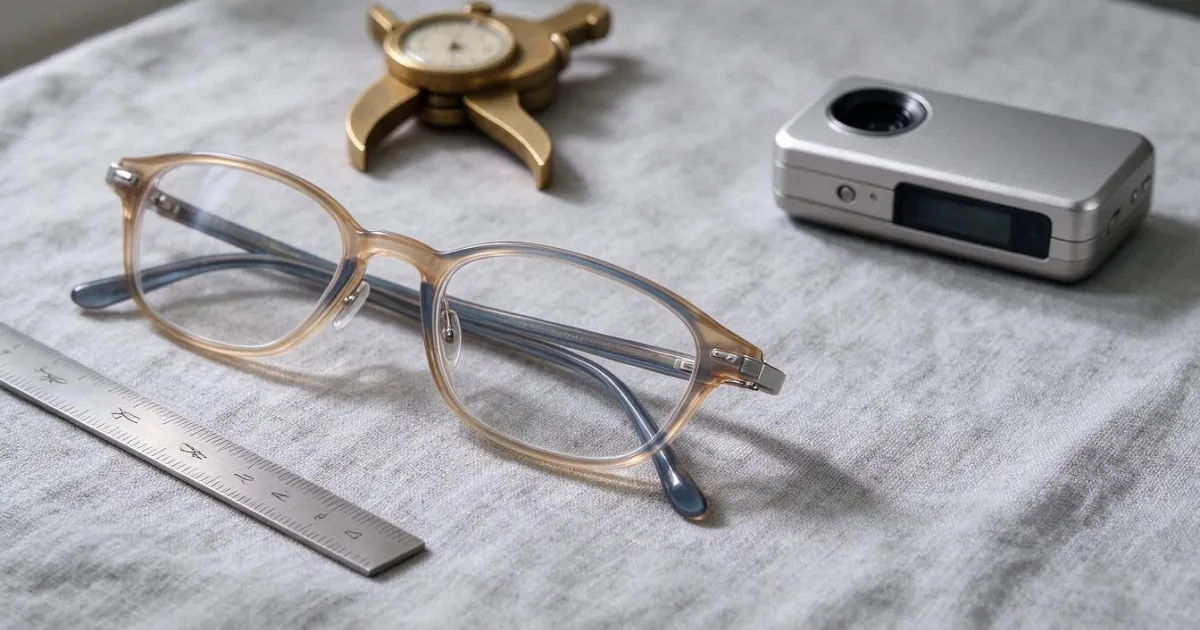
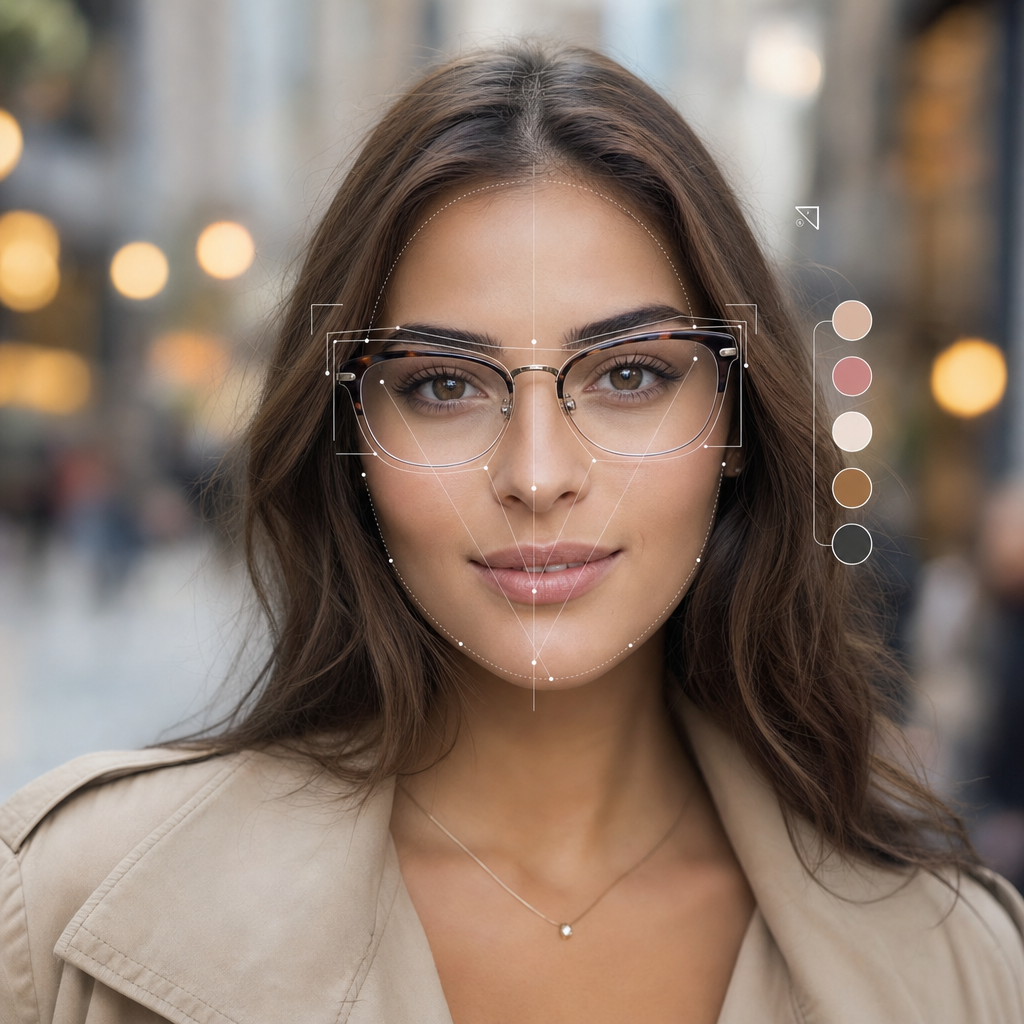
Almost everyone chooses glasses for their shape and color, and then discovers that the problem was another: the size. This guide explains what the numbers on glasses mean, how to compare them with your own face, and what signs indicate a poorly sized frame, with the measurement references used by opticians. If you also want to have the shape, color, and material decided before entering the store, the AI ideal frame glasses study from aiOptic, the AIsToHire application, analyzes a photo of you and returns an infographic with those decisions already made.
What the numbers on glasses mean: 52 □ 18 140, one by one
These are the three dimensions of the frame in millimeters. The 52 is the caliber or horizontal width of each lens at its widest point; the 18, preceded by the square symbol, is the width of the bridge, that is, the distance between the two lenses in the area that rests on the nose; the 140 is the total length of the temple, from the hinge to the tip. The symbol □ is not decorative: it indicates that the measurements follow the boxing system, the method of fitting each lens into a circumscribed rectangle for measurement.
| Number | What it measures | Typical range | What happens if it is wrong |
|---|---|---|---|
| 1st — Caliber | Horizontal width of each lens | 40-62 mm | Frame that protrudes from the face or that presses at the sides |
| 2nd — Bridge | Distance between the two lenses | 14-24 mm | Marks on the nose, glasses that slip or that rest too high |
| 3rd — Temple | From the hinge to the tip | 120-150 mm (common, 135-145) | Pressure behind the ear or glasses that do not stay in place |
Source of the ranges: All About Vision and the measurement guide from cristalesgafas.com.
A detail that explains many failed purchases: the sum that interests you is not any of the three numbers separately, but caliber × 2 + bridge, which is the approximate width of the front. A 52 □ 18 frame occupies about 122 mm of front; a 48 □ 20, about 116 mm. Two sizes that seem very different at first glance end up separated by six millimeters.
Where those measurements are engraved and what standard regulates them
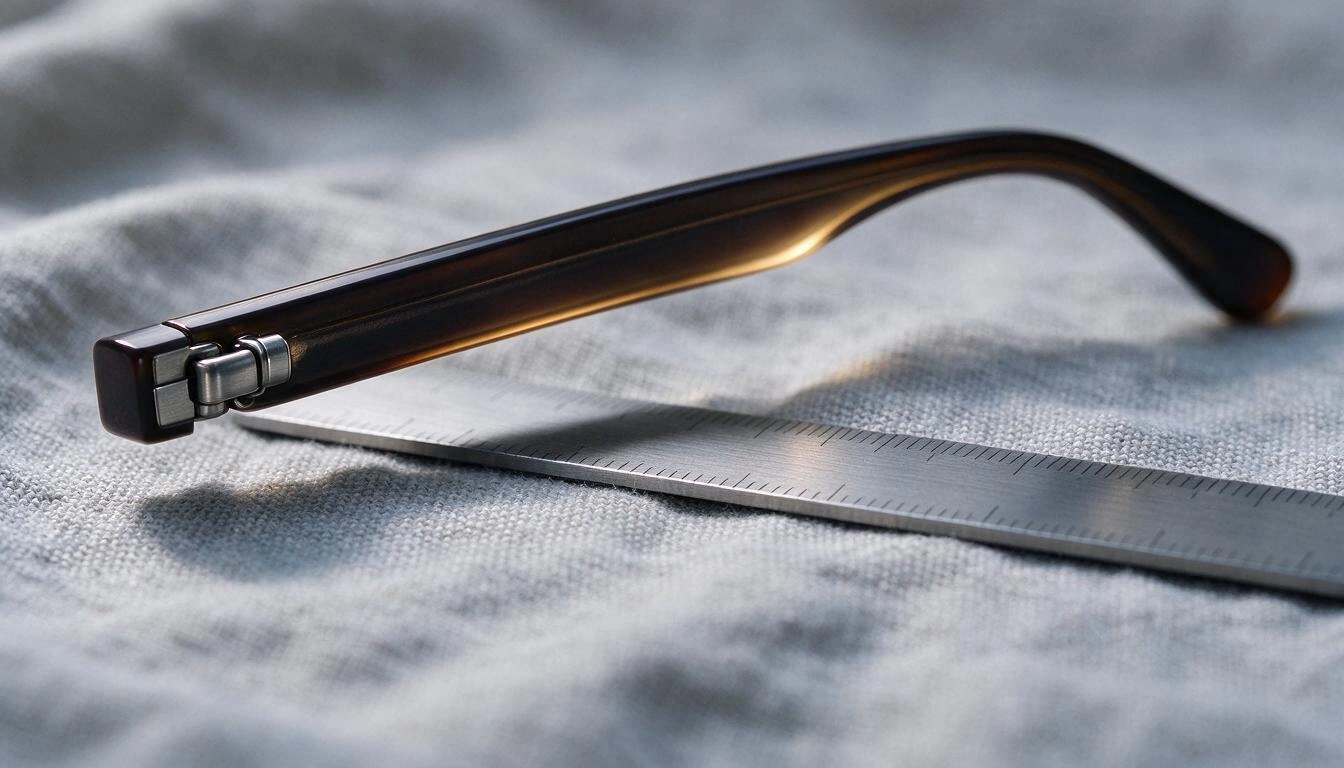
They are engraved on the inner face of the temple —almost always on the left— and, in some metal frames, on the bridge. If your frame does not have them, you can measure them with a millimeter ruler: a margin of 1 or 2 mm does not alter the result, because the optician verifies the measurements when mounting the lenses.
Behind those numbers is a standard. The UNE-EN ISO 8624, in its 2021 version, establishes the measurement system and the vocabulary for eyeglass frames: it defines exactly what caliber is and how it is measured. You can consult its file at the Spanish Association for Standardization and the European version in the catalog of EN ISO 8624:2020. The complementary standard, ISO 12870, establishes the general requirements and testing methods for frames, and is the usual reference for legible and indelible marking on the temple; its scope is described in the file of ISO 12870.
Translated: when you compare a 52 from one brand with a 52 from another, you are comparing the same thing. What is not comparable is how that width is distributed on your face.
How to know if your glasses size is correct: the facial width rule
The starting check is simple: the total width of the frame should match, with a margin of a few millimeters, the width of your face measured at the height of your temples. Look straight at yourself in a mirror: the outer edge of the front should end right where the side of your head begins, without protruding outside and without staying inside the line of the temples.
How to measure yourself at home, in three steps:
- Facial width. With a flexible measuring tape or a ruler in front of the mirror, measure the horizontal distance between the temples, at the point where the arms would rest. Size guides from optical shops like Ulloa Óptico and Oren Óptica also use the width at the height of the cheekbones as a reference for the size.
- Width of the candidate frame. Calculate size × 2 + bridge and add a couple of millimeters for the thickness of the material and hinges.
- Compare. If the difference is within ±4 mm, the size is viable. If the frame is clearly wider, it will slip; if it is narrower, the arms will pinch.
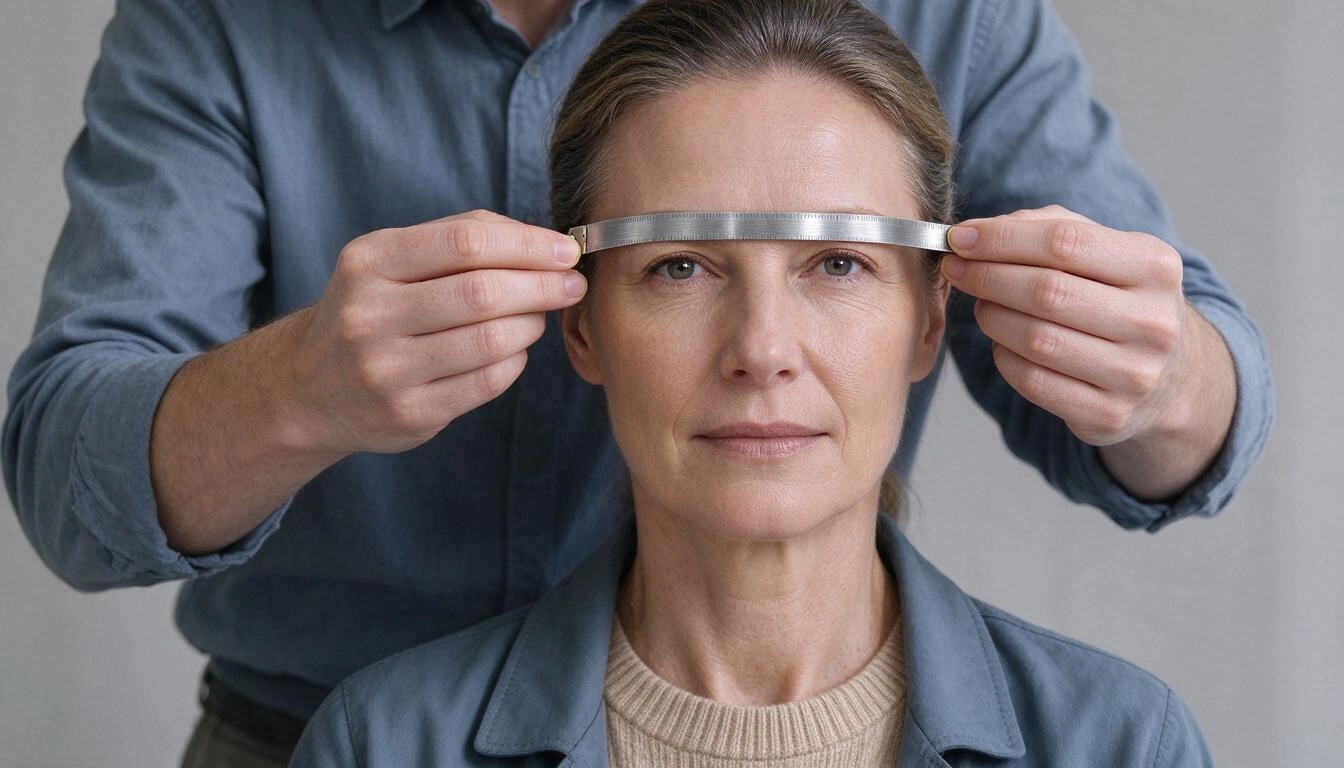
Two more checks that do not depend on any recorded number: the pupils must be centered in each lens, neither shifted towards the bridge nor towards the outer edge, and the frame must stay in place when tilting the head forward.
The six signs that your frame size is poorly chosen
There are six symptoms that opticians identify as indicative of an incorrect size, not just a simple misfit: red marks on the bridge of the nose, pressure on the temples, arms that dig behind the ear, frame that slips when looking down, need to constantly readjust to see clearly, and, in progressives, losing the reading area. The inventory of symptoms is collected by Lentiamo and by Óptica Universitaria.
| Sign | What measurement is wrong | What can be corrected and what cannot |
|---|---|---|
| Red marks on the nose | Bridge too narrow or poorly placed pads | Pads yes; acetate bridge, no |
| Pressure on the temples | Front narrower than facial width | Arm opening, a little; size, no |
| Arms digging behind the ear | Arm too short or very curved tip | The tip can be curved; the length, no |
| The frame slips when lowering the head | Front wider than the face or bridge too open | Pads and curvature, partially; the size, no |
| Readjusting to see clearly | Pupils misaligned with respect to the size | Can be recentered by remounting, if the size allows |
| Losing the near zone in progressives | Insufficient lens height | Cannot be corrected: need to change frame |
The practical boundary is that last column. The optician can adjust pads, arm opening, front tilt, and tip curvature; what they cannot do is create millimeters of size or height that the frame does not have.
What changes in small or narrow faces
In small or narrow faces, the problem is not style, it is that the standard catalog starts above their size. Size guides from optical shops place the small range in sizes from 48 to 50 mm, and below 48 the options are greatly reduced; this is noted by Ulloa Óptico and, applied to small and elongated faces, the blog of Multiópticas.
What to look for in that case:
- Size between 46 and 50 mm and a proportionally narrower bridge (14-17 mm), so that the optical center falls where it should.
- Adjustable pads instead of fixed acetate bridge: on narrow faces, nasal support is the critical point.
- Arms of 135-140 mm rather than 145-150, which leave the glasses loose.
- Front without excessive curvature, because a very wraparound base visually widens the frame.
The industry has noticed. On November 11, 2026, Optimoda released the new collection autumn-winter 2026-27 of Adidas Sport Eyewear, which precisely expands adjustments and sizes: the model Anemos Light S SP0116 is a reduced version with ventilation in the front and arms, adjustable supports and compatibility with graduated clip, and the Kentro S SP0127 extends the same size enlargement to the running segment. The complete reference is in the review of the Adidas Sport Eyewear collection.
That a sports brand launches "S" versions with adjustable pads and arms is confirmation that the small size had been neglected: adjusting stops being a remedy and becomes a product specification.
Progressives: the measurement that is not engraved on the rod
In progressives, the deciding measurement is the lens height —the vertical dimension of the lens within the frame— and it does not appear among the three engraved numbers. Progressive designs need at least 28-30 mm of height to accommodate the distance, intermediate, and near zones; below that, one of them is cropped, almost always the reading zone. This is detailed by Farmaoptics, which sets the minimum at 30 mm for all zones to fit, and cristalesgafas.com, which mentions 28 mm as the comfort floor.
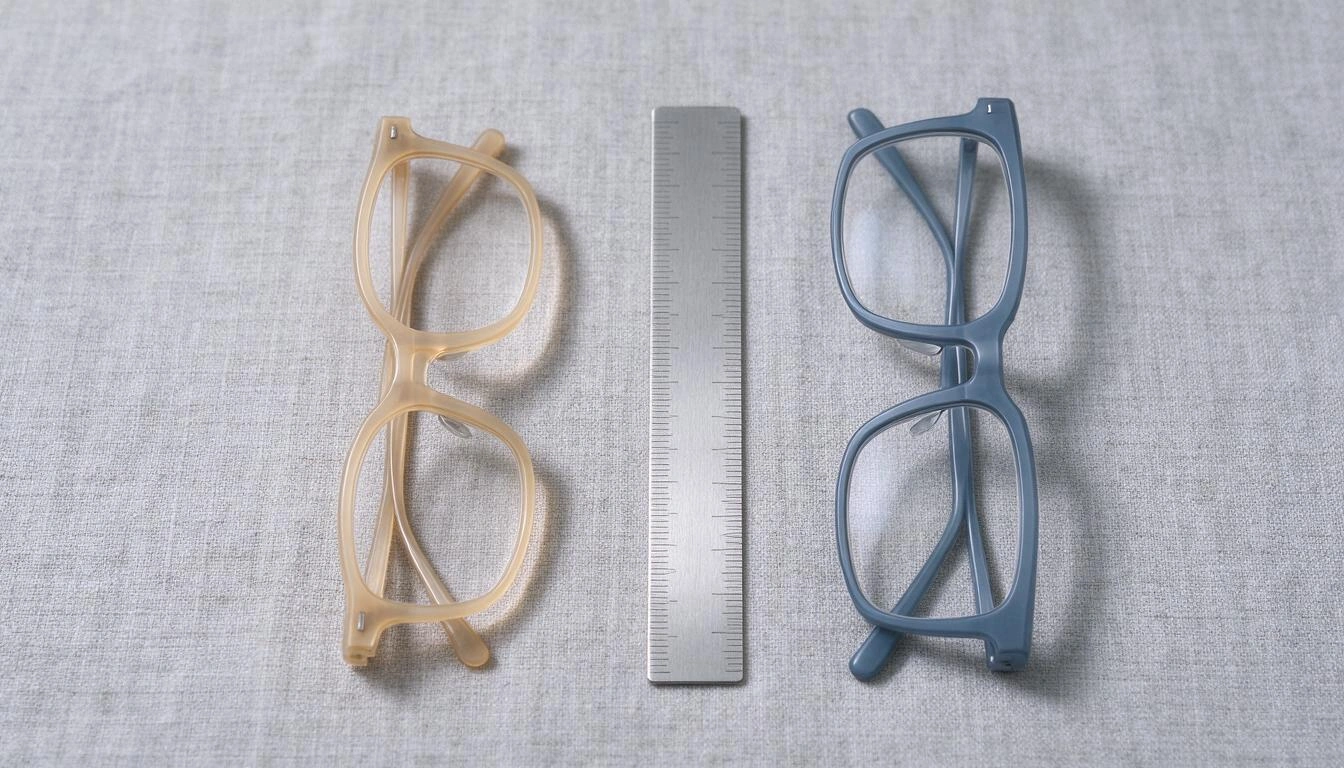
This immediately rules out very narrow frames from top to bottom, those thin rectangular ones of 25 mm in height that work aesthetically but not optically. It adds a second measurement, the mounting height: the optician measures in millimeters from the center of your pupil to the bottom edge of the frame, with the glasses already on and in a natural head position. That data depends on your face and the specific frame, so it cannot be inherited from previous glasses or calculated from home.
The segment is not marginal. The autumn-winter 2026 campaign of Opticalia, "I do not give up anything", is primarily aimed at progressive users, with a collection of over 28 models and a 2×1 promotion focused on that type of lens, running from September 4 to November 30, 2026, according to the campaign presentation reported by Lookvision.
Why getting the size right matters more in 2026: the same glasses, more expensive
Because spending on glasses is rising while the number of glasses remains stable. The White Paper on Vision 2026 from FEDAO, with data from 2025, estimates the turnover of the Spanish optical sector at €2,251 million (+3.94%), but the growth comes from price, not volume: prescription frames added €421.9 million (+4.10%) with barely 30,516 more units (+0.60%) and an average price of €82.46 (+3.48%). The data was published by Optimoda on October 9, 2026, in its analysis of the optical market at two speeds.
| Category (2025 data) | Turnover | Variation in euros | Variation in units | Average price |
|---|---|---|---|---|
| Ophthalmic lenses | €1,024 million | +3.10% | +0.57% | €64.23 (+2.52%) |
| Prescription frames | €421.9 million | +4.10% | +0.60% | €82.46 (+3.48%) |
| Sunglasses | — | +3.74% (+€11.4 million) | −0.77% (−28,538 units) | €85.88 (+4.54%) |
| Total sector | €2,251 million | +3.94% | — | — |
Data: White Paper on Vision 2026 from FEDAO, via Optimoda, October 9, 2026. The three combined categories account for around 78.3% of the sector's turnover. FEDAO attributes the increase to a shift towards higher value-added products —mid and high ranges and more advanced lens technologies— not to a generalized price increase.
The takeaway for buyers is straightforward: if you only renew every few years and each renewal costs more, a poorly chosen size is an expensive and long-lasting mistake. And in progressives, the penalty multiplies, because the advanced lens you are paying for does not perform in a frame that does not provide height.
What to ask at the optical store: five specific questions
Having five prepared questions turns the frame fitting into an objective check rather than an impression in front of the mirror. These are the questions, in the order they should be asked.
- "What is my facial width at the temples and what range of caliber corresponds to me?" This is the data that filters the catalog before you start trying on.
- "How much lens height does this frame have?" Mandatory if you wear progressives: below 28-30 mm, discard it.
- "Are my pupils centered in this caliber?" If they are not, the fitting drags an off-center issue and you need to look for another caliber or another bridge.
- "What can you adjust on this frame and what can't you?" The nose pads, the temple opening, and the bending of the end are real margins; the caliber and height are not.
- "Does this frame accept a prescription or solar clip?" Relevant if you want a single frame for indoors and outdoors, a formula that both Adidas with its prescription clip and Opticalia with its solar clip models are pushing.
And a bonus: ask them to note the three measurements of the frame you just bought. The next renewal starts with those three numbers in your pocket.
Frequently Asked Questions About Glasses Size
What do the numbers 52 18 140 on my glasses mean?
That each lens measures 52 mm in width, the bridge between lenses measures 18 mm, and each temple measures 140 mm from the hinge to the tip. Always in millimeters and always in that order.
How do I know what size of glasses I need?
Measure the width of your face at the temples and compare it with the width of the front of the frame, which is calculated as eye size × 2 + bridge. If the difference is within about 4 mm, the size works for you; the optician confirms the final measurement.
What size is a small glasses frame?
Optical size guides place the small range at 48-50 mm eye size, and below 48 mm the options become scarce. For narrow faces, a bridge of 14-17 mm and temples of 135-140 mm are also advisable.
Can any frame be used for progressive lenses?
No. The frame needs a lens height of at least 28-30 mm for the distance, intermediate, and near zones to fit. Very low frames cut off the reading area and that cannot be fixed with any subsequent adjustment.
Do two frames with the same numbers fit the same?
Not necessarily. The eye size does not account for the curvature of the front, the thickness of the material, the shape of the lens, or the type of nose support, and any of those four factors changes how the frame sits on your face.
Can a frame that is tight be widened?
Only partially. The optician can widen the temples, change pads, and reshape the tips, but cannot increase the eye size or the bridge. If the front is narrower than your face, the adjustment alleviates the symptom but not the cause.
Where are the measurements of my frame engraved?
On the inner side of one of the temples, usually the left one, and on some metal frames on the bridge. If they do not appear, they can be measured with a millimeter ruler with an acceptable error of 1 or 2 mm.
Before going to the optician, decide what cannot be measured with a ruler
The size is confirmed by the optician; the style, color, and material can be decided at home, and that is exactly what aiOptic does, the AIsToHire application for choosing glasses. You upload a photo and receive an infographic with the shape of your face, your skin undertone, your color season with its exact color palette, and the frame shapes, colors, and materials that suit you best, as well as a virtual try-on to see yourself with the glasses on. You can do the ideal frame study for glasses before your appointment and enter the optician with the catalog already filtered, to dedicate the visit time to what truly needs a professional in front: your facial width, lens height, and pupil alignment.
Take the free aiOptic study with a photo and enter the optical store with the shape, color, and material of your frame already decided.
Take the free aiOptic study with a photo and enter the optical store with the shape, color, and material of your frame already decided.Keep reading
View all articles →
What glasses suit me: how to know the shape of your face and choose a frame without making mistakes

Why Your Car Insurance Increased in 2026: Average Premium of €1,412 and Historic Record

Discussing via WhatsApp or talking in person: what science says about couple conflicts through messages