 aiOptic
What glasses suit me: how to know the shape of your face and choose a frame without making mistakes
Team at aiOpticWritten with AI assistance16 min readIn summary
- Whether glasses suit you depends on three different things: the shape (which should contrast with that of your face), the proportion (the measurements in millimeters engraved on the temple), and the color (your skin undertone, not your favorite color).
- To know what shape of face you have, you only need four measurements with a measuring tape: forehead width, cheekbone width, jaw width, and total face length. With those four numbers, you can identify one of the seven canonical shapes.
- The rule used by opticians is contrast: angular frames for round faces and soft frames for angular faces. The goal is to balance, not to repeat your shape.
- The numbers on the inside of the temple (
52□18-140) are caliber, bridge, and temple length in millimeters, standardized by the ISO 8624 standard. They are the most reliable way to get it right when buying online. - aiOptic, the app from AIsToHire, performs this analysis from a single front photo and returns a downloadable visual guide with the shapes, colors, and materials that suit you, plus a virtual try-on generated with your own face. It does not measure millimeters or provide prescriptions: that remains the work of the optician-optometrist.
You try on fifteen frames in front of the optical store mirror, all seem "more or less good" and you end up choosing the one that looks most like the one you were wearing. This is the story of almost everyone, and it’s not your fault: choosing a frame mixes three criteria that no one explains separately. This article separates them, gives you the method to measure your face in five minutes, and the tables to decide. In the end, you will see how aiOptic, the AI-powered eyeglass fitting study from AIsToHire, resolves that same analysis from a single photo.
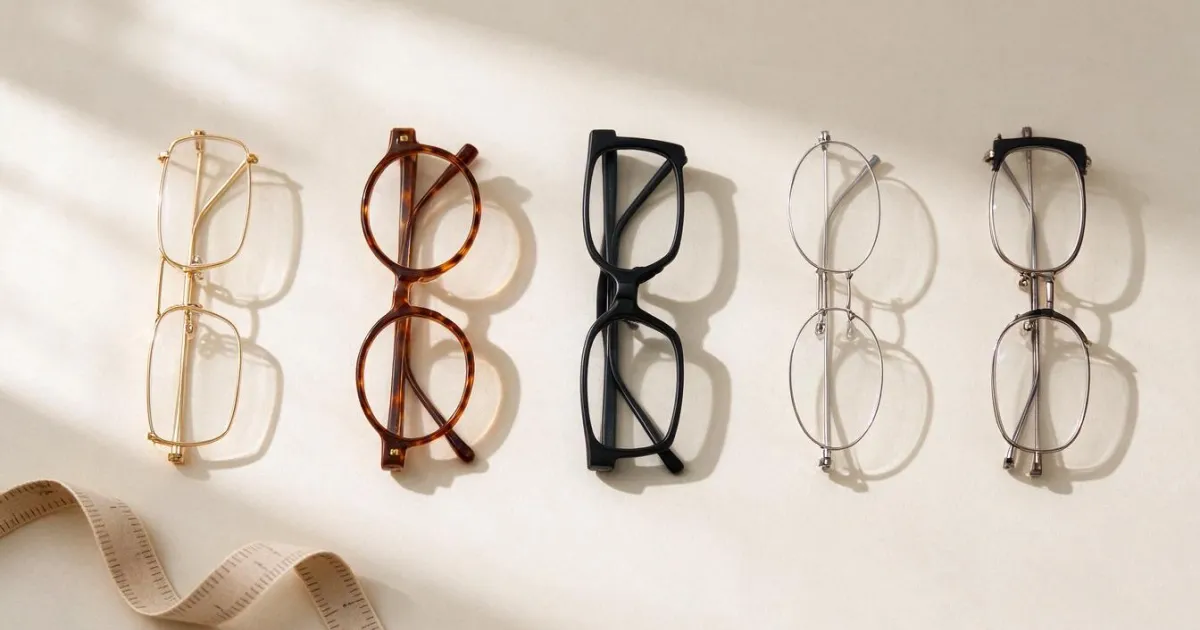
Whether glasses suit you depends on three factors, not one
A frame looks good on you when it gets shape, proportion, and color right at the same time. The shape must contrast with your face shape to balance it; the proportion is pure millimeter (that the frame measures what your face measures); and the color depends on your skin undertone and the contrast between hair, eyes, and skin. Failing in just one of the three is enough for something to feel "off" without you being able to say why.
| Factor | What it decides | How to check |
|---|---|---|
| Shape | If the frame balances or exaggerates your face | By measuring the shape of your face and applying the contrast rule |
| Proportion | If the frame is your size | With the measurements in mm of the temple and the width of your face |
| Color | If it brightens or dulls you | With your skin undertone, eye color, and hair color |
The good news is that all three are measurable. You don’t need to "have an eye": you need to measure.
How to know what shape of face you have: four measurements and five minutes
Grab a flexible measuring tape (the kind used for sewing) and stand in front of the mirror with your hair tied back and your face clear. You need four numbers: forehead width, cheekbone width, jaw width, and total face length. Comparing them to each other tells you your shape; the absolute value in centimeters doesn’t matter.
- Forehead width: from temple to temple, at the widest part, halfway between the eyebrows and the hairline.
- Cheekbone width: from the most prominent point of one cheekbone to the other, going just below the tear duct.
- Jaw width: from the jaw angle (just below the ear) to the other side, along the line of the bone.
- Face length: from the hairline to the tip of the chin, in a straight line.
- Compare: which of the three widths is the largest? How much is the length divided by the largest width?
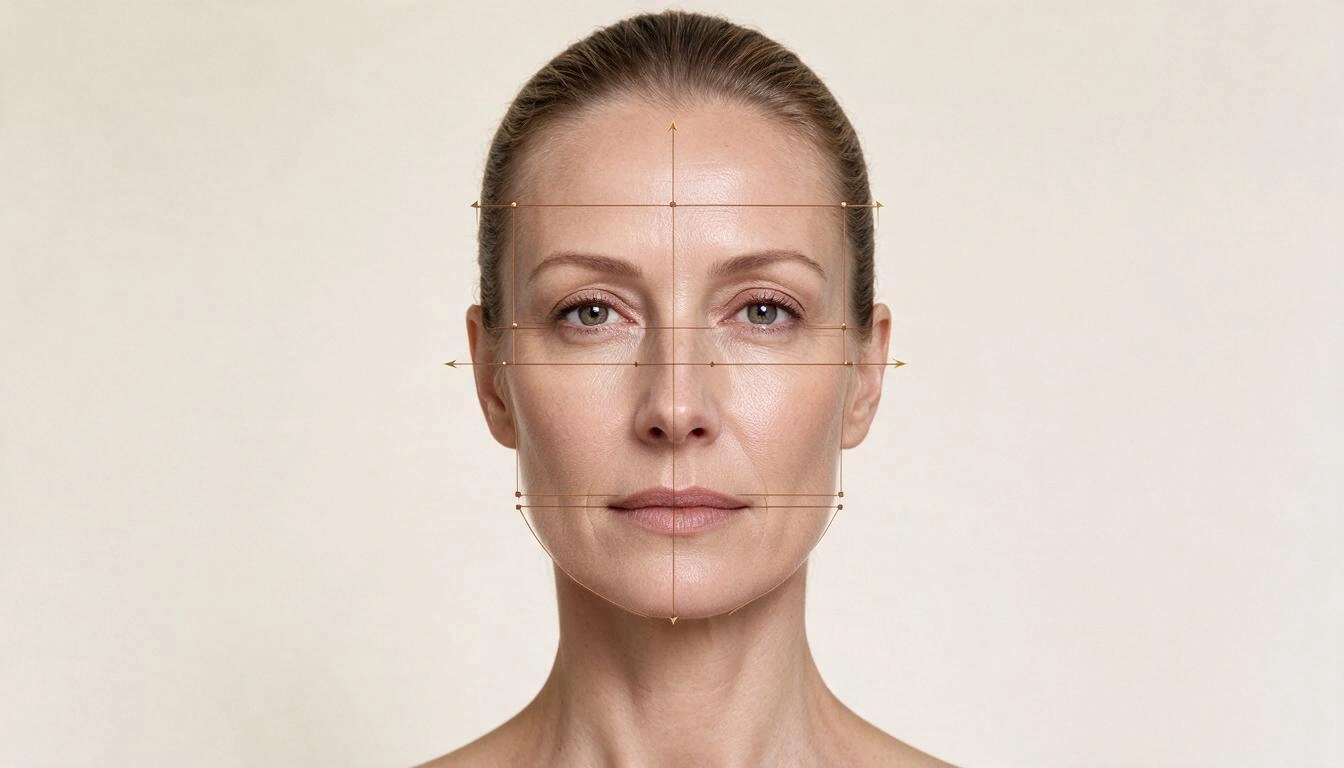
With those four data points, this table places you. The thresholds are indicative (image consulting is not an exact science); if you’re torn between two shapes, decide by looking at the jawline: angular leans towards square or rectangular, rounded leans towards round or oval.
| Shape | Width relationship | Length ÷ largest width | Jawline hint |
|---|---|---|---|
| Oval | Cheekbones are the widest; forehead slightly larger than jaw | ≈ 1.3 – 1.5 | Soft line, no sharp angles |
| Round | Cheekbones are the widest; forehead and jaw similar | ≤ 1.3 | Rounded jaw, full cheeks |
| Square | Forehead, cheekbones, and jaw almost equal (less than 1 cm difference) | ≤ 1.4 | Wide and angular jaw |
| Long (oblong) | All three widths similar | ≥ 1.5 | Face longer than wide, high forehead |
| Heart-shaped | Forehead > cheekbones > jaw | ≈ 1.4 – 1.6 | Narrow or pointed chin |
| Diamond | Cheekbones clearly the widest; forehead and jaw narrow | ≈ 1.5 | Defined cheekbones, sharp chin |
| Triangular | Jaw > cheekbones > forehead | ≈ 1.4 | The wider part is at the bottom |
These are the same seven categories used by the aiOptic analysis, so you can compare your home measurement with what the AI detects.
What frame balances each face shape
The professional rule is contrast: if your face is round, look for frames with angles; if it is angular, look for curves; and if it is elongated, look for height and visual weight to shorten it. The frame should not replicate the shape of your face; it should compensate for it.
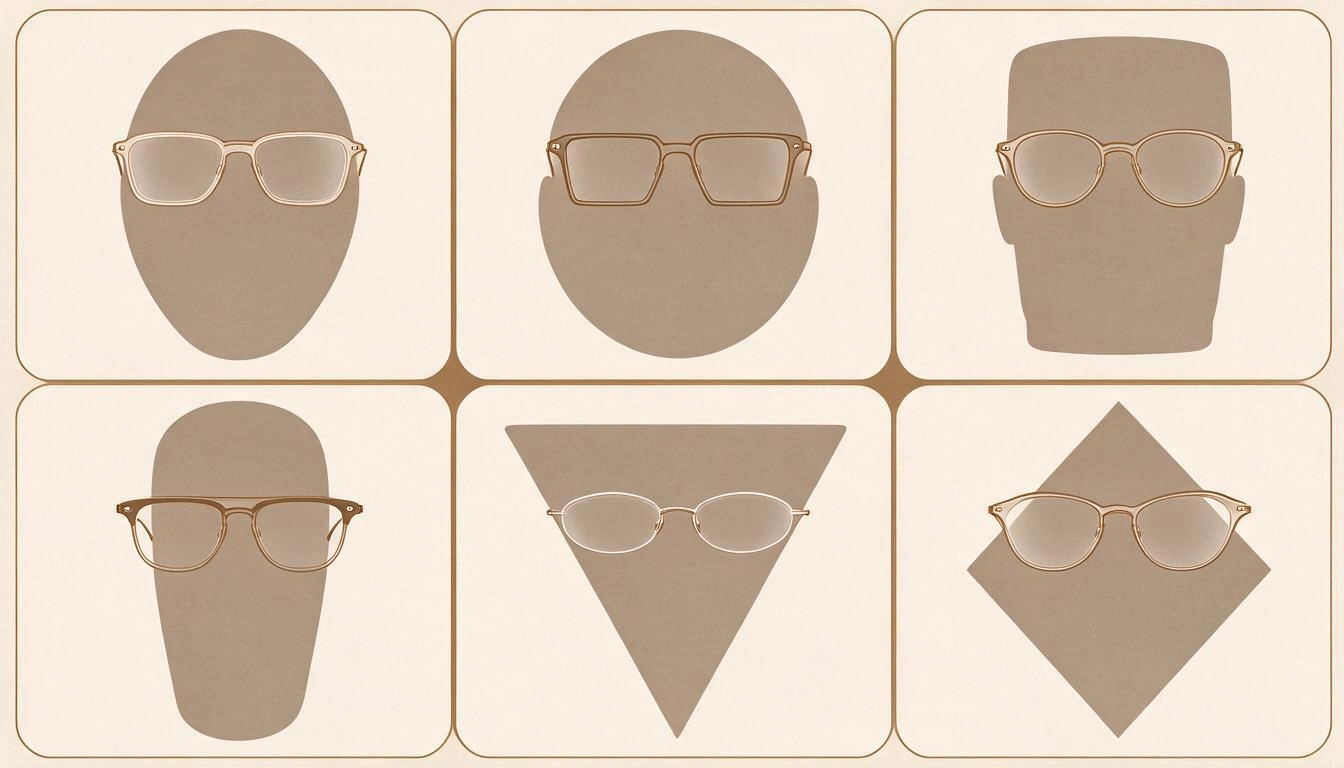
| Face Shape | What to Look For | Shapes that Work | Best to Avoid |
|---|---|---|---|
| Oval | Maintain the balance you already have | Almost all: soft rectangular, square with rounded corners, panto, browline | Huge frames that cover half the face or very small ones that elongate it |
| Round | Add angles and structure | Rectangular, square, geometric, browline | Small round and very curved ovals: they add roundness |
| Square | Soften the jawline | Round, oval, panto, thin metal, aviator | Thick, straight squares, very wide and angular |
| Elongated (oblong) | Visually shorten and add width | High-caliber frames (more "deep"), browline, low bridge, detail on temples | Narrow, small frames or very high bridge |
| Heart | Balance the wide forehead and narrow chin | Oval, round, without a lower rim, with a slightly wider bottom | Thick browline and heavily decorated frames on top |
| Diamond | Add width to forehead and chin, soften cheekbones | Oval, browline, slightly lifted shapes, without a lower rim | Narrow and angular frames that further highlight the cheekbone |
| Triangular | Add visual weight at the top | Browline, lifted shapes, marked upper rim, semi-open | Low frames, thick lower rim, or very narrow |
And three checks that apply to any face, no matter how you look at it:
- The total width of the frame should approximate the width of your face: the hinges should be roughly at the height of your temples, without sticking out or digging in.
- Your eyes, centered horizontally in each lens and at the height of the center or slightly above.
- Your eyebrows, visible above the rim or accompanied by the upper line of the frame; having the rim cut them in half is what gives the effect of "these glasses aren't mine".
What the numbers engraved on the temple (52□18-140) mean
These are three measurements in millimeters: lens caliber (52), bridge (18), and temple length (140). They are standardized by the international standard ISO 8624, Ophthalmic optics. Eyeglass frames. Measurement system and terminology (current edition of 2020), which defines the so-called boxing system with which all manufacturers outline their frames. It is the most useful information available for buying without trying on.
| Number | What it Measures | Typical Range | What Happens if it Fails |
|---|---|---|---|
| Caliber | Horizontal width of each lens | 40 – 62 mm | Too large: the frame droops and sticks out from the face |
| Bridge | Distance between the two lenses | 14 – 24 mm | Short: digs into the nose. Long: slips all day |
| Temple | Length of the arm to the curve | 120 – 150 mm | Short: presses behind the ear. Long: doesn't hold |
The practical trick: take the glasses that you already have and fit well, look for those numbers inside the temple and don't stray more than ±2 mm in caliber and bridge. It’s the shortcut used by those who buy frames online without missing.
Watch out for a piece of information that is not engraved on the frame: the interpupillary distance (IPD), the distance between the centers of your pupils (in adults, it usually ranges between 54 and 74 mm). It is what allows centering the lenses, and it is measured by the optician. Without it, a perfect frame can end up with poorly centered lenses.
The color of the frame is determined by your skin undertone, not your favorite color
The undertone is the underlying hue of your skin and does not change even if you get a tan: it can be warm (golden, peach), cool (pink, blue), or neutral. It is the factor that decides whether a tortoiseshell frame brightens you up or a black one dulls you down, and it can be checked in thirty seconds at home.
Three home tricks that coincide when you get it right:
- The veins on your wrist in natural light: greenish → warm; bluish or purple → cool; not sure → neutral.
- Gold or silver: hold a piece of each next to your face. The one that brightens you up marks your temperature.
- Pure white against off-white: if the optical white leaves you looking tired and the off-white flatters you, you are warm (and vice versa).
| Undertone | Frame Colors that Usually Work | Metals | What Usually Looks Dull |
|---|---|---|---|
| Warm | Tortoiseshell/havana, honey, amber, brown, olive green, beige, brick red | Gold, bronze, copper | Pure black, cool gray, bright silver |
| Cool | Black, gray, navy blue, burgundy, violet, dusty pink, clear crystal | Silver, gunmetal, steel | Oranges, intense golds, yellowish beige |
| Neutral | Almost everything; safe bets in medium tones: taupe, light tortoiseshell, bluish gray | White gold, steel, combinations | Very saturated extremes |
And a second layer, the eye color: if you want them to stand out, look for contrast (copper and amber with blue eyes; burgundy and purple with green eyes; blue and green with brown eyes). If you prefer harmony, choose shades close to the color of your iris. The same goes for hair: grays call for cool tones (silver, blue, burgundy) and a warm brown calls for tortoiseshell, honey, or gold.
Materials: acetate, metal, titanium, TR-90 and combined
The material decides the weight, what can be adjusted, and how much it withstands. It's not just an aesthetic detail: a frame that is too heavy on the bridge leaves a mark and you end up taking it off.
| Material | Feel and weight | Adjustment | Suited for | Watch out for |
|---|---|---|---|---|
| Acetate | Thick and present, medium weight | Adjustable when heated | Those who want color, tortoiseshell or presence; disguises the edge of thick lenses | Heavier in high prescriptions |
| Metal (steel, monel) | Thin and discreet | Highly adjustable, with adjustable nose pads | Small faces, sober styles, noses that need height | Nickel allergies in cheap alloys |
| Titanium | Very light and strong | Adjustable, hypoallergenic | All-day use, high prescriptions, sensitive skin | Clearly higher price |
| TR-90 (polyamide) | Extremely light and flexible | Not very moldable in shape | Sports, children, intensive use | Fewer "dress" finish options |
| Combined (browline) | Acetate on top, metal on bottom | Mixed | Faces that need visual weight on the top | Not all shapes allow it |
The fact that explains why titanium costs more: with the same volume, it weighs about 40% less than steel (density of 4.5 g/cm³ versus about 7.8 g/cm³). In glasses that you wear for twelve hours a day, that is noticeable on the bridge of the nose.
Five mistakes that make you regret the frame
- Choosing by trend and not by proportion. An XXL frame on a small face is not modern, it's a frame that is too big for you.
- Buying online without checking the millimeters. The catalog photo says nothing about size; the three numbers on the arm do.
- Forgetting the prescription. With high myopia, a large frame with a thin rim thickens the edge of the lens; a small frame with a closed rim disguises it. Ask about it before ordering.
- Trying on glasses without the final lenses. The final weight changes with the lens index and thickness.
- Deciding only with the optical store mirror. Without glasses on, you can't see up close, and with them on, you don't see how others see you. A front-facing photo, at the same distance and with the same light, is a much better judge.
How to know which glasses suit you with a photo: this is how aiOptic works
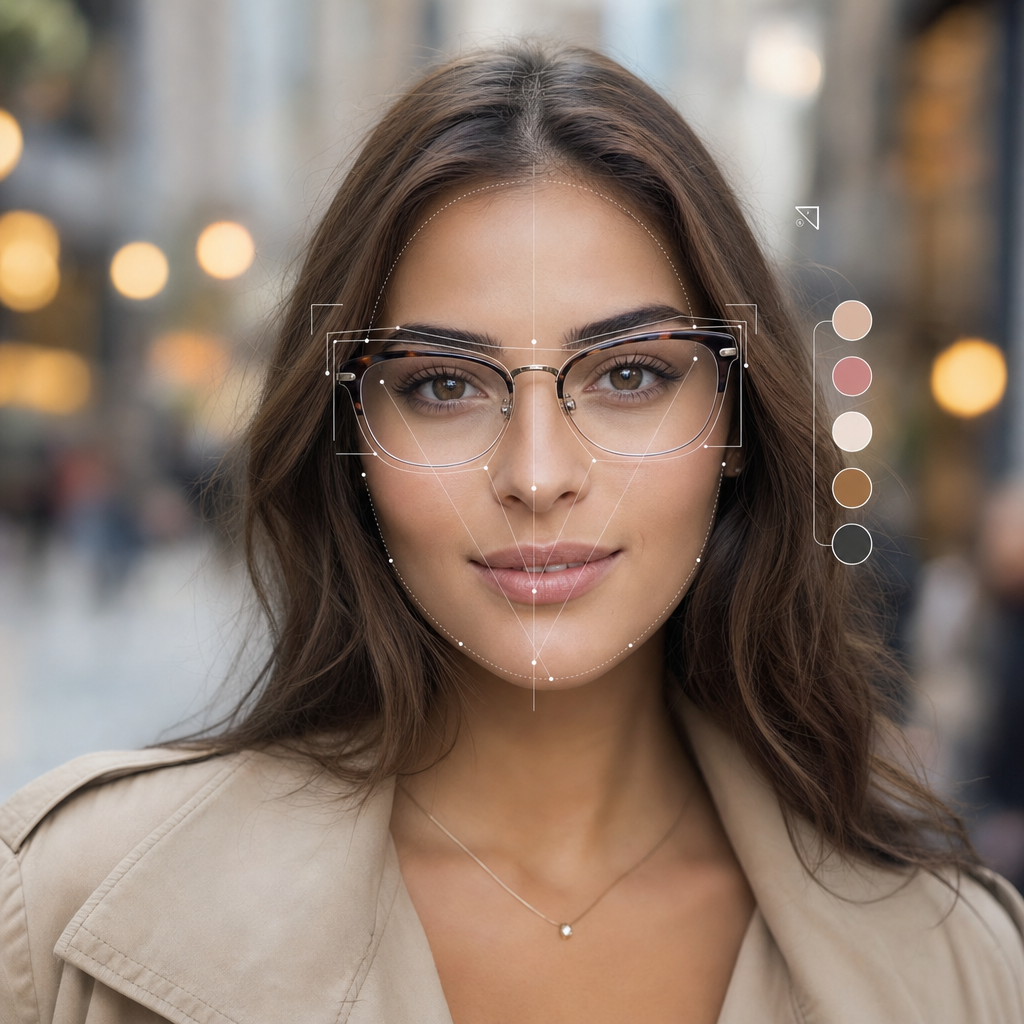
aiOptic is the mini-app from AIsToHire that performs this complete analysis based on a single frontal photo: it detects the shape of your face among seven categories, your features, skin undertone, and your personal colorimetry, and with that, it builds the recommendation of shapes, colors, finishes, and frame material, as well as the three shapes you should avoid.
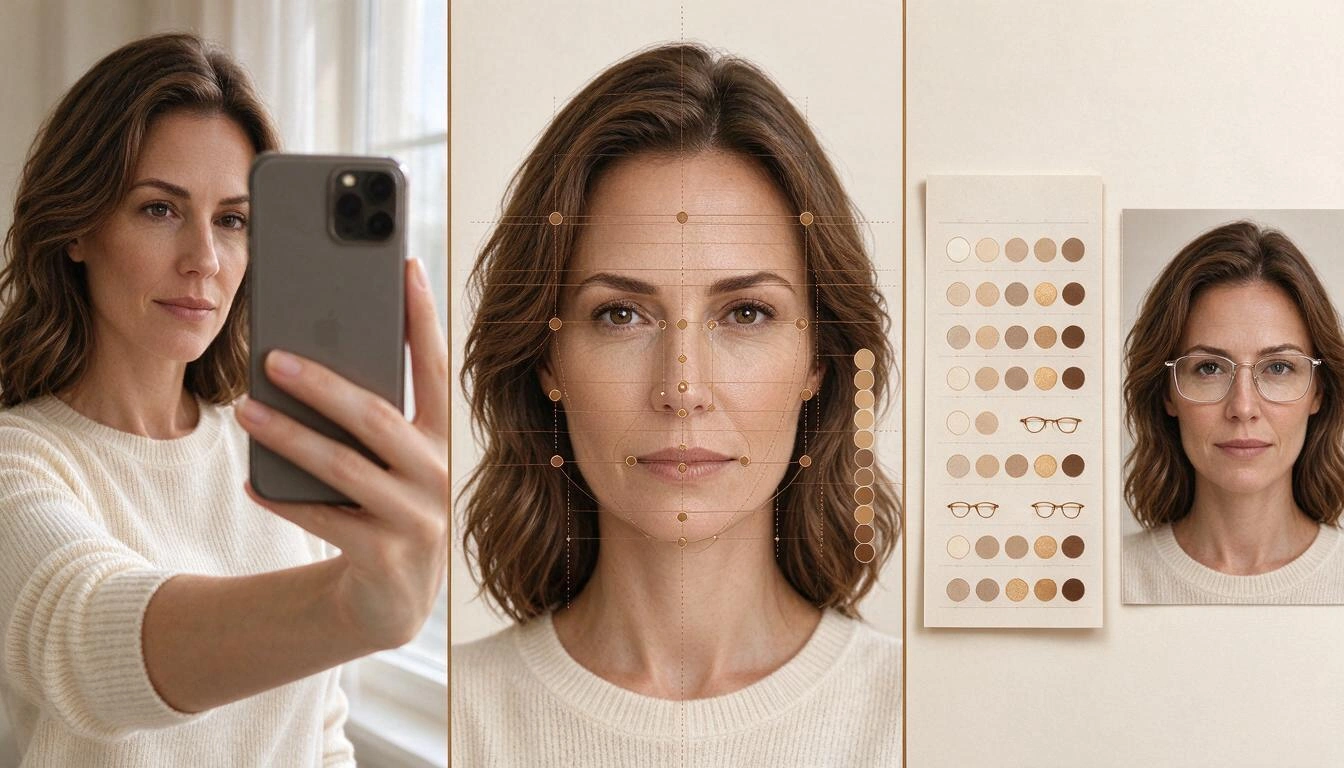
The flow is three steps:
- Take the photo. A front selfie, with natural light, face clear, and without glasses on (the AI needs to see your eyes and eyebrows). The front camera opens directly on the phone; you can also upload one you already have, up to 12 MB.
- Let it analyze. The AI returns face shape, features, undertone, color season, ideal palette, frame shapes that suit you, specific colors and finishes, recommended material, and style.
- Download your two images. A complete visual guide and a virtual test in which you appear wearing the recommended glasses, always with clear lenses.
The guide is a vertical poster of several panels, built on your own photo and labeled in your language:
| Panel | What it shows you |
|---|---|
| Facial and color analysis | Your portrait with the analysis diagram overlaid |
| Face shape | Reference silhouettes with yours marked |
| Facial features | The descriptors that condition the recommendation |
| Ideal palette | Six exact colors from your personal palette |
| Colors that suit you | Jewelry metals and clothing colors |
| Frame shapes | The specific shapes that suit you |
| Colors and finishes | Miniatures of you with different frame finishes |
| Yes ✓ / Avoid ✗ | Three recommended shapes versus three to avoid |
| Recommended styles | Up to five distinct looks with visibly different glasses |
The two images can be zoomed in with a finger and downloaded, and all your analyses are saved for later review.
What aiOptic does not do, and it's good to be clear. It does not measure millimeters or your interpupillary distance, it does not tell you your prescription or detect any vision problems, it is not a store catalog (it does not show you specific frames for sale or prices) and the virtual test is an AI-generated image, indicative: it is not a photograph of a real frame on your face. Prescription glasses are a healthcare product (Regulation (EU) 2017/745, applicable since May 26, 2021), and refraction, centering, and fitting are the responsibility of the optometrist (Law 44/2003, of November 21, on the regulation of health professions). aiOptic is image consulting, not healthcare advice, and does not replace the examination at the optical store.
What to take to the optical store (or what to check before buying online)
- The three numbers of your current glasses, if they fit well (thickness, bridge, and arm).
- Your face shape and the two or three frame shapes you are looking for, which you can rule out in advance.
- Your undertone and two or three specific colors, so you don't decide with the catalog in front of you.
- Your current prescription and the DIP, essential if you buy online.
- The guide downloaded from aiOptic, if you have generated it: showing it at the counter saves half of the fittings.
Frequently Asked Questions
How do I know what shape my face is?
Measure with a flexible measuring tape the width of your forehead, your cheekbones, your jawline, and the total length of your face, and compare the four numbers with the table in this article. If you don't want to measure yourself, aiOptic deduces it from a frontal photo and tells you which of the seven shapes you fit into.
What glasses suit me if I have a round face?
Those that add angles: rectangular, square with defined corners, geometric, or browline. What you should avoid are small round frames and very curved oval ones, because they repeat the roundness of the face instead of compensating for it.
How do I know if a frame is my size?
By the three numbers engraved on the inside of the temple, in millimeters: lens width, bridge width, and temple length. Compare them with those of glasses that already fit you well and don't deviate more than ±2 mm. As a visual check, the hinges should be at the height of your temples without protruding.
What do the numbers on the inside of the glasses mean?
They follow the format 52□18-140 and are the lens width, bridge width, and temple length in millimeters, according to the measurement system of ISO standard 8624 (2020 edition). The square symbol between the first two indicates that this system is used.
Can I know what glasses look good on me with a photo?
Yes, for the shape and color part. With a frontal photo, the shape of the face, skin undertone, and colorimetry can be classified, and from there, the shapes and colors of frames that suit you emerge. What a photo does not provide are the millimeters or the interpupillary distance: that is measured in person.
Do black glasses suit everyone?
No. Pure black is a cool color with very high contrast: it works very well on cool undertones and on people with marked contrast, but it can harden and dull a warm undertone. In that case, tortoiseshell, brown, olive green, or deep blue often look better.
Is it worth buying prescription glasses online?
It can work out well if you have done your homework: a valid prescription, interpupillary distance measured by an optician, and the measurements in millimeters of a frame that you already know fits you well. The risk is usually not in the lens but in getting the size and centering right without anyone adjusting the frame for you.
Does aiOptic tell me my prescription or detect vision problems?
No, and it shouldn't. aiOptic analyzes aesthetics: face shape, colorimetry, and which frames suit you. The prescription, the state of ocular health, and lens centering are the responsibility of the optician-optometrist and the ophthalmologist.
How should the photo be for the analysis to come out well?
Frontal, with natural light, face clear, and without glasses or sunglasses, because the AI needs to see the eyes and eyebrows. A photo taken at the moment with the front camera of your phone or one you already have, in image format and up to 12 MB, is acceptable.
Does the virtual test show me glasses that I can buy?
It is not a catalog. The virtual test is an AI-generated image based on your own photo, with lenses always transparent, so you can see how the type of recommended frame looks on you. Then you search for that shape, that color, and that material at the optician or store of your choice.
aiOptic is the mini-app from AIsToHire that, based on a single frontal photo, analyzes your face shape and colorimetry and provides you with a downloadable visual guide with frames, colors, and materials that suit you, plus a virtual test where you see yourself wearing them. It is available at aistohire.com/es/aioptic-estudio-gafas-de-ver-montura-ideal-ia-143. It does not replace the optician: it helps you reach the optician knowing exactly what to ask for.
Upload a front-facing photo and let aiOptic tell you which frames suit you: you will receive a downloadable visual guide and your virtual try-on with the glasses on. Start for free with aiOptic, the AI-powered eyewear study from AIsToHire.
Upload a front-facing photo and let aiOptic tell you which frames suit you: you will receive a downloadable visual guide and your virtual try-on with the glasses on. Start for free with aiOptic, the AI-powered eyewear study from AIsToHire.Keep reading
View all articles →
What the numbers on your glasses (52 □ 18 140) mean and how to know if your size is correct

Why Your Car Insurance Increased in 2026: Average Premium of €1,412 and Historic Record

Discussing via WhatsApp or talking in person: what science says about couple conflicts through messages