 aiMusic
Declaring Your Music as AI When Distributing in 2026: Spotify AI Credits, DDEX, DistroKid, and the Deezer Filter
Team at aiMusicWritten with AI assistance19 min readIn summary
- A single declaration applies to almost all platforms. The disclosure standard for AI that Spotify announced with DDEX on September 25, 2025 travels within the metadata of your release: you mark it once at the distributor and it appears in the credits on Spotify, on Apple Music tags, and on YouTube.
- Spotify's AI Credits have been in place since April 2026 and the first distributor to support them was DistroKid. Spotify says it already receives "tens of thousands of credits daily" (Spotify Newsroom, 10/20/2026).
- Mixing and mastering with AI are not declared. Only lyrics, composition, and generated audio are declared: this is delineated by DistroKid's AI Credits help.
- "100% AI" and "AI-assisted" are not the same and the difference costs visibility. The AI filter that Deezer announced on October 14, 2026 only excludes from search what is totally generated by AI.
- Declaring does not penalize; cloning voices does. Spotify claims it does not lower rankings for declaring, but it has removed over 75 million spam tracks in twelve months and prohibits unauthorized vocal imitations.
If you are about to upload a single made with AI —or launch an entire virtual artist— 2026 has been the year when this stopped being a gray area and became a mandatory checkbox on your distributor's form. The good news is that the real work is not legal, it's metadata: knowing what to declare, with what granularity, and what to keep closed before sending the package. At aiMusic, the virtual record label with AI from AIsToHire, that work is already structured by track, but the criterion is the same whether you use a tool or fill in the fields by hand. This guide is that criterion, with the sources and dates for each rule.
What changed in 2026 and why does it affect you even if you only release a single?
In 2026, platforms moved from detecting AI to asking you to declare it, and from there to allowing the listener to filter it. The three milestones are the rollout of Spotify's AI Credits over the DDEX standard in April, the "AI Persona" badge for artist identities generated with AI in August, and the announcement of Deezer's switch in October. None of the three prohibits you from publishing: all three change how you are perceived.
The context is one of volume. Deezer explains that in January 2025, totally AI-generated music accounted for 10% of daily uploads, and that in July 2026 it surpassed 50%, with an average of 90,000 tracks per day (TechCrunch, 10/14/2026). According to its own press room, between January 2025 and August 2026 it detected and excluded 42 million tracks generated by AI and labeled over 14 million albums, although AI only represents between 1% and 3% of listens.
That gap —lots of uploads, little listening— is the reason why filtering came before prohibition. And it is also the reason why you, who publish a single and not 10,000, should declare properly: it is what separates you from the noise.
What is the DDEX standard for AI declaration?
DDEX is the organization that defines the metadata formats with which labels and distributors deliver music to platforms, and its main message is the ERN (Electronic Release Notification)/): the XML package that travels from your distributor to Spotify, Apple Music, or YouTube. The AI declaration was added as fields within that message, so it's not "a Spotify form": it is a property of the release that all receiving platforms read.
This explains what is useful for an independent creator: you declare once, at the distributor, and the label propagates. There is no need to go into Spotify for Artists to repeat it, nor on Apple Music, nor on YouTube.
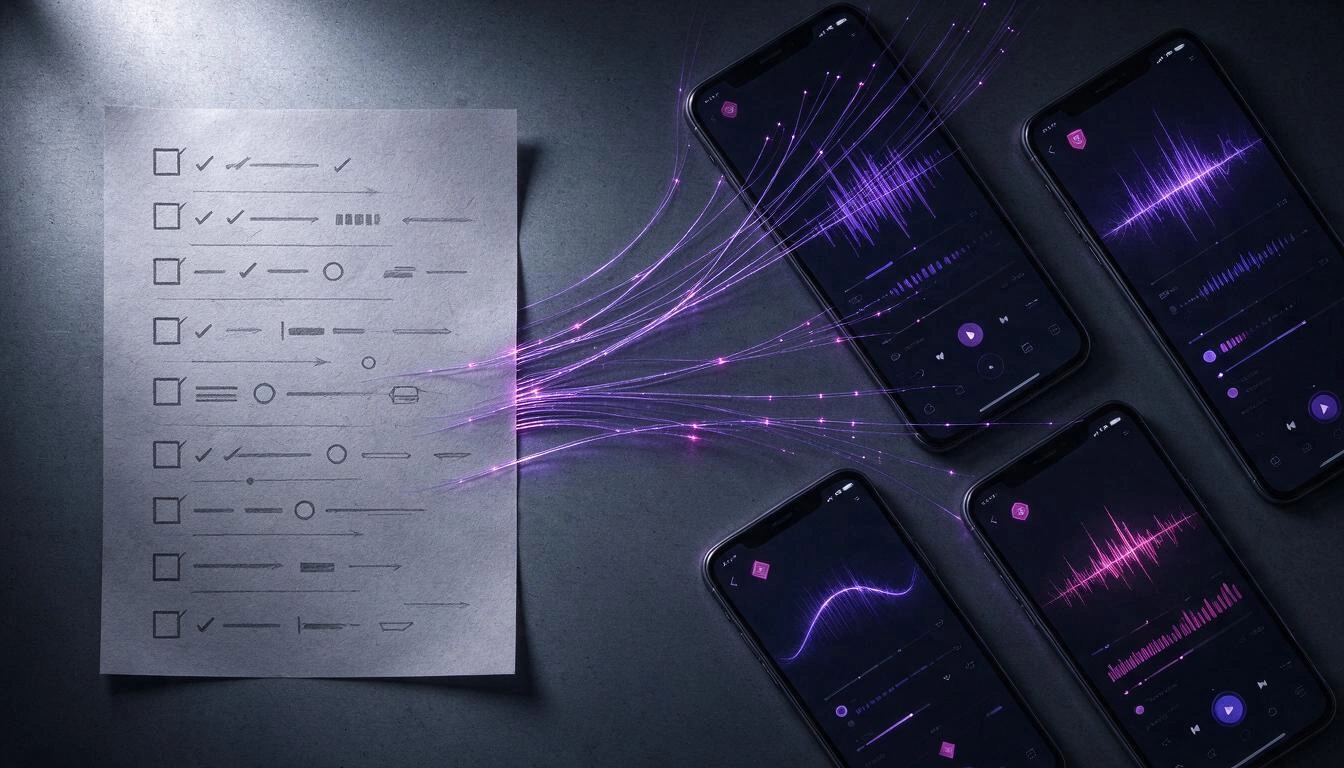
The standard arose from an initiative that Spotify announced on September 25, 2025 alongside 19 distributors and label service providers, including DistroKid, CD Baby, Believe, EMPIRE, Amuse, FUGA, IDOL, RouteNote, Revelator, Soundrop, EmuBands, Labelcamp, Kontor New Media, Downtown, AudioSalad, NueMeta, SonoSuite, EMS GmbH, and Supply Chain. The declared approach was explicitly nuanced: to allow indicating "where and how AI intervened —whether it was voices, instrumentation, or post-production—" instead of forcing to classify each song as "is AI" or "is not AI".
The usual granularity of the standard works on three levels:
| Declaration Level | What it covers | Typical example |
|---|---|---|
| Release | The cover and assets of the release | Cover generated with an image model |
| Recording | The audio heard on that specific track | Synthetic voice, generated instrumental |
| Work (composition) | Melody, structure, and lyrics | Lyrics written by a text model |
The practical consequence: a song can have an AI cover, human instrumental, and AI lyrics, and that is stated as such. There is no need to choose a single label for the entire album.
How do you fill out the AI Credits step of DistroKid?
DistroKid shows a direct question during the upload —"Does this song include music, vocals, or lyrics generated by AI? Using AI for mastering or mixing does not count"— and, if you answer yes, it allows you to detail which part. According to their AI Credits documentation, what is declared is generated audio (vocals, instrumentals), generated lyrics, and generated compositions (melody or arrangement not composed by a person).
The options it offers when finalizing are four, and it's worth reading them as what they are —a scale, not a moral label:
- The lyrics — the AI wrote the text.
- The music — the AI composed the melody.
- All the audio — everything the listener hears is generated by AI.
- Part of the audio — part is AI and part is human.
And what does not require AI Credits, also according to DistroKid:
- Pitch correction, autotune, and similar.
- AI-assisted mixing or mastering.
- AI-assisted workflows (productivity tools, stem splitting, noise cleaning).
The mental rule is simple: if the AI generated something that the listener hears or reads, it is declared; if the AI only processed something that already existed, it is not.
DistroKid indicates that, today, the services that show this information to the listener are Spotify, Apple Music, and YouTube. And watch out for a calendar detail: Apple Music's transparency labels started to be implemented in March 2026 and Spotify's AI Credits began in beta on April 16, 2026 with DistroKid as the first distribution partner (RightsDocket, 04/29/2026).
What is the difference between "fully generated by AI" and "AI-assisted"?
The difference is what decides whether your music disappears from a search or not. Deezer's switch excludes what is fully generated by AI; a hybrid track —synthetic voice over an instrumental you played, or human lyrics over a generated arrangement— does not fall into that category. Declaring accurately is not courtesy: it is the difference between being filterable and not being so.

This clashes with the most common reflection of the starting creator: marking "all AI" out of caution, to avoid making a mistake. It is exactly the costly error. If there is indeed human contribution —composition, lyrics, performance, arrangement, artistic direction— declaring it as partial is more truthful and keeps you out of the filterable bucket.
The opposite is also a mistake, and more serious: declaring "partial" what is entirely generated. Platforms do not rely solely on your word. Deezer rolled out its own detection in early 2025 and Spotify says it uses "a combination of signals: listener interactions, upload patterns, metadata, and information from various third-party AI detection tools". Lying in the box exposes you to having it corrected, and to being labeled as an unreliable declarer.
| Track Type | How it is declared | Effect on Deezer | Effect on Spotify |
|---|---|---|---|
| 100% generated by AI (audio, lyrics, and composition) | "All the audio" + lyrics + music | Excludable from search with the listener's switch | Visible AI credits; no penalty for declaring |
| Hybrid (synthetic voice, human instrumental or lyrics) | "Part of the audio" and/or only lyrics or only music | Not excluded by the switch | Visible AI credits by component |
| Human with AI only in mixing/mastering | Not declared | No label | No label |
Deezer's switch: what it filters exactly and what it does not
Deezer announced on October 14, 2026 a switch that allows the listener to exclude from search results tracks, albums, and artists fully generated by AI, with a launch expected before the end of 2026 and global rollout in the following months. It is reversible: the listener can deactivate it whenever they want.
Two nuances matter a lot and are often miscounted:
- It is a search filter, not a withdrawal from the catalog. The music remains on the platform.
- The exclusion from recommendations already existed separately: Deezer has been removing fully generated AI music from its algorithmic recommendations and editorial playlists for some time.
The justification is demand. In a Deezer study with Ipsos from November 2025, 45% of streaming users said they wanted to filter 100% AI music, 80% wanted it to be clearly labeled, 73% wanted to know if the service recommends AI music, and 52% believed that AI songs should not compete on the charts with human ones. The most uncomfortable data from the same study: 97% could not distinguish generated music from human music in a blind test.
It is worth remembering where Deezer came from: in June 2025 it was the first platform to explicitly label AI-generated music, framing it as a fight against streaming fraud. According to its figures, 85% of listens from AI tracks in 2025 were fraudulent.
What no platform forgives: voice clones, deepfakes, and impersonation
Here there are no nuances or scales. Spotify's impersonation policy states that vocal imitation is only allowed if the imitated artist has authorized its use, and this covers unauthorized voice clones, deepfakes, and vocal replicas. What is perfectly legitimate, on the other hand, is a synthetic voice that belongs to an original and invented artist: there is no one to impersonate.
The magnitude of the cleanup reflects the seriousness of the matter. Spotify claims to have removed more than 75 million "spammy" tracks in twelve months for serious or repeated violations, and to have taken out of recommendations more than 50 million "slop" and spam tracks in the last year — these remain on the platform, but are not recommended (Spotify Newsroom, 20/10/2026).
The behaviors that the music spam filter targets, in Spotify's words, are mass uploads, duplicates, SEO tricks, abuse of artificially short tracks, and other forms of slop. If you publish a real catalog, with spaced releases and consistent metadata, none of this affects you. If your plan was to flood, it affects you all.
Bandcamp is the extreme case on the other side: on January 13, 2026, it banned music created "totally or substantially" by AI, as well as any use of AI to imitate other artists or their styles. The review is done by people, users can report suspicious content, and the platform reserves the right to remove music on suspicion. If your project is a virtual artist, Bandcamp simply is not your channel.
Virtual artists: Spotify already labels them with a separate badge
If your project is an avatar-artist and not a standalone track, there is an additional layer that many people do not have on their radar: the badge "AI Persona". Spotify announced it on August 11, 2026 and began displaying it in mid-September 2026 on artist profiles, search results, and track rows in playlists, to indicate that "the identity of an artist may be generated by AI and does not represent a real person".
Two things to know before launching such a project:
- You can self-declare from Spotify for Artists, or Spotify's review team may apply the badge on its own; if they apply it, you can appeal or self-declare. The listener sees, when tapping the badge, which of the two things happened.
- It has a discovery cost: by default, Spotify does not include AI Personas in editorial or algorithmic recommendations, unless the user follows the artist directly.
This requires careful reading of the mantra that "declaring does not penalize". It is true at the track level: Spotify states that the initiative "is not about punishing artists who use AI responsibly or lowering the ranking of tracks for declaring how they were made". But at the level of artist identity there is indeed a distribution consequence, and the strategy of a virtual artist must assume it: your growth will come from direct followers and your own marketing, not from the algorithm. A related fact from the same report of October 2026: tracks with indicators of AI generation are ten times more likely to fall below the threshold of 1,000 listens that grants royalties.
Platform map as of November 2026
As of November 2026, there is no single rule: there are four distinct positions, and each requires a different channel decision. Spotify labels without penalizing at the track level, Deezer labels and allows filtering, SoundCloud accepts direct publishing from generators with source notice, and Bandcamp prohibits.
| Platform | Stance on AI music | What it does with the label | Reference date |
|---|---|---|---|
| Spotify | Allowed, declaration via DDEX | Displays AI Credits per component; "AI Persona" badge for generated identities, outside default recommendations | AI Credits 04/16/2026; badge 08/11/2026 |
| Apple Music | Allowed, declaration via DDEX | Transparency labels when AI affects a material part of the recording or lyrics | Implementation since 03/2026 |
| Deezer | Allowed and labeled | Label since 06/2025; listener switch to exclude 100% AI from search | Announcement 10/14/2026 |
| YouTube | Allowed | Displays AI Credits information provided by the distributor | According to DistroKid, supported service |
| SoundCloud | Allowed, no AI checkbox in uploader | Tracks published from Eleven Music carry a notice identifying the source | Integration 11/05/2026 |
| Bandcamp | Prohibited if wholly or substantially AI | Does not apply: it is removed | Policy 01/13/2026 |
The most recent move is from SoundCloud: on November 5, 2026, it opened direct publishing from Eleven Music, the generator from ElevenLabs, so that it is created in one tool and published on the platform without leaving the flow (TechCrunch). According to Music Week, those tracks carry notices identifying Eleven Music as the source of creation, and are subject to existing AI, ownership, and rights policies of SoundCloud. SoundCloud Artist Pro subscribers also receive three months of Eleven Music Pro, with up to 1,000 monthly generations.
What does the EU AI Act require and since when?
The transparency obligations of Article 50 of the European AI Regulation apply from August 2, 2026, with a deadline until December 2, 2026 for generative AI systems that were already on the market to comply with the machine-readable marking of Article 50(2) (Article 50 guide). For an independent musician, the distribution of responsibilities is key: the technical marking falls on the provider of the generator, not on you.
What directly affects you, according to the official FAQ from the European Commission on Article 50, is the obligation of the deployment responsible to disclose the content when it constitutes a deepfake: image, audio, or video generated or manipulated that impersonates a real person. That is, the European regulation and Spotify's impersonation policy point to the same place from different directions.
The Commission has also published a Code of Good Practices on transparency of AI-generated content, which is voluntary adherence, as a tool to demonstrate compliance with the marking and labeling. None of this replaces the box from your distributor: they are different layers that, in practice, ask for the same thing —to say how it was made.
Metadata checklist before sending to the distributor
Before sending a release, there are seven things that should be finalized, and the AI declaration is just one of them. The order matters: correcting metadata after the release is in stores is slow and, in the case of codes, sometimes impossible.

- ISRC per track. Identifies each recording. If you don't have yours, DistroKid generates them for free upon upload; if you plan to change distributors someday, it's preferable to manage them yourself so that the recording retains its identifier.
- UPC/EAN per release. Identifies the product (single, EP, album). Same criteria as with ISRC.
- High-resolution square cover. The de facto standard is 3000×3000 px, RGB, JPG or PNG, 1:1 ratio. No illegible text, third-party logos, or URLs.
- AI content flag per track and per component. Lyrics, music, and audio separately; mixing and mastering excluded. Decide before uploading if the track is fully or partially generated.
- Complete credits. Composers and authors with legal name, performers, producer. If there is synthetic voice from your own artist, the human credits for composition and lyrics still exist and must be included.
- Copyright and label. ℗ (recording) and © (work) lines with year and holder, and the name of the label if you publish under your own.
- Synchronized lyrics and clean title. No promotional tags in the title ("prod. by", "official audio"); most platforms reject or normalize them.
Finalizing this manually, song by song, is where hours of a release go. It is exactly the part that a tool like aiMusic, the virtual record label with AI artists resolves by design: each artist is created with their own identity and voice profile —with validation that blocks references to famous artists, meaning no risk of unauthorized cloning—, each track carries a transparency flag AI / Hybrid / Human that travels to the metadata.json of the package, there are fields for ISRC, UPC, label, and copyright, the cover is validated at 3000 px, there is a checklist prior to distribution of seven points, and the result comes out as a ZIP ready to deliver to the distributor.
Frequently Asked Questions
Is it mandatory to declare that my music is generated by AI?
In the distributor, yes in practice: DistroKid asks the question mandatorily during the upload. Legally in the EU, Article 50 of the AI Regulation places the technical marking on the provider of the generator and the disclosure on who deploys a deepfake, not on the musician who publishes an original song. The real way it obligates you is contractually, via platform and distributor.
Will Spotify penalize me for declaring that I used AI?
Spotify expressly states that it does not lower the ranking of tracks for declaring how they were made. There is a relevant exception that is not at the track level but at the artist level: profiles with the "AI Persona" badge are excluded by default from editorial and algorithmic recommendations, unless the listener follows the artist.
If I use AI only for mixing and mastering, do I have to declare it?
No. DistroKid explicitly excludes it: pitch correction, autotune, AI-assisted mixing and mastering, and assisted workflows do not require AI Credits. Only what the AI generated is declared: lyrics, composition, or audio.
Will Deezer's filter remove my music from the platform?
No. The switch announced on October 14, 2026, excludes tracks, albums, and artists that are entirely generated by AI from the search results of those who activate it, and it is reversible. The music remains in the catalog. What does happen separately is that music entirely generated by AI does not enter algorithmic recommendations or Deezer's editorial playlists.
Can I use an AI voice for my virtual artist without getting into trouble?
Yes, as long as the voice does not imitate an identifiable real person. What the platforms prohibit is impersonation: Spotify only allows vocal imitation with the authorization of the imitated artist. A synthetic voice that belongs to an invented character, with its own name, biography, and image, does not impersonate anyone.
Where can I not publish music made with AI?
On Bandcamp. Its policy from January 13, 2026, prohibits music created wholly or substantially by AI and the use of AI to imitate other artists or styles, with human review and the possibility of removal due to suspicion. Spotify, Apple Music, Deezer, YouTube, and SoundCloud accept it with varying degrees of labeling.
Do I have to declare it on each platform separately?
No. That is the beauty of the DDEX standard: the declaration is made once in the distributor, it is embedded in the release metadata (the ERN message) and travels to the receiving platforms. DistroKid indicates that today it is shown to the listener by Spotify, Apple Music, and YouTube.
What resolution does a release cover need?
The de facto standard is 3000×3000 pixels, square, in RGB and in JPG or PNG. There are distributors that accept less, but below 3000 px you risk that some store will reject the release or display it poorly on large screens.
What you take away from here
The AI declaration in 2026 is not a scary procedure, it is a precision procedure: a well-placed checkbox in the distributor keeps you out of filters that do not apply to you, leaves your credits visible on three platforms, and separates you from the spam that platforms are removing from tens of millions of tracks. What sinks you is not using AI, it is declaring it poorly or cloning a voice that is not yours.
If your project is a virtual artist, the work starts before the single: identity, own voice, proper cover, and coherent metadata from the first track. aiMusic, the miniapp for creating AI artists and preparing music releases from AIsToHire, brings that framework set up — transparency flag per track, ISRC, UPC, label and copyright fields, validated cover at 3000 px, pre-checklist, and distribution ZIP — so what you have left to decide is the only thing that cannot be automated: which part of the song is yours.
Prepare your next release with the AI declaration and metadata already sorted — create your artist in aiMusic
Prepare your next release with the AI declaration and metadata already sorted — create your artist in aiMusicKeep reading
View all articles →
How to Publish an AI-Made Song on Spotify: Requirements, Metadata, and Deadlines (2026)

Why Your Car Insurance Increased in 2026: Average Premium of €1,412 and Historic Record

Discussing via WhatsApp or talking in person: what science says about couple conflicts through messages