 aiLogistic
Mandatory electronic control document: what the inspection requires from October 2026
Team at aiLogisticWritten with AI assistance17 min readIn summary
- From October 5, 2026, the administrative control document for domestic public road freight transport in Spain will only be valid in electronic format (the so-called DeCA). The date is set by the eighth transitional provision of Law 9/2025 on Sustainable Mobility, which allowed ten months from its entry into force.
- The technical requirements are in the Resolution of June 5, 2026, of the General Directorate of Road and Rail Transport: native PDF of less than 5 MB, with a QR code pointing to a direct HTTPS download URL, without registration or clicks, and minimum retention of 12 months.
- The document must exist electronically before starting the transport. A scanned paper delivery note afterwards is not valid: the resolution requires original generation in electronic format.
- The eCMR is not mandatory and does not replace this obligation: it is voluntary and pertains to international transport. The DeCA is for domestic transport and cabotage in Spain; international transport with CMR is excluded.
- Continuing with paper is equivalent to driving without a control document: serious infringement of the LOTT, with fines starting at 401 euros per shipment, according to Fenadismer (June 2026).
It has been five weeks since the stack of delivery notes in the glove compartment ceased to be valid before an agent. If you have a small fleet, from five to fifty trucks, and until October you dispatched shipments with a printed waybill in three copies, the change is not cosmetic: now the document must be created on a computer, carry a QR that the inspector scans at the roadside, and be issued before the truck starts. In this article, we break down exactly what the inspection requires, what data the document contains, how it differs from the eCMR, and what is being seen in the first real checks. For the operational part —the one that affects you every morning— the AIsToHire team has set up aiLogistic, an app for fleet management, routes, and tachograph for transport companies that includes a digital delivery note with photo and signature; at the end of the article, we explain what it covers and what it does not, without smoke.
What is the DeCA and since when is it mandatory?
The DeCA is the electronic administrative control document: the same control document that was required on paper for each public road freight transport shipment, but generated digitally. It has been mandatory in Spain since October 5, 2026 for domestic transport and for cabotage operations, without extension or grace period.
It is not a new document nor a new obligation: the control document already existed since the Order FOM/2861/2012, of December 13. What changes is the medium. What was previously a sheet that the driver kept in the folder is now a file with an associated web address.
The obligation arises from the eighth transitional provision of Law 9/2025, of December 3, on Sustainable Mobility, which stated that the control document for goods and the passenger route sheet must necessarily be digital within ten months of the law's entry into force. This deadline expired on October 5, 2026, as confirmed by both the Ministry of Transport and Sustainable Mobility and sector associations: Fenadismer on June 15, 2026, and Aetrac on September 29.
What regulation says what? The legal map in a table
There are three regulations at play, and it is important not to confuse them, as each one contributes a different piece: the date, the content, and the technical format.
| Regulation | What it contributes | Date |
|---|---|---|
| Law 9/2025 on Sustainable Mobility (DT 8ª) | Sets the obligation for electronic format within 10 months → October 5, 2026 | BOE 291, 2025 |
| Order FOM/2861/2012 | Regulates the control document: what data it contains (art. 6), exclusions, and retention | December 13, 2012 |
| Order TRM/282/2026 | Corrects FOM/2861/2012 and distributes responsibility between shipper / carrier; also tweaks the driver’s tachograph card | BOE 77, March 28, 2026 |
| Resolution of June 5, 2026 | Defines the technical requirements: PDF, 5 MB, QR, HTTPS, retention | BOE 143, June 12, 2026 |
A nuance that is often misunderstood in many places: Order TRM/282/2026 is not the one that creates the obligation for the electronic format. According to the analysis of the text, that order corrects internal references of article 7 of FOM/2861/2012 and clarifies who is responsible for what data, and it came into force on March 29, 2026. The date of October 5 comes from Law 9/2025, and the "how" from the June Resolution.
What data should the control document contain?
The content has not changed with digitalization: it remains that of Article 6 of Order FOM/2861/2012. There are seven blocks of data plus observations, and the inspection checks them one by one in the PDF downloaded from the QR.
- a) Name, NIF, and address of the contractual shipper.
- b) Name and NIF of the effective carrier.
- c) Place of origin and destination of the shipment.
- d) Nature and weight of the transported goods.
- e) Identification of the special circulation authorization, if applicable.
- f) Date of transport of the shipment.
- g) License plate of the vehicle used; in articulated sets, both tractor and semi-trailer must be listed.
- Observations or reservations requested by the participants.
Order TRM/282/2026 clarified the distribution of responsibility for the accuracy of this data: the contractual shipper is responsible for sections a), b), c), and d) —parts, origin, destination, nature, and weight—, and the effective carrier for sections e), f), and g) —special authorization, date, and license plates—. For a traffic manager, this is very specific: if the declared weight is wrong, the problem is not yours; if the license plate of the semi-trailer that finally left is not the one listed, then it is.
Watch out for a detail that costs money: the document is per shipment, not per vehicle. A delivery truck with twelve deliveries from twelve different shippers needs twelve control documents, and each one that is missing is a potential infraction.
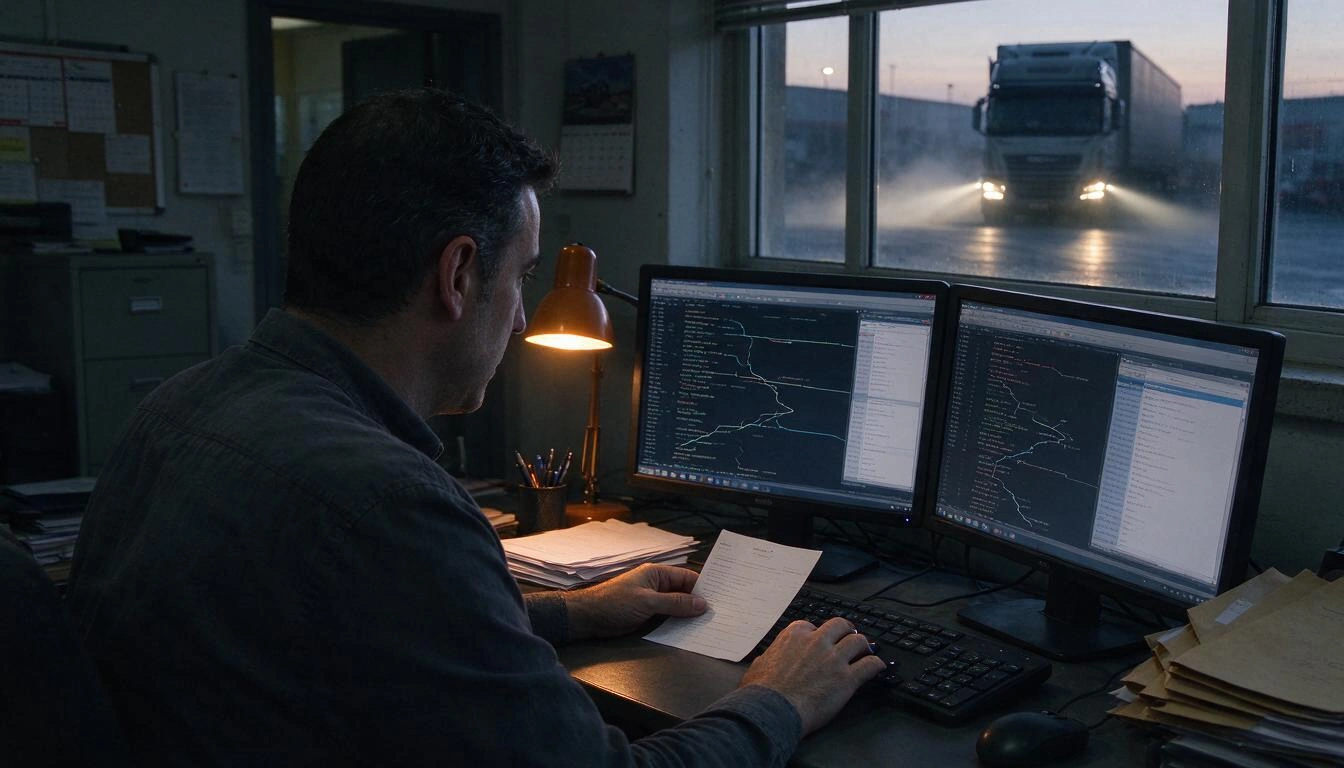
The document must exist electronically BEFORE starting
This is the phrase that most changes the routine of an SME: the control document must be generated originally in electronic format and be available before starting the transport. A PDF obtained by scanning or photographing a paper delivery note that already existed is not valid as DeCA.
The Resolution of June 5, 2026, is explicit about the file requirements:
| Requirement | What it requires |
|---|---|
| Format | PDF native, generated digitally (not scanned) |
| Size | Not exceeding 5 MB |
| Metadata | Must include creation and modification timestamps |
| QR Code | Embedded in the PDF, pointing to a unique and specific web address |
| URL | HTTPS with TLS 1.2 or higher, direct download of the PDF without authentication or manual interaction |
| Availability | Active access throughout the service; it can be deactivated 7 days after completion |
| Preservation | Minimum 12 months in the repository of the provider or authorized system |
| Modifications | Modifying the PDF or generating a new one during transport is allowed, with traceability of the change |
| Electronic signature | Only required (AdES at minimum, or QES) when the document also serves for contractual purposes |
There is an important gateway: according to the resolution itself, compliance through Regulation (EU) 2020/1056 (eFTI) exempts from the format requirements of this resolution. And in the transport of goods, it is sufficient for one of the parties —shipper or carrier— to keep it, as long as the other can download it.
How is it presented on the road? The QR rules
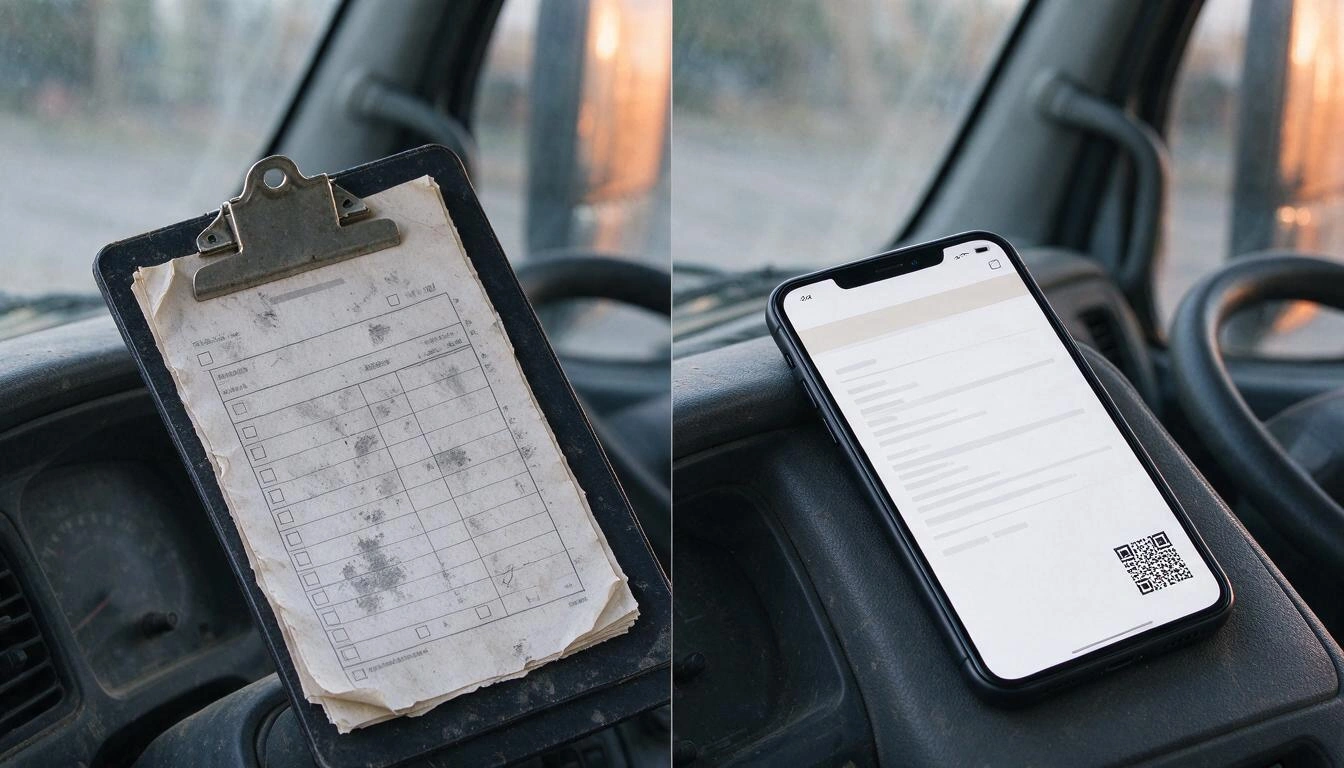
In a control, the driver shows the QR: they can do it on their mobile screen or in a printed copy, but in both cases, the copy must carry the QR code. The agent scans it with their terminal and downloads the PDF from the server at that moment, instead of reviewing paper.
This reverses the logic of the glove compartment folder. Previously, the document was the paper; now the paper —if printed— is just a vehicle for the QR, and what the inspection validates is the file that lives on the server. Hence the requirements for the URL: if the link requires registration, if the website takes time, or if it only opens a preview instead of downloading the PDF, the document does not comply.
Paper vs electronic: what really changes
| Aspect | Before (paper) | Since October 5, 2026 (DeCA) |
|---|---|---|
| Valid support | Bill of lading / printed delivery note | Native PDF with QR; scanning of paper is not valid |
| Moment of issuance | When loading, by hand, at the dock | Generated before starting the transport |
| What the agent looks at | The sheet that the driver carries | Downloads the PDF from the QR |
| Copies | Two: shipper and carrier (art. 8 FOM/2861/2012) | Shared access; it is enough for one party to keep it if the other can download it |
| Preservation | Physical file | Minimum 12 months in accessible repository |
| Error correction | Crossed out and signed | New PDF or modification with traceability |
What happens if I keep using paper?
You circulate without a valid control document. From October 5, 2026, the paper delivery note without a QR code does not cover domestic transport, and the lack of the control document, carrying it incomplete, or not keeping it is a serious infringement of the Ley 16/1987 de Ordenación de los Transportes Terrestres (art. 141.17), with a fine that starts at 401 euros according to Fenadismer (June 15, 2026).
And remember the shipping rule: the penalty is not counted by stopped trucks, it is counted by the missing document. A delivery with several drops without DeCA multiplies the risk.
The Ministry did not foresee any phase after October 5 free of penalties. Fenadismer did request it —it asked the Administration for a "merely educational and advisory role, free of penalties" during the first weeks—, according to its information from October 8, 2026, but that is a request, not a moratorium in force.
DeCA and eCMR are not the same (and eCMR is not mandatory)
The eCMR is the international electronic waybill, covered by the Additional Protocol to the CMR Convention of 2008, in force in Spain since 2011. It is voluntary: no regulation from 2026 imposes it. The DeCA, on the other hand, is mandatory and affects domestic transport and cabotage in Spain.
| DeCA | eCMR | |
|---|---|---|
| What it is | Administrative control document | Waybill (contractual transport document) |
| Scope | Spanish domestic transport and cabotage | International transport between countries signing the Protocol |
| Mandatory? | Yes, from October 5, 2026 | No, it is voluntary |
| Legal basis | Law 9/2025 + FOM/2861/2012 + Resolution 5-Jun-2026 | Additional Protocol to the CMR (2008), in force in Spain since 2011 |
| Format | Native PDF with QR, < 5 MB | According to the accredited eCMR platform |
Can they coexist? Yes, and here is the nuance that saves work: the Order FOM/2861/2012 admits that other documentation —a waybill— can serve as an administrative control document if it contains all the data from article 6. That is, a complete eCMR can serve as a control document. What does not work is the reverse: having your own digital delivery note does not make you an issuer of eCMR, and international transport subject to CMR is outside the obligation of Spanish electronics.
What is being seen in the first real checks
Five weeks after the entry into force, the reported problems do not come so much from the document as from the readers and the practices of some shippers. Fenadismer documented on October 8, 2026, failures when scanning the QR codes in roadside checks that, according to the federation, were not in the generated digital documents, but in "the configuration or reading of the devices used by the control agents".
The most uncomfortable front for SMEs is contractual. The same federation reported two practices:
- Mandatory proprietary platforms. A relevant shipper requires drivers to register on their platform to be hired, loading them with administrative tasks that, in Fenadismer's words, "do not correspond" to the driver.
- "Provisional" DeCA. Some shippers generate provisional documents that are only formalized when the driver validates the data, thus transferring the responsibility of generating the DeCA, which, by legal distribution, is largely the shipper's, to the driver —and ultimately to the carrier—.
In addition, the commercial warning: Fenadismer publicly alerted about abusive offers and non-compliant solutions sold in the wake of the obligation, as reported by trans.info. Before signing a subscription, check the specifics: Is the PDF generated natively? Does it have a QR with direct download without login? Do they keep it for 12 months? Who is the data owner?
In December, the first balance from the Administration on these months is expected, and at the beginning of 2027, the new Inspection Plan will determine which checks are maintained and which are added.
The next step already has a date: eFTI in July 2027
The DeCA is the first Spanish step; the European one arrives in 2027. The Regulation (EU) 2020/1056 on electronic transport information of goods (eFTI) obliges the competent authorities of the Member States to accept the regulatory information transmitted electronically through certified platforms.
The date the sector is working with is July 9, 2027, and the key is who is obligated: according to Transporte Profesional, the obligation falls on the authorities, not on the companies; for operators, use remains optional until a possible review in 2029. Translated: you will not be fined in 2027 for not using eFTI, but you will be able to demand that digital documents be accepted in any EU country.
In other words: the direction of the journey is clear, and those who already have digital operations will reach 2027 without surprises.
What you can get ready this week
If you come from the paper delivery note, the least painful work order is this:
- Decide who issues each DeCA. Talk to your usual shippers: do they generate it and give you the link, or do you generate it? Put it in writing in the conditions, because the distribution of responsibility in Article 7 is already established.
- Check the solution, not the brochure. Native PDF, QR with direct download without registration, HTTPS, preservation for 12 months, traceability of changes.
- Train the driver in three gestures. Open the shipping document, show the QR on the screen, and know what to do if there is no coverage: also carry the printed copy with the QR.
- Separate the DeCA from your delivery note. They are two different things: the DeCA is the administrative document that validates the inspection; the delivery note/POD is your proof of delivery to the customer and in case of a claim. Digitizing the second does not exempt you from the first, but it is where time is recovered and discussions are avoided.

And this is where a tool like aiLogistic fits in: at point 4 and in everything surrounding the transport. The app generates delivery notes and delivery receipts with photo and signature of the receiver, with the PDF available at the headquarters without calling anyone, and also manages the planning and optimization of the order of stops, the cost per route and vehicle —fuel, driver, tolls, and allocation of fixed costs, with its €/km—, the fleet expirations (MOT, insurance, maintenance, license, CAP, ADR, cards) and the tachograph module: download counters for 28 and 90 days, archiving of the .ddd files you upload and report of violations of Regulation (EC) 561/2006.
The honest warning, because it is exactly what the sector is suffering with inflated offers: the digital delivery note from aiLogistic is not a certified eCMR nor is it presented as the issuer of DeCA in accordance with the Resolution of June 5, 2026. It is your proof of delivery and your operation; you will continue to issue or receive the electronic control document through the means you agree upon with your shipper.
Frequently Asked Questions
Is the electronic control document mandatory for self-employed individuals with a single truck?
Yes. The obligation does not depend on the size of the company, but on the type of service: public domestic road transport of goods and cabotage within Spanish territory. A self-employed person with a tractor is equally obliged as a fleet of fifty.
Can I still carry the paper delivery note just in case?
You can carry a printed copy, but it must include the QR code, because that is what the agent scans. A traditional paper delivery note, without QR and without a native PDF behind it, is not valid as a control document from October 5, 2026.
Is a scanned PDF of the signed delivery note valid?
No. The Resolution of June 5, 2026 requires that the file be generated originally in electronic format. Files obtained by scanning a previous physical document are not valid as a control document.
Who has to generate the DeCA, the shipper or the carrier?
Both formalize it and each one is responsible for their data: the contractual shipper of the parties, origin, destination, nature, and weight; the effective carrier of the special authorization, date, and license plates, according to Order TRM/282/2026. In practice, the system is usually issued by the one who contracts, but the distribution of responsibility is what the regulation states, not what the platform says.
Does the eCMR serve as a control document?
Yes, if it contains all the data from Article 6 of Order FOM/2861/2012: that order admits that other documentation, such as a waybill, can serve as an administrative control document. But the eCMR is not mandatory and international transport subject to CMR does not fall under the Spanish electronic obligation.
What happens if the driver has no coverage during the control?
The QR must be scannable by the agent from their own terminal, which is the one that downloads the PDF from the server. That is why it is advisable to also carry the printed copy with the QR: it covers the case of a mobile with no battery or no signal. If the problem is with the agent's reader, there are reported precedents by Fenadismer on October 8, 2026, of incidents attributed to the configuration of those devices.
Is there a fine for not having the DeCA from day one?
The regulation does not provide for any grace period after October 5, 2026. The lack of the control document, its non-compliance, or its non-preservation is a serious violation of the LOTT with a fine starting at 401 euros, and it is counted per shipment, not per vehicle.
How long do I have to keep the documents?
At least 12 months, in the provider's repository or in another authorized system. In goods, it is enough for one of the parties to keep it if the other can download it.
Conclusion: paper no longer covers, operations can be organized
The change on October 5, 2026, is small on paper —a PDF with a QR— and large in routine: it requires issuing before leaving, agreeing with each shipper who generates what, and having the file accessible for twelve months. If you also take the opportunity to take out of paper what the law does not require but costs you hours —the proof of delivery, transport costs, fleet expirations, tachograph deadlines—, the effort to adapt pays off by itself.
That is exactly what aiLogistic resolves, the AIsToHire app for transport SMEs: you can see what a digital delivery note with photo and signature of the receiver looks like inside a fleet and routes app and check if it fits with your way of working before changing anything.
See how a digital delivery note with photo and signature looks in aiLogistic: create your free account, register your first truck, and make a test delivery in two minutes.
See how a digital delivery note with photo and signature looks in aiLogistic: create your free account, register your first truck, and make a test delivery in two minutes.Keep reading
View all articles →
How often should the tachograph be downloaded: 28 and 90-day deadlines, filing, and fines in 2026

Why Your Car Insurance Increased in 2026: Average Premium of €1,412 and Historic Record

Discussing via WhatsApp or talking in person: what science says about couple conflicts through messages