 aiLogistic
How often should the tachograph be downloaded: 28 and 90-day deadlines, filing, and fines in 2026
Team at aiLogisticWritten with AI assistance18 min readIn summary
- The driver card is downloaded at most every 28 days and the vehicle memory every 90 days. This is established by Regulation (EU) 581/2010, applicable since October 1, 2010.
- To count these deadlines, only days with recorded activity are counted (considering 3 of the same Regulation): a truck that is stopped for three weeks does not "consume" time.
- The downloaded data must be kept for a minimum of one year (art. 33.2 of Regulation (EU) 165/2014), in chronological order and legible.
- The significant lack of data that the company must retain at its headquarters is a very serious infringement, with a base amount of €2,001 and loss of reputation, according to the penalty scale of the Ministry of Transport (code BD01.01, version of 07/09/2021).
- 2026 brings two new dates: G2V2 smart tachograph mandatory in vans from 2.5 to 3.5 t in international transport from July 1, and digital control document (DeCA) mandatory in Spain from October 5.
If you manage the traffic of a small fleet, the question is not whether you know the tachograph deadlines: it is whether you remember them on the due date. The 28 days of a driver card do not fall on a fixed date on the calendar, each driver operates independently and the 90 days of each truck's memory follow another schedule. This article compiles the exact deadlines, their legal basis, the actual amounts of the Ministry's penalty scale, and what changes in 2026 — and, at the end, how a vertical app like aiLogistic, from AIsToHire, turns all that into a counter that alerts before the deadline is exceeded. This is not legal advice: it is the operation, with the sources in front.

How often should digital tachograph data be downloaded?
At most every 28 days the driver card and every 90 days the unit installed in the vehicle. These are the maximum deadlines of Regulation (EU) 581/2010 of the Commission, published in the DOUE on July 2, 2010, and applicable since October 1, 2010, and they apply directly in all Member States: there is no national transposition that modifies them.
The same Regulation defines what needs to be downloaded: "any data recorded by the digital tachograph other than the detailed speed data". And it adds a result obligation that is often overlooked: the transfer must be done "in such a way as to avoid loss". If the file is corrupt or truncated, for practical purposes that download does not exist.
| What is downloaded | Maximum deadline | Legal basis | Who is responsible |
|---|---|---|---|
| Driver card | 28 days | Art. 1, Regulation (EU) 581/2010 | The transport company |
| Memory of the vehicle unit | 90 days | Art. 1, Regulation (EU) 581/2010 | The transport company |
| Retention of downloaded data | Minimum 1 year | Art. 33.2, Regulation (EU) 165/2014 | The transport company |
| Periodic inspection of the tachograph in an authorized workshop | At least every 2 years | Art. 23, Regulation (EU) 165/2014 | The transport company |
| Validity of the driver card | Maximum 5 years | Art. 28, Regulation (EU) 165/2014 | The driver (and the company, in practice) |
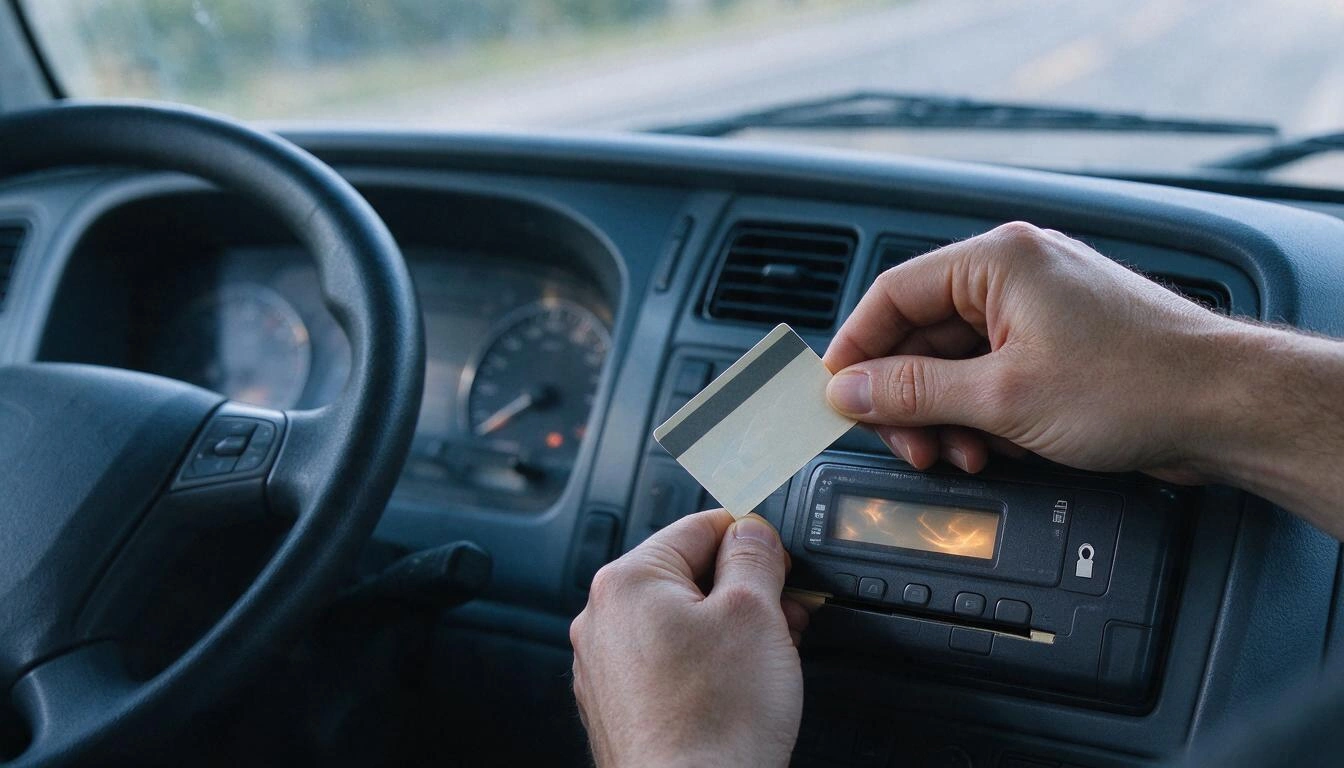
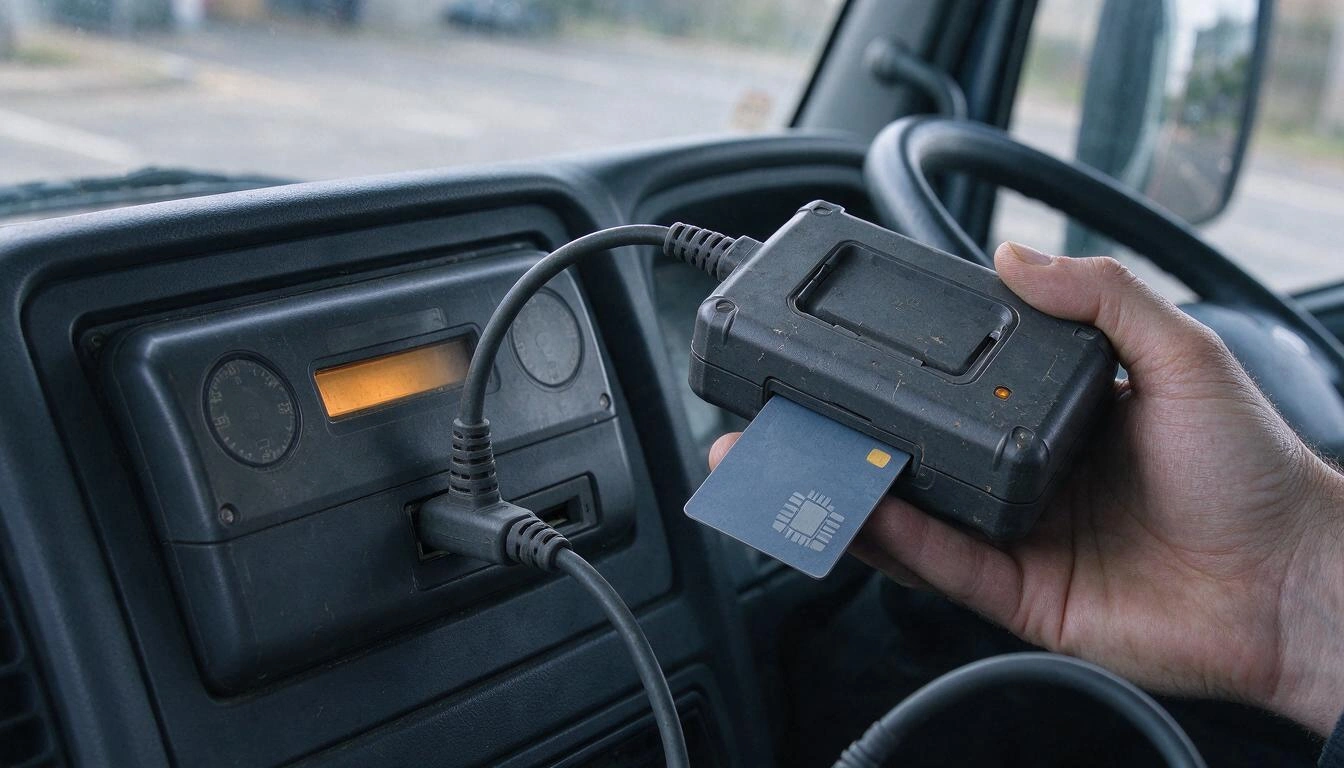
The download of the card is done with the driver's chip; the download of the vehicle memory is done by connecting a key or download terminal to the dashboard equipment itself. These are two distinct operations, with different deadlines, and it is precisely there that forgetfulness creeps in.
The detail that almost no one applies: only days with recorded activity count
The 28 and 90 days are not just calendar days: recital 3 of Regulation (EU) 581/2010 establishes that, to determine the maximum transfer deadlines, only days with recorded activity must be counted. A truck immobilized for a month due to a breakdown, or a driver on sick leave, do not exhaust the deadline as long as there is no activity.
In practice, this has two opposite consequences, and it is important to be clear about them:
- It gives you real breathing room in fleets with seasonality or reinforcement vehicles that are parked for weeks in the yard.
- It forces you to know when there was activity, that is, to have the data. If you do not know which days the truck was running, you cannot defend the count in front of an inspection; you revert to the short deadline purely due to lack of evidence.
That is why the operational recommendation of the sector is not to push it to the limit: download the cards on a weekly or biweekly routine and the vehicles monthly, so that the legal deadline is never what saves you. A margin of 5 days on the card (download at 23) and 10 on the vehicle (at 80) absorbs vacations, sick leave, and long trips without having to calculate anything.
How long should .ddd files be kept and how?
The legal minimum is one year from their use, and it is not enough just to have them: Article 33.2 of Regulation (EU) 165/2014 requires them to be kept "in chronological order and in a legible form," and also obliges the company to provide a copy to the driver upon request. A folder with automatic names and duplicate files meets that requirement; a structure by driver, vehicle, and period meets it as well.
There are two nuances that cost money when not taken care of:
- The structure of the file matters. The Ministry's guidelines explicitly classify "the retention of records in the company without complying with the regulatory field structure or file extension" as a very serious infringement (code BD01.13), with a base amount of €2,001. That is to say: converting the
.dddto another format and discarding the original is a risk. - The gaps are visible. If there is a missing period between two downloads from the same card, there is a hole in the file. The inspection does not need to prove anything else: that hole is, in itself, the lack of data.
Aside from the legal year, an inspection or a labor claim may refer to earlier periods, so many companies keep the .ddd files for much longer. That is no longer an obligation: it is a personal criterion, and the storage cost of a few kilobyte files is negligible compared to having to say "I don't have it."
What is the fine for not downloading or not retaining the tachograph data?
The infringement is not called "not downloading": it is called lack of recorded data that must be retained at the company's headquarters, and it is graded based on whether it is significant or not. These are the codes and base amounts from the sanctioning scale published by the Ministry of Transport (non-aggravated version, 07/09/2021), which refer to Article 33.2 of Regulation (EU) 165/2014 and to the LOTT.
| Code | Infringing act | Qualification | Base amount | Extra |
|---|---|---|---|---|
| BD01.01 | Significant lack of record sheets or tachograph data or cards that the company must retain at its headquarters (art. 140.21 LOTT) | Very serious | €2,001 | Loss of honorability (public transport) |
| BD02.05 | Non-significant lack of those same records or data (art. 141.13 LOTT) | Serious | €601 | — |
| BD01.13 | Retaining records without complying with the regulatory field structure or file extension (art. 140.21 LOTT) | Very serious | €2,001 | Loss of honorability (public transport) |
| BD01.02 | The documentation provided does not allow determining the total kilometers for the required period, due to a cause attributable to the company (art. 140.21 LOTT) | Very serious | €2,001 | Loss of honorability (public transport) |
Three warnings about this table, to read it well:
- These are base amounts without aggravating circumstances. The final amount comes from a sanctioning file and can increase within the legal range of Article 143 LOTT.
- The difference between "significant" and "non-significant" is assessed by the inspector based on the file, not an automatic criterion. Between €601 and €2,001 there is a leap that depends on how many data are missing and for how long.
- The loss of honorability is the costly damage, not the fine: it affects the public transport authorization, and that is why a very serious accumulated offense weighs much more than its price tag.
What changes in 2026 for a Spanish transport company?
2026 adds two obligations with deadlines and an inspection plan that directly targets them. None replace the download deadlines: they are added to the same calendar you already have.
| Date | What comes into effect | Who it affects | Source |
|---|---|---|---|
| 31/12/2024 (sanction from 01/03/2025) | The records that the driver carries on board increase from 28 to 56 days prior plus the current day (art. 36 Regulation (EU) 165/2014, amended by Regulation (EU) 2020/1054) | All vehicles with a tachograph, analog or digital | Todotransporte, 27/12/2024 |
| 21/08/2025 | End of the deadline to replace the first-generation smart tachograph with the G2V2 in international transport vehicles | Heavy vehicles in international transport | Confebus |
| 01/07/2026 | Smart tachograph G2V2 mandatory in vehicles from 2.5 to 3.5 t that carry out international freight transport | Vans in international transport | Inspection Plan 2026, Fenadismer, 10/12/2025 |
| 05/10/2026 | Electronic Administrative Control Document (DeCA) mandatory: the control document moves to digital format with QR | Public freight transport in Spain (excludes international and complementary private transport) | Law 9/2025 of Sustainable Mobility and Resolution of 05/06/2026, BOE-A-2026-12784 |
The National Transport Inspection Plan 2026, whose lines were previewed by the Ministry in December 2025, prioritizes precisely the three new features: new weights and dimensions, digital control document, and the latest version of the smart tachograph, in addition to the control of delinquency and compliance with the prohibition of loading and unloading by drivers in logistics platforms.
For a 3.5 t van that until now operated outside the tachograph and starts making an international delivery per month, the change is not just the device: it is suddenly entering the same 28 and 90-day calendar, with the same fines.
The most sanctioned time violations on the road, with their scale
More than half of the penalties for professional drivers in the last major European campaign were for driving and rest times. In the Operation Truck&Bus from February 9 to 15, 2026, coordinated by ROADPOL and executed in Spain by DGT and Guardia Civil, 26,189 professional vehicles were inspected in seven days: over 5,700 penalties, of which 2,961 (52%) were for non-compliance with driving and rest times, 257 for improper use of the tachograph, 991 drivers for incomplete documentation, and 736 vehicles with serious technical faults, with 46 immobilized.
What turns those figures into management is knowing that the penalty is graded by minutes. This is the official scale of the Ministry for the two most frequent violations:
| Violation | Segment | Qualification | Base Amount |
|---|---|---|---|
| Continuous driving without a break (over 4 h 30) | >4 h 30 and <5 h | Minor | 100 € |
| Continuous driving without a break | ≥5 h and <6 h | Serious | 401 € |
| Continuous driving without a break | ≥6 h and <8 h | Very serious | 1,001 € |
| Continuous driving without a break | ≥8 h and <10 h | Very serious | 1,500 € |
| Continuous driving without a break | ≥10 h | Very serious | 2,000 € |
| Daily driving excess (over 10 h) | >10 h and <11 h | Minor | 100 € |
| Daily driving excess | ≥11 h and <12 h | Serious | 401 € |
| Daily driving excess | ≥12 h and <13 h 30 | Very serious | 1,001 € |
| Daily driving excess | ≥13 h 30 and <15 h | Very serious | 1,500 € |
| Daily driving excess | ≥15 h | Very serious | 2,000 € |
| Daily driving excess | ≥15 h without a break or rest of at least 4 h 30 | Very serious | 4,001 € |
Source: penalty scale without aggravating factors from the Ministry of Transport (07/09/2021), codes CA11–CA13 and CC01–CC03, based on arts. 6.1 and 7 of Regulation (EC) 561/2006. Several of these segments also involve immobilization of the vehicle (art. 202 ROTT).
The important data for management: the difference between 401 € and 1,001 € in the break is 60 minutes. And those 60 minutes are in the .ddd you take each week, not in the driver's memory.
How to set up a tachograph download calendar that won't slip your mind
The method that works in fleets of 5 to 50 vehicles has four components: a counter per resource, a margin, a fixed routine, and an organized file. No software is needed to understand it; it just needs to not be on a post-it.
- A counter for each driver and another for each vehicle. Not a company calendar: 14 trucks and 18 drivers mean 32 independent counters, each with its last download.
- Margin over the legal deadline. Notifying at 23 days for the card and at 80 for the vehicle leaves a long week for reaction before non-compliance.
- A fixed and communicated routine. Fridays for downloads, for example: the driver knows to hand in the card and the truck entering the yard gets downloaded. What doesn't have a day, doesn't get done.
- An auditable file. Original file kept as is, classified by driver and vehicle, with coverage gaps marked to explain them before someone else finds them.
And a fifth component that is not from the tachograph but lives in the same calendar: ITV, insurance, maintenance, license, CAP, ADR, and expiration of cards. It’s the classic blind spot, because tachograph compliance systems do not check the ITV and maintenance systems do not check the CAP. For the traffic manager, it’s the same question every morning: can this truck and this driver go out today?

The cost of not having costs controlled: 1.42 € per kilometer
While chasing deadlines, the other hole in a transport SME is accepting loads without knowing what they cost. According to the Road Freight Cost Observatory of the Ministry of Transport, as of July 31, 2026, an articulated vehicle for general cargo had a unit cost of 1.42 €/km traveled and 1.67 €/km loaded, with an annual operating cost of 170,875.68 €.
| Item | Weight on total cost | Year-on-year variation |
|---|---|---|
| Personnel and allowances | 32.4 % | — |
| Fuel | 31.7 % | +14.4 % |
| Insurance | — | +4.5 % |
Source: Cost Observatory of the Ministry of Transport, 2nd quarter of 2026, according to the analysis by Fenadismer recorded by Guitrans on 17/09/2026. In the same quarter, transport prices rose by 5.9% year-on-year and ton-kilometers by 9.4%.
With two-thirds of the cost in personnel and fuel, the cost of a load is determined by kilometers and hours. And the kilometers depend on the order of the stops: the difference between the sequence that goes alone and the optimized sequence is money, not aesthetics.
How aiLogistic fits into all this (and what it doesn't do)
aiLogistic is the vertical transport and logistics app from AIsToHire: it brings together in the same tool the download counters of the tachograph, fleet and personnel expirations, and the actual cost of each route. You can see it in detail on the page of aiLogistic: fleet, routes and tachograph for transport companies.
What it does, as mentioned above:
- 28 and 90-day counters per driver and per vehicle, with configurable alerts (30/15/7 days by default, and custom thresholds for downloads) so that the legal deadline is never what alerts you.
- Upload and archive of the
.dddfiles that you download: it detects corrupt or truncated files, preserves the original, marks coverage gaps, and resets the corresponding resource counter. - Report of violations of Regulation (EC) 561/2006 with a deterministic engine —not generative— that indicates the exact minutes of excess and responds "not evaluable" when data is missing. Exportable to PDF.
- Unique traffic light panel with ITV, insurance, maintenance (by date or by kilometers), license, CAP, ADR, and expiration of cards, with the status recalculated at each reading and a block of "cannot leave today".
- Routes and costs: optimized order of stops with time windows and weights, estimated kilometers and hours, and detailed cost in fuel, driver, tolls, and allocation of fixed costs, with its €/km and margin.
- Reports and delivery notes with photo and signature from the driver's mobile.
And what it doesn't do, said plainly because it's exactly what differentiates an honest tool from a brochure:
- It does not physically download the tachograph. That requires the key or the approved reader; the app manages the deadlines and the files that you upload.
- It does not have GPS or telematics: there is no real-time position or reading of the CAN-bus, and therefore there is no need to install anything in the cabins.
- It does not issue the DeCA or electronic control documents, nor invoices. For the obligation of October 5, 2026, you will need the corresponding tool.
- It does not provide legal advice. The amounts and qualifications in this article come from the Ministry's scale and do not replace the resolution of a sanctioning file or the criteria of your advisory.
Frequently asked questions about tachograph data download
How often should the driver's card be downloaded?
Every 28 days at most, according to art. 1 of Regulation (EU) 581/2010. Only days with recorded activity count. In practice, it is advisable to download every week or every 15 days to avoid pushing the deadline.
And the truck's memory?
Every 90 days at most, also by Regulation (EU) 581/2010, with the same criterion of days with activity. If the vehicle changes companies or is sold, it must be downloaded before parting with it to avoid losing the data from the period it was yours.
What happens if I miss the download deadline?
What is sanctioned is not the delay itself, but the lack of data that the company must keep at its headquarters: €601 if the lack is considered not significant (serious) and €2,001 plus loss of honorability if it is significant (very serious), according to codes BD02.05 and BD01.01 of the Ministry's scale. If you download late but do not lose any data, the gap does not exist.
How long do I have to keep the .ddd files?
At least one year from their use, in chronological order and in readable form (art. 33.2 of Regulation (EU) 165/2014). It is advisable to keep the original file without converting it: altering the structure or extension of the file is classified as a very serious infringement.
How many days of records does the driver have to carry on board?
The current day and the previous 56 days, from December 31, 2024 (previously it was 28), due to the amendment of art. 36 of Regulation (EU) 165/2014 introduced by Regulation (EU) 2020/1054. Sanctions for this point began to be applied on March 1, 2025.
Does my 3.5-ton van need a tachograph in 2026?
If it does international transport of goods and its MMA is 2.5 t or more, yes: from July 1, 2026 it must have a second-generation smart tachograph (G2V2). Strictly national transport with vans under 3.5 t remains exempt from this obligation.
Can the tachograph be downloaded remotely?
Yes, there is remote download hardware that does it without going through the yard, but it is equipment that is installed in the vehicle. aiLogistic does not perform the download: it manages the deadlines and the files you upload, regardless of how you obtained them.
Are violations detected by artificial intelligence?
In aiLogistic, no: the analysis of the .ddd is done by a deterministic engine with the rules of Regulation (EC) 561/2006, which says "not evaluable" when it lacks data instead of inventing a result. AI only intervenes if you ask it to, to draft the explanation you pass to the driver.
Is this suitable for a fleet of 6 trucks?
Yes, and in fact, this is the size where it is most noticeable: with 6 trucks and 8 drivers, there are already 14 download counters plus a dozen expirations of ITV, insurance, and qualifications, which is exactly the volume where an Excel falls short and a large fleet software is disproportionate.
Start with the calendar, not with the fine
The deadlines for the tachograph are not difficult: they are numerous. 28 days per driver, 90 per vehicle, one year of archiving, two years of workshop review, five for the card, plus the ITV, insurance, CAP, and ADR. None are complicated separately and all are missed for the same reason: they are not posted anywhere to warn.
If you want to have those counters calculating themselves, the .ddd archive organized, and the cost of each transport before accepting it, aiLogistic —the vertical transport and logistics app from AIsToHire— is made exactly for that: you can see everything it includes on the aiLogistic page for fleet, routes, and tachograph and register your first truck in two minutes.
Put the tachograph deadlines on autopilot with aiLogistic: 28 and 90-day counters per driver and vehicle, filing of your .ddd files, ITV panel and authorizations, and the real cost of each route. Create your free account and register your first truck in two minutes.
Put the tachograph deadlines on autopilot with aiLogistic: 28 and 90-day counters per driver and vehicle, filing of your .ddd files, ITV panel and authorizations, and the real cost of each route. Create your free account and register your first truck in two minutes.Keep reading
View all articles →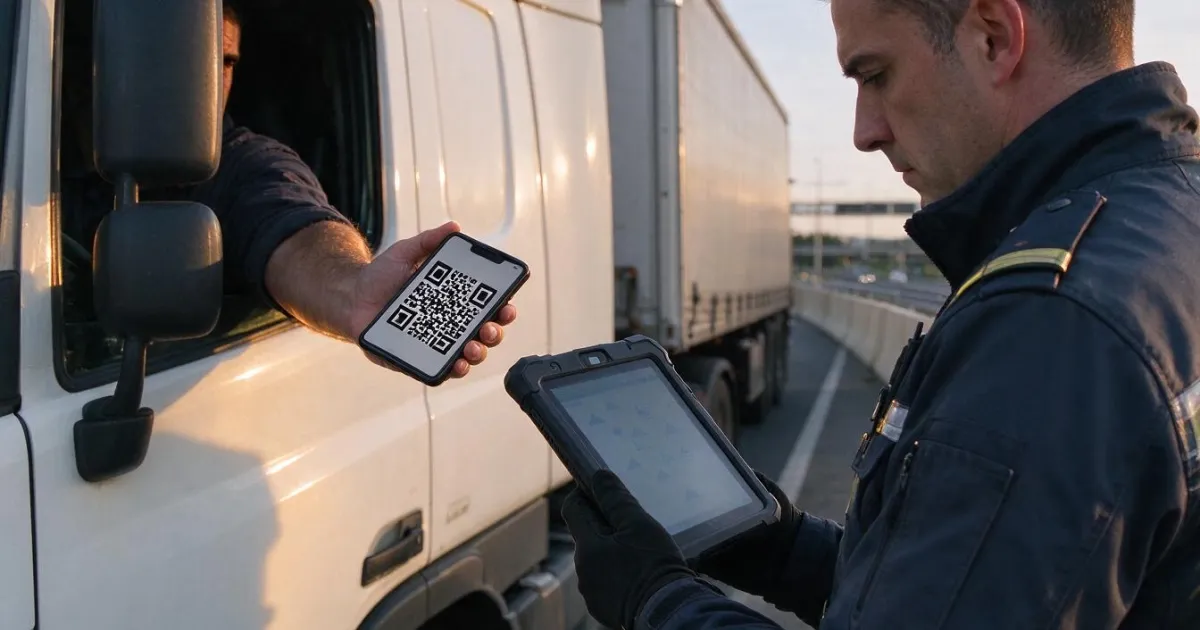
Mandatory electronic control document: what the inspection requires from October 2026

Why Your Car Insurance Increased in 2026: Average Premium of €1,412 and Historic Record

Discussing via WhatsApp or talking in person: what science says about couple conflicts through messages