 aiLiving
How much does a comprehensive renovation cost in 2027: price per m² and breakdown by item
Team at aiLivingWritten with AI assistance18 min readIn summary
- A comprehensive renovation in Spain ranges, at closing prices of 2026, between 400-600 €/m² for basic quality, 600-1,100 €/m² for medium quality, and 1,100-1,500 €/m² for high quality. For an 80 m² apartment, that amounts to about 32,000 €, 68,000 €, or 104,000 € respectively.
- Labor accounts for between 35% and 55% of the budget, and it is the item that will most strain the price in 2027: the VII General Construction Agreement agreed on a +3% for 2026 and includes a wage guarantee clause effective from January 1, 2027.
- Two budgets for the same apartment differ by 20,000 € almost always for the same reason: one measures all items and the other leaves out complete installations, kitchen furniture, carpentry, or waste management.
- The 10% VAT is not automatic: it requires housing to be at least two years old and that the materials provided by the contractor do not exceed 40% of the taxable base. The Royal Decree-Law 29/2026, of October 6 extended it to rental housing effective from December 1, 2026.
- The only thing that levels the conversation with the contractor is coming with your measurements taken. With aiLiving, the interior and exterior design app from AIsToHire, you can create the real plan of your home and get a rough estimate before the first visit: interior and garden design with estimated budget.
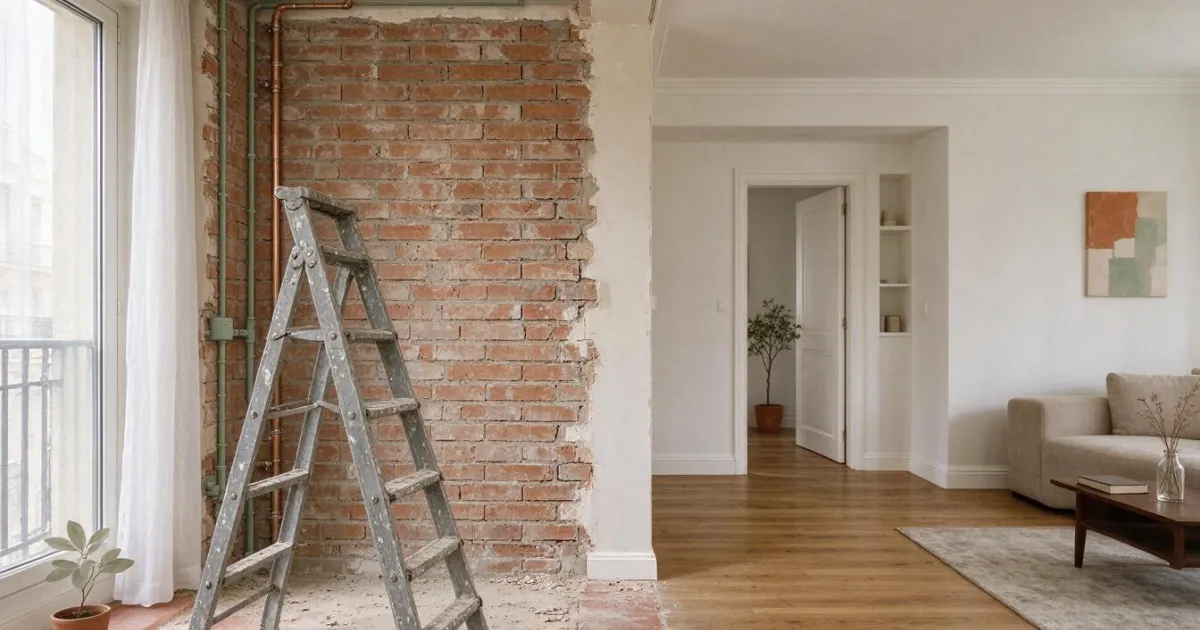
There comes a moment, when you have decided to renovate, where you find yourself alone in front of three PDFs that look nothing alike. One states 38,000 €, another 52,000 €, and the third 61,000 € — and all three say "comprehensive renovation of the apartment." You have no way of knowing if the cheap one has left half the work out or if the expensive one is charging you for their new car. This guide is the price map you need: the real ranges of the Spanish market, the weight of each item, and the questions that turn an opaque budget into a comparable one. And a tool to avoid going in blind: aiLiving, the app from AIsToHire to design and measure your home, with which you can draw the plan and estimate the cost yourself before picking up the phone.
How much does a comprehensive renovation cost in 2027?
A comprehensive housing renovation in Spain costs, based on the closing prices of 2026 and the material forecasts for 2027, between 400 and 1,500 €/m² depending on the quality level. The medium quality range —the one most people contract— is between 600 and 1,100 €/m², excluding VAT. Habitissimo placed the average price in its update on June 10, 2026, at 550 €/m², with a usual range of 460-650 €/m², and the 2026 comprehensive renovation price guides raise high qualities to 1,000-1,500 €/m².
The difference between the two ranges is not an error: Habitissimo measures the average contracted budget (which includes many partial renovations or contained qualities) and the guides by qualities measure complete comprehensive renovations, with new installations and kitchens and bathrooms from scratch.
| Quality Level | Price per m² (excluding VAT) | 60 m² Apartment | 80 m² Apartment | 100 m² Apartment |
|---|---|---|---|---|
| Basic (standard finishes, distribution preserved) | 400-600 €/m² | 24,000-36,000 € | 32,000-48,000 € | 40,000-60,000 € |
| Medium (new installations, complete kitchen and bathrooms) | 600-1,100 €/m² | 36,000-66,000 € | 48,000-88,000 € | 60,000-110,000 € |
| High (high-end materials, custom carpentry, home automation) | 1,100-1,500 €/m² | 66,000-90,000 € | 88,000-120,000 € | 110,000-150,000 € |
Two corrections that almost no one tells you:
- The price per m² rises the smaller the home. Kitchens and bathrooms are the most expensive items per square meter, and in a 50 m² apartment, they weigh proportionally much more than in a 120 m² one. A 30 m² studio ranges, according to Habitissimo, between 400 and 650 €/m² just because a large part of the cost does not scale with the surface area.
- Madrid and Barcelona are above the national average. Industry portals estimate this differential at around 20-30%, mainly due to the cost of trades and the logistics of construction in buildings without freight elevators.
Why is the price per m² not useful for comparing budgets?
Because the €/m² is not a price, it is a quotient: it completely depends on what items each contractor has included in the numerator. Two companies can offer 650 €/m² and be selling work that differs in 15,000 € in scope. The €/m² serves to know what league you are playing in; not to decide.
The typical mistake is to compare the total and the €/m² of three offers without first checking that all three include the same eight things: demolition and debris removal, masonry, complete plumbing installation (not just new points), complete electrical installation with a new panel and certificate, interior and exterior carpentry, flooring and coverings, painting, and kitchen and bathroom appliances and furniture.
If a budget does not distinguish between "replacing the electrical installation" and "extending the existing installation," it is not a budget: it is a disguised estimate.
Breakdown item by item: where each euro goes
In a medium-quality comprehensive renovation, kitchens and bathrooms account for between 22% and 33% of the budget, masonry and coverings another 20-30%, and installations (plumbing and electricity) between 14% and 22%. Painting, which is what everyone looks at, rarely exceeds 8%.
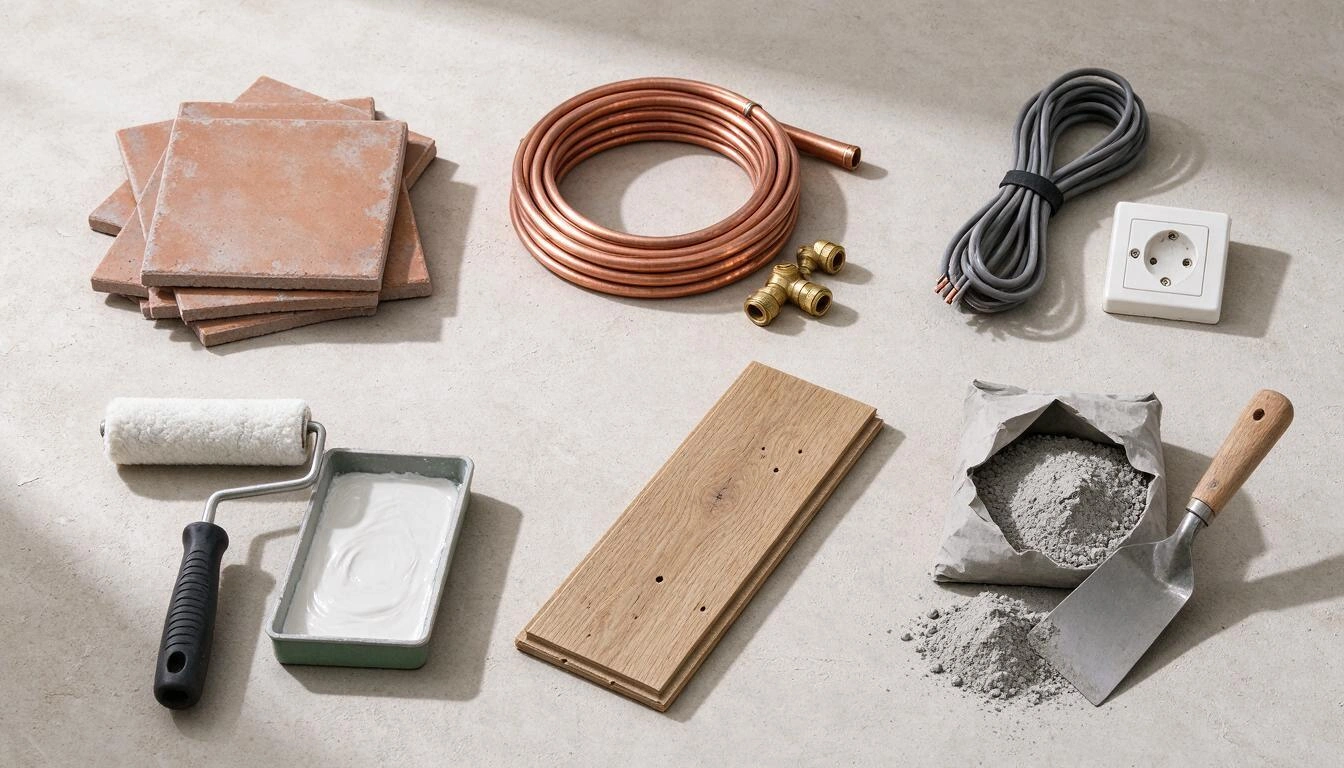
This is the structure of items that the sector's budget guides handle, with the weights published by arquality and Strom Project for 2026, applied to an 80 m² apartment with a budget of €60,000:
| Item | % of total | Amount in 80 m² / €60,000 | What must appear in the breakdown |
|---|---|---|---|
| Licenses, project, and procedures | 3-5% | 1,800-3,000 € | Municipal fee, ICIO, technical fees if there is a project |
| Demolition and debris management | 5-10% | 3,000-6,000 € | m² of wall demolished, bags or container, transport to authorized manager |
| Masonry and partitioning | 10-15% | 6,000-9,000 € | m² of new partition, raised floors, false ceilings, plastering |
| Plumbing and HVAC | 6-10% | 3,600-6,000 € | Total or partial replacement, number of points, drains, radiators or aerothermal |
| Electricity | 8-12% | 4,800-7,200 € | New panel, number of circuits, number of light points and outlets, bulletin |
| Kitchen (furniture and appliances) | 12-18% | 7,200-10,800 € | Linear meters of furniture, countertop, included or excluded appliances |
| Bathrooms (sanitary and faucets) | 10-15% | 6,000-9,000 € | Shower tray, screen, toilet, cabinet, faucet |
| Interior and exterior carpentry | 8-12% | 4,800-7,200 € | Number of doors, cabinets, windows, and type of thermal bridge break |
| Flooring and coverings | 10-15% | 6,000-9,000 € | m² and format, baseboard, leveling of support |
| Painting and finishes | 5-8% | 3,000-4,800 € | m² of wall, number of coats, plastering |
If an offer does not include measurement units (m², ml, units) next to each line, you cannot compare it with another. That is the true quality criterion of a budget, far above the total.
Why does labor take more than half of the budget?
Because in interior renovation almost all work is manual, and because the labor cost in construction is rising faster than that of the Spanish economy. Sector guides place labor between 35% and 55% of the total of a comprehensive renovation, with items like demolition or painting reaching 80-90% because the material is almost irrelevant.
The data from 2026 explains the trend:
- Labor costs in construction rose 7.5% year-on-year in the first quarter of 2026, more than double the average of the Spanish economy, according to data from the Harmonized Labor Cost Index of the INE collected by Brainsre.
- The VII General Agreement of the Construction Sector set an increase of 3.5% for 2025 and 3% for 2026, plus a 0.25% contribution to the pension plan, according to the Labor Foundation of Construction. The salary guarantee clause may add a review effective from January 1, 2027 if the accumulated CPI from December 2025 and 2026 exceeds 7.25%.
- There is competition among trades: housing starts exceeded 64,000 units between January and May 2026, 13% more than in the same period of 2025 and the best record for those months since 2008, according to the CEPCO situation report collected in November 2026. When new construction is booming, the good plumber in your neighborhood has a schedule and price.
The hourly rates that the 2026 guides handle are €25-40/h for a skilled mason and €30-50/h for electricians and plumbers. Multiply by the days that each item involves and you will understand why "remove this wall" never costs €200.
Why do two budgets for the same apartment differ by €20,000?
Almost never due to the contractor's margin: due to the scope. In an 80 m² apartment, the difference between replacing the complete installations or just expanding them, between a kitchen costing €4,000 or €12,000, and between including or not including carpentry and waste management, adds up to more than €20,000 without making the total evident.
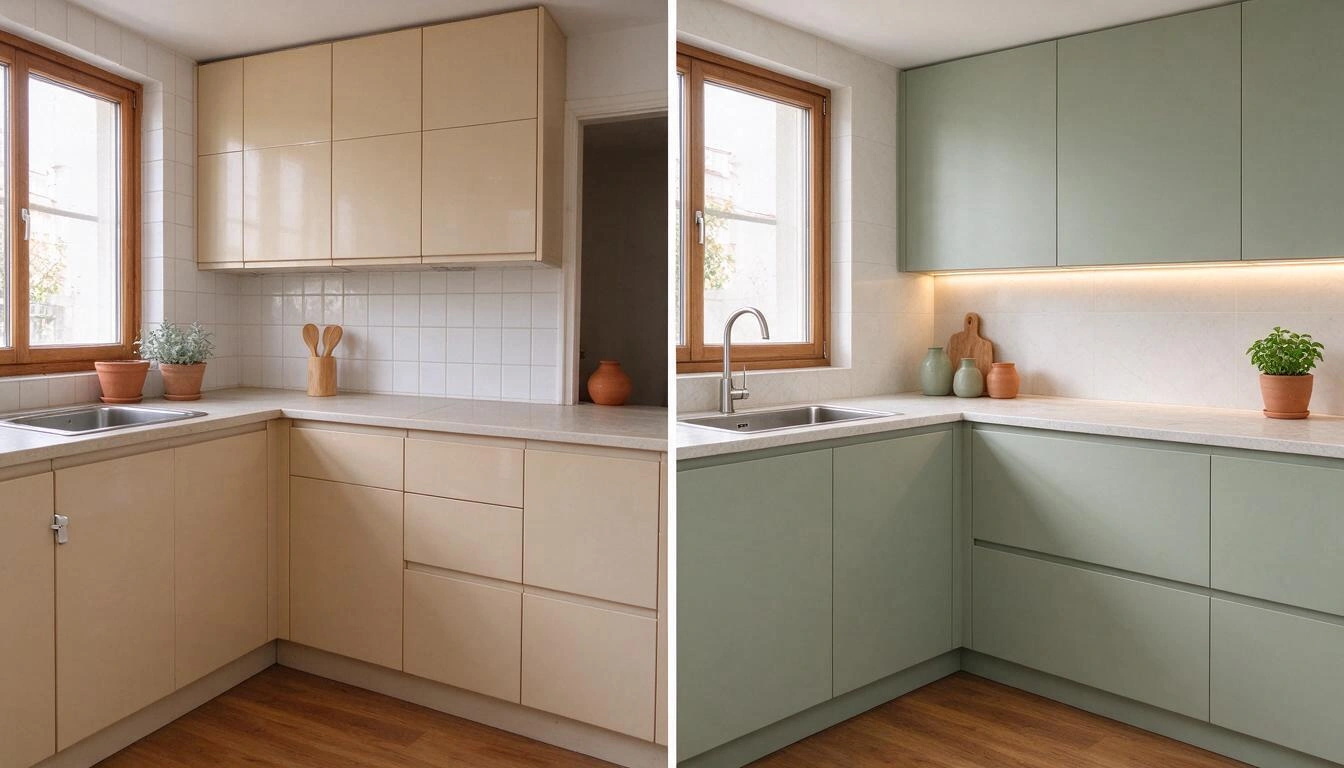
These are the six cracks through which those €20,000 escape, in order of impact:
- Complete vs. partial installations. Renovating all plumbing and all electricity with a new panel and certificate versus reusing the existing: €6,000-10,000 difference in an average apartment. It is the item that is most "forgotten" in low budgets.
- Kitchen and appliances. Between basic laminated furniture and lacquered furniture with a stone countertop, there is €8,000 in the same 3-meter kitchen. And many budgets exclude appliances without stating it clearly.
- Carpentry. Six standard doors versus six custom lacquered doors with built-in wardrobes: €3,000-6,000. If windows are also replaced, it adds another €4,000-8,000.
- Demolition and debris. The removal by an authorized manager has costs and paperwork. A budget that does not quantify bags or containers will charge you for it later as an extra.
- Level of intervention on the support. Raising floors, leveling crooked walls, or completely removing textured ceilings are hours that are not visible in the result but are reflected in the total. In apartments built before 1980 is where unforeseen issues arise.
- Licenses, ICIO, and health and safety. Small items (3-5%) that some budgets leave "to be covered by the client" and that you end up paying anyway.
On top of this, there is the pressure of materials expected in 2027. According to the construction material price forecasts published by AECO360 in June 2026, materials account for between 40% and 55% of the construction budget, and for 2027 it is projected:
| Material | Forecast 2027 | Affected item |
|---|---|---|
| Copper (wiring) | +5-8 % | Electricity |
| Pine wood C24 | +4-6 % | Carpentry, false ceiling structure |
| Rock wool | +4 % | Insulation, partition walls |
| Reinforced steel | +3-5 % | Structural masonry |
| Facing brick | +3 % | Masonry, exteriors |
| Cement | +2-3 % | Masonry |
| Sand, gravel, porcelain | Stable | Flooring and coverings |
The factor with the most uncertainty is energy: the general IPRI surged 18.3% year-on-year in September 2026, and more than 80% of that increase comes from rising energy costs, according to the same CEPCO report. Energy-intensive materials —cement, ceramics, glass— are the ones that transfer that cost to the budget first.
VAT, ICIO, and licenses: the taxes that change your total
The jump in VAT from 10% to 21% can cost you €6,600 on a renovation of €60,000, and it depends on requirements that are met or not when drafting the budget. To apply the 10%, the property must be for personal use, the previous construction or rehabilitation must have been completed at least two years before the start of the works, and the materials provided by the contractor cannot exceed 40% of the taxable base. If that threshold is exceeded, 21% applies to everything.
The recent news: the Royal Decree-Law 29/2026, of October 6, published in the BOE on October 7, 2026, extends the reduced rate of 10% to renovation and repair works for properties intended for rental as primary residences, regardless of the landlord's condition, effective from December 1, 2026, while maintaining the requirements for age and the 40% of materials. That same decree declares rehabilitation aids from the State Housing Plan 2026-2030 exempt from taxation.
In addition to VAT, there are municipal taxes:
| Concept | Amount | Note |
|---|---|---|
| ICIO (Tax on Constructions, Installations, and Works) | Up to 4% of the actual cost of the work | Rate set by each municipality; calculated without VAT or fees |
| Municipal license fee | Variable by municipality | Independent of ICIO |
| Technical fees | Only if there is a project | Mandatory if structure, facade, or use is altered |
Regarding permits, the practical rule applied by municipalities: major work license with technical project when load-bearing walls, roofs, facades are touched or the use is changed; minor work license when partitions or the layout of installations are modified; and responsible declaration or prior communication when only finishes are changed. Always confirm with your municipality's ordinance, as the classification varies.
And a savings avenue that remains open: deductions in personal income tax for works improving energy efficiency, extended by the Royal Decree-Law 7/2026, of March 20 (BOE of March 21, 2026). They are 20%, 40%, or 60% depending on the energy savings achieved, and require an energy efficiency certificate after the work. In contrast, the application window for the rehabilitation aids from Royal Decree 853/2021 with Next Generation funds closed on June 30, 2026, as reported by the specialized portals on rehabilitation aids: if you have a subsidy, check which regional program is in effect before sizing the budget.
Also on the horizon is the Directive (EU) 2024/1275 on the energy efficiency of buildings, whose general transposition deadline expired on May 29, 2026, and which, according to the Green Building Council Spain, Spain reached without completing the details. It does not impose works on individual homes, but it sets the rehabilitation calendar for the built stock: if you are going to renovate in 2027, including insulation and efficient carpentry in the scope is a decision with resale value, not just comfort.
What to ask the contractor to make the budget comparable
Ten questions turn three incomparable budgets into three offers that you can place side by side. These are not questions of distrust: a good contractor answers them quickly and appreciates a client who asks them, as they prevent conflict halfway through the work.
- Is the plumbing and electrical installation a complete replacement or an extension of the existing one? Does it include a new panel and certificate?
- How many light points, sockets, and circuits are measured in the budget?
- Are the appliances included? With what reference amount?
- What amount per m² is reserved for flooring and tiles? (That figure decides whether you can choose the material you like or not.)
- Is the debris management and its transport to an authorized manager included and quantified?
- Who processes and pays for the license, fees, and ICIO?
- Are there items "to be defined" or "according to the client's choice"? Ask for them with a fixed amount or cap.
- What is the execution period and what penalty for delay?
- What is the payment schedule? The reasonable thing is a moderate advance and certifications for actual progress, never the bulk in advance.
- What VAT applies and why? If they give you 10%, ensure that the materials provided do not exceed 40% of the taxable base.
Also, ask for the budgets with the same structure of items. The most effective way: send your item template and measurements, and have each company fill in the prices. This way you compare prices, not interpretations.
How to arrive at the visit knowing your order of magnitude
Information asymmetry is corrected in only one way: measuring your house before anyone comes. If you arrive with the m² of each room, the linear meters of the kitchen, the number of doors, and the m² of flooring and walls to be painted, the budget stops being a black box and becomes a list of unit prices that you can discuss.
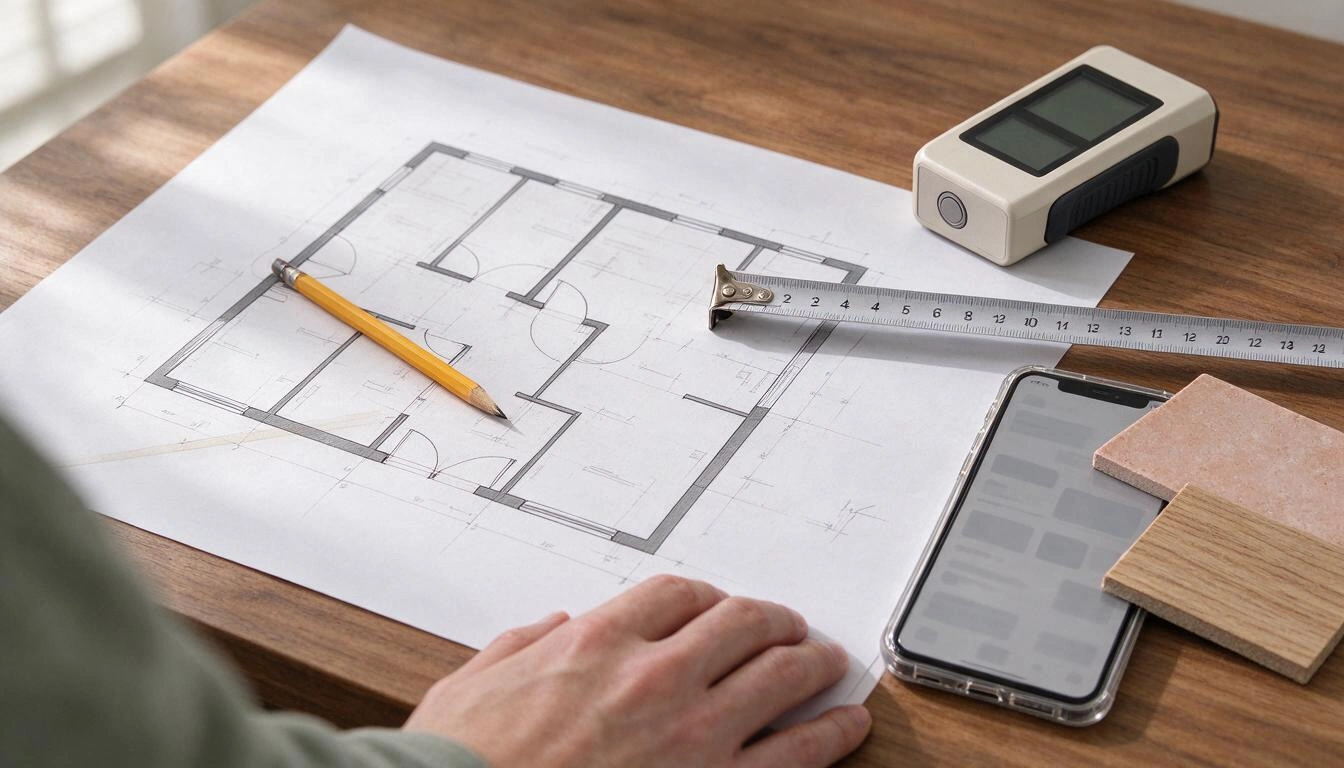
This is where aiLiving fits in, the interior and exterior design app from AIsToHire. You draw the plan of your home with your actual measurements —or parts of one of its room templates— and the app automatically calculates the square meters per room, the m² of flooring and cladding including waste, the liters of paint excluding doors and windows, and a cost estimate with market reference prices that adds labor as 55% of materials and work. You can see the room in 3D, try out floors, colors, and furniture to scale before deciding, and take the shopping list and measurements to the visit. It’s an estimate to know the order of magnitude and compare options, not a fixed budget or a substitute for the professional — but it’s exactly what you lack when you sit down to listen to the first contractor.
Here’s the tool: calculate the estimated budget for your renovation with the real plan.
Frequently asked questions about the price of a comprehensive renovation
How much does it cost to renovate an 80 m² apartment in 2027?
Between €32,000 and €48,000 with basic quality (€400-€600/m²), between €48,000 and €88,000 with medium quality (€600-€1,100/m²), and between €88,000 and €120,000 with high quality (€1,100-€1,500/m²), excluding VAT. In Madrid and Barcelona, expect an additional 20-30% for the cost of trades.
What percentage of the budget is labor?
Between 35% and 55% of the total in a comprehensive renovation, according to industry guides from 2026. In items with little material, such as demolition or painting, labor reaches 80-90% of the line.
Why is one budget €20,000 cheaper than another?
Almost always due to scope, not margin. The most common causes are: partial installations instead of complete ones, kitchen and appliances excluded or with very low reference amounts, carpentry not included, debris management not quantified, and "to be defined" items that increase during the work.
When is the 10% VAT applied in a renovation and when is the 21%?
The 10% is applied if the recipient is a natural person for private use, the property was completed or rehabilitated at least two years before the start of the works, and the materials provided by the contractor do not exceed 40% of the taxable base. If that 40% is exceeded, the 21% is applied to the total. Since December 1, 2026, Royal Decree-Law 29/2026 extends the 10% to works in homes intended for regular rental.
Will renovation prices rise in 2027?
The forecast points to moderate but widespread increases. On the material side, AECO360 projected in June 2026 increases of +5-8% in copper, +4-6% in C24 wood, and +2-5% in cement and steel for 2027. On the labor side, the construction agreement leaves open a wage guarantee clause effective from January 1, 2027.
Do I need a building permit for a comprehensive renovation of my apartment?
It depends on what you touch. If the structure, facade, or common elements are not affected, in most municipalities a responsible declaration or prior communication is sufficient; if walls or installation layouts are modified, a minor work permit; and if load-bearing walls, roofs, or facades are touched, a major work permit with a technical project is required. Always check the municipal ordinance, as classifications vary from one municipality to another.
Can I deduct a renovation in my income tax return?
Only the part of improving energy efficiency. Deductions of 20%, 40%, and 60% in personal income tax for works that reduce heating and cooling demand or the consumption of non-renewable primary energy were extended by Royal Decree-Law 7/2026, of March 20, and require a certificate of energy efficiency after the work.
How much can I deviate from the initial budget?
It is prudent to reserve 10-15% of the total as a cushion for unforeseen events, and more if the building is older than 1980: deteriorated downpipes, floors that need to be raised, or obsolete common installations are the most common extras and appear once demolition has already taken place.
In conclusion: the budget is earned before the first visit
Renovating is not expensive due to the contractor's whim: it is expensive because labor accounts for more than half, because the labor cost of construction rises by 7.5% year-on-year, and because energy-intensive materials remain under pressure heading into 2027. What you can control is to stop comparing totals and start comparing measured items. That is the only conversation in which the client does not lose.
If you want to sit down with the contractor knowing your square meters, your quantities, and your order of magnitude, aiLiving —the interior and exterior design app from AIsToHire— allows you to create the real plan of your home, see it in 3D, try materials, and obtain a cost estimate with your own measurements before requesting the first quote: design and budget your renovation with the real measurements of your plan.
Draw the plan of your home with your actual measurements in aiLiving, see how it looks in 3D, and get your cost estimate before requesting the first quote.
Draw the plan of your home with your actual measurements in aiLiving, see how it looks in 3D, and get your cost estimate before requesting the first quote.Keep reading
View all articles →
Minimum Measurements at Home: How Much Free Space to Leave in the Living Room, Kitchen, and Bathroom

Why Your Car Insurance Increased in 2026: Average Premium of €1,412 and Historic Record

Discussing via WhatsApp or talking in person: what science says about couple conflicts through messages