 aiHairTone
How to Know What Shape My Face Is: The 4 Measurements, the 7 Types, and Which Haircut Suits Each One
Team at aiHairToneWritten with AI assistance15 min readIn summary
- The shape of the face is determined by four measurements (forehead width, cheekbone width, jaw width, and total length) and two proportions: length ÷ cheekbones, and which of the three widths is the largest.
- If length ÷ cheekbones is between 1.4 and 1.6 and the cheekbones are the widest measurement, we are talking about an oval face; below 1.3 tends to be round or square; above 1.6, elongated.
- This is not a scientific classification: it is a hairdressing industry convention that helps to decide what the cut should do (lengthen, widen, soften an angle), not to label anyone.
- The cut does not change your face: it changes where the eye looks. That’s why the same hairstyle flatters an elongated face and detracts from a round one.
- aiHairTone, the mini-app from AIsToHire, makes this classification from a single front photo: it fits it into one of seven face types, detects skin undertone and hair type, and returns a downloadable infographic with recommended cuts, cuts to avoid, ideal tone, and a palette of three colors.
"What shape is my face?" is almost always the question people type into Google just before booking an appointment at the hair salon. And it makes sense: it’s the data upon which all the others hang, because a cut is not chosen by fashion but by proportion. This guide explains how to measure your face in five minutes with a tape measure, what proportion defines each of the seven types, and what the cut is supposed to do in each case. At the end, you will see how aiHairTone, the mini-app from AIsToHire, solves the same step from a photo —and, above all, what it does not do.
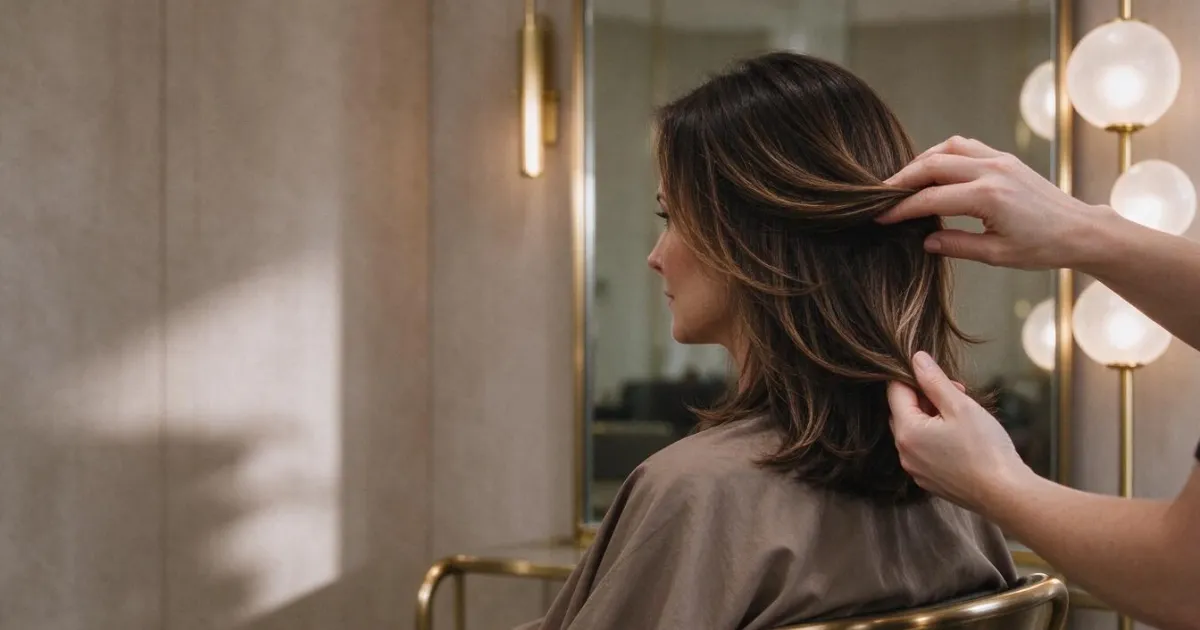
What shape is my face? It is decided with four measurements and two proportions
Your face shape comes from comparing four measurements: forehead width, cheekbone width, jaw width, and total length of the face. With these four numbers, you only need to answer two questions: which of the three widths is the largest, and how many times does the cheekbone width fit into the length. Those two answers give you the type unambiguously in most cases.
The common mistake is to decide by looking in the mirror. A mirror reflects a face with hair around, styled, with makeup, and with the head slightly tilted: four things that distort just the silhouette you want to see. That’s why the measurement is done with the hair completely pulled back and facing forward.
How to measure your face in five minutes, step by step
You need a flexible tape measure (the sewing kind) and a mirror. If you don’t have a tape, a string that you can later measure with a ruler will work. Pull all your hair back, including sideburns and bangs, and look straight ahead.
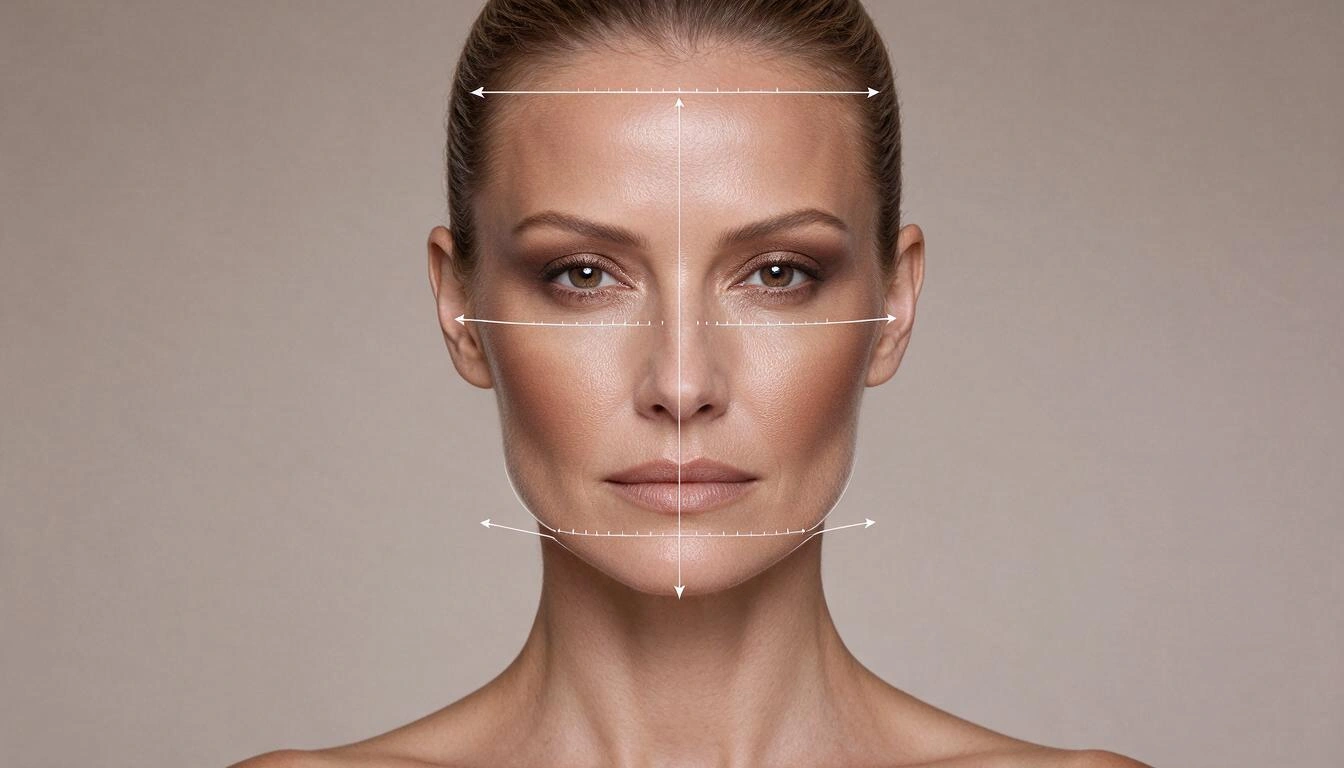
- Forehead width. From one temple to the other, at the widest point (midway between the eyebrows and the hairline).
- Cheekbone width. From one cheekbone to the other, passing the tape over the most prominent point, just below the outer corner of the eye.
- Jaw width. From the angle of the jaw under one ear to the other, passing through the tip of the chin; if it’s easier for you, measure from the angle to the chin and multiply by two.
- Face length. From the center of the hairline to the tip of the chin, vertically.
Write down the four in centimeters with one decimal and calculate length ÷ cheekbone width. That number gives the most information: below 1.3, the face "reads" as wide; around 1.5, balanced; above 1.6, long.
Two practical warnings. First: measure twice and take the average, because a centimeter difference in the cheekbones changes the result. Second: don’t measure from a close-up photo taken with a mobile —the wide-angle of mobile phones expands the center of the image and narrows the edges, so the nose appears larger and the jaw smaller than they are.
The seven types of face and the exact proportion that distinguishes them
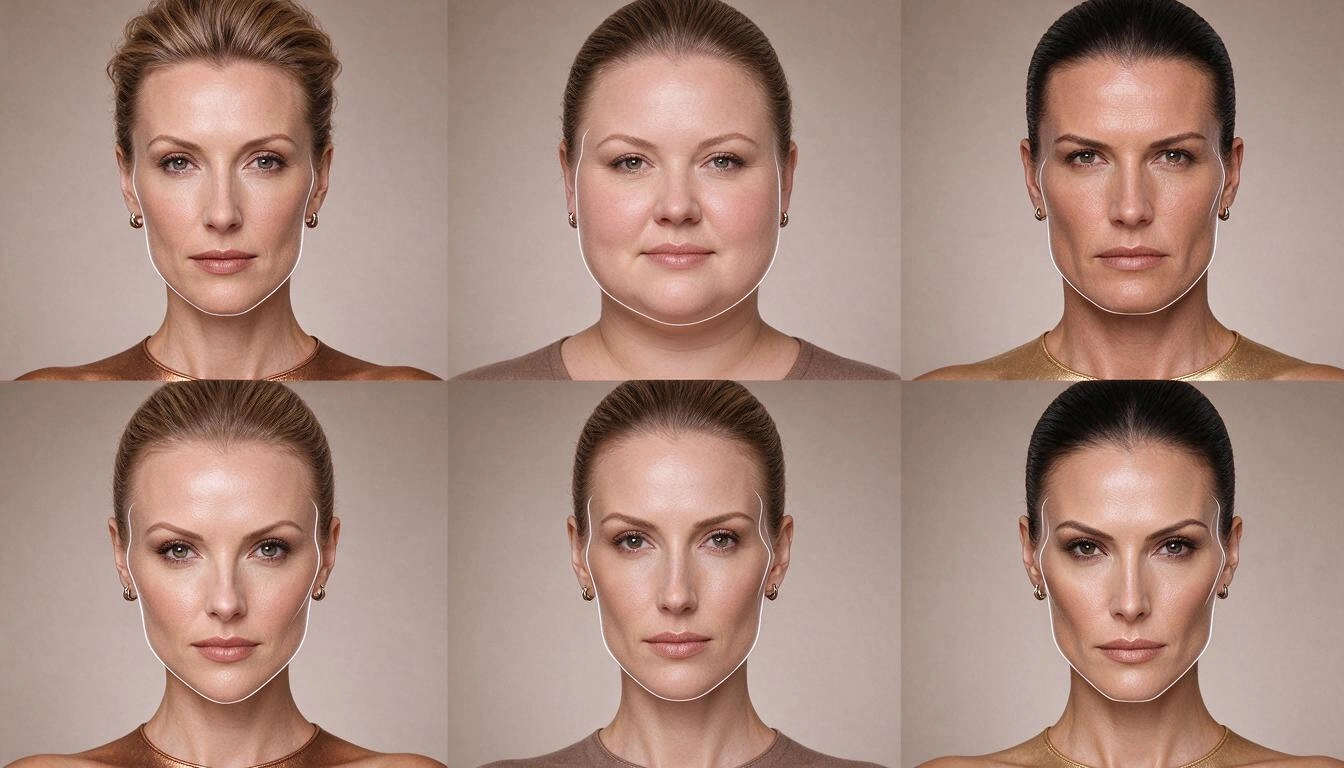
These are the seven types that the industry works with —and that aiHairTone works with— and the specific signal that separates them in measurements. The thresholds are what are used as a working rule in hairdressing, not an official standard: near the border, two neighboring types are equally valid.
| Shape | Signal in measurements | Distinguishing feature |
|---|---|---|
| Oval | length ÷ cheekbones between 1.4 and 1.6; cheekbones the largest width; forehead slightly wider than the jaw | Smooth transition from cheekbone to chin, without angles |
| Round | length ÷ cheekbones less than 1.3; all three widths similar | Full cheeks and jaw without a visible angle |
| Square | length ÷ cheekbones less than 1.4; all three widths within ~1 cm of each other | Marked jaw angle and straight forehead |
| Elongated (oblong) | length ÷ cheekbones greater than 1.6; all three widths similar | The face is clearly longer than wide |
| Heart | the forehead is the largest width; the jaw at least 2 cm narrower | Pointed chin, often with a widow's peak |
| Diamond | the cheekbones exceed both the forehead and the jaw by 2 cm or more | Very prominent cheekbones with narrow forehead and chin |
| Triangle | the jaw is the largest width and the forehead the smallest | Visual weight in the lower part of the face |
An example with real numbers: three sets of measurements and what comes out of each
To illustrate how the decision works, three real measurements from three different people, with the calculations made:
| Measure | Case A | Case B | Case C |
|---|---|---|---|
| Forehead | 13.0 cm | 13.5 cm | 14.5 cm |
| Cheekbones | 14.0 cm | 13.8 cm | 13.0 cm |
| Jaw | 11.5 cm | 13.4 cm | 10.8 cm |
| Length | 20.5 cm | 17.2 cm | 19.0 cm |
| Length ÷ cheekbones | 1.46 | 1.25 | 1.46 |
| Widest width | Cheekbones | Forehead (technical tie) | Forehead |
| Result | Oval | Square | Heart |
Notice A and C: they have the same length ÷ cheekbones ratio (1.46) and yet are different types. What separates them is which of the three widths prevails. That is the reason for measuring all three and not just sticking with the vertical proportion.
What the cut needs to do for each face shape
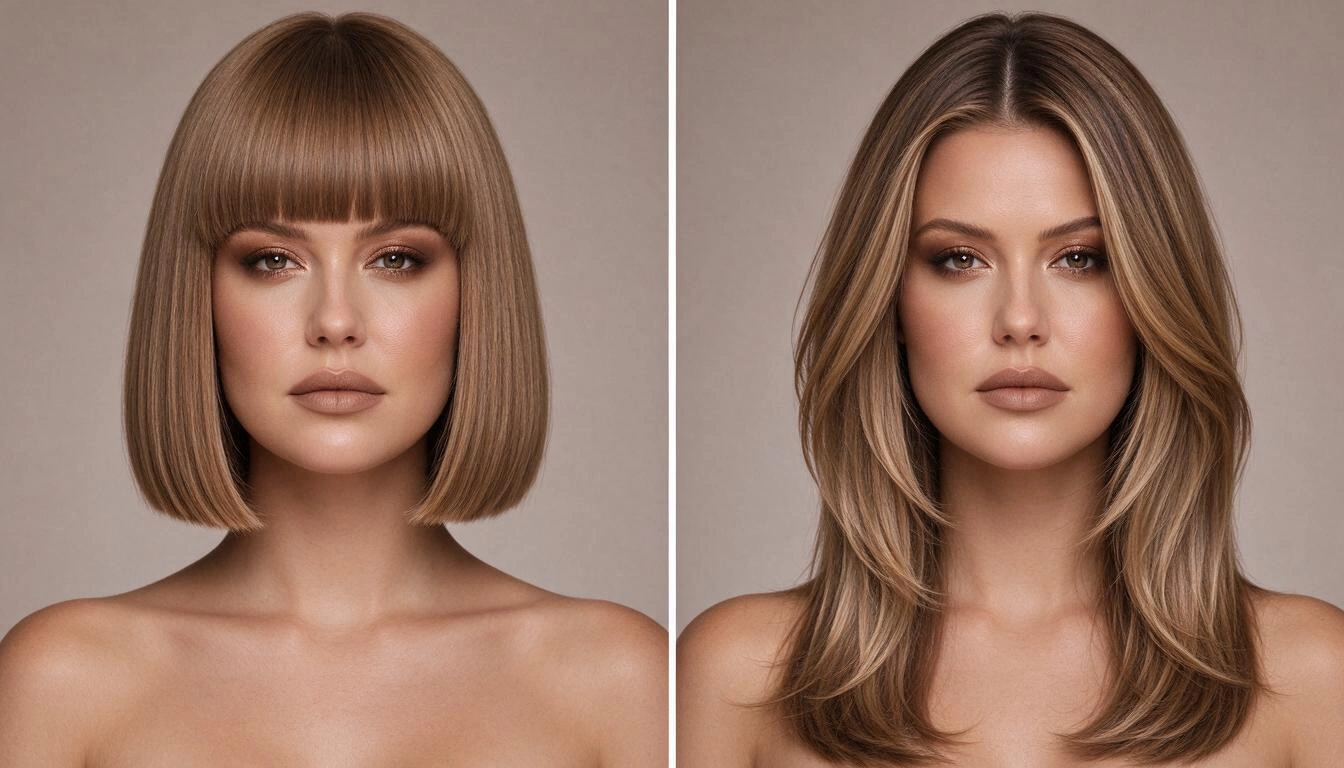
A cut does not modify your bones: it modifies the contour surrounding the face and, with it, the proportion perceived by the eye. The general rule is to compensate: lengthen what looks wide, widen what looks narrow, soften what looks angular. This table summarizes what usually works and what usually detracts in each type.
| Shape | Visual Goal | Usually Works | Usually Detracts |
|---|---|---|---|
| Oval | Maintain proportion | Almost any length; texture and density dictate the decision | Changes that remove too much body if the hair is very fine |
| Round | Lengthen and refine | Long layers starting below the chin, side part, volume at the crown, midi mane | Straight bob at chin height, heavy straight bangs, very rounded manes |
| Square | Soften the jaw angle | Loose waves, layered cuts that fall over the jaw, curtain bangs, long bob below the collarbone | Blunt cut right at the jawline, straight and wide bangs, very tight hair |
| Elongated | Reduce length and add width | Bangs (straight or curtain), waves at cheekbone height, medium length, volume on the sides | Very long and straight hair without layers, too much volume at the crown |
| Heart | Compensate for wide forehead and narrow chin | Curtain bangs, layers that add volume from the cheekbones down, bob at collarbone | Volume at the crown, very tight updos with the forehead exposed |
| Diamond | Widen forehead and chin | Curtain or side bangs, bob with ends out, layers that end below the chin | Hair completely pulled back, layers that end at cheekbone height |
| Triangle | Add weight at the top | Volume at the crown and cheekbones, shorter layers on top, side bangs | Straight and heavy manes that end right at the jawline |
The clearest way to see it is with the same face and two different cuts: it changes the silhouette, not the person.
The 2.25 rule is a useful shortcut, but it doesn't decide for you
There is a classic shortcut in the trade for the question "short or long hair?": the so-called 2.25 rule, popularized by the team of British stylist John Frieda. Place a pencil horizontally under the chin and a ruler vertically from the earlobe; if the distance between the earlobe and the pencil is less than 5.7 cm (2.25 inches), short hair usually flatters; if it is greater, long hair usually works better.
It is a shortcut, not a law. It ignores hair texture, density, neck, height, and the lifestyle of the person sitting in the chair, which are precisely the things a professional looks at before picking up the scissors. By the way: aiHairTone does not apply this rule or measure centimeters; it classifies the shape of the face and proposes cuts based on that classification.
For color, another factor prevails: skin undertone, not face shape
The cut is decided by proportion; the color, by skin undertone. These are two independent decisions, and mixing them is the source of half the dyes that don't quite convince: a beautiful blonde can wash out a face if its temperature goes against the skin.
The undertone is classified into three families and there are three quick home tests:
- Wrist veins, in daylight: greenish → warm; bluish or purplish → cool; a mix of both → neutral.
- Jewelry: if gold lights you up more than silver, aim for warm; the reverse for cool; if both look good on you, neutral.
- White paper against raw paper: bring both close to your face without makeup; the one that doesn't leave you looking tired indicates your family.
All three fail with warm artificial light, with self-tanner, with makeup on, or with a poorly calibrated screen. Therefore, it is advisable to do them by a window and without a filter. The industry convention is that warm undertones go well with golds, coppers, and caramels; cools with ashes and cool browns; and neutrals accept intermediate tones. aiHairTone returns just that: an ideal tone named and three color samples in hexadecimal that are consistent with the undertone detected in the photo.
What exactly does aiHairTone do with your photo, and what does it not do
aiHairTone starts from a single front photo and works in two chained steps: first, an AI analyzes the image and returns the face shape (from the seven types in the table above), the skin undertone (warm, cool, or neutral), the hair type (straight, wavy, curly, or afro), recommended haircuts, those to avoid, the ideal hair tone, a palette of three colors, and a styling tip; then, a second AI draws all of that on your own photo in the form of a downloadable vertical infographic.
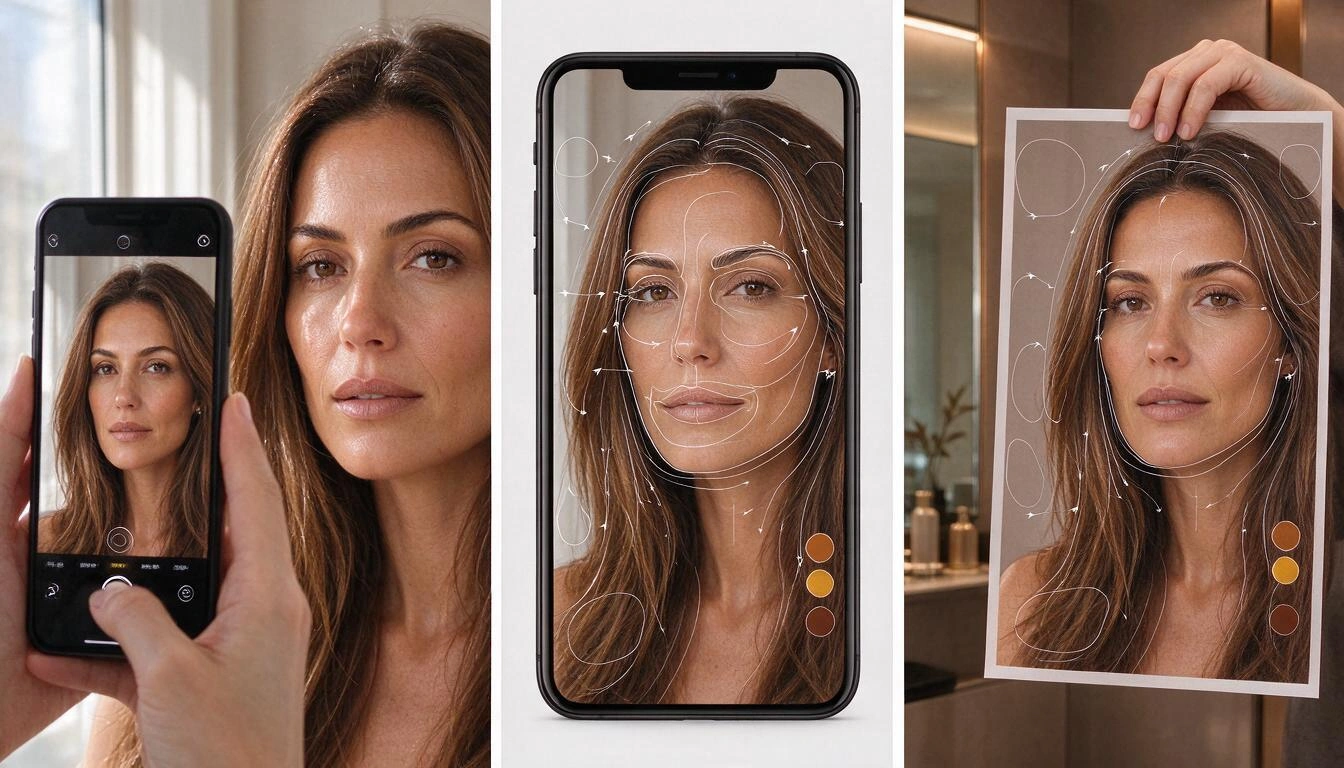
The concrete details, without embellishments:
| Input | What it returns | What it DOES NOT do |
|---|---|---|
| A front photo (taken with the camera or uploaded from the gallery), image format, and up to 12 MB | Face shape among 7 types · undertone among 3 · hair type among 4 · recommended haircuts · haircuts to avoid · ideal tone · palette of 3 colors · styling tip · infographic about your photo | It does not show you the haircut on: it does not simulate how you would look with different hair |
| Free account on AIsToHire; works on mobile and computer | History with your latest analyses, viewer with zoom and image download to save or send | It does not measure centimeters or angles: it classifies, it does not measure |
| No forms or questionnaires | Result in about a minute under normal conditions (depends on the generation queue) | It does not assess the condition of the hair: neither porosity, nor density, nor if it withstands bleaching |
That last column is the important one. Many people come looking to "try haircuts with my photo," and that is another thing: the infographic from aiHairTone keeps your face and hair as is and overlays the panels with the analysis. It is a sheet for deciding and for showing, not a hairstyle simulator.
How to take the result to the hair salon without losing anything along the way
The practical utility lies in arriving at the appointment with specific vocabulary instead of with a "something that suits me." Two people can ask for "layers" and refer to completely different cuts; a haircut name, a tone, and color samples are much less ambiguous.
- Download the infographic and save it on your mobile (on mobile, the download button opens the native menu to save it in Photos or send it via message).
- Show it at the beginning of the consultation, not when they have already started cutting.
- Treat haircut names as a starting point: the person attending to you sees your density, your cowlick, your gray hairs, and how your hair falls when wet, and that a photo does not convey.
- If you are going to change color, also bring the three samples: discussing a hexadecimal is easier than discussing the word "caramel."
The honest limits: this is aesthetic guidance, not a diagnosis
It is worth stating clearly. The classification of face shapes does not have scientific consensus: it is a working system from the hairdressing sector, useful for deciding proportions and nothing more. Any tool that automates it —including aiHairTone— inherits that limitation, and the result may vary slightly between two photos of the same person if the lighting, angle, or hairstyle changes.
And about color: aiHairTone suggests tones, it does not assess your health or that of your hair. Coloring decisions are made with a professional. Hair dyes are regulated in the EU by the Regulation (EC) No. 1223/2009 on cosmetic products, fully applicable since July 11, 2013, which sets maximum concentrations for coloring substances and requires that the packaging includes usage warnings, including that dyes may cause severe allergic reactions and should not be used to dye eyebrows or eyelashes. Read the label, perform the sensitivity test indicated by the manufacturer, and in case of any history of reaction, consult a healthcare professional. No app replaces that.
Frequently Asked Questions
How do I know what shape my face is if I have bangs or a lot of hair?
By pulling it all back, including bangs and sideburns, and looking at yourself head-on in good light. Loose hair covers up the two references you need: the hairline and the jaw angle. If you use an app like aiHairTone, the same advice applies: a front photo with clear hair gives a more reliable analysis than one with bangs covering the forehead.
Can I know the shape of my face with a photo instead of a tape measure?
Yes, and that's what aiHairTone does, but with two caveats. The first is framing: a very close-up photo with your phone distorts the proportions, so step back a bit and look at the camera. The second is that a photo gives a classification (oval, round, square…), not the four measurements in centimeters; if you want the numbers, you need the tape.
What is the best face shape?
None. It is often repeated that the oval shape is "the ideal" because it allows for more lengths without needing to compensate for anything, but that makes it the easiest to style, not the best. Defined faces —high cheekbones, defined jaw— work best in photography, and there the oval does not win.
Does the shape of the face change with age or weight?
The bone proportions hardly change, but what is visible does: weight variations modify the volume of the cheeks and the jawline, and over the years the lower third tends to lose definition. This is why a face that was classified as oval can be read as round, and vice versa. If some time has passed, measure again or repeat the analysis with a current photo.
Does aiHairTone show me how I would look with the cut?
No, and that is the most important difference from what many people expect. The infographic uses your real photo without changing your hair or face: on top, panels are drawn with the face shape, the undertone, the hair type, recommended cuts, those to avoid, the ideal tone, and color samples. It is a recommendation sheet, not a hairstyle simulation.
What if I wear glasses, have a beard, or have already dyed hair?
The analysis is done the same way, but reliability decreases. Glasses cover part of the cheekbones, a dense beard hides the jaw angle, and a recent dye changes the color reference. The same goes for beauty filters: they alter the skin tone, which is exactly the data on which the undertone hangs. A photo without a filter, with natural light, and looking at the camera.
Is this also valid for men?
Yes. The analysis is based on the geometry of the face and skin undertone, which do not depend on gender, and the logic of compensating proportions is the same. What changes are the names of the cuts proposed by the AI, which adapt to what it sees in the photo.
How long does it take and what do I need to try it?
A free account on AIsToHire and a front photo —taken at the moment with the camera or chosen from the gallery, in image format and less than 12 MB—. There are no forms: you upload the photo and the analysis and infographic chain together automatically, usually in about a minute, depending on the generation queue. Each analysis is saved in your history for you to view again or download.
In a nutshell
aiHairTone is the mini-app from AIsToHire that, based on a single front photo, classifies the shape of your face among seven types, detects your skin undertone and hair type, and returns a downloadable infographic with the cuts that suit you, those to avoid, the ideal hair tone, and a palette of three colors to show at the hair salon. You can try it at aiHairTone — what haircut and color suit me. What decides the final cut is still yours and whoever is attending to you with scissors in hand.
Upload a front photo and discover your face shape, your undertone, and the haircuts that flatter you with aiHairTone. It's free and the analysis arrives in less than a minute.
Upload a front photo and discover your face shape, your undertone, and the haircuts that flatter you with aiHairTone. It's free and the analysis arrives in less than a minute.Keep reading
View all articles →
Cashmere brunette, buttery bronde, or espresso: which winter shade flatters you based on your skin undertone

Discussing via WhatsApp or talking in person: what science says about couple conflicts through messages
Mind map, concept map, and outline: differences and when to use each one