 AistoTrip
How to Organize a Day-by-Day Travel Itinerary in 2026: Method, Real Schedules, and What Has Changed
Team at AistoTripWritten with AI assistance15 min readIn summary
- An itinerary doesn't fail due to poor site choices, but because of timing: most plans add up the duration of visits and forget about travel times, entry lines, meals, and rest.
- The method that works is a budget of hours per day (6 hours of activity if you go easy, 8 hours normal, 10 hours intense) from which you subtract travel times and margins before adding the fourth or fifth stop.
- In 2026, many monuments can no longer be visited "when you arrive": the Louvre has a capacity of 30,000 visitors per day and mandatory time slot reservations, the Acropolis 20,000 with timed entry, and Pompeii 20,000 with named tickets (France 24, Jan 5, 2026; GreekReporter, Oct 14, 2026; Archaeological Park of Pompeii).
- The plan also depends on new procedures and fees: the EES European system has been fully operational since April 10, 2026, ETIAS is expected in the last quarter of 2026, and cities like Barcelona, Venice, or Edinburgh have raised or introduced tourist taxes in 2026.
- What follows is the step-by-step method, with tables, a realistic day template, and the six mistakes that ruin most plans.
Planning a trip day by day is, in practice, a fitting problem: schedules that change depending on the day of the week, fixed-time tickets, distances that seem like ten minutes on the map but are thirty on the street. AistoTrip, the travel assistant from AIsToHire, is born precisely from that problem: instead of giving you a list of sites, it calculates if the day fits. But before delegating it to a tool, it’s wise to understand the method, because it’s the same one you should know to demand from any plan, whether done by an app or by you in a notebook.

An itinerary fails due to timing, not sites
The mistake that ruins almost all itineraries is adding visits without considering what’s in between them. A day with five stops of an hour and a half isn’t 7.5 hours: it’s 7.5 hours plus four travel times, plus a sit-down meal, plus the access controls of the monuments with time slots. That’s where a plan of five stops turns into one of three and a discussion at six in the evening.
The way to avoid this is to invert the order of the calculation: first, set how many hours of activity you can handle, then subtract the travel times and margins, and only with what’s left do you add stops.
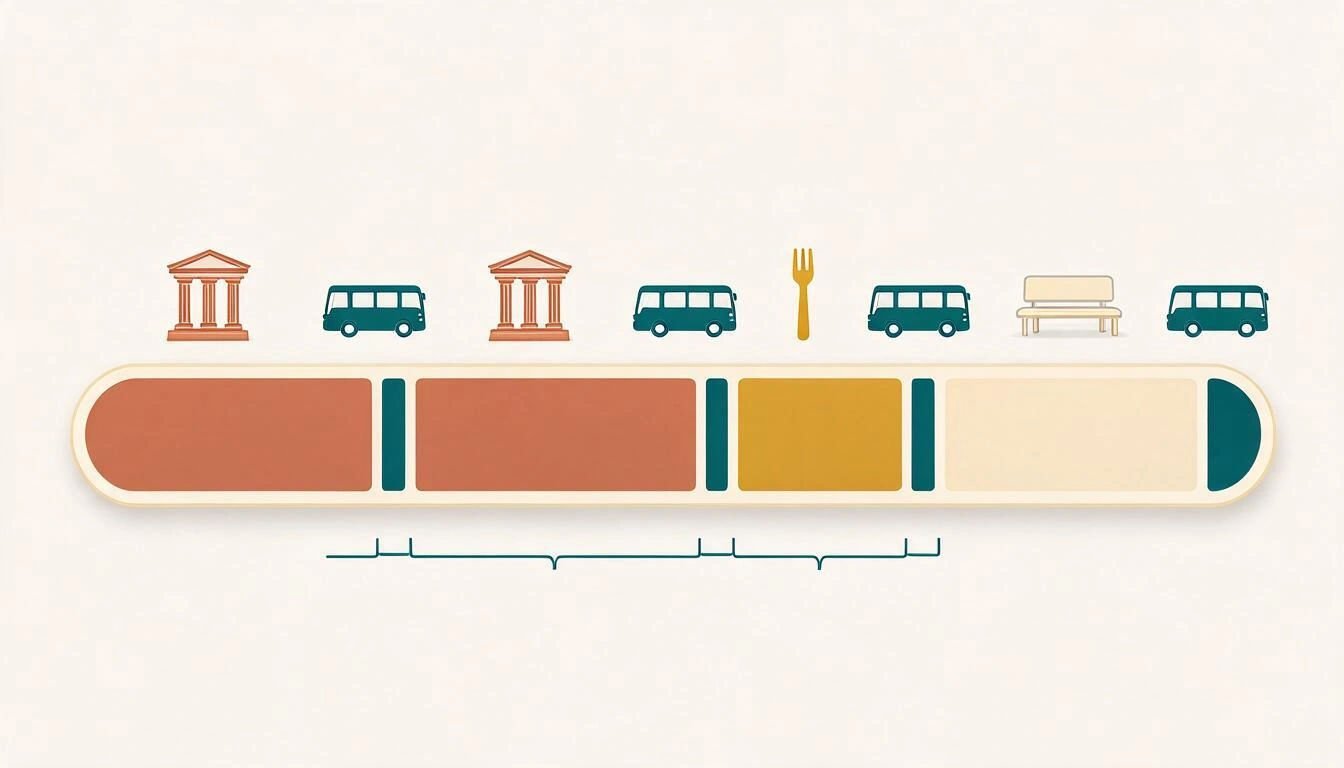
This table is a planning base —work estimates, not data from any official source— to ensure the hour budget doesn’t come from intuition:
| Day block | Minutes to reserve | Why it’s underestimated |
|---|---|---|
| Large museum (like Louvre or Prado) | 150–210 | It’s planned as "one visit" and takes half a day |
| Medium museum or house-museum | 60–90 | Room closures and cloakroom |
| Monument with timed entry | 90–120 + 20–30 for access | Access control isn’t in the brochure |
| Viewpoint, square, neighborhood | 20–40 | This block absorbs delays |
| Sit-down meal | 75–105 | With wait time for a table, it rarely goes below 75 min |
| Urban journey door to door | map time × 1.3–1.4 | Transfers, traffic lights, finding the right entrance |
| Rest or return to accommodation | 45–60 | It’s removed from the plan and ends up being taken anyway |
Practical rule: if the day adds up to more than 85% of your hour budget, it won’t fit. Remove the lowest priority stop and keep it as an alternative.
How many visits can truly fit in a day?
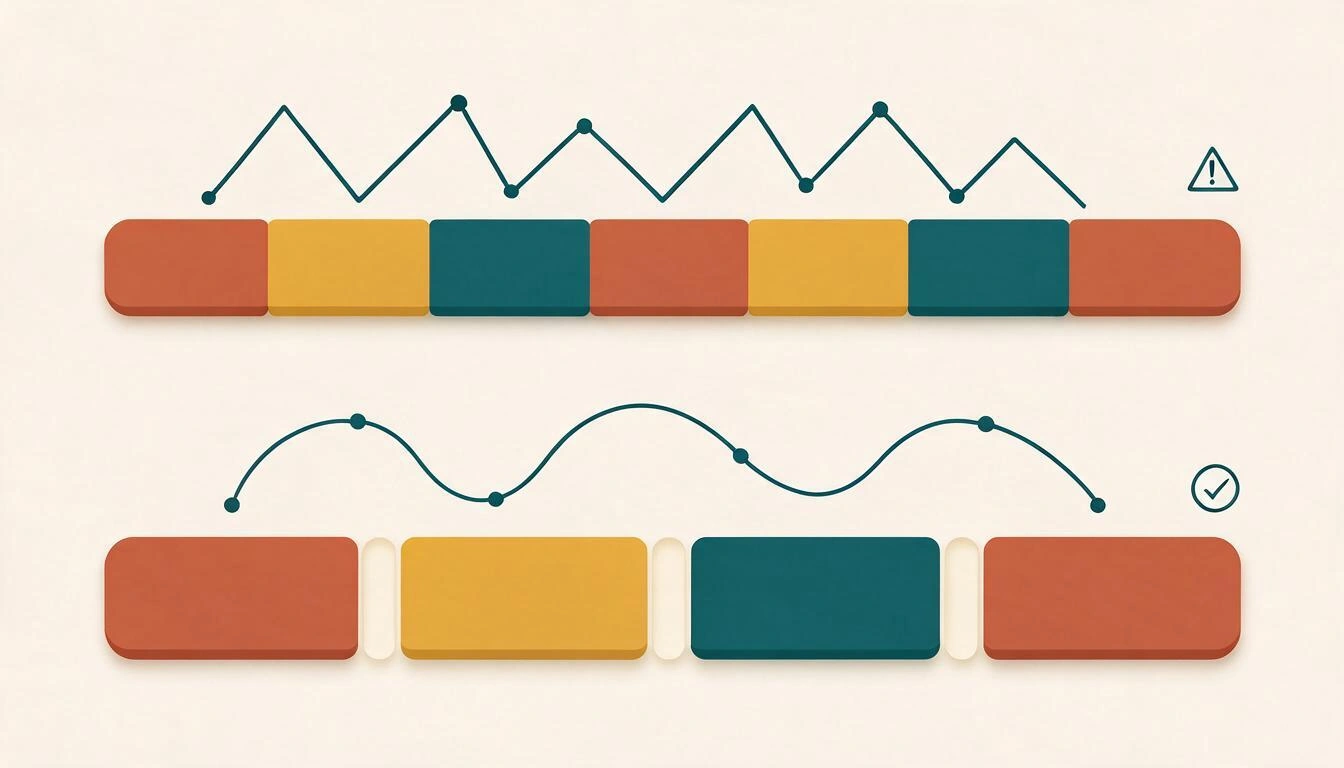
Between three and seven, depending on the pace you choose, and the difference isn’t about will but about margin. A relaxed day has about 3 stops and 6 hours of activity with a 40% margin on each trip; an intense day reaches 6 or 7 stops and 10 hours, but only works with a 10% margin, meaning everything goes well.
These are the three paces that AistoTrip uses as calculation parameters, not as decorative labels: each changes the number of stops, the hour cap, the margin added to the trips, and the time the day starts.
| Pace | Stops/day | Hours of activity | Margin on trips | Start |
|---|---|---|---|---|
| Relaxed | up to 3 | ≤ 6 h | +40 % | no earlier than 10:00 |
| Normal | 4–5 | ≤ 8 h | +20 % | 09:30 |
| Intense | 6–7 | ≤ 10 h | +10 % | 08:30 |
Two adjustments that almost nobody makes and that are very noticeable:
- Day 1 drops a level. If you arrive on a long flight or with a time change, plan the arrival as if you were on a relaxed pace, even if the rest of the trip is intense.
- With children or a multigenerational group, the pace isn’t "normal". Long museum blocks and chains of three back-to-back visits without breaks are the source of half of the days that get abandoned in the late afternoon.
What has changed in 2026: you no longer choose the time, it is assigned to you
The fundamental change in recent years is that the major monuments have shifted from a queue to a time slot with capacity. This means that your itinerary is no longer organized around what you feel like seeing first, but around the hours you have managed to secure. If you buy a ticket for a monument for 14:30, the entire day is built backwards and forwards from that time.
| Monument | Limit and access | What it implies for the plan | Source |
|---|---|---|---|
| Louvre Museum (Paris) | Capacity of 30,000 visitors/day and mandatory advance booking of time slot; 9 million visits in 2025. From January 14, 2026, €32 for visitors from outside the EEA (+45%) | Half-day block and fixed time: it is the anchor of the day | France 24 (Jan 5, 2026) and France 24 (Nov 27, 2025) |
| Acropolis (Athens) | Cap of 20,000 visitors/day and entry in one-hour slots (3,000 people in the 8:00–9:00 slot); 4,609,113 visits in 2025, about 12,600 per day | The first hour slots are the first to sell out; midday heat discourages the rest in summer | GreekReporter (Oct 14, 2026) |
| Pompeii | Named tickets and limit of 20,000 daily accesses | Must be purchased in the name of each traveler and carry identification | Parco Archeologico di Pompei |
| Sagrada Família (Barcelona) | Ticket valid only for the chosen time, named and without physical ticket office; online sale about two months in advance | Arriving late means losing the ticket: don’t schedule anything tight before | Sagrada Família, official FAQ |
And 2026 brings a textbook case of how current events drive demand: it is the centenary of Gaudí's death, the tower of Jesus Christ of the Sagrada Família was topped with the last arm of its cross on February 20, 2026, reaching 172.5 meters, Pope Leo XIV blessed the tower on June 10, and the basilica has approached five million annual visitors for the first time (CNN, Jun 8, 2026; El Debate, Mar 24, 2026). Practical translation: in a destination with anniversaries, the booking window advances by weeks.
Consequence for the method: fixed-time visits are placed first on the calendar, and the rest of the day is filled around them. It doesn't work the other way around.
Procedures and fees in 2026 that do change your plan
Two new layers affect the itinerary before leaving home: border controls and tourist taxes. The EU Entry and Exit System (EES) began to roll out on October 12, 2025, and has been fully operational since April 10, 2026, with biometric registration of nationals from third countries at the border crossing; ETIAS, the prior travel authorization, is expected in the last quarter of 2026, with a transition period before it becomes mandatory (European Commission; Hosteltur). If you are traveling with a non-EU passport, allow more time at the first crossing control.
In the fees section, 2026 has been a year of increases and new introductions:
| Destination | What is paid | Amount | From | Cap / detail | Source |
|---|---|---|---|---|---|
| Barcelona | Catalan accommodation tax + municipal surcharge | Municipal surcharge of €5 per person per night; a 5-star hotel reaches €12 (€7 + €5) | April 1, 2026 | Up to 7 nights; from 17 years old | idealista (Apr 2, 2026) |
| Venice | Contributo di accesso for one-day visitors | €5 when paid up to four days in advance; €10 in the 4 days prior | April 3 to July 26, 2026 (60 marked days) | From 8:30 to 16:00; exempt for those staying in the city; mandatory from 14 years old | Comune di Venezia |
| Edinburgh | Visitor levy on accommodation | 5% of the accommodation price, before VAT | July 24, 2026 | Limited to 5 consecutive nights | City of Edinburgh Council |
This is not legal or tax advice, and conditions change: always check the procedure and amount on the official country or municipality website before traveling. What is indeed the responsibility of the plan is to budget it: five nights in Barcelona for two people in a mid-range hotel add up to dozens of euros that were not included in the reservation price.
The 7-step method for creating a day-by-day itinerary
- Set the immovable. Arrival, departure, check-in and check-out times. Day 1 and the last day are almost never full days: treat them as half days.
- Choose the pace before the sites. 3, 4-5, or 6-7 stops. The rest of the plan depends on this number.
- Make a long list and prioritize it in three levels. Essential / I would like / if there’s time left. Without priorities, you can't cut back later, and there’s always a need to cut back.
- Book first what has a fixed time. Monuments with time slots, shows, a specific dinner. Those are the anchors.
- Group by geography, not by theme. Two museums in the same neighborhood on the same day save more time than two museums of the same style at opposite ends. And avoid zigzagging: a well-planned day draws a loop, not a star.
- Validate times by day of the week. This is the most common and costly mistake: many museums close on Mondays or Tuesdays, and summer and winter hours do not match. A "4-day" plan without real dates cannot be validated.
- Leave a written alternative for each day. A plan B for indoors in case of rain and a backup stop if something closes. An itinerary without alternatives is not an itinerary: it’s a wish.
How AI fits into all this (and what you shouldn't expect from it)
AI has become a mainstream planning tool: according to the Global Travel Confidence Index by Allianz Partners, conducted by Ipsos with 11,010 respondents in ten markets, 45% of travelers use or plan to use artificial intelligence to organize their vacations, and Spain leads Europe with 41%, ahead of France (29%), the UK (27%), and Germany (24%) (Allianz Partners, Jun 2, 2026).
What a language model does well is write and reorganize. What it does poorly, if not connected to real data, is schedules, prices, and distances: a memory-generated plan can send you to a museum on the day it closes. The difference between a generic chat and a useful travel assistant lies in whether the plan is validated against data from real sites and calculated routes, and whether you can iterate on it without starting from scratch.
That’s where AistoTrip comes in, within the AIsToHire mini-apps platform. To put it plainly, this is what it does and what it doesn’t:
| What it does | What it doesn’t do |
|---|---|
| Creates the trip with just the destination and completes it by asking (dates or number of days, travelers, type of group, interests, pace, indicative budget) | Does not buy or reserve tickets, hotels, or transportation for you |
| Resolves the destination to a real place with coordinates and country, and disambiguates repeated names | Does not replace checking the schedule on the official website the day before |
| Distributes stops among days seeking variety and calculates the fit with real routes and margins according to the pace | Does not guarantee availability: if the capacity is full, it’s full |
| If the day doesn’t fit, removes the lowest priority stop and leaves it as a backup for the day instead of silently deleting it | Does not provide legal, immigration, or tax advice on fees and visas |
| Allows iteration through conversation: change a restaurant you don’t like, shorten the trip, request another option | |
| Estimates a cost per stop and a subtotal per day to compare with your budget | |
| At the end, the create itinerary button generates the travel documentation and useful phone numbers |
That last part is what travelers with a mobile in hand appreciate the most: having the plan, the routes, and the phone numbers in one place instead of scattered across eight screenshots and an email.
Frequently Asked Questions
How many things can I see in a day without getting exhausted?
Between three and five in a European city, and three if you arrive that same day or are traveling with children. The limit is not the number of places, but the hours: about 6 hours of actual activity if you go slowly and about 8 if you go at a normal pace, including travel and food.
How far in advance do I need to buy tickets for monuments?
It depends on the monument, and the correct answer is always on its official website. As a reference, the Sagrada Família sells tickets online about two months in advance, and the ticket is only valid for the chosen time (official FAQ); at places with a daily capacity limit, such as the Louvre (30,000/day) or the Acropolis (20,000/day), the good time slots sell out faster than the rest. If you are traveling during peak season or to a destination with a special event, buy as soon as sales open.
How much time should I leave between one visit and another?
Add the time from the map and then add between 10% and 40% depending on your pace: 40% if you are going slowly and with children, 10% only if you are moving very quickly and know the transport. And never schedule two tickets with fixed times back-to-back without at least a 30-minute gap between the exit of one and the entry of the other.
Should I plan the trip with ChatGPT or with a travel app?
A generic chat is good for brainstorming and drafting, but it doesn’t know if the museum closes that Tuesday or how long it takes you door to door. For a day-by-day itinerary, you need something that validates schedules by date and calculates actual travel times; otherwise, you will end up rewriting the plan at the destination.
Do I need ETIAS to travel to Europe in 2026?
As of October 26, 2026, ETIAS is still not required: the European Commission places it in the last quarter of 2026, with a transition period before it becomes mandatory (European Commission). The EES, on the other hand, has been fully operational since April 10, 2026. Check your specific case in the official sources, as it depends on your nationality.
Is the tourist tax paid when booking or at the destination?
It depends on the city and the type of tax. In Barcelona, it is an amount per person per night that is usually charged by the accommodation; in Edinburgh, it is a 5% added to the accommodation price; in Venice, the contributo di accesso is paid by the day visitor before entering, and those who sleep in the city are exempt. Include it in the budget from the beginning: in long trips, it is not pocket change.
What do I do if it rains or my visit is canceled halfway through the trip?
Having an indoor alternative for each day is what separates a bad day from a different day. The practical thing is to reorganize only the affected day —swap the outdoor block for the museum you had reserved— instead of redoing the entire itinerary.
How many days do I need for a large European city?
For the must-sees of a large capital, three full days allow for about 12-15 stops at a normal pace, but count the arrival and departure days as half days. If the destination has a half-day museum (like the Louvre), that museum alone can take almost a whole day from the total.
Create your next itinerary without fighting with a spreadsheet
The method of this article —budgeting hours, pace over places, anchoring first what has a fixed time, validating schedules by date, and leaving alternatives— works the same in a notebook as in an app. The difference is how long it takes you and how many times you redo it. AistoTrip, the travel assistant from AIsToHire, is built on exactly these calculations: you tell it where you are going and how many days, it fills in what’s missing by asking questions, and it builds your trip day by day with routes, schedules, and alternatives, so you can keep adjusting it by talking ("not this restaurant, another one"; "in the end, I’m going one day less") until you hit create itinerary and take it with the documentation and phone numbers.
You still do the tickets, flights, and reservations on the official websites. What it saves you is the part that really burns: checking if the day fits.
Tell AistoTrip where you're going and how many days you have, and let them create a day-by-day itinerary for you — with routes, schedules, and alternatives — before you book anything.
Tell AistoTrip where you're going and how many days you have, and let them create a day-by-day itinerary for you — with routes, schedules, and alternatives — before you book anything.Keep reading
View all articles →
ETIAS 2027: when it comes into effect, how much it costs, and which travelers need it

Why Your Car Insurance Increased in 2026: Average Premium of €1,412 and Historic Record

Discussing via WhatsApp or talking in person: what science says about couple conflicts through messages