 AisDiet
How many calories should I eat per day to lose weight? The formula, the real deficit, and the table by profile
Team at AisDietWritten with AI assistance17 min readIn summary
- Your daily calories come from three steps, not one: basal metabolism (what you burn at rest), by an activity factor, and only then the deficit or surplus.
- AisDiet uses the revised Harris-Benedict formula (Roza and Shizgal, 1984), activity multipliers from 1.2 to 1.9, and a fixed deficit of 400 kcal/day to lose weight or +300 kcal/day to gain muscle. No 800 kcal diets or promises of "2 kg per week".
- 400 kcal/day is 2,800 kcal a week. With the classic equivalence of 7,700 kcal per kilogram of fat (Wishnofsky, 1958), it results in ~0.36 kg/week in theory; in practice, less, because expenditure decreases as weight drops (Hall, Int J Obes, 2008).
- The number is not the problem: the problem is knowing what you really ate. In Lichtman's study in the New England Journal of Medicine (1992), people who did not lose weight underestimated their intake by 47%.
- AisDiet turns the goal into 7 days × 4 meals with your allergies, intolerances, and preferences, and lets you correct each ingredient of the analysis by photo. It is not medical advice nor does it replace a healthcare professional.
If you have searched for "how many calories should I eat a day to lose weight", you have likely already found five calculators that give you five different numbers and none that explain what to do with them. This article solves both parts: the exact calculation, step by step, with the formula written out so you can repeat it with a calculator; and the difficult leap, which is converting that number into real food and an honest record of what you eat. The latter is precisely what AisDiet, the AI diet planning app from AIsToHire does.
A warning before you start: everything that follows is general nutrition information, not personalized medical or dietary advice. AisDiet is an app generated with artificial intelligence —that’s how you are notified when you open it for the first time— and its plans and estimates may contain errors. If you have diabetes, hypertension, an eating disorder, are pregnant, or are taking medication, the calculation in this article does not apply to you: what you need is a healthcare professional to assess you.
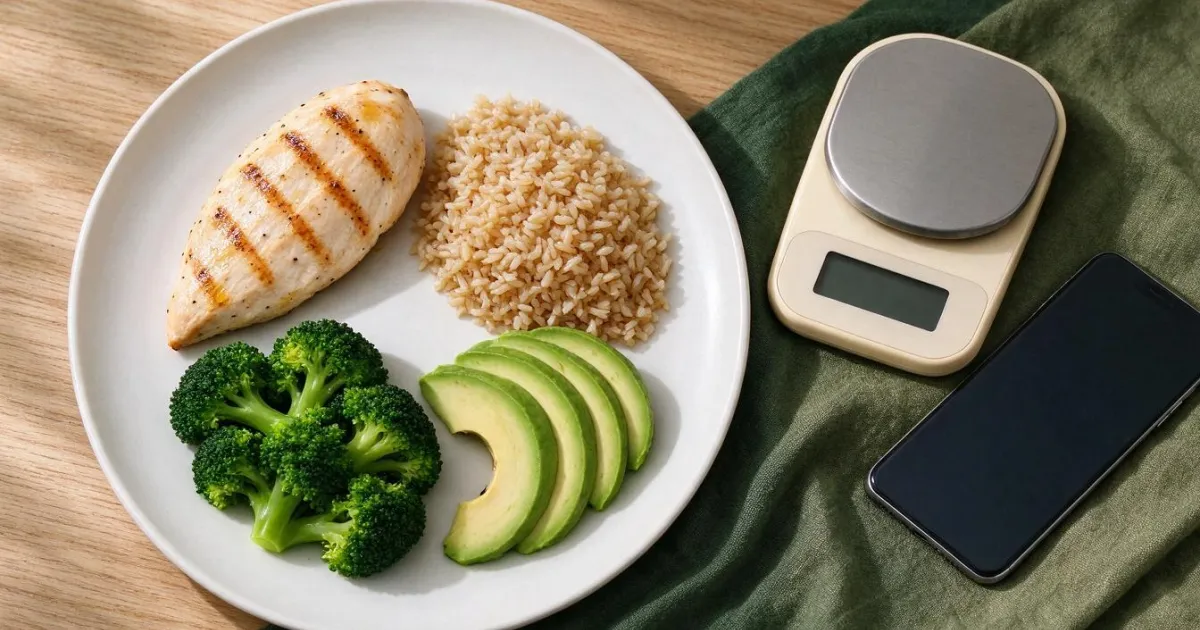
How many calories should I eat a day? The calculation has three steps, not one
Your daily calories for weight loss are calculated in three steps: first the basal metabolism (BMR), which is what you burn lying down doing nothing; then you multiply it by an activity factor to obtain the total daily expenditure (TDEE); and only at the end do you subtract the deficit. The most common mistake is skipping the second step and eating at basal, which for most people is too aggressive a diet.
The scheme is always the same:
- BMR: minimum energy to keep you alive (breathing, pumping blood, maintaining temperature). It depends on weight, height, age, and sex.
- TDEE = BMR × activity factor: adds movement, work, and exercise.
- Goal = TDEE − deficit (lose weight) or TDEE + surplus (gain muscle).
The activity factors that AisDiet applies are the classic ones from Harris-Benedict:
| Activity Level | Description | Multiplier |
|---|---|---|
| Sedentary | Office work, little exercise | ×1.2 |
| Light | Exercise 1-3 days/week | ×1.375 |
| Moderate | Exercise 3-5 days/week | ×1.55 |
| Active | Exercise 6-7 days/week | ×1.725 |
| Very active | Intense daily exercise | ×1.9 |
A note that saves disappointments: the 2,000 kcal you see on food labels are not your goal. They are the "reference intake" for an average adult set by Regulation (EU) No 1169/2011 in its Annex XIII, and are there to calculate percentages on the label, not to tell you how much you should eat.
What formula does AisDiet use and how does it differ from Mifflin-St Jeor?
AisDiet calculates basal metabolism using the revised Harris-Benedict equation (Roza and Shizgal, American Journal of Clinical Nutrition, 1984), not Mifflin-St Jeor. Both are valid population estimates, and the difference between them is usually between 3% and 6%, which is noise compared to the error of mismeasuring what you eat.
These are the two formulas, with weight in kilograms, height in centimeters, and age in years:
Revised Harris-Benedict (the one AisDiet uses)
Men: 88.362 + (13.397 × weight) + (4.799 × height) − (5.677 × age)
Women: 447.593 + (9.247 × weight) + (3.098 × height) − (4.330 × age)

Mifflin-St Jeor (1990)
Men: (10 × weight) + (6.25 × height) − (5 × age) + 5
Women: (10 × weight) + (6.25 × height) − (5 × age) − 161
What each one yields for two specific profiles:
| Profile | Revised Harris-Benedict | Mifflin-St Jeor | Difference |
|---|---|---|---|
| Woman, 35 years, 165 cm, 72 kg | 1,473 kcal | 1,415 kcal | 58 kcal (4%) |
| Man, 42 years, 178 cm, 95 kg | 1,977 kcal | 1,858 kcal | 119 kcal (6%) |
The practical conclusion: don’t change calculators looking for the "right" number. Choose one, use it for three or four weeks, weigh yourself using the same method, and adjust according to what happens on the scale. That is what turns an estimate into your real number.
How much deficit is reasonable? 400 kcal per day, and why not 1,000
AisDiet applies a fixed deficit of 400 kcal/day when you choose to lose weight, and a surplus of 300 kcal/day when you choose to gain muscle. There is no slider for "losing 1 kg per week," and it is a conscious decision: aggressive deficits are abandoned sooner and compromise protein and micronutrient intake.
The calculation of what to expect, with the numbers on the table:
- 400 kcal/day × 7 days = 2,800 kcal/week.
- The classic equivalence is 7,700 kcal per kilogram of fat tissue (Wishnofsky's rule, 1958, the famous "3,500 kcal per pound").
- 2,800 ÷ 7,700 = 0.36 kg/week, just over one and a half kilograms per month at best.
And now the honest part that almost no one writes: that linear rule overestimates long-term loss. Kevin Hall demonstrated (International Journal of Obesity, 2008) that as you lose weight, your total expenditure decreases —you weigh less, moving your body costs less energy— so the same deficit yields less and less. That’s why a real loss of 0.2-0.3 kg/week sustained over months is a normal result, not a failure.
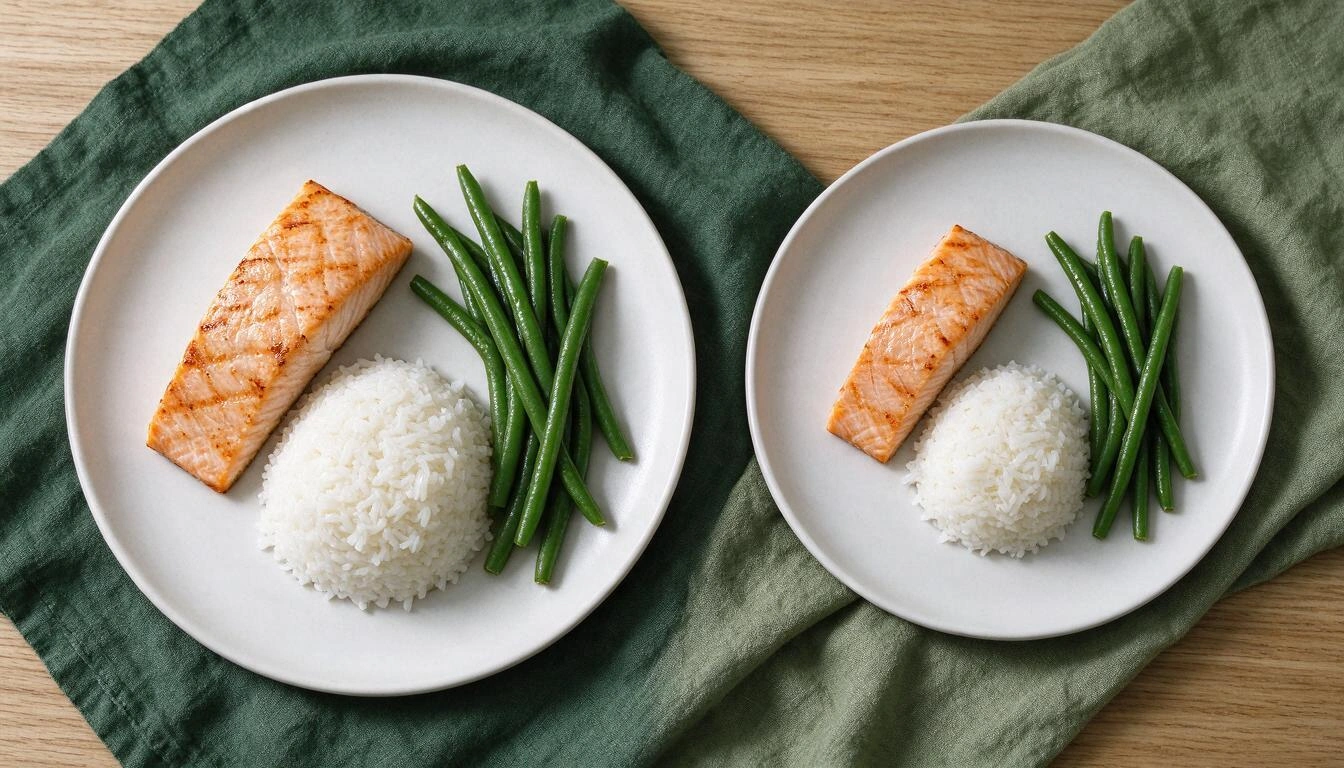
That photo is, more or less, what 400 kcal less looks like: the same plate, the same foods, slightly smaller servings. There are no forbidden foods or a list of "superfoods" behind it.
The safety floor. If subtracting the deficit causes the goal to fall below 1,200 kcal, AisDiet raises it to the minimum it applies —1,200 kcal for women and 1,500 kcal for men— and warns you before generating the plan. The clinical guidelines from the British NICE (CG189) reserve diets below 800 kcal/day for programs with clinical supervision and for a maximum of 12 consecutive weeks. If your calculation gives you such a low number, the problem is not the calculator: it’s that you need a professional.
Table: what AisDiet calculates for four real profiles
These four examples are calculated with the exact formulas that the app runs, so you can compare your case without installing anything. The distribution of macronutrients depends on the goal: losing weight uses 35% protein / 35% carbohydrates / 30% fats; maintenance, 25/45/30; gaining muscle, 30/45/25.
| Profile | Activity | Goal | BMR | TDEE | Target calories | Protein | Carbs | Fats |
|---|---|---|---|---|---|---|---|---|
| Woman, 35 y.o., 165 cm, 72 kg | Moderate (×1.55) | Lose weight | 1,473 | 2,283 | 1,883 kcal | 165 g | 165 g | 63 g |
| Man, 42 y.o., 178 cm, 95 kg | Sedentary (×1.2) | Lose weight | 1,977 | 2,372 | 1,972 kcal | 173 g | 173 g | 66 g |
| Woman, 28 y.o., 160 cm, 55 kg | Light (×1.375) | Maintain | 1,331 | 1,830 | 1,830 kcal | 114 g | 206 g | 61 g |
| Man, 30 y.o., 180 cm, 70 kg | Active (×1.725) | Gain muscle | 1,720 | 2,966 | 3,266 kcal | 245 g | 367 g | 91 g |
Notice the second case: a sedentary man weighing 95 kg ends up with a nearly identical target to that of a woman weighing 72 kg who trains four days a week. The activity factor weighs as much as the body, and it’s the reason why copying someone else’s diet doesn’t work.
Look at your grams of protein per kilo before trusting the percentage
A macro distribution in percentages can give a very odd protein figure when your weight and your calories don’t align. The check you should always do is to divide the grams of protein by your kilos: the usual reference for maintaining muscle mass in a deficit is around 1.6 g/kg/day, the point at which the benefits stop increasing according to the meta-analysis by Morton and colleagues (British Journal of Sports Medicine, 2018).
Applied to the same four profiles from the previous table:
| Profile | Plan Protein | Weight | Protein per kilo | Reading |
|---|---|---|---|---|
| Woman, 72 kg, lose weight | 165 g | 72 kg | 2.3 g/kg | Above the reference |
| Man, 95 kg, lose weight | 173 g | 95 kg | 1.8 g/kg | Within range |
| Woman, 55 kg, maintain | 114 g | 55 kg | 2.1 g/kg | Above the reference |
| Man, 70 kg, gain muscle | 245 g | 70 kg | 3.5 g/kg | Well above: check it |
The last case is the perfect example of why it’s wise to look at the number and not the percentage: 3.5 g/kg is much more than any consensus considers useful. If you get something like this, it’s reasonable to adjust the profile (activity, goal) and, if you have any renal or hepatic condition, consult it with a healthcare professional first. In AisDiet, the goals are recalculated when you change your data in Settings —weight, activity, or goal— and the app shows you the new number before saving.
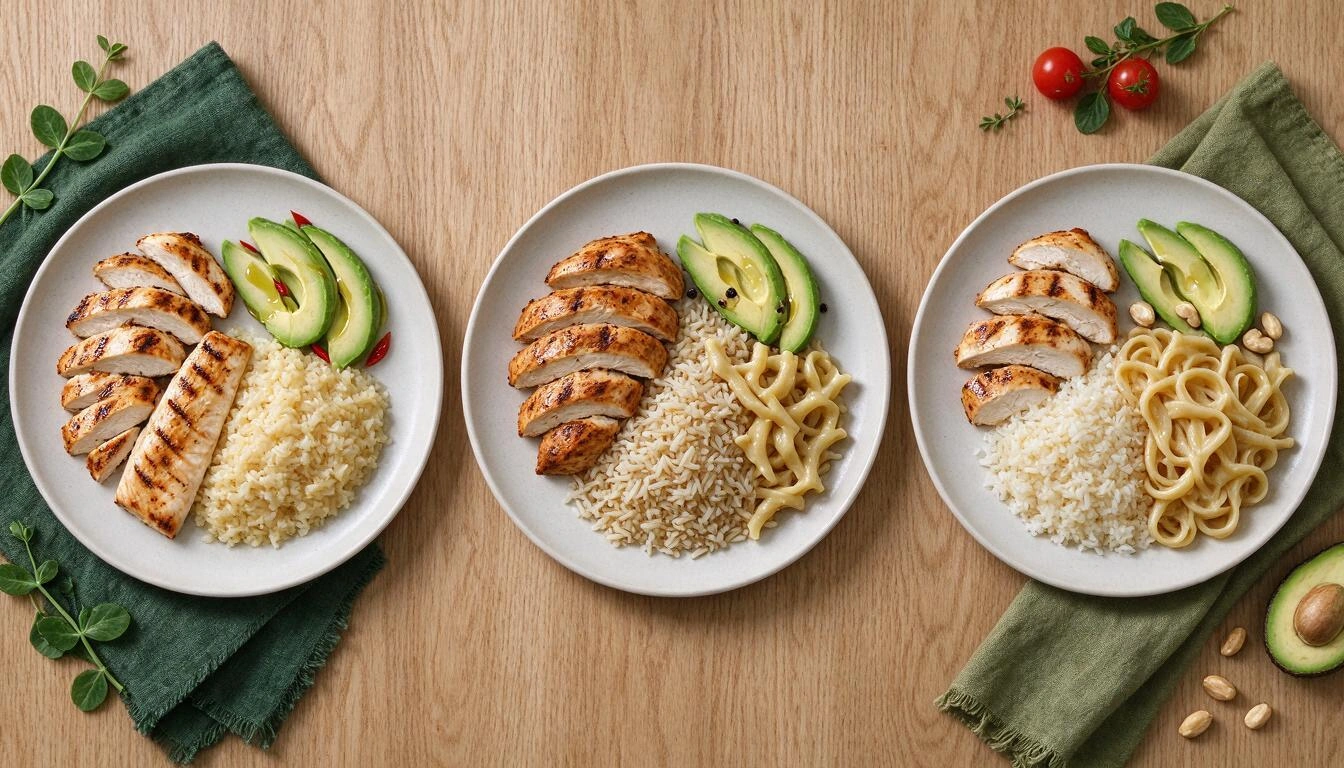
The number is useless if you don't know what you ate: the underreporting problem
This is where almost all diets break down. In the classic study by Lichtman and colleagues (New England Journal of Medicine, 1992), a group of people convinced that "they weren't losing weight by eating very little" was measured with doubly labeled water: they underestimated their actual intake by 47% and overestimated their physical activity by 51%. They weren't lying: they didn't know.
That's why keeping a record matters more than the calculator. And that's why AisDiet records food from a photo: you open the scanner, take a picture of the plate, and the AI returns the breakdown ingredient by ingredient.

What the analysis returns, exactly:
- Name of the dish (editable).
- Each detected ingredient with its estimated amount in grams (or in ounces and cups if you use imperial units).
- Calories, protein, carbohydrates, and fats of each ingredient separately.
- A confidence percentage for each ingredient, which the app colors: green from 90%, yellow from 80%, orange below.
And most importantly: everything can be corrected before confirming. You can change the amount, edit the calories or macros of any ingredient, remove what the AI has invented, and manually add what isn't visible in the photo. That last part is the real limit of any food scanner: the oil from the pan, the sugar from the sauce, or the butter in the sauté doesn't show up in the image. If you've cooked with two tablespoons of oil, add them yourself; that's about 240 kcal that no photo will capture.
One operational detail worth knowing: only the meals you have scanned or recorded count for the day. The weekly plan is a proposal; seeing a dish in the planner does not add calories or points until you register it.
How AisDiet turns your goal into seven days of real food
Once you have the number, AisDiet generates a plan of 7 days with 4 meals each —breakfast, lunch, snack, and dinner: 28 dishes— built around your calories and macros, with a margin of ±10% in calories and ±15% in macronutrients, and with the rule of not repeating the same dish more than twice in the week.
What the app takes into account when generating it, which you have configured during registration:
| Profile data | How it's used in the plan |
|---|---|
| Allergies | Critical restriction: any ingredient containing or derived from them is prohibited |
| Intolerances | Avoided (lactose, fructose, histamine, FODMAP, gluten sensitivity, or any you specify) |
| Health conditions | Declared in the profile and transferred to the plan (diabetes, hypertension, cholesterol, uric acid…) |
| Foods you like | Prioritized |
| Foods you dislike | Not included |
| Rated dishes | Those you mark with "like" generate similar dishes; those you mark with "dislike" won't appear again |
And what you can do about the already generated plan:
- Regenerate a specific dish without touching the rest of the day.
- Mark a dish as "dislike": in addition to saving it for the future, the app replaces that dish right there.
- Request the recipe for any dish: ingredients with amounts for one person, numbered steps, and a final tip. It is generated on demand and cached for 30 days, so opening it again is instantaneous.
- Track your weight: weight log with trend graph, calculated BMI, and progress photos.
- Ask the AI assistant within the app itself: it can consult your profile, today’s date, your plan, your recipes, and your weight progress, and can also record a meal or weight for you, always asking for your confirmation before writing anything.
When the plan reaches its last day, the app generates the next week's plan with your updated data.
The daily score of 100 points: what it measures exactly
AisDiet scores each day from 0 to 100 distributed across five blocks. It's not a moral grade: it's a way to see at a glance what part of your day has deviated, because it's not the same to exceed calories as it is to fall short on protein.
| Block | Maximum | How to achieve it |
|---|---|---|
| Calories | 30 pts | 30 if you are within ±10% of the target; 20 at ±20%; 10 at ±30%; 0 outside |
| Protein | 25 pts | 25 if you reach 90% of the target; 15 from 70%; 8 from 50% |
| Macro quality | 20 pts | 20 if carbohydrates and fats are between 80% and 120%; 12 if only one; 5 if neither |
| Consistency | 15 pts | 15 if you register all meals of the day; 12 from 75%; 8 from 50% |
| Streak | 10 pts | 10 with 7 days or more of streak; 7 from 3 days; 4 with 1 day |
That is: 90 of the 100 points depend solely on what you eat and record today. From 80, the app labels it as "Excellent"; below 40, as "Needs improvement".
What AisDiet DOES NOT do (and when you should see a professional)
AisDiet plans meals and estimates nutrients; it does not diagnose, treat diseases, and does not replace a dietitian-nutritionist or your doctor. The app itself warns you in a notice that you must accept the first time you open it: it is generated with artificial intelligence, any data displayed may contain errors, and important decisions should be consulted with qualified professionals.
To avoid surprises, here is what the app does not include today:
- It does not weigh your food for you. Everything it calculates from a photo is an estimate; the kitchen scale is still more accurate.
- It does not read barcodes of packaged products.
- It does not track micronutrients. It monitors calories, protein, carbohydrates, and fats; not vitamins, minerals, fiber, or sodium.
- It does not connect with bracelets, watches, or activity apps. Your expenditure comes from the activity factor you declare, not from your actual steps.
- It does not put you in touch with a human nutritionist. The plan and the responses are generated by an AI.
- It does not promise a result. Neither weight, nor deadlines, nor "lose X in Y weeks".
And the cases in which you should bypass the calculator and make an appointment directly: pregnancy and lactation, diabetes with medication, kidney or liver disease, history of eating disorders, bariatric surgery, or any situation where a professional has already prescribed you a diet.
Frequently Asked Questions
How many calories should I eat a day to lose weight?
It depends on your weight, height, age, sex, and, above all, your activity level. The calculation is: basal metabolism × activity factor (from 1.2 to 1.9) − deficit. AisDiet applies a deficit of 400 kcal/day, which for a 35-year-old woman, 165 cm, 72 kg, and moderate activity gives 1,883 kcal/day. For a 42-year-old man, 178 cm, 95 kg, and a sedentary lifestyle, 1,972 kcal/day.
Is it true that 1,200 calories a day is the minimum?
1,200 kcal for women and 1,500 kcal for men is the floor that AisDiet applies: if your count goes below that, the app raises the target and notifies you. It is not a biological law, it is a prudent common usage limit. Diets below 800 kcal/day are reserved, according to NICE guidelines (CG189), for programs with clinical supervision and a maximum of 12 weeks.
How much weight will I lose with a deficit of 400 kcal a day?
In theory, about 0.36 kg per week: 2,800 kcal weekly divided by the 7,700 kcal that equals one kilogram of fat. In practice, less, because total expenditure decreases as you lose weight. No one, neither this app nor any other, can guarantee you a figure.
Why does each calculator give me a different number?
Because they use different formulas. The revised Harris-Benedict (the one AisDiet uses) and Mifflin-St Jeor differ between 3% and 6% for the same profile, and the activity factors are rough estimates. Choose one, stick with it for three or four weeks, and adjust with what the scale shows: your real number is the one that is verified, not the one that is calculated.
Do calorie-counting apps with a photo really work?
They help you go much faster than writing everything down by hand, but they are estimates. They identify visible ingredients well and fail with the invisible: cooking oil, sugar from sauces, butter. That’s why AisDiet shows a confidence percentage per ingredient and lets you edit amounts, correct macros, delete what doesn’t belong, and add what the camera doesn’t see before confirming.
Can I use it if I am vegetarian, celiac, or have allergies?
Yes. Upon registration, you indicate allergies (and you can write those not on the list), intolerances, health conditions, foods you like, and foods you don’t want to see. Allergies are included in the plan as critical restrictions. Still, always check the ingredients of each dish: it is AI-generated content and may be incorrect, and in the case of a severe allergy, the error is unacceptable.
Do I have to mark the meals in the plan for them to count?
Meals count towards your totals and your score when you register them: by scanning the photo of the dish or asking the app's AI assistant. Seeing the dish in the planner does not count by itself; the plan is the proposal, the registration is what measures your day.
How often do I need to recalculate my calories?
When something that goes into the formula changes: weight, activity level, or goal. As a practical reference, review it every 4-6 kg lost or every two or three months, because expenditure decreases as weight decreases. In AisDiet, it is enough to update your data in Settings: the goal and macros are recalculated, and the app offers to regenerate the plan.
Does AisDiet replace a nutritionist?
No. It is a planning and tracking tool generated with AI. It does not diagnose, does not treat diseases, and does not replace the assessment of a dietitian-nutritionist or your doctor, especially if you have a pathology, are pregnant, or taking medication.
AisDiet is the AIsToHire app that calculates your daily calories and macronutrients, generates a weekly plan of 7 days with 4 meals adapted to your allergies and preferences, and records what you eat from a photo of the dish with an editable ingredient breakdown. It is available at AisDiet - Easy Diet Management and works in the mobile browser, without installing anything. What it does not do, and it is worth repeating, is replace a healthcare professional: counting calories is mathematics, but your health does not fit into a formula.
Calculate your calories with AisDiet and turn them into a 7-day plan
Calculate your calories with AisDiet and turn them into a 7-day planKeep reading
View all articles →
How much protein do you need per day with Ozempic or Mounjaro (and how to distribute it in 3 meals)

Why Your Car Insurance Increased in 2026: Average Premium of €1,412 and Historic Record

Discussing via WhatsApp or talking in person: what science says about couple conflicts through messages