 Aiscoloring
Less than an hour of screen time before age 5: what changes at home with the 2026 guidelines
Team at AiscoloringWritten with AI assistance16 min readIn summary
- On March 27, 2026, the British Government published its first official guide on screens for children under 5 years old: no screens before 2 years old (except for shared activities with an adult) and a maximum of one hour a day between 2 and 5, "less if possible".
- The guide adds three contextual rules that matter as much as the clock: no screens during meals, none in the hour before sleep and screen-free bedrooms.
- The World Health Organization has said almost the same since April 2019; the Spanish Association of Pediatrics is stricter: zero screens until 6 years old.
- The weak point is not the figure, it's the replacement: the official guide itself proposes "screen swaps" and names coloring among the alternatives for meals.
- The British guide also recommends not allowing children under 5 to use toys, tools, or AI chatbots until more evidence is available. This does not affect an adult using a tool to print an activity on paper: the child colors on paper, without a screen in front.
If you have a child between 1 and 6 years old, March 2026 changed the framework of the conversation: for the first time, a European government set a specific figure —one hour— for the screen time of preschoolers. The practical question is not whether the figure is reasonable, but what do you fill that hour with that you take away while the pasta boils or you enter a meeting. This article reviews what the three major references (UK, WHO, and AEP) say exactly, what each rule implies in a real home, and what alternatives work in the three impossible moments. At AIsToHire, we maintain Aiscoloring, a tool that generates coloring drawings from a description and prepares them for printing, so the "paper replacement" is exactly the problem we are interested in.
What the new British guide of March 2026 says exactly
On March 27, 2026, the British Department of Education and the Department of Health published on the Best Start in Life portal a guide for families with children under 5 years old with two limits: for children under 2 years old, "avoid screen time except for family-shared activities that promote bonding, interaction, and conversation"; for 2 to 5 years old, "try not to exceed 1 hour a day. Less if possible". The text was developed by a panel of experts (the Early Years Screen Time Advisory Group) co-led by the Children’s Commissioner, Rachel de Souza, and pediatrician Russell Viner.
It is not a rule or a law: it is guidance for families and healthcare professionals, also distributed through Family Hubs. The official announcement justifies it with a developmental argument: 90% of brain growth occurs before the age of 5, and at those ages, learning occurs primarily through warm and receptive interactions with adults.
The rules that accompany the figure are, in practice, the ones that most change day to day:
- Meals without screens, to protect family conversation.
- Not one hour before sleep, because it may affect sleep.
- Screen-free bedrooms.
- Watch together whenever possible: co-viewing is associated with better cognitive development and allows for content filtering.
- Slow and predictable content is better than fast and overstimulating social media-style videos.
- No background screens, especially during meals, play, or family time.
- No social media or AI: "social media is not made for young brains" and recommend not allowing young children to use toys, tools, or AI chatbots until there is more evidence.
- Explicit exception for screen support technology in children with special educational needs or disabilities: there, the limits do not apply the same way.
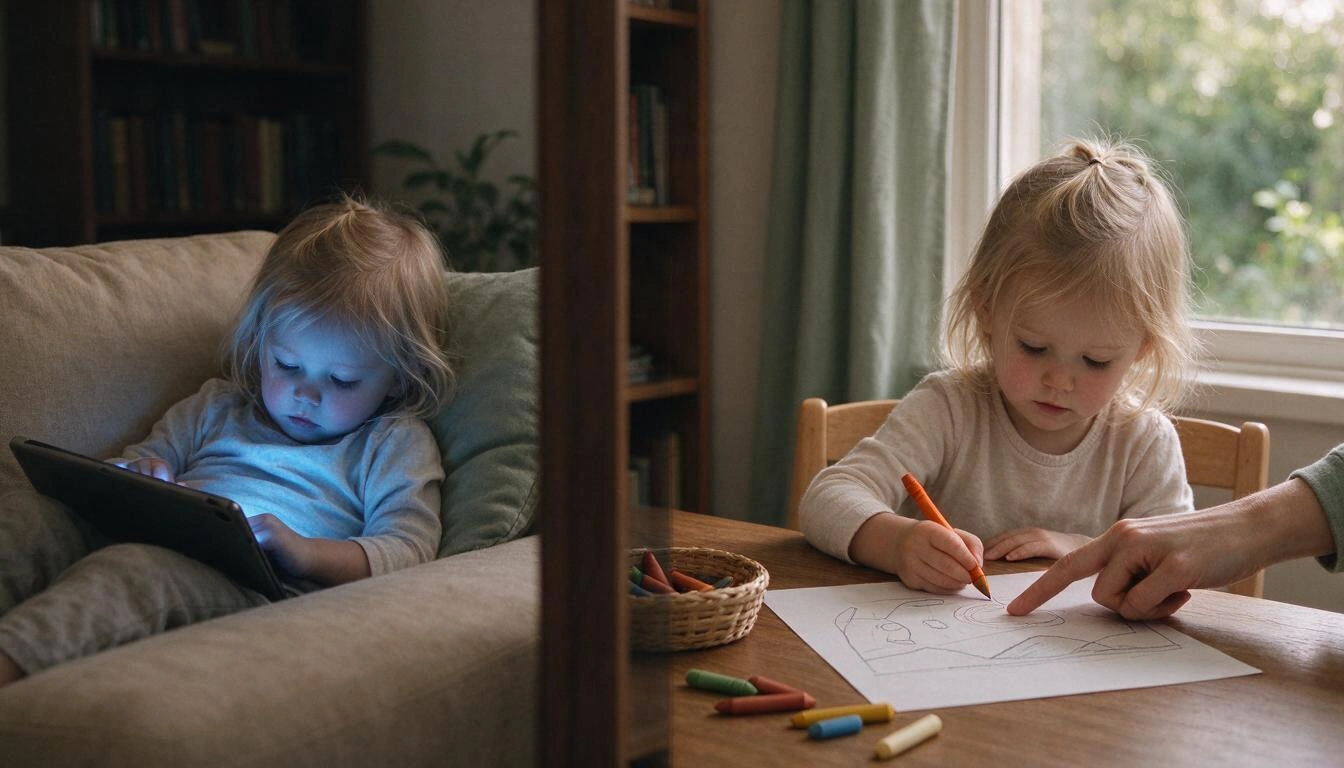
Table: screen time by age according to WHO, AEP, and British guidelines
The three references do not contradict each other: they agree on the direction and differ in tone. WHO and the UK set one hour starting at age 2; Spanish pediatrics goes further and advises against any recreational screen time until age 6. Here is the comparison by age groups:
| Age | British guideline (Mar-27-2026) | WHO (Apr-2019) | AEP (Mar-2025) |
|---|---|---|---|
| 0-12 months | Avoid; only shared activity with an adult | Not recommended | Avoid |
| 1 year | Avoid; only shared activity | Not recommended | Avoid |
| 2 years | Max. 1 h/day, "less if possible" | Max. 1 h/day, "less is better" | Avoid |
| 3-4 years | Max. 1 h/day | Max. 1 h/day (sedentary screen time) | Avoid |
| 4-5 years | Max. 1 h/day | Out of reach (the guideline goes up to 4) | Avoid |
| 5-6 years | Out of reach (goes up to 5) | Out of reach | Avoid until 6 |
| 7-12 years | Not covered | Not covered | Less than 1 h/day, including homework and school use |
| 13-16 years | Not covered | Not covered | Less than 2 h/day, including school time |
And these are the cross-cutting rules, where the 2026 guideline contributes more than just a number:
| Rule | British guideline 2026 | WHO 2019 | AEP 2025 |
|---|---|---|---|
| Screen-free meals | Yes, explicit | Does not address it | Yes |
| Screen-free hour before sleep | Yes, explicit | Protects sleep: 11-14 h (1-2 years) and 10-13 h (3-4 years) | Yes |
| Bedroom without devices | Yes | Does not address it | Yes (restricts bedrooms and bathrooms) |
| Watch together / adult supervision | Yes, recommended | Does not address it | Yes |
| Screens off in the background | Yes | Does not address it | Does not detail |
| AI and social media in preschool | Avoid until more evidence is available | Does not address it | Does not detail for 0-6 |
| Support technology (NEAE) | Explicit exception | Does not address it | Does not detail |
WHO does not treat screen time as an isolated problem, but as a distribution of 24 hours: replacing sitting time with active play (minimum 180 minutes daily from 1 to 4 years) and protecting sleep. That is the key to understanding the 2026 guidelines: it is not about reducing screen time, it is about what fills that gap.
In Spain, there is also a third framework: the committee of 50 experts convened by the Ministry of Youth and Childhood delivered a report in December 2024 with 107 measures that, according to the press, recommends zero screens from 0 to 3 years and advises against digital devices from 3 to 6, except for occasional needs and under adult supervision.
Why the guideline insists so much on children under 2 years
Because before the age of 2 the problem is not the content, it is the displacement: every minute of solo screen time is a minute not spent on face-to-face interaction with an adult, which is the main mechanism of learning at that age. That is why the British guideline does not state "one hour" for those under 2: it states "avoid," and opens the only exception for shared use.
The guideline specifies what counts as acceptable shared activity: video calls with family and friends, or looking at digital photo albums together. That is, the screen as a conversation object, not as autonomous entertainment.
The data that explains the urgency comes from real consumption. The report Children and parents: media use and attitudes by Ofcom, published on May 21, 2026, measured for the first time screen use in children under 2 years: 85% of families say their child aged 6 months to 2 years watches some screen and 65% say they connect to the internet. Among 3 to 5 year-olds, 84% connect.
What "one hour a day" means in the daily life of a household
It means, in most homes, cutting back between one and two hours. In Spain, the report Screens, childhood, and adolescence in Spain by the Gasol Foundation, presented in September 2026 based on data from the PASOS study, estimates the average for children and adolescents at 215.5 minutes daily (187 on weekdays and 287 on weekends), with seven out of ten exceeding the maximum recommended of 120 minutes.
Translated to a day with a 3-year-old, a well-spent hour looks like this:
| Time of day | What usually happens | What the 2026 guideline asks for |
|---|---|---|
| Breakfast and departure | Short videos while getting dressed | Screen out of the table; background music or conversation |
| Mid-morning / park | — | Active play (WHO asks for 180 min/day from 1 to 4 years) |
| Lunch | Drawings on the tablet to eat | Table without screens; board games, coloring, "I spy" |
| Afternoon: cooking or working | 40-60 min of screen time as a babysitter | This is the real gap: here goes table activity |
| After dinner | One more episode | Last hour of the day without screens |
| Sleep | Device in the room | Bedroom without screens; shared story |
The important distribution is that of the right column: the allowed hour is more useful before the afternoon, because the time frame from 6:00 PM to 8:30 PM directly conflicts with the rule of the hour before sleep.
The three difficult moments: cooking, remote working, and waiting
These are the three moments when the screen wins, and none is solved by willpower: it is solved by having a prepared table activity, independent and lasting 20-30 minutes, that does not require an adult to be hovering. This is what works in each case.
While cooking (20-40 min). You need the child to be in sight, seated, and occupied. The following work: coloring a large sheet with few shapes, stickers, modeling clay on a tray, sorting legumes by color in egg cartons, or giving them a real cooking task (washing leaves, peeling mandarins). What does not work: anything that requires reading instructions.
While remote working (45-90 min). The problem here is the duration, not the initial engagement. The tactic that holds up best is to chain two or three different activities in a pre-prepared "station": a coloring sheet, a second more detailed sheet in case the first runs out, and a construction game. Preparing the materials the night before makes the difference between 60 minutes of calm and a tablet in 10 minutes.
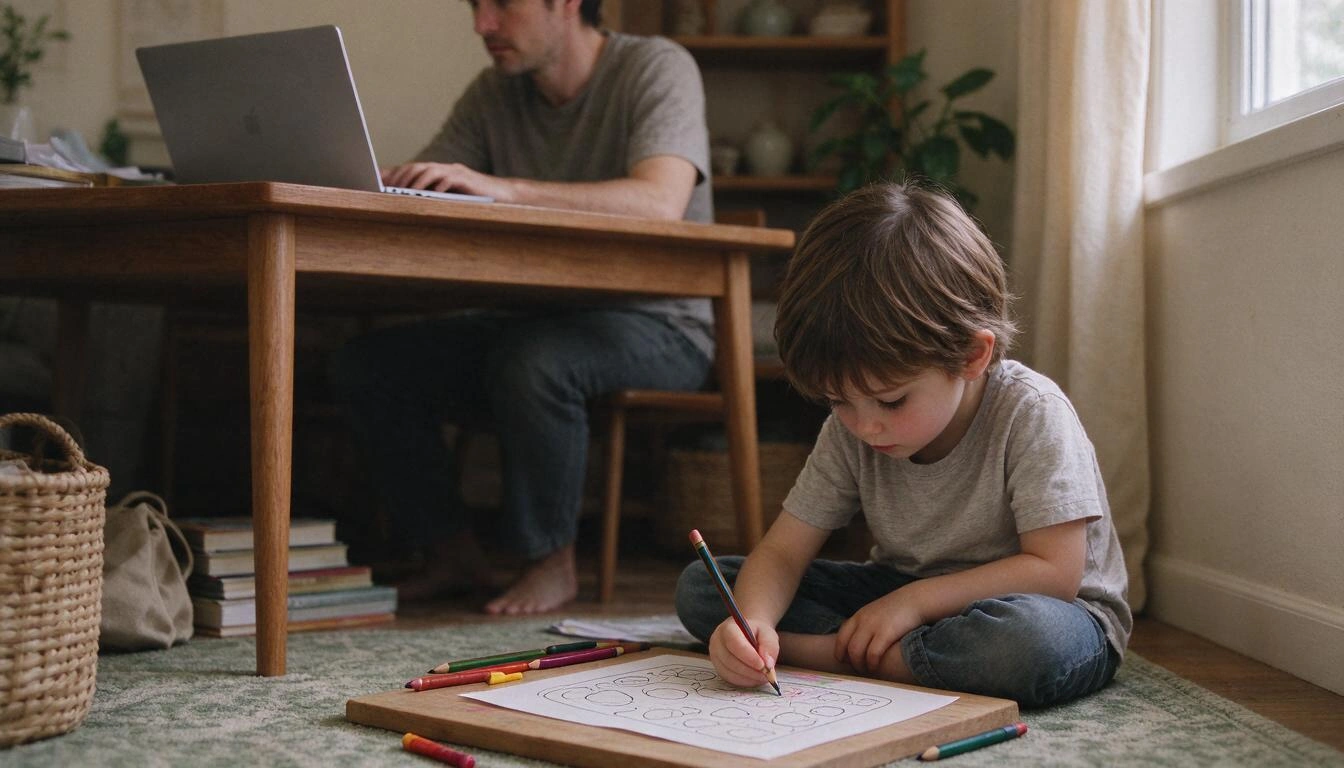
Waiting: doctor, restaurant, train (10-45 min). This is the toughest case because you do not control the environment or the time. What fits in a bag: a folder of folded printed sheets, a flat case with 6 thick crayons (not 24: they fall out), a sticker book, and a set of picture cards. The advantage of paper in a waiting room is twofold: it does not need batteries or wifi, and it does not generate the fight of "one more" when taken away.
The cross-cutting rule: do not remove the screen without offering the swap in the same gesture. The British guide calls this screen swap and explicitly suggests, for meals, "background music, simple conversation, board games, coloring, or even I spy with colors or letters," and for the night, reading stories together.
Why coloring appears in the official guide as a substitute
Because it meets the four conditions needed for a screen swap in preschool: it is independent (the child does not need an adult next to them), it is long (holds attention for 15-30 minutes), it is a table activity (compatible with cooking or working alongside), and it is zero screen. It is not a coincidence that the British Government's guide literally names it among the screen swaps for meals.
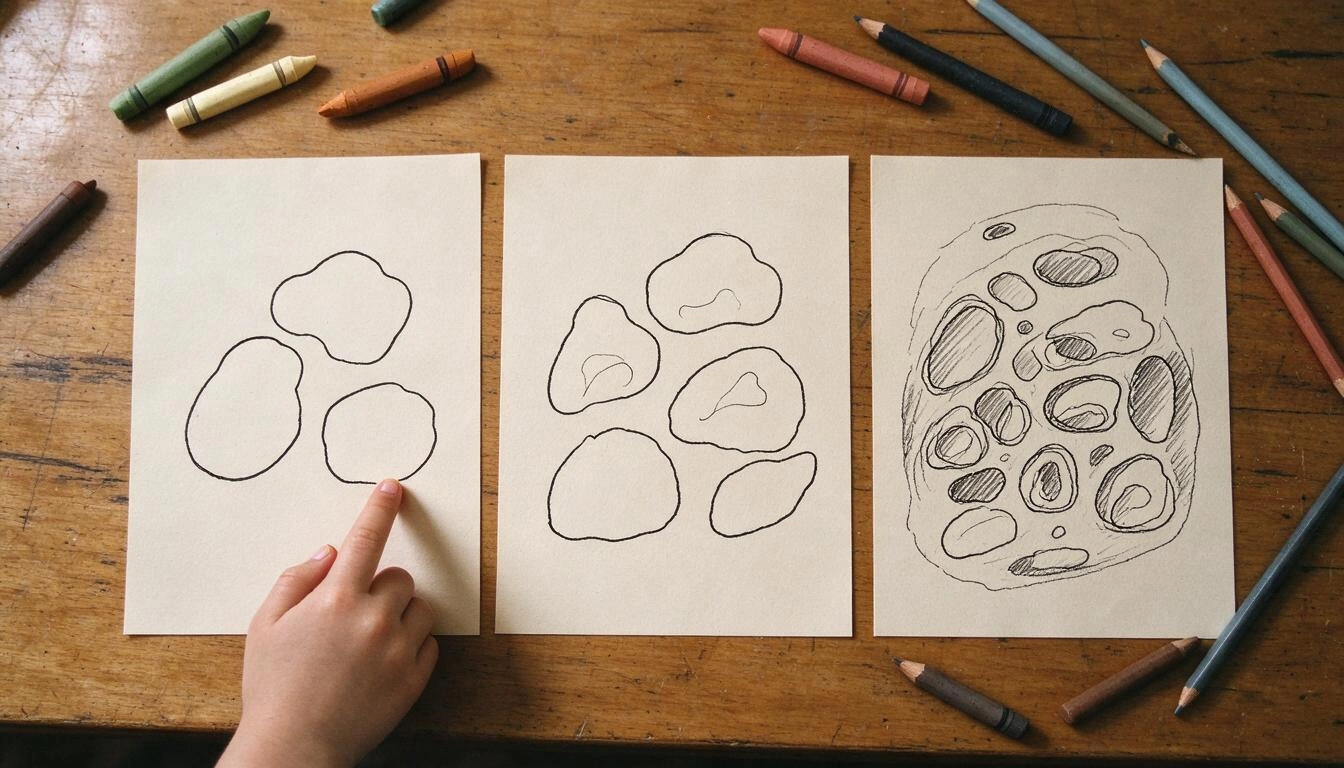
The condition for it to work is age appropriateness, and this is where most downloaded sheets from the internet fail: a sheet with 30 fine elements frustrates a 3-year-old in two minutes, and one with four thick shapes bores a 7-year-old in the same time. The useful progression is: few large shapes and thick lines at ages 2-4; simple scene with a simple background at ages 5-7; detail and depth from age 8.
Here, an honest clarification is necessary, because the same 2026 guide asks not to let children under 5 use toys, tools, or AI chatbots until there is more evidence. That recommendation speaks of the child interacting with a screen or device. Generating a sheet is a task for the adult that takes a minute and ends at a printer: what reaches the child is a black and white sheet and a box of crayons. If the child does not touch the device, there is no screen time for the child to count.
The criticisms: is an hour a day realistic in 2026?
The main objection is not to the figure, but to the viability. The Education Policy Institute, on March 27, 2026, pointed out two specific gaps: the guide says nothing about how to manage a preschooler's screen time when there are older siblings at home, nor about how to maintain a common standard among different caregivers (grandparents, babysitters, nursery school).
The EPI adds an argument worth keeping in mind: if the recommendations prove difficult to apply in modern life, the net effect may be more family stress, and stress also harms parenting and development. In the advisory group's report, the consulted families asked for advice on "how to use screens better, rather than setting unhelpful and unrealistic standards."
The practical takeaway: treat the hour as a weekly trend goal, not as a daily counter that gets violated. Reducing from an average of 150 to 90 minutes is a real change; failing on Tuesdays does not invalidate the week.
How to choose the right difficulty level according to age
Choose by motor skill, not by thematic interest: a 3-year-old may be obsessed with dinosaurs and still need a dinosaur with eight thick lines. The operational rule is the minimum size of the enclosed areas: if an area is smaller than the footprint of their finger, they will go outside and get frustrated.
| Age | Appropriate complexity | Sign that you got it right |
|---|---|---|
| 2-4 years | 3-4 large elements, very thick lines, no background | Fills in without going outside too much and goes back for another |
| 5-7 years | 6-8 elements, simple background | Chooses colors on purpose and finishes the sheet |
| 8-10 years | 10-15 elements, background with depth | Asks for a specific scene and takes care of it |
| 11-14 years | 15-25 elements, complete background | Spends 30 minutes without getting up |
| Adult | Mandala or zentangle | Uses it as a break, not as a task |
If you generate the sheet from a description, the age parameter translates "a friendly dragon" into three thick lines or into a scene of twenty elements. In Aiscoloring that selector is mandatory for that reason: the same idea produces very different results depending on the age range, and getting the range right is the difference between 25 minutes of calm and an abandoned sheet.
Frequently asked questions
How much screen time can a 2-year-old have in 2026?
A maximum of one hour a day, and less if possible, according to the official British guide published on March 27, 2026, and the WHO recommendations from April 2019. The Spanish Association of Pediatrics is more restrictive and recommends avoiding screens altogether until age 6.
Do video calls with grandparents count as screen time?
Not in the same sense. The British guide expressly cites video calls with family and friends as one of the acceptable shared activities even for those under 2 years old, because they involve interaction and conversation with an adult rather than passive consumption.
Is it mandatory to follow the British guide if I live in Spain?
No. It is not a legal norm in the UK: it is guidance for families and healthcare professionals. In Spain, the clinical reference is the AEP Family Digital Plan, updated in March 2025, which recommends avoiding screens until age 6.
What should I do if my young child has older siblings with a tablet?
This is precisely the gap that the Education Policy Institute pointed out in the guide on March 27, 2026: the document does not address it. In practice, the two levers left are to separate time slots (older children's screen time when the little one is not in the room) and to avoid background screens being left on, which the guide does mention expressly.
Why should I avoid screens an hour before bedtime?
Because it can affect sleep, according to the 2026 guide, and sleep is the other major goal of these recommendations: the WHO asks for 11 to 14 hours of quality sleep between 1 and 2 years and 10 to 13 between 3 and 4, including naps. This is the rule with the most consensus among the three references.
Is it okay to use an AI app to entertain a 3-year-old?
The British guide recommends not letting children under 5 use toys, tools, or AI chatbots until there is more evidence, and that includes smart speakers and chat apps. It is different if the adult uses a tool to prepare material that will end up on paper: there the child does not interact with any device.
How long can a young child color?
It depends more on the fit to their age than on their character: with an appropriate sheet, between 15 and 30 minutes in preschool. With a sheet that is too detailed, less than five. That is why the level of detail is the parameter that is most important to get right.
What should I carry in my bag for a waiting room without a phone?
Printed sheets folded in a thin folder, a flat case with six thick crayons, a sticker notebook, and a set of picture cards. Paper does not need battery or coverage and, when removed, does not provoke the typical negotiation of "one more video".
How to start this week without fighting with anyone
Don't try to go from two hours to one in a day. Choose one single moment —usually cooking time— and prepare the transition before removing the screen: two printed sheets appropriate for the age, the crayons out of the box, and a clear table. If that moment holds for a week, add the hour before sleep. Those two time slots, by themselves, usually cut more than half an hour a day.
For the material part, Aiscoloring, the tool from AIsToHire for this, is the quick route: you describe the scene that interests your child —"an astronaut cat", "a friendly dragon", "a treehouse"—, choose the age range, and get a black and white page ready to print in less than a minute; you can also start from a photo of your child or your pet. You can create a coloring drawing adapted to the child's age and have the bag folder sorted before the next waiting room.
Describe the scene your child loves, choose their age, and have a coloring page ready to print in under a minute: the paper relief for cooking, remote working, or waiting.
Describe the scene your child loves, choose their age, and have a coloring page ready to print in under a minute: the paper relief for cooking, remote working, or waiting.Keep reading
View all articles →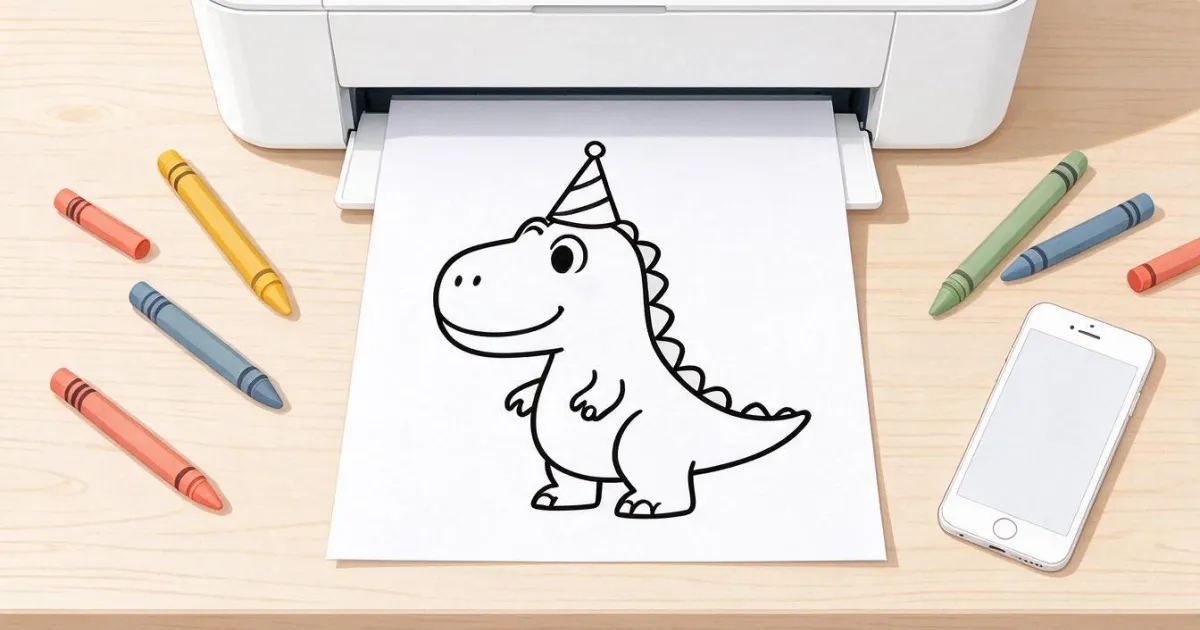
Printable Coloring Pages: How to Get the One You Need and Print It Well on A4

Why Your Car Insurance Increased in 2026: Average Premium of €1,412 and Historic Record
Discussing via WhatsApp or talking in person: what science says about couple conflicts through messages