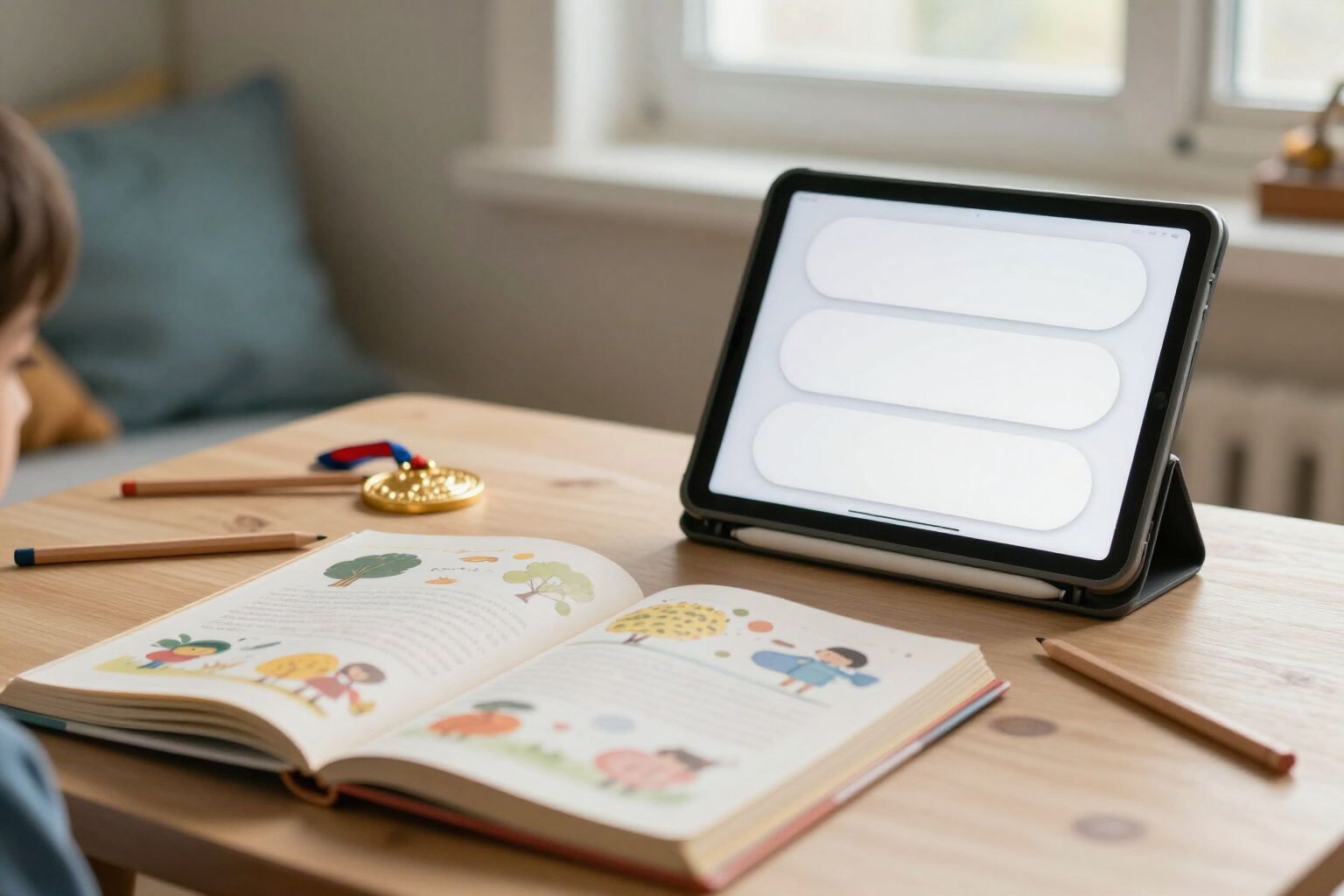
10-Question Test with Server-Side Correction
Each short story for children concludes with 10 questions about what was just read. Options are reshuffled with each attempt, and the correct answer never leaves the server: there’s nothing to inspect in the browser.
Proof that the child understood the short story for children is not provided by the child: it’s provided by the server.
In Zuki Read —AIsToHire’s children's reading comprehension app— reading the short story for children is only half the task. When the child finishes reading (or listening to) it, the text closes, and a 10-question written test begins, specifically about that short story for children, not a generic one: the short story for children has just been generated for them. The first short story for children in each profile is for calibration and has 5 questions instead of 10.
The questions mix four types: literal (what the text says), inferential (what can be deduced), vocabulary (what a word means in that context), and evaluative (what they think about what happened). The distribution depends on the age group: for 6-7 year olds, literal questions are more prominent, and there are no evaluative ones; for 10-12 year olds, inference and opinion questions are fully introduced.
Each question is shown with three options, and the correct answer remains stored in the database: while the test is in play, it NEVER travels to the browser. The child sends their chosen answer, and it is the server that compares, counts attempts, adds points, and decides the medal. Neither opening developer tools, nor monitoring network traffic, nor reloading the page can reveal the solution or inflate the score.
If they fail, nothing serious happens: the three options are reshuffled again with distractors from the same pool —so it’s impossible to guess by elimination or memorizing the position—, a hint appears that does not reveal the answer, and they can keep trying without a timer or penalty; after the third failure, Zuki suggests rereading the short story for children. What does change is the score: getting it right on the first try is worth 10 points, and each failure subtracts 3, with a minimum of 2 points per correct answer. You can see the rest of the app on the Zuki Read landing page: https://aistohire.com/zuki-read-reading-comprehension-kids-150
Benefits of 10-question test with anti-cheat
True anti-cheat
the correct answer resides on the server and is not sent to the client during the test. There is nothing to inspect in the browser or console.
Score calculated in the backend
points, medal, badges, and streaks are decided based on the server-saved state, never by what the browser reports.
Four types of questions, not just memory
literal, inferential, vocabulary, and evaluative, in the proportion appropriate for their age. Comprehension is measured, not recalling isolated facts.
Three options reshuffled on each attempt
after a mistake, the options are remixed with distractors from the same pool, without marking the incorrect one, so they think about the question again.
Hint instead of punishment
when failing, a hint appears that doesn't reveal the solution, and after the third mistake, the app suggests rereading the short story. No clock and no loss of progress.
Getting it right on the first try counts more
10 points for the first attempt, −3 for each mistake, and a minimum of 2 for a correct answer, with +20 if the test is perfect. The gold, silver, or bronze medal is decided by the first-try correct answers.
Questions from their short story, not from a bank
they are generated based on the text the AI just wrote for them, with its title and characters. There are no recycled tests that can be memorized.
Review afterward, never before
upon finishing, they can review question by question what they answered, which was correct, and why. That explanation only appears once the test is closed.
Truly check if they understood the short story
Create your free account on Zuki Read: their first short story comes with a calibration test and the result awaits you in the parents area.