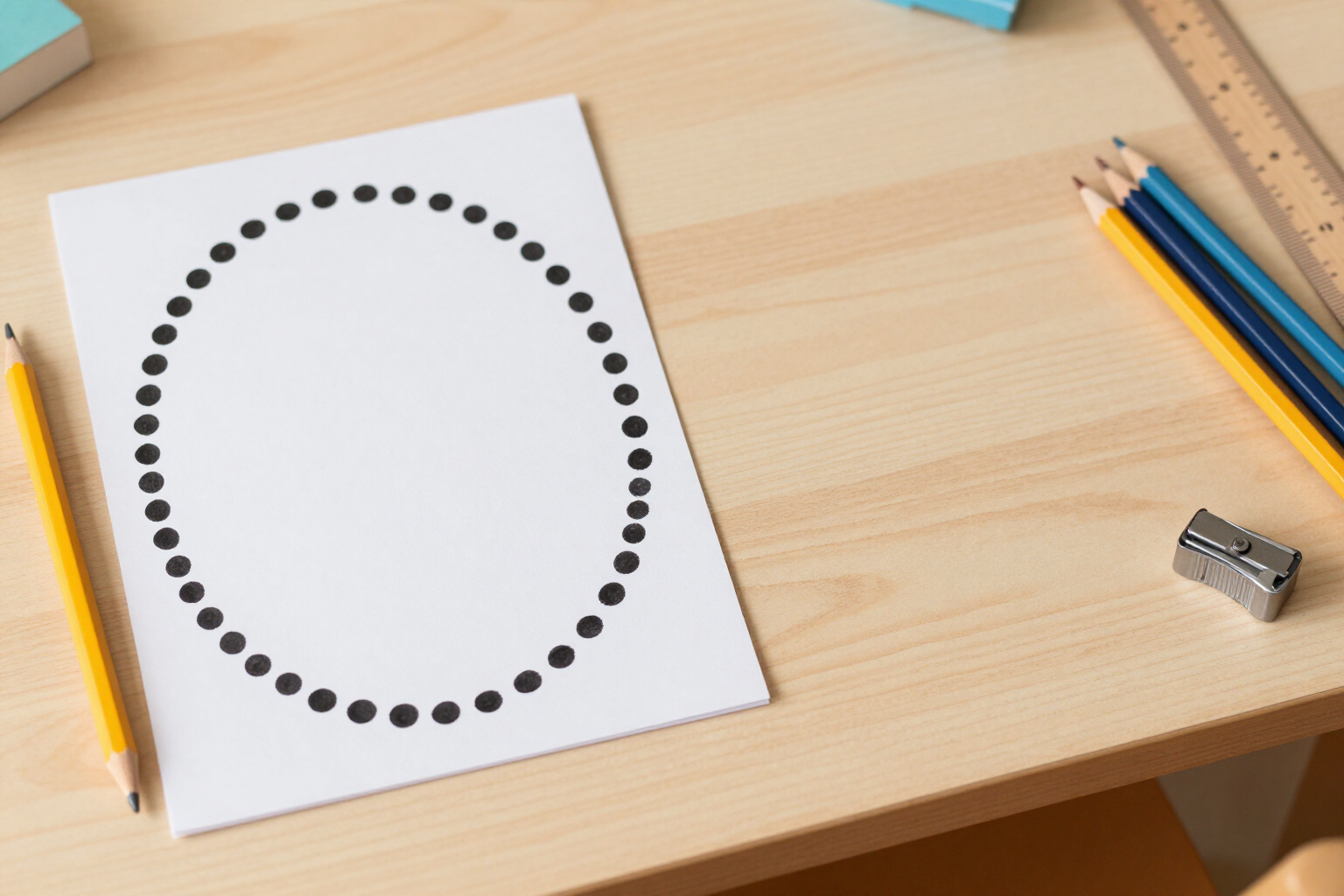
Automatically Numbered Dots: AI Draws, Algorithm Numbers
In Zuki Dots, the numbers on the printable worksheet are not placed by artificial intelligence; they are calculated by an algorithm. That's why the sequence goes from 1 to the end without jumps, without repeated numbers, and without strange order.
The problem with connect the dots printable worksheets made with AI isn't the drawing: it's the numbers.
When you request a drawing in Zuki Dots, the AI generates only the line art: the figure traced with thin black lines on a white background, without fill, without shadows, and — incidentally — without a single number or dot. That's where its work ends. From that image, the server's algorithm takes over. First, it binarizes the drawing and skeletonizes it to a one-pixel thickness using the Zhang-Suen method; then it prunes the loose branches left by the thinning, reconstructs the figure's graph, and recognizes each stroke separately: the silhouette's contour, the wing, the eye, the mouth. On each long stroke, it distributes dots at regular travel distances, not by eye, with the separation corresponding to the chosen age level. The part that makes the difference is the order. The dots are not numbered stroke by stroke (which causes the numbers to jump from one side of the page to the other): all the dots of the figure are gathered and numbered following a continuous path that starts at the top-left dot and at each step jumps to the closest unvisited dot. The result is a 1, 2, 3... sequence that always moves to the dot next to it, so a child can follow it with a pencil without looking up to find the next number. Before drawing the sheet, the algorithm discards dots that would fall almost on top of another so that no two numbers are stuck together, places each digit towards the outside of the figure, and adds a white halo behind it so it can be read even if it touches a line. Very short strokes, like an eye, are drawn already completed as helper lines and do not receive a number. The final sheet comes out in black and white, ready for A4 printing.
Benefits of Automatic Dot Numbering
Continuous numbering without jumps
a single sequence from 1 to the last dot for the entire figure, not a different numbering for each stroke, so the next number is always next to the previous one.
Zero typographical errors
numbers are generated by code, not a generative model, so there are no repeated, missing, or illegible figures, unlike when AI is asked to number.
Dots distributed by real distance
the algorithm measures the stroke length and places a dot every certain distance, preventing crowding in curves and gaps in straight lines.
Age-based density
the level you choose (3-5, 6-8, 9-12, or 13+) changes the dot separation, from few, widely spaced dots for the youngest to many, close-together dots for those who want detail.
Always legible numbers
each digit is positioned outside the drawing, has a white halo, stays within the sheet margins, and overly close dots are discarded to prevent label overlap.
Unnumbered details
short strokes like an eye or an eyebrow are already drawn as helper lines, preventing the number count from being cluttered with micro-sequences of two or three dots.
Reproducible result
the path always starts in the same place and follows the same rule, so the printable worksheet is consistent, and you can reprint it from your history exactly as it appeared.
See the difference in your first printable worksheet
Write your drawing idea, choose the age, and see how the numbering turns out. Creating an account is free.