 Zuki Puzzles
How many pieces should a puzzle have according to age? Practical guide from 3 to 12 years
Team at Zuki PuzzlesWritten with AI assistance17 min readIn summary
- As a starting guideline: 4-12 pieces for ages 3 to 5, 6-24 pieces for ages 6 to 8, and 9-42 pieces for ages 9 to 12. The comfortable point is usually at 6, 12, and 20 pieces respectively.
- The age printed on the box of a puzzle is primarily a safety label, not a measure of difficulty: Royal Decree 1205/2011 requires a warning "not suitable for children under 36 months" when there are small pieces.
- Practical time rule: about 4 seconds per piece. A well-fitting 12-piece puzzle is completed in around 48 seconds; if your child takes three times longer, it's too big for them.
- Before removing pieces, reduce difficulty: start with the edges, keep the guiding silhouette visible, and offer a hint to lower the bar without changing the puzzle.
- Zuki Puzzles automatically applies these ranges based on the age of each child profile, allowing the adult to set minutes and puzzles per day.
Choosing the wrong number of pieces is the most common reason a child abandons a puzzle after two minutes. This guide compiles the age ranges, observable signs that a puzzle is too big or too small, and specific adjustments that lower the difficulty without changing the picture. In the end, you will see how Zuki Puzzles, the children's puzzle app from AIsToHire, turns these ranges into a game that adapts automatically to each child's age.
How many pieces should a puzzle have according to the child's age?
For ages 3 to 5, between 4 and 12 pieces; for ages 6 to 8, between 6 and 24; for ages 9 to 12, between 9 and 42. Within each range, the comfortable number to start is 6, 12, and 20 pieces. These ranges are what Zuki Puzzles uses for each child profile and match the usual progression of children's cardboard puzzles in the European market.
| Child's Age | Reasonable Range | Starting Point | What happens below | What happens above |
|---|---|---|---|---|
| 3-5 years | 4-12 pieces | 6 pieces | Solved at a glance, no challenge | Loses sight of the complete picture and gets stuck |
| 6-8 years | 6-24 pieces | 12 pieces | Finishes without looking at the image | Starts trying pieces randomly |
| 9-12 years | 9-42 pieces | 20 pieces | Gets bored in the second game | Struggles, but usually persists if there is visual help |
Two important nuances:
- The range is more useful than the exact number. A 4-year-old with puzzle experience may be comfortable with 12 pieces; another 6-year-old just starting may be comfortable with 6. That's why the recommendation is a range and not a figure.
- The proportion matters more than the total. 12 large pieces on a 10-inch screen are much easier than 12 tiny pieces on a small mobile: what matters is the size of the piece in relation to the child's finger.

The age on the box is a safety label, not a measure of difficulty
The age listed on a cardboard puzzle largely responds to safety regulations, not to an assessment of cognitive difficulty. In Spain, Royal Decree 1205/2011, of August 26, on the safety of toys —which transposes Directive 2009/48/EC— requires the warning "Not suitable for children under 36 months" on toys that may pose a risk for that age, and the harmonized standard UNE-EN 71-1 defines the cylinder test used to determine if a piece is "small".
What this means in practice:
- A "3+" on the box mainly tells you that the pieces are not a choking hazard, not that this puzzle has the appropriate difficulty for your 3-year-old.
- Many manufacturers extend the range upwards for commercial reasons ("3-6 years"), so the high end of the label is usually optimistic.
- In an app, there are no physical pieces, so the choking risk disappears and the only real variable is difficulty. That’s precisely what allows adjusting the number of pieces piece by piece instead of buying another box.
If you are choosing a physical puzzle, the age label is a minimum safety guideline that must be respected. If you are choosing difficulty, look at the number of pieces and the size of each one.
Five signs that the puzzle is too big for your child
A puzzle is above the child's level when they stop using the picture as a reference and start trying pieces randomly. This is the most reliable sign, and it appears before frustration. These five can be observed in a couple of minutes of play:
- Tries by brute force. Picks up a piece and takes it to four or five holes in a row without looking at the picture.
- Asks for help before trying. Extends the piece to you as soon as they pick it up, without having made any attempt.
- Abandons below 25% of the puzzle. If they get up with two out of twelve pieces placed, it’s not disinterest: it’s overload.
- Takes more than three times the expected time (see the 4-second rule below).
- Gets angry with the piece, not with themselves. "This piece is broken," "it’s useless." It’s displaced frustration, and it’s a good time to lower the bar.
Three signs that it has become too small for them
A puzzle is below their level when they complete it without looking at the picture and do not ask for it again. The signs are quieter than those of frustration, and that’s why they are often overlooked:
- Finishes in less than 2 seconds per piece and without a single error.
- Stops looking at the reference image: goes by shape and border color, almost automatically.
- Does not repeat. A well-fitting puzzle is requested again; an easy one is done once and forgotten.
The 4 seconds per piece rule: how long it should take
A practical reference is 4 seconds per piece: that is the target time that Zuki Puzzles uses to decide if a game has gone well. It is not a measure of intelligence or a clinical benchmark: it is a gameplay threshold that separates "smooth" from "stuck" and, in practice, works well from ages 3 to 12 because the number of pieces is already adjusted to the age.
| Pieces | Target time (4 s/piece) | Too big if it takes more than |
|---|---|---|
| 4 | 16 seconds | ~48 seconds |
| 6 | 24 seconds | ~1 min 12 s |
| 12 | 48 seconds | ~2 min 24 s |
| 20 | 1 min 20 s | ~4 minutes |
| 24 | 1 min 36 s | ~4 min 48 s |
| 42 | 2 min 48 s | ~8 min 24 s |
How to read the table:
- Within the target time: the level is fine. If they also do it without errors, you can increase pieces.
- Between one and three times the target time: learning zone. This is where it is advisable to stay.
- More than three times: they are guessing. Decrease pieces or activate aids.
- Below 1 second per piece: they are not solving, they are dragging randomly and hitting by the tolerance of the fit. In Zuki Puzzles, that time is discarded and does not count as a record.
What to do when they get frustrated: lower the difficulty without changing puzzles
Before removing pieces, remove uncertainty: most blockages are resolved by leaving more information visible on the board, not by reducing the challenge. These five adjustments go from least to most aggressive, and it is advisable to apply them in that order.
1. Increase the level of visual aid. A board can show three different things: the very faint complete drawing in the background, only the silhouettes of the pieces, or barely some outlines. Each one is a step of difficulty.
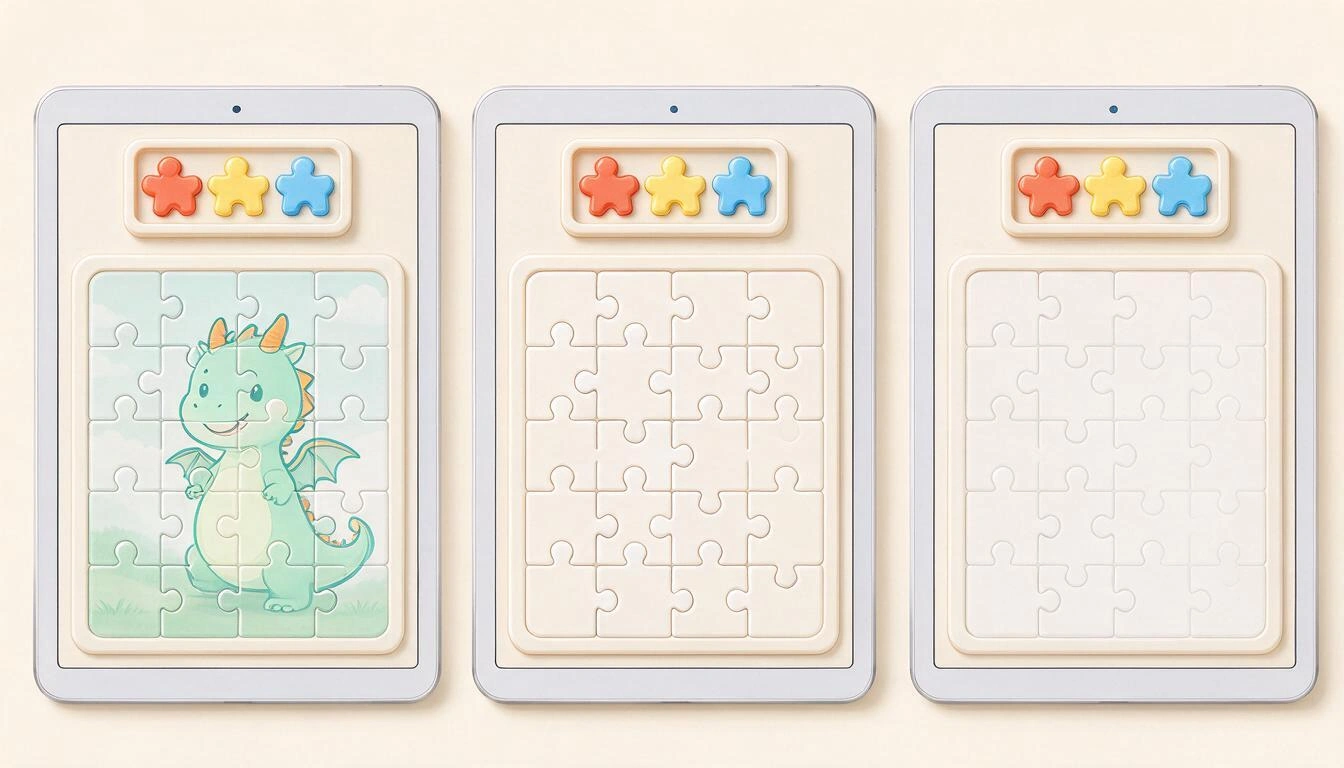
In Zuki Puzzles, this is chosen only according to age —faint drawing in the background until 5 years, silhouettes from 6 to 8, and faint outlines from 9 onwards— and can be forced or removed from the piece selector.
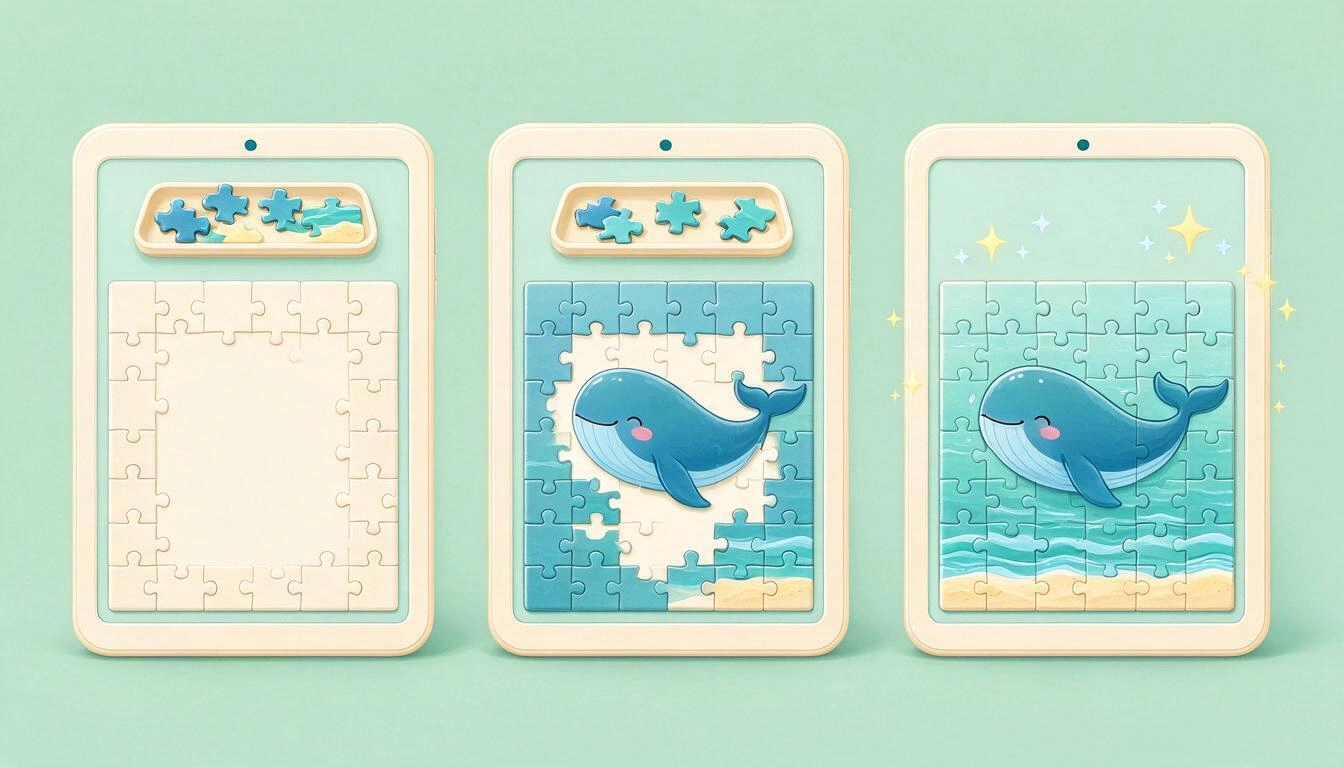
2. Start with the edges. This is the strategy that adults use without thinking and that children do not discover on their own until they are 6 or 7 years old. Assembling the frame first reduces the problem to a closed space and gives an early victory.
3. Offer a specific hint, not the solution. "Look for a piece with a lot of green" works better than placing it yourself. In the app, there is a hint button that points to a piece and, if necessary, also its slot; using it has a deliberate cost: with one hint, the puzzle is scored at most with 2 stars, and with two or more, with 1.
4. Reduce pieces, but a little. Go down from 12 to 9, not from 12 to 4. A big jump downward is read as "this was not for you".
5. As a last resort, extra large pieces. For the youngest or for a first contact, Zuki Puzzles allows going down to 2 pieces with the option of extra large pieces activated in the family area.
And a note that is not technical: do not redo the puzzle for them. Placing the difficult piece yourself ends the game but does not change anything for the next one.
How to level up without getting bored: the jump of two at a time
The most reliable way to progress is to increase by two pieces after two clean games in a row, not to jump to the next age range. A 7-year-old child who already does 12 pieces without errors does not need to go to 24: they need 14, then 16, then 18.
A concrete criterion for deciding when to level up:
| Situation | What to do |
|---|---|
| Two consecutive games within the target time and without errors | Increase 2 pieces |
| Within the time but with some errors | Repeat the same number |
| Outside the time or with hints | Decrease 2 pieces or increase visual aid |
| They have done it 3 times and no longer ask for it | Change the drawing, not the difficulty |
That last case is the most frequent and the worst diagnosed: many times what has run out is not the level, it is the drawing. A new drawing with the same pieces revives interest without touching the difficulty.
How Zuki Puzzles Applies All of the Above
Zuki Puzzles is a web app for jigsaw puzzles for children aged 3 to 12 that adjusts the number of pieces to the age of each profile and allows the adult to control the playtime. Each child in the household has their own profile —up to 8 on the same device— with their age, stars, and preferences, and the game suggests the number of pieces without anyone having to set anything up.
What it does exactly, verified on the app:
| Aspect of this guide | What the app does |
|---|---|
| Piece range by age | 4-12 (3-5 years), 6-24 (6-8), 9-42 (9-12), with 6/12/20 preselected |
| Fine adjustment | The number increases or decreases by two from the selector, labeled Easy / Normal / Hard |
| Target time | Pieces × 4 seconds; within the target, an extra star is earned |
| Visual help | Three levels of guidance, assigned by age and switchable before starting |
| Start with the edges | "Edges first" switch on the piece selector |
| Hints | Hint button, plus an automatic hint if the child has not touched anything for 30-60 s (depending on their age) |
| Tolerance for dropping the piece | More generous the younger the age (20% of piece size at 3-5 years vs. 15% at 9-12) |
| Extra large pieces | Option that allows reducing to 2 pieces |
| Drawings | Catalog by themes (animals, fantasy, vehicles, nature, food, and sports) plus drawings that the child describes and the AI generates |
| Rewards | 3 stars per game, 18 medals, 72 stickers in 6 albums, and a store that is paid with coins earned while playing |
Two details that matter to an adult:
- The score is calculated on the server, not in the browser: stars, records, and streaks cannot be "earned" by tampering with the device. An impossible time (less than 1 second per piece) is discarded.
- There are no ads, external links, or real money purchases within the game. Store coins can only be obtained by completing puzzles.
About the drawings generated with AI: the child writes in a sentence what they want to see —maximum 200 characters— or taps one of the suggested ideas for their age, and the illustration is generated in color. Each description passes a moderation filter before being drawn, and blocked requests are recorded for the adult to see in the activity report.
Puzzles on Tablet and Screen Time: What the WHO and AAP Say
International reference guidelines do not distinguish between "good screen" and "bad screen" by type of play: they talk about total time and adult supervision. The World Health Organization, in its guidelines on physical activity, sedentary behavior, and sleep in children under 5 years (April 2019), recommends no screens before 2 years and a maximum of 1 hour per day between 2 and 4. The American Academy of Pediatrics, in its statement Media and Young Minds (Pediatrics, November 2016), sets the limit at 1 hour daily of quality content between 2 and 5 years, preferably accompanied by an adult.
Translated to what you can set up in the app, from the family zone protected by a parental gate:
| Control | What it allows |
|---|---|
| Minutes per day | A daily playtime cap per profile (0 = no limit) |
| Puzzles per day | A daily game cap per profile (0 = no limit) |
| "10 more minutes" | Grant a one-time extension after the parental gate (between 5 and 30 minutes) |
| Activity report | Series of the last 7 days, skill averages, drawings requested, and requests rejected by moderation |
Limitations of what is stated here: Zuki Puzzles is a game, not a certified educational tool, diagnostic, or therapy, and nothing in this article replaces the judgment of a professional. The screen time recommendations are from the WHO and AAP, not from the app; if you are concerned about your child's development or their relationship with screens, the conversation is with your pediatrician.
What Research Says About Puzzles and Spatial Thinking
There is observational evidence that playing with puzzles in preschool age is associated with better spatial skills, but association is not causation. The most cited study is by Levine, Ratliff, Huttenlocher, and Cannon, Early puzzle play: A predictor of preschoolers' spatial transformation skill (Developmental Psychology, 2012, vol. 48, no. 2, pp. 530-542): following children recorded in their homes between 26 and 46 months, those who played with puzzles performed better in a spatial transformation task at 54 months, and the quality of interaction with the adult —the spatial language used— was also related to the outcome.
How to interpret it honestly:
- It is an observational and longitudinal study, not a controlled trial: it does not prove that puzzles cause that improvement.
- The finding that holds best is the role of the adult: what mattered most was playing with the child and talking while playing ("turn it", "that corner goes up", "look for the piece of sky").
- None of this changes whether playing on screen or cardboard; what changes is that on screen the adult tends to leave the child alone. If there is one piece of advice that emerges from the study, it is to sit next to them.
Frequently Asked Questions
How many pieces should a puzzle have for a 3-year-old child?
Between 4 and 6 pieces to start, with a reasonable maximum of 12 if they already have experience. At that age, what makes a difference is not the number but the size: the piece has to be clearly larger than their index finger.
And for a child aged 5, 6, or 8?
At 5, between 6 and 12 pieces. From 6 to 8 years old, the comfortable range is from 6 to 24 pieces, with 12 as a common starting point. From age 9, it can go up to 42 without any problem if the child plays regularly.
My child gets frustrated and abandons the puzzle after two minutes, what should I do?
Lower the difficulty without changing the puzzle: keep the silhouette of the pieces visible, start with the edges, and give a verbal hint instead of placing the piece yourself. If they still abandon it, reduce two pieces, not half. And sit next to them: in studies on puzzle play, adult companionship weighs as much as the puzzle itself.
How long should it take a child to complete a puzzle?
As a practical reference, about 4 seconds per piece: 24 seconds for 6 pieces, 48 for 12, just over a minute for 20. If it takes more than triple that, the puzzle is too big for them; if it takes less than 2 seconds per piece, it has become too small.
Do tablet puzzles work the same as cardboard ones?
They work the same in terms of shape recognition and strategy, but they do not replace physical manipulation: a cardboard puzzle trains the grip and actual rotation of the piece. The reasonable approach is to combine them. The clear advantage of the screen is that you can change the number of pieces and the drawing without buying another box.
How much screen time per day is reasonable for playing puzzles?
The WHO (2019) recommends a maximum of 1 hour of screen time daily between ages 2 and 4, and the American Academy of Pediatrics (2016) recommends the same between ages 2 and 5, with an adult present. In Zuki Puzzles, you can set a limit on minutes and puzzles per day for each profile from the family area.
Does Zuki Puzzles have ads or in-game purchases?
No. There are no ads within the game, nor external links, nor real money purchases: the coins in the store are earned by completing puzzles. Access to the app is done with an AIsToHire account.
Can I use the same tablet with two children of different ages?
Yes: you can create up to 8 profiles on the same account, each with their name, age, avatar, and their own stars, medals, and time limits. The number of pieces automatically adjusts to the age of each profile, so a 4-year-old and a 10-year-old can play the same drawing with different difficulties.
What should I do if my child gets bored because the puzzle is too easy for them?
First, change the drawing, not the difficulty: what usually gets exhausted is the image. If they still solve it in less than 2 seconds per piece and without errors twice in a row, increase by two pieces and remove visual aid (from faint drawing to just silhouettes, or from silhouettes to outlines).
Can the child create their own drawings to assemble?
Yes. The child describes in one sentence what they want to see —a dragon, a rocket, a dolphin— or taps one of the proposed ideas for their age, and the AI generates a color illustration to play as a puzzle. Each description goes through a moderation filter before being drawn, and the adult can see in the activity report what each child has requested and which requests have been blocked.
Where to try Zuki Puzzles
Zuki Puzzles is the puzzle app for children aged 3 to 12 from AIsToHire: it adjusts the number of pieces to the age of each profile (4-12, 6-24, or 9-42 pieces), allows the child to invent the drawing by describing it to the AI, and lets the adult set minutes and puzzles per day from a protected family area. It is available on the Zuki Puzzles page on AIsToHire.
Create your child's profile on Zuki Puzzles, enter their age, and assemble the first puzzle with the appropriate number of pieces: starting is free and there are no ads or in-app purchases.
Create your child's profile on Zuki Puzzles, enter their age, and assemble the first puzzle with the appropriate number of pieces: starting is free and there are no ads or in-app purchases.Keep reading

Discussing via WhatsApp or talking in person: what science says about couple conflicts through messages
Mind map, concept map, and outline: differences and when to use each one

Quishing: how they change your business's QR code for a fake one (and how to avoid it)